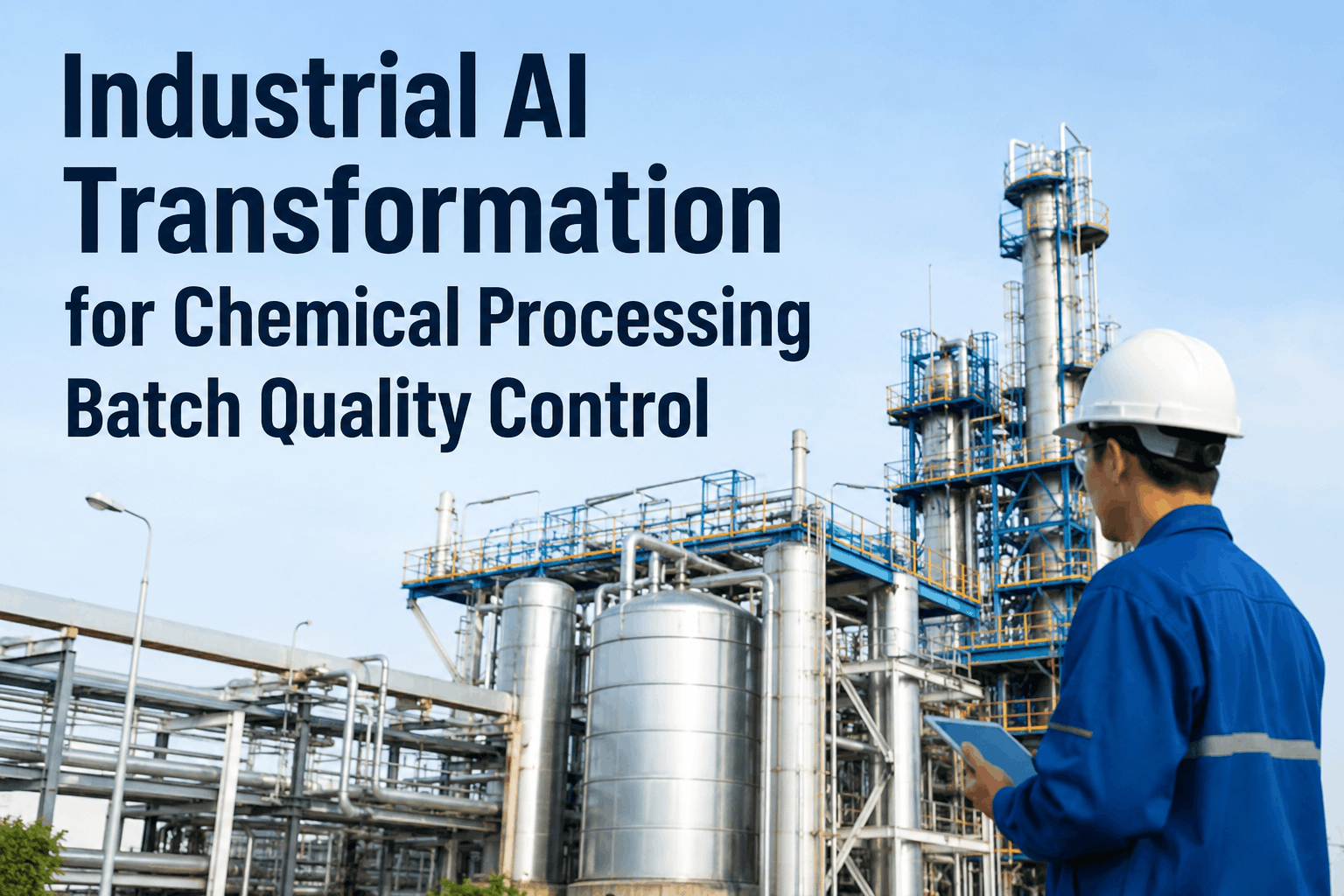
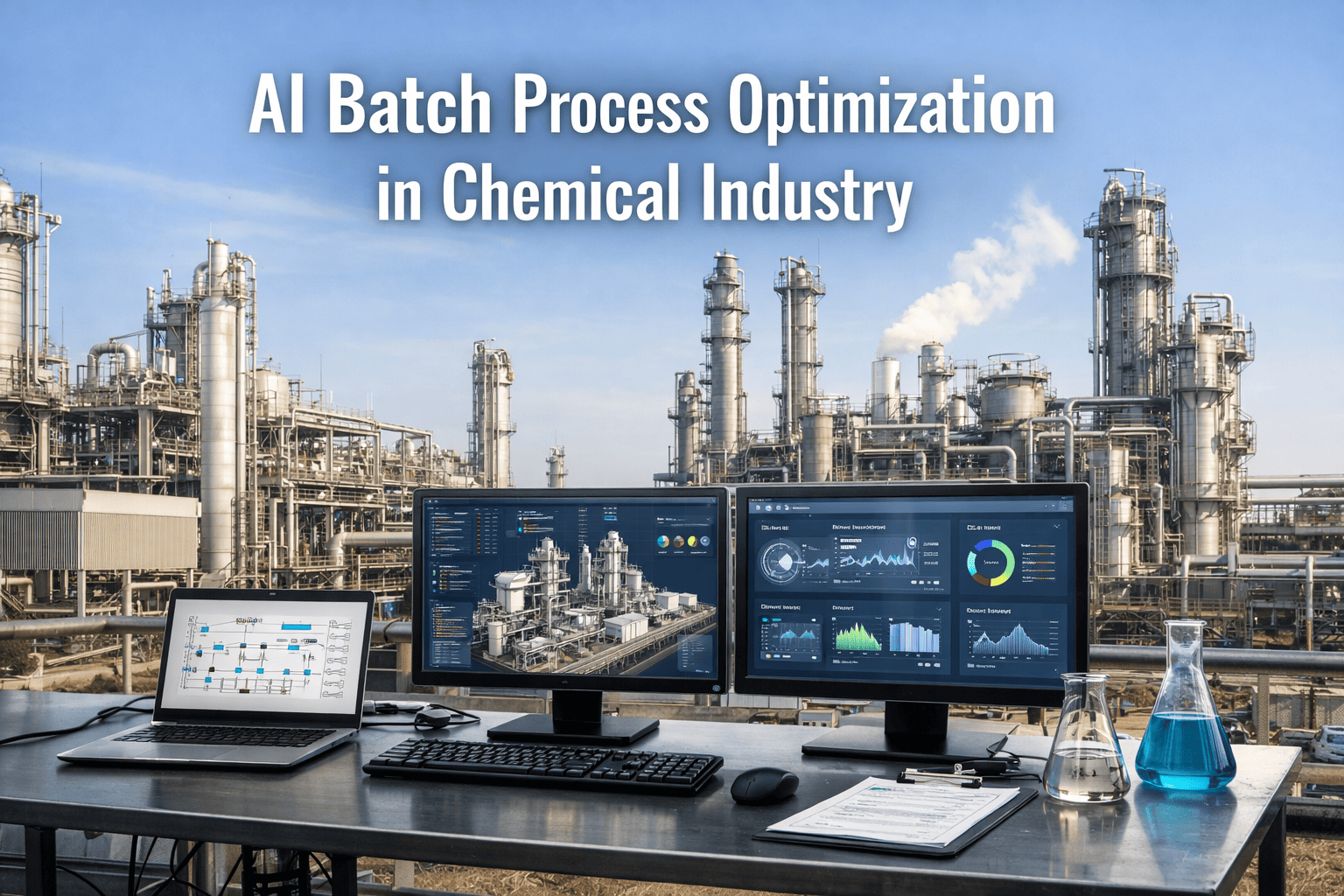
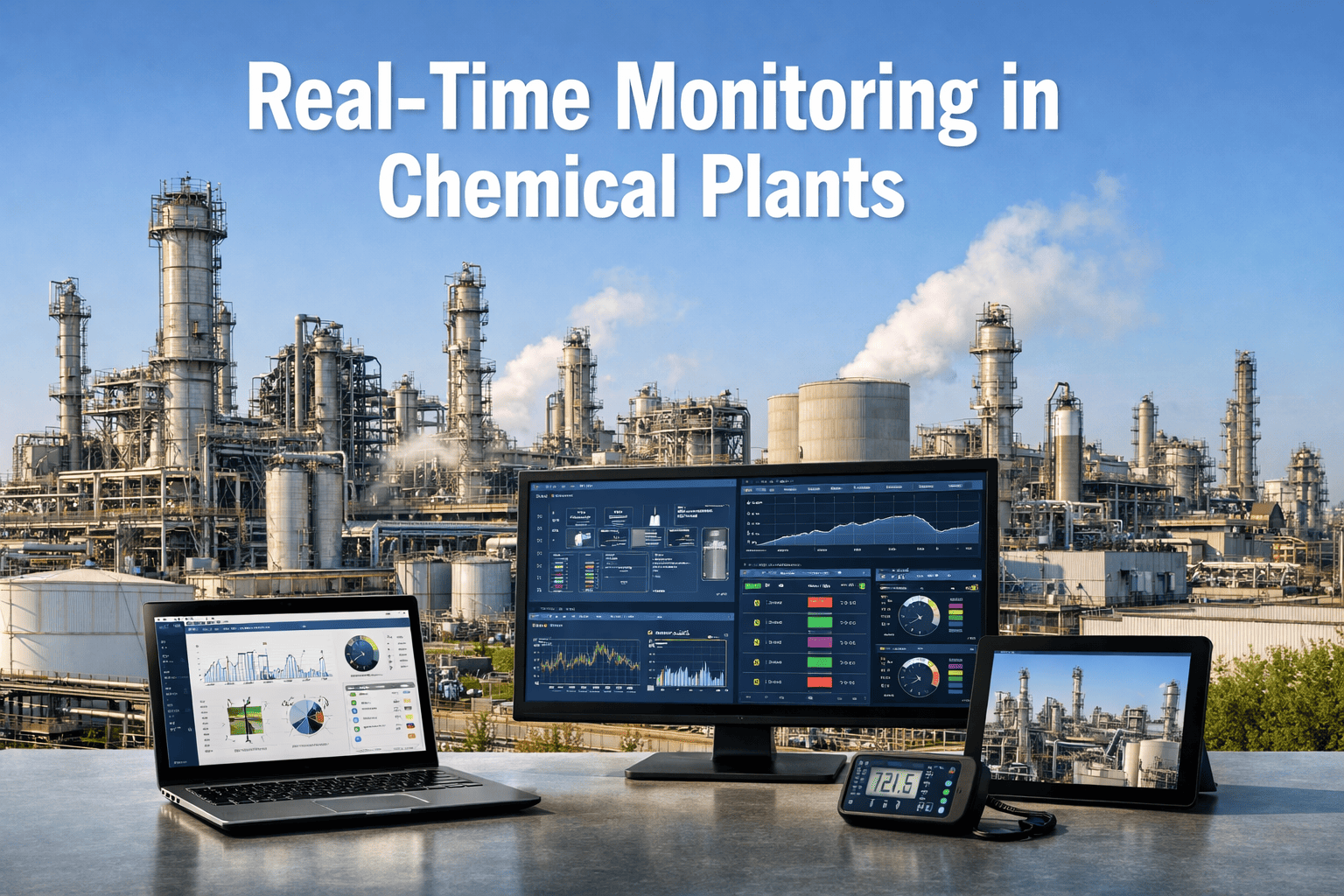
Chemical plants run thousands of simultaneous reactions. Temperatures shift by fractions of a degree. Pressure fluctuates across dozens of vessels. A single miscalculation cascades into off-spec batches, wasted feedstock, and unplanned shutdowns costing $50,000+ per hour. For decades, operators managed this complexity with manual readings, gut instinct, and fixed setpoints. That era is ending. AI is now embedded in the control rooms of the world's largest chemical manufacturers — not as an experiment, but as operational infrastructure. 76% of chemical companies already use AI to optimize production. The market for AI in chemicals reached $2.8 billion in 2025 and is growing at 29%+ annually. This is not a future trend — it is the present competitive divide.
iFactory Blog
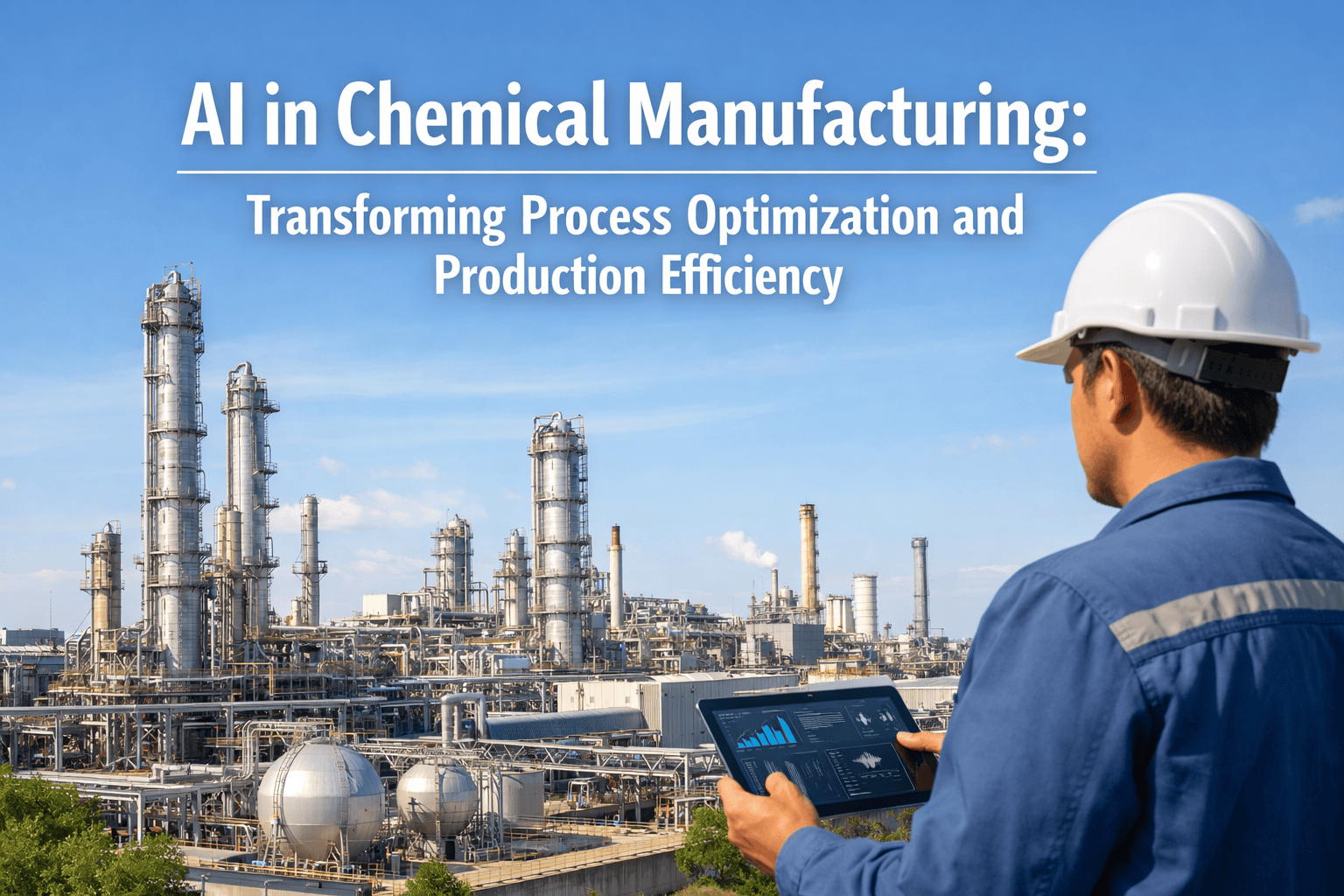
AI in Chemical Manufacturing
Transforming Process Optimization and Production Efficiency
Book a Demo
$2.8B
AI in Chemicals Market (2025)
29%+
Annual Growth Rate (CAGR)
76%
Of Chemical Firms Using AI Today
Why Chemical Manufacturing Needs AI More Than Any Other Industry
Chemical production is fundamentally different from discrete manufacturing. You cannot inspect a molecule on an assembly line. Reactions are nonlinear, raw materials vary batch to batch, and the gap between optimal and wasteful operation is measured in decimal points that compound into millions. Traditional Advanced Process Control (APC) relies on fixed equations that struggle with this nonlinear behavior. Operators compensate by running conservatively — sacrificing throughput to avoid off-spec product. AI changes this equation entirely.
01
Variable Feedstock Quality
Raw material properties shift between suppliers and shipments. AI models adapt reactor setpoints in real time as feed quality changes — maintaining yield without operator intervention.
02
Unplanned Equipment Downtime
A single compressor failure can halt an entire production line for days. Predictive maintenance catches bearing degradation and seal wear weeks before catastrophic failure occurs.
03
Energy-Intensive Operations
Chemical plants consume 10% of global energy. AI-managed thermal cycles and grid-aware scheduling are delivering 30% reductions in energy costs at leading facilities worldwide.
04
Tightening Regulatory Pressure
Environmental compliance now requires continuous monitoring — not quarterly reports. AI automates emissions tracking, generates audit-ready documentation, and flags deviations instantly.
The 5 High-Impact AI Applications Reshaping Chemical Plants
AI in chemical manufacturing is not one technology — it is a suite of interconnected capabilities that address different operational challenges. Here is where the real value is being captured today.
1
Real-Time Process Optimization
Closed-loop AI systems ingest high-frequency sensor data from across the plant — temperature, pressure, flow rates, catalyst ratios — and write optimized setpoints directly back to the DCS in real time. Unlike traditional APC, these models learn from your plant's actual operational history and adapt as conditions change. The result: reactors run at peak efficiency continuously, not just when an expert operator is on shift.
5–8%
increase in production yield at plants using closed-loop AI optimization
2
Predictive Maintenance
Machine learning algorithms analyze vibration patterns, thermal signatures, and acoustic data from pumps, compressors, and heat exchangers. They detect microscopic anomalies — a bearing starting to degrade, a seal beginning to leak — weeks before human operators would notice. Maintenance shifts from reactive firefighting to scheduled precision interventions during planned downtime windows.
20–50%
reduction in unplanned downtime reported across chemical facilities
3
AI-Powered Quality Control
AI-enabled soft sensors monitor quality parameters in real time — without expensive physical analyzers for every measurement point. By correlating process variables with product quality outcomes, these virtual sensors detect a drifting batch within minutes, not hours. Operators get early warning to correct before an entire batch goes off-spec.
30%
reduction in batch defects at BASF using AI-enabled soft sensors
4
Digital Twin Simulation
Virtual replicas of physical plants mirror real-time operations using live sensor feeds. Engineers test what-if scenarios — catalyst changes, throughput increases, energy load shifts — without risking production. Digital twins also serve as training simulators for new operators, preserving institutional knowledge as experienced staff retire.
5%
improvement in energy efficiency at Dow's ethylene cracking furnaces via digital twin
5
Supply Chain & Demand Intelligence
AI models process historical transaction data, weather forecasts, commodity indices, and real-time market signals to produce accurate demand forecasts. Chemical producers balance production loads, optimize transport routes, and simulate disruption scenarios — turning volatile supply chains into responsive, data-driven operations.
15–25%
improvement in demand forecast accuracy using AI-driven analytics
Real-World Results: How Industry Leaders Are Using AI
The most compelling proof is not market projections — it is what the world's largest chemical companies are actually achieving with deployed AI systems right now.
BASF
Deployed IoT sensors across pumps and compressors with Schneider Electric's EcoStruxure platform. AI models forecast equipment failures, enabling proactive repair scheduling. Built digital twins of entire plants to optimize utilities and reduce emissions.
20%
Less Unplanned Downtime
30%
Fewer Batch Defects
15%
Reduced R&D Costs
Dow Chemical
Implemented IoT-based predictive maintenance and digital twin models for ethylene cracking furnaces. AI-driven energy management now optimizes resource consumption across facilities in real time.
40%
Better Production Reliability
1,000t
Material Savings / Year
25%
Water Usage Reduction
Shell
AI-driven predictive maintenance deployed across 10,000+ equipment units, processing 20 billion data points weekly from 3 million+ sensors. Early detection at the Pernis refinery alone prevented $2 million in losses.
20%
Lower Unplanned Downtime
15M
Daily Health Predictions
5–15%
Maintenance Cost Savings
The AI Value Chain: From Sensor to Strategic Decision
Understanding how AI creates value in a chemical plant requires seeing the full data pipeline — from the sensor on a reactor wall to the executive dashboard that informs capital allocation.
Step 1
Data Capture
IoT sensors on reactors, columns, and pipelines stream temperature, pressure, flow, vibration, and composition data at millisecond intervals into the plant historian.
Step 2
AI Processing
Machine learning models identify hidden correlations between hundreds of variables simultaneously — patterns no human operator could detect across thousands of data streams.
Step 3
Actionable Insights
AI generates specific setpoint recommendations with confidence levels and driver variables — fully explainable, not black-box. Operators see exactly why each change is suggested.
Step 4
Closed-Loop Control
Optimized targets are written directly to the DCS. The system continuously learns from every batch, building plant-specific intelligence that improves over time.
The Revenue Impact Is Already Measurable
AI's contribution to chemical company revenue is projected to grow from 6% in 2025 to 14% by 2028. For a $10 billion chemical company, that represents an $800 million revenue opportunity — not in five years, but within the current planning cycle.
Predictive Maintenance Adoption
AI Formulation R&D Automation
AI-Driven Customer Service
Real-Time Process Recommendations
Source: IBM Institute for Business Value — Chemicals in the AI Era (2026)
What Separates AI Leaders from AI Laggards
After studying implementations across the chemical sector, a clear pattern emerges. Companies that succeed with AI treat it as operational infrastructure — not an innovation experiment. Here is what distinguishes the two approaches.
Approach
Treat AI as innovation project
Treat AI as operational infrastructure
Scope
Isolated pilot programs
Enterprise-wide deployment strategy
Metrics
Innovation KPIs
Operational performance metrics (OEE, yield, cost)
Data Strategy
Wait for perfect data
Start now — AI itself exposes data gaps
Integration
Standalone AI tools
Connected to MES, ERP, DCS, SCADA
Revenue Impact
Marginal ROI
6–14% of total revenue by 2028
Companies with a well-defined, enterprise-wide AI strategy see significantly greater ROI on their AI investments. The companies treating AI as an innovation project are missing the point. The ones treating it as operational infrastructure are pulling ahead.
IBM Institute for Business Value, 2026
Getting Started: A Practical Roadmap
You do not need perfect data or a massive IT overhaul to begin capturing value from AI. The most successful chemical manufacturers start with high-impact, low-risk applications and expand from there.
Phase 1
Weeks 1–6
Foundation & Quick Wins
Connect existing sensor data to AI analytics. Deploy predictive maintenance on 2–3 critical assets (compressors, pumps). Establish baseline OEE and yield metrics. This phase typically delivers measurable ROI within 60 days.
Phase 2
Months 2–4
Process Optimization
Expand AI to reactor and distillation column optimization. Implement AI-powered quality monitoring with soft sensors. Integrate energy management for peak-load optimization and grid-aware scheduling.
Phase 3
Months 4–8
Plant-Wide Intelligence
Deploy digital twin simulation for the complete production line. Enable system-wide optimization that balances throughput across all units simultaneously. Connect supply chain AI for end-to-end demand-driven production.
Phase 4
Ongoing
Autonomous Operations
Transition to closed-loop AI control for routine decisions. AI handles setpoint adjustments, maintenance scheduling, and production sequencing autonomously — with human oversight for exceptions and strategic decisions.
Your Plant Is Generating the Data. AI Turns It Into Profit.
iFactory helps chemical manufacturers deploy AI-driven process optimization, predictive maintenance, and digital twin simulation — from first sensor connection to plant-wide autonomous operations. Every percentage point of improved yield, every hour of prevented downtime, every kilowatt of optimized energy flows directly to your bottom line.