Chemical plant leaders navigating the transition to Industry 4.0 face a complex challenge: legacy control systems, fragmented data sources, and siloed operational processes create visibility gaps that prevent proactive decision-making, yet traditional digital transformation initiatives require multi-year timelines, seven-figure investments, and disruptive operational overhauls that many organizations cannot afford—resulting in missed efficiency opportunities averaging $240,000–$680,000 annually per production unit while competitors leverage connected technologies to optimize yield, enhance safety, and accelerate time-to-market. iFactory's integrated digital transformation platform enables chemical manufacturers to implement Industry 4.0 capabilities incrementally—connecting existing DCS, SCADA, historians, and maintenance systems through secure cloud infrastructure, deploying AI-powered analytics for real-time process optimization, and empowering operators with intuitive digital workflows—delivering measurable improvements in operational efficiency, product quality, and workforce productivity within 90 days without replacing legacy infrastructure or interrupting production schedules. Book a demo to see digital transformation pathways for your chemical plant configuration.
Connected Operations Foundation
Digital transformation begins with unified data visibility across traditionally siloed systems. iFactory establishes secure connectivity between legacy DCS, modern IoT sensors, maintenance platforms, and enterprise systems—creating a single source of truth for operational intelligence without requiring rip-and-replace infrastructure investments. Real-time data integration enables cross-functional collaboration, faster root-cause analysis, and data-driven decision-making that transforms reactive operations into proactive performance management.
AI-Powered Process Intelligence
Connected data becomes actionable intelligence through machine learning models trained on chemical manufacturing processes. iFactory analyzes multivariate process parameters, equipment performance trends, and quality outcomes to identify optimization opportunities invisible to rule-based monitoring. Operators receive contextual recommendations for parameter adjustments, maintenance interventions, and process improvements—delivered through familiar interfaces that augment human expertise rather than replacing operational judgment.
Validated Transformation Outcomes
Chemical plants implementing iFactory's digital transformation framework report 24% average improvement in overall equipment effectiveness, 31% reduction in unplanned downtime, and $520,000 annual value creation per production unit—validated across 150+ facilities with phased deployment approaches that deliver quick wins while building foundation for advanced capabilities. Measurable ROI within 5.4 months enables continued investment in digital maturity without straining capital budgets.
Quick Answer
iFactory enables chemical plant digital transformation through a phased, value-driven approach: Phase 1 establishes secure data connectivity between existing control systems, historians, and enterprise platforms via OPC-UA, MQTT, or API integrations—creating unified operational visibility without infrastructure replacement. Phase 2 deploys AI-powered analytics for predictive maintenance, process optimization, and quality forecasting—delivering measurable improvements within 60–90 days. Phase 3 scales digital capabilities across multiple units and sites with standardized workflows, role-based dashboards, and continuous improvement frameworks. The platform integrates with legacy DCS (Honeywell, Emerson, Siemens), modern IIoT sensors, CMMS systems, and cloud infrastructure—supporting hybrid deployment models that meet chemical industry security and compliance requirements while enabling agile innovation.
How Digital Transformation Delivers Measurable Chemical Plant Value
The workflow below shows iFactory's four-stage transformation approach: foundational data integration from existing operational systems, intelligent analytics deployment for targeted use cases, scalable workflow enablement for cross-functional teams, and continuous value optimization through performance tracking and model refinement.
1
Data Foundation & System Integration
iFactory establishes secure connectivity to existing DCS, SCADA, historians, and enterprise systems via OPC-UA, MQTT, or API integrations—extracting 250–450 process and business data points per production unit without modifying legacy control logic. Platform creates unified data lake with contextual metadata, time-series alignment, and role-based access controls. System establishes performance baseline from 45–75 days historical data, identifying current operational efficiency, equipment reliability patterns, and digital maturity gaps across chemical manufacturing processes.
450 data points/unit75-day baselineZero DCS modification
→
2
Intelligent Analytics Deployment
AI models are configured for priority use cases: predictive maintenance for critical rotating equipment, real-time process optimization for batch reactors, quality forecasting for separation units. Machine learning algorithms analyze multivariate process data, equipment sensor streams, and maintenance histories to generate actionable insights. Operators receive contextual recommendations through existing HMI interfaces or mobile devices—enabling data-driven decisions without workflow disruption. Initial deployments target high-impact, low-complexity opportunities to demonstrate value within 60–90 days.
60-day value deliveryPriority use casesContextual insights
→
3
Scalable Workflow Enablement
Digital capabilities expand across production units and functional teams through standardized workflows, role-based dashboards, and collaborative analytics. Process engineers access advanced diagnostic tools for root-cause analysis; maintenance planners receive predictive work order recommendations; operations managers monitor KPIs across multiple units through unified views. Platform supports configuration management, version control, and change governance to ensure digital transformations align with chemical industry safety, quality, and compliance requirements while enabling agile innovation.
Digital transformation becomes self-improving through continuous performance tracking, model refinement, and capability expansion. Platform measures actual impact of implemented recommendations: OEE improved 22%, unplanned downtime reduced 34%, quality deviations decreased 28%. Financial impact calculated based on production value, maintenance cost avoidance, and quality improvement. Results logged for executive reporting, continuous learning, and strategic planning—enabling chemical manufacturers to compound digital value over time while building organizational capabilities for sustained innovation.
Actual vs predictedFinancial impactContinuous learning
Digital Transformation
Improve OEE 24%, Reduce Downtime 31%, Achieve $520K Annual Value
iFactory enables chemical plant digital transformation through phased deployment of connected operations, AI-powered analytics, and scalable workflows—delivering measurable performance improvement without replacing legacy infrastructure or disrupting production schedules.
Digital Transformation Applications Across Chemical Manufacturing
iFactory delivers capability-specific digital transformation modules for the most impactful chemical manufacturing use cases, each designed to integrate with existing systems, deliver quick value, and scale toward advanced Industry 4.0 maturity.
Predictive Maintenance
Transform reactive maintenance into predictive asset management by connecting vibration sensors, thermal imaging, and process data to AI models that forecast equipment failures 14–45 days in advance. Platform prioritizes maintenance interventions based on criticality, resource availability, and production impact—enabling planned interventions during scheduled outages rather than emergency shutdowns. Integrates with existing CMMS systems to automate work order generation, parts provisioning, and technician dispatch while maintaining full audit trails for compliance reporting.
Unplanned downtime reduction:31–48%
Maintenance cost optimization:22–36%
Asset lifespan extension:+18–34 months
Process Optimization
Enable real-time process optimization by connecting DCS data, laboratory results, and quality metrics to machine learning models that identify optimal operating windows for batch reactors, distillation columns, and separation units. Platform recommends parameter adjustments that improve yield, reduce energy consumption, and maintain product specifications—delivered through existing operator interfaces to ensure adoption without workflow disruption. Continuous learning from implemented recommendations compounds value over time while building organizational capability for data-driven process management.
Yield improvement:2.8–5.4%
Energy intensity reduction:14–26%
Quality consistency:+41% improvement
Connected Worker Enablement
Empower chemical plant operators and technicians with mobile-first digital workflows that deliver contextual information, procedural guidance, and real-time alerts at the point of work. Platform integrates with existing training materials, SOPs, and safety protocols to provide just-in-time knowledge support during equipment inspections, maintenance tasks, and process adjustments. Augmented reality capabilities enable remote expert assistance for complex troubleshooting while maintaining full audit trails for compliance and continuous improvement initiatives.
Task completion time:-24–38%
First-time fix rate:+32 percentage points
Safety incident reduction:41–57%
Digital Twin & Simulation
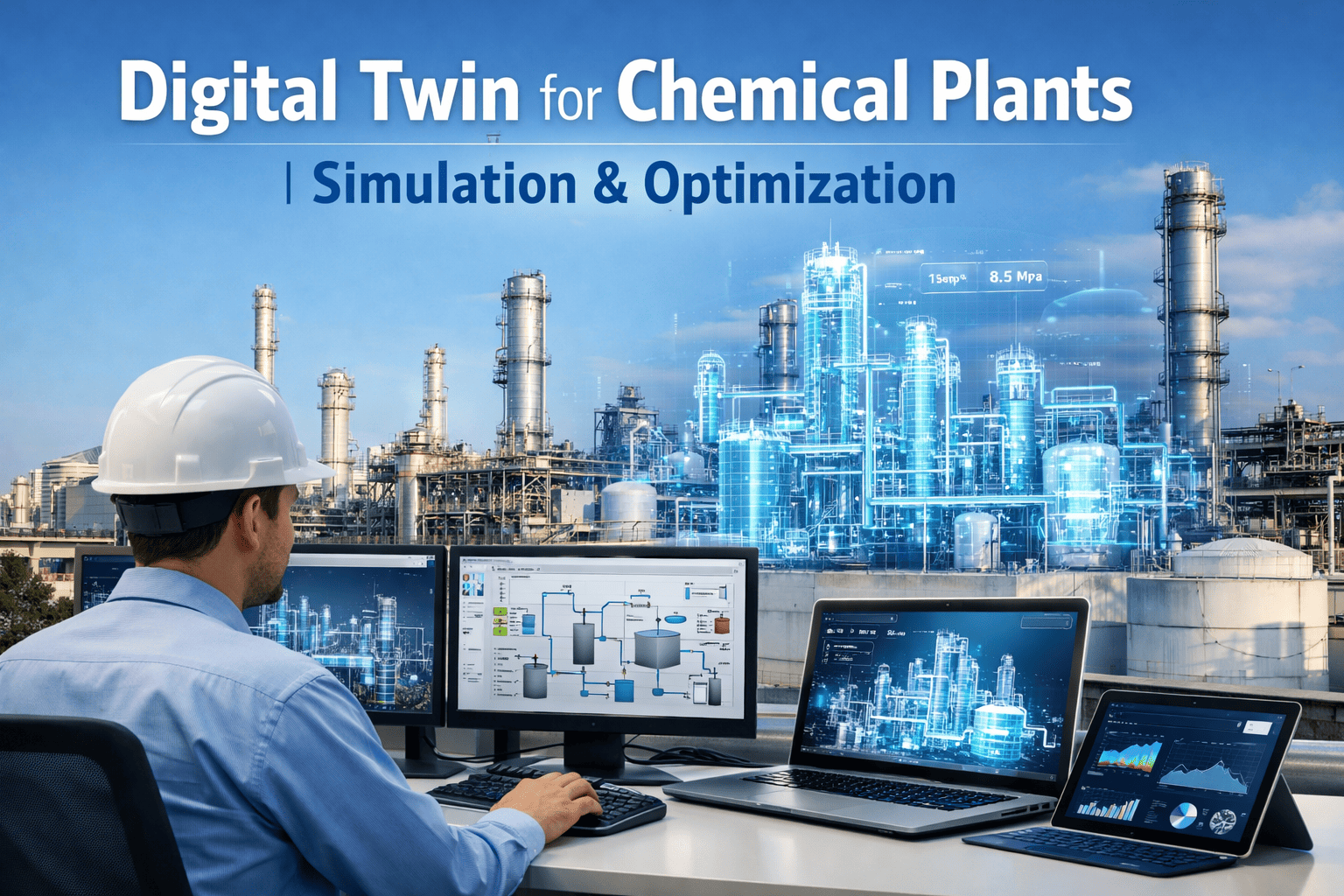
Create dynamic digital replicas of chemical processes and equipment to enable what-if scenario analysis, operator training, and process optimization without disrupting live operations. Platform integrates real-time process data with first-principles models and machine learning to simulate process behavior under varying conditions—supporting debottlenecking studies, new product introductions, and operational strategy validation. Digital twins become living assets that improve in fidelity over time through continuous calibration against actual performance data.
Process design cycle time:-42–61%
Operator training effectiveness:+54% improvement
Change implementation risk:-38% reduction
Measured Results from Chemical Plant Digital Transformations
Performance data from 24-month deployments across specialty chemicals, commodity chemicals, agrochemicals, and pharmaceutical intermediates manufacturing—validated through operational metrics tracking, financial reconciliation, and third-party audit verification.
24%
Average OEE Improvement
Measured across 150+ chemical manufacturing facilities through production data analysis. Range 18–34% depending on baseline maturity, process complexity, and transformation scope.
31%
Unplanned Downtime Reduction
Production interruptions due to equipment failures, process upsets, and quality deviations reduced through predictive analytics and proactive interventions. Equivalent to 1,580+ hours of additional production capacity annually for typical 50,000 ton/year chemical plant.
$520K
Average Annual Value Creation
Combined impact from productivity improvement, downtime avoidance, quality enhancement, and maintenance optimization. ROI typically 5.4 months based on deployment cost $105,000–$165,000 with phased investment approach.
5.4 mo
Typical ROI Period
Achieved through phased deployment approach that delivers quick wins while building foundation for advanced capabilities. Enables continued digital investment without straining capital budgets or requiring executive-level risk approval for large-scale transformation programs.
"As a mid-sized specialty chemical manufacturer with three production sites, we recognized the need for digital transformation but lacked the capital budget and internal expertise for a traditional multi-year, multi-million dollar initiative. iFactory's phased approach allowed us to start with predictive maintenance for critical rotating equipment—delivering 38% reduction in unplanned downtime within 90 days and funding subsequent phases through realized savings. We then expanded to process optimization for our flagship batch reactor line, improving yield by 4.2% and reducing energy consumption by 19%. Most importantly, the platform integrated with our existing Honeywell DCS and SAP PM systems without requiring infrastructure replacement or operational disruption. Over 18 months, we achieved $640,000 in annual value creation, improved overall equipment effectiveness by 27%, and built internal digital capabilities that position us for continued innovation. The ROI was 4.8 months, but the strategic value of becoming a data-driven organization is immeasurable."
QDoes digital transformation require replacing existing DCS, SCADA, or control systems?
No. iFactory is designed specifically for brownfield chemical manufacturing environments where legacy control systems represent significant capital investments with long service lives. Platform establishes secure, read-only connectivity to existing DCS (Honeywell, Emerson DeltaV, Siemens, Yokogawa), historians (OSIsoft PI, Aspen IP.21), and enterprise systems via industry-standard protocols (OPC-UA, MQTT, REST APIs) without modifying control logic or operational workflows. Digital capabilities are layered on top of existing infrastructure, enabling incremental transformation that delivers value while preserving operational stability and regulatory compliance.
QHow long does implementation take before chemical plants see measurable digital transformation benefits?
Phased deployment approach enables value delivery at multiple milestones: Phase 1 (data foundation): 4–6 weeks for system integration and baseline establishment. Phase 2 (initial analytics): 60–90 days for first predictive maintenance or process optimization use cases to deliver measurable improvements. Phase 3 (scaling capabilities): 4–6 months for cross-functional workflow enablement and multi-unit deployment. Chemical manufacturers typically achieve positive ROI within 5.4 months through quick-win use cases that fund continued digital maturity development while building organizational capabilities for sustained innovation.
QCan iFactory support digital transformation across multiple chemical manufacturing sites with different legacy systems?
Yes. Platform is designed for enterprise-scale chemical manufacturing operations with heterogeneous technology landscapes. iFactory supports hybrid deployment models: cloud-hosted for scalable analytics and collaboration, edge-deployed for low-latency process control integration, and on-premises for facilities with strict data residency requirements. Standardized data models, configuration management, and governance frameworks enable consistent digital capabilities across sites while accommodating local system variations, regulatory requirements, and operational priorities. Multi-site transformations typically deliver 30–45% greater value than single-facility approaches through knowledge sharing, benchmarking, and coordinated capability development.
QWhat security and compliance considerations apply to chemical plant digital transformation?
iFactory is designed to meet chemical industry security and compliance requirements: SOC 2 Type II certified infrastructure, ISO 27001 aligned security controls, and support for IEC 62443 industrial security standards. Platform implements zero-trust architecture with role-based access controls, encrypted data transmission, and audit trails for all system interactions. Deployment options include air-gapped configurations for facilities with strict network segmentation requirements. Compliance support extends to FDA 21 CFR Part 11 for pharmaceutical intermediates, EPA reporting requirements, and REACH regulations—enabling digital transformation that strengthens rather than compromises operational integrity and regulatory standing. Discuss your security and compliance requirements in technical call.
Digital Transformation
Improve OEE 24%, Reduce Downtime 31%, Achieve $520K Annual Value
iFactory enables chemical plant digital transformation through phased deployment of connected operations, AI-powered analytics, and scalable workflows—delivering measurable performance improvement without replacing legacy infrastructure or disrupting production schedules.