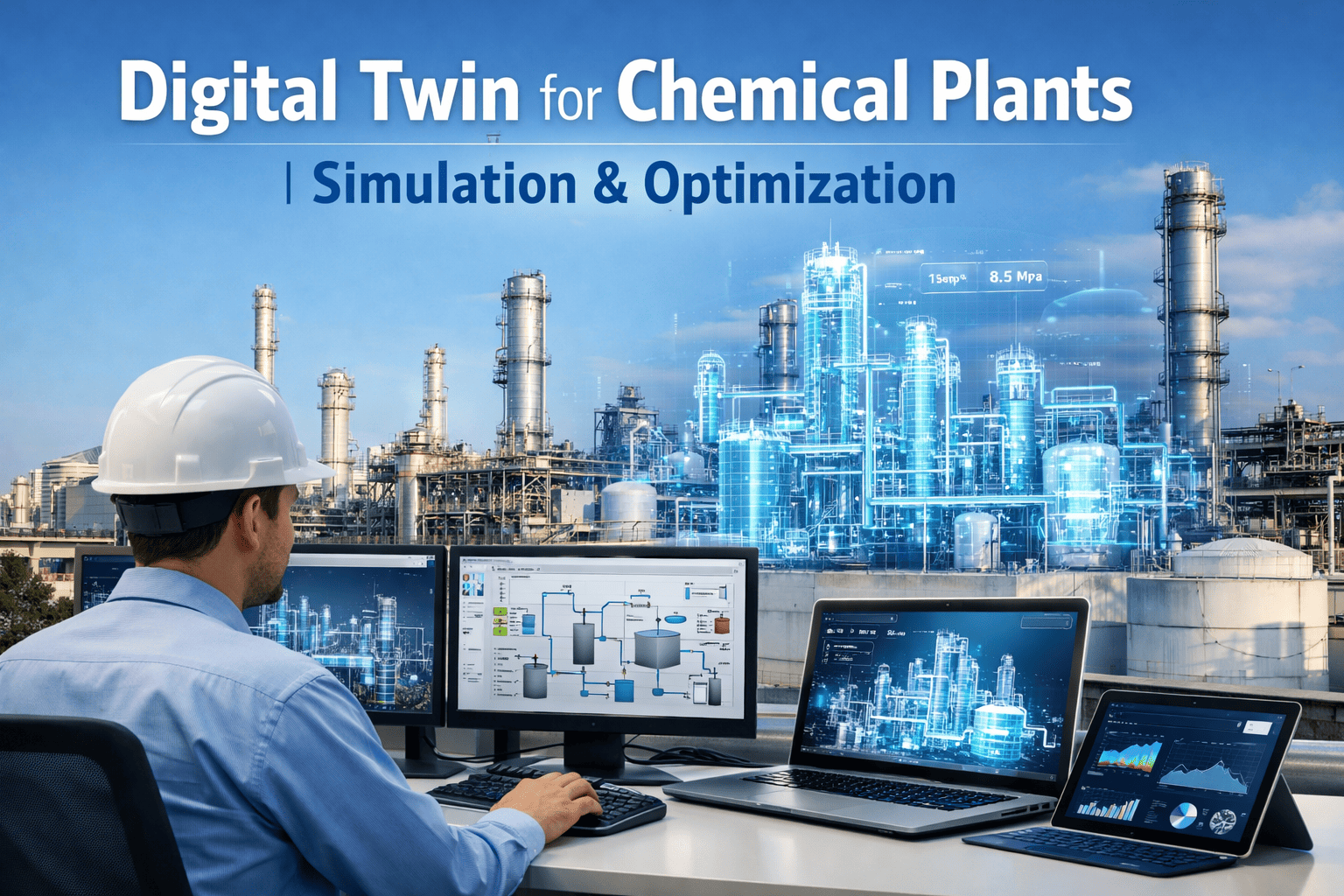
What if you could test a 15% increase in reactor feed rate, switch to a cheaper catalyst, or redesign your distillation sequence — and see the exact impact on yield, energy, quality, and safety without touching a single valve on the real plant? That's what digital twins deliver. By creating a living virtual replica of your reactors, columns, and entire process chain — fed by real-time sensor data and powered by AI — digital twins let engineers simulate changes, optimize parameters, and predict deviations before they happen in the physical world. The global digital twin market is exploding from $21 billion in 2025 to $150 billion by 2030, growing at 47.9% annually. In chemical manufacturing specifically, process twins are the fastest-growing segment because the ROI is undeniable: 15–30% returns within the first few years, 50% shorter development cycles, and 25–55% maintenance cost reductions.iFactory's integrated MES, CMMS, and EAM platform provides the real-time data foundation that makes digital twins actually work connecting every sensor, every asset history, and every maintenance record into the continuous data stream that keeps your digital twin accurate, actionable, and alive.
75% of businesses now use digital twins. More than 40% of manufacturers are in the pilot phase heading toward enterprise rollout. In the chemical industry, AGC Inc. deployed a process digital twin for their vinyl chloride monomer plant — achieving full-scale operation. A chemical manufacturer using digital twin technology achieved $2 million in annual savings through decreased equipment failures alone. Process twins — focused on workflow optimization in manufacturing and chemical applications — are the second-largest and fastest-growing digital twin segment. The technology isn't theoretical. It's operational. And the chemical plants deploying it now are building compounding advantages that late adopters can't replicate.
What Is a Digital Twin — And Why Chemical Plants Need One
A digital twin isn't a static 3D model sitting on an engineer's screen. It's a dynamic, continuously updated virtual replica of your physical plant — fed by real-time sensor data, enriched by AI, and capable of simulating "what if" scenarios that would be dangerous, expensive, or impossible to test on the real process. Here's the critical difference:
- Continuously updated with real-time sensor data
- AI learns and adapts to actual process behavior
- Predicts deviations before they occur in the real plant
- Simulates changes using current actual conditions
- Bi-directional: insights flow back to operations in real time
- Built once with design-basis assumptions
- Doesn't reflect actual equipment degradation or fouling
- Can't predict deviations — only models ideal conditions
- Runs on historical or assumed data — not live data
- One-directional: engineer runs it, then interprets manually
Why chemical plants specifically need digital twins: Chemical processes are governed by non-linear thermodynamics, complex reaction kinetics, and multi-variable interactions that make "intuition-based" optimization impossible at scale. A 0.5°C temperature change can shift selectivity 3%. A 2% feed composition variation can drop yield 5%. A catalyst that's 80% through its lifecycle behaves differently than a fresh one. Digital twins capture all of this — because they combine physics-based process models with real-time AI learning from your actual plant data. And they need a platform like iFactory to feed them the clean, continuous, contextualized data they require.
The Digital Twin Market: What the Numbers Show
Digital twin technology has moved from concept to competitive necessity. The investment momentum — especially in chemical and process manufacturing — is accelerating faster than almost any other industrial technology:
5 Ways Digital Twins Transform Chemical Manufacturing — Powered by iFactory Data
A digital twin is only as good as the data feeding it. iFactory's integrated MES + CMMS + EAM platform provides the continuous, clean, contextualized data stream that keeps digital twins accurate and actionable. Here are the five high-value applications:
iFactory is the data backbone your digital twin needs. Without clean, continuous, contextualized data from production (MES), maintenance (CMMS), and asset health (EAM), a digital twin becomes a disconnected simulation. iFactory ensures your twin reflects reality — every sensor reading, every work order, every equipment condition — in real time. See how iFactory powers digital twin intelligence →
Why iFactory Is the Data Foundation Digital Twins Require
A digital twin without clean, real-time data is just an expensive screensaver. Here's what iFactory provides that makes digital twins actually work in chemical plant environments:
The iFactory advantage for digital twins: Most digital twin implementations fail not because of the simulation software — but because of the data. Dirty data. Missing maintenance records. Sensor readings that aren't contextualized. Equipment conditions that aren't tracked. iFactory solves all of this by providing a unified, clean, continuous data stream from MES + CMMS + EAM — the three pillars that keep your digital twin accurate, actionable, and aligned with reality. Without iFactory, your twin drifts from the physical plant within weeks. With iFactory, it stays synchronized indefinitely.
iFactory: The Data Backbone That Makes Digital Twins Work
A digital twin is only as good as its data. iFactory provides the clean, continuous, contextualized data stream from production, maintenance, and asset health that keeps your twin accurate and actionable. 500+ facilities. 50+ countries. On-premise. Sovereign. See how iFactory powers digital twin intelligence in 30 minutes.
Your Path to Digital Twin-Enabled Chemical Manufacturing
You don't need to digitize your entire plant at once. The proven path starts with high-value assets, builds the data foundation, and scales twin coverage as ROI compounds. iFactory deploys in 2–4 weeks:
Install iFactory on-premise. Connect to your DCS/SCADA via OPC-UA, Modbus, MQTT, or PROFINET. Register every asset with complete hierarchies and maintenance histories. Establish real-time data streams from critical equipment. This phase creates the clean, continuous data backbone that digital twins require — and delivers immediate value through predictive maintenance and real-time production visibility, even before the twin is built.
Build your first digital twin on the asset where downtime hurts most — typically a critical reactor, main distillation column, or bottleneck compressor. iFactory feeds the twin with real-time sensor data, maintenance history, and production context. Engineers begin simulating process changes, predicting failures, and optimizing catalyst performance. Initial ROI — visible within 3–6 months — justifies expansion.
Expand from single-asset twins to process twins covering the entire production chain — from feed preparation through reaction, separation, and purification. iFactory's unified MES + CMMS + EAM provides the cross-system data that process twins need to simulate upstream-downstream interactions. This is where 15–30% ROI, 25–55% maintenance cost reduction, and 20% energy optimization become measurable reality.
The complete plant-wide digital twin is operational — continuously updated by iFactory's data platform, continuously learning from AI, and continuously improving process parameters, maintenance schedules, and energy efficiency. Every work order completion improves the next prediction. Every process optimization is validated before implementation. The twin and the platform form a self-improving loop that gets more accurate and more valuable over time.
iFactory platform results: 500+ facilities across 50+ countries. 25–40% lower maintenance costs. 40% less unplanned downtime. 70% fewer emergency repairs. $150K+ average annual savings per facility. Enterprise customers save $1.8M–$3.2M annually. These results come from the same unified data platform that powers digital twins — meaning your digital twin investment builds on an already-proven operational intelligence foundation.
Frequently Asked Questions
A digital twin is a dynamic virtual replica of a physical asset or process — continuously updated with real-time sensor data and enriched by AI. In chemical manufacturing, digital twins model reactors, distillation columns, heat exchangers, and entire process chains. They combine physics-based simulation models with machine learning to predict how the real plant will behave under different conditions — enabling engineers to test changes, optimize parameters, and predict failures without disrupting production.
iFactory provides the real-time data foundation that digital twins require to stay accurate. The platform connects to every sensor via OPC-UA, Modbus, MQTT, and PROFINET — streaming temperature, pressure, flow, and composition data continuously. The CMMS provides complete asset maintenance histories. The MES provides production context (OEE, batch data, quality metrics). The EAM provides equipment lifecycle information. Together, these three data streams keep your digital twin synchronized with physical reality — and when the twin identifies an action, iFactory's CMMS executes it.
92% of companies report ROI above 10% from digital twin investments, with 50% achieving returns of 20% or more. Payback periods typically range from 12–36 months, with manufacturing projects often showing initial results in 3–6 months. Specific benefits include 25–55% maintenance cost reductions, 50% shorter development cycles, 15–42% operational efficiency improvements, and 20% energy consumption reduction. A chemical manufacturer achieved $2 million in annual savings through digital twin-driven equipment failure prevention alone.
No. Digital twins can be implemented in existing brownfield plants — and that's where most of the ROI is, because existing plants have the most optimization potential. iFactory connects to legacy DCS, SCADA, and sensor systems via industry-standard protocols. Non-invasive sensors can be added to uninstrumented equipment in hours. The best approach is to start with a pilot twin on your highest-value asset, prove ROI, then scale. AGC Inc. deployed their process digital twin at an existing vinyl chloride monomer plant — not a new build.
Your digital twin contains your most valuable intellectual property — process models, catalyst performance data, yield correlations, and optimization parameters. iFactory runs 100% on-premise with edge AI, ensuring all data stays inside your network. Your digital twin's simulation results, predictive models, and optimization insights never leave your plant. This is critical for chemical manufacturers where process IP is competitive advantage — and where cloud-based tools create unacceptable data exposure risk.
Your Plant Has the Data. iFactory Turns It Into a Digital Twin That Delivers.
92% of companies see 10%+ ROI from digital twins. 50% achieve 20%+ returns. But the twin is only as good as the data. iFactory provides the unified MES + CMMS + EAM data platform that keeps your twin accurate, actionable, and aligned with reality — all on-premise, all sovereign, all continuously improving. 500+ facilities. 50+ countries. See the foundation in 30 minutes.