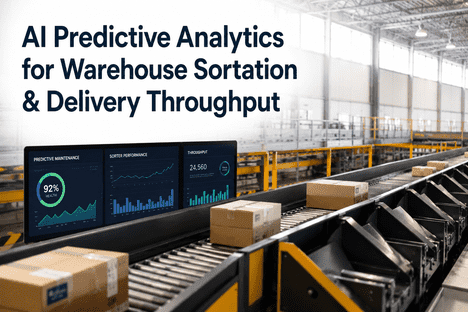
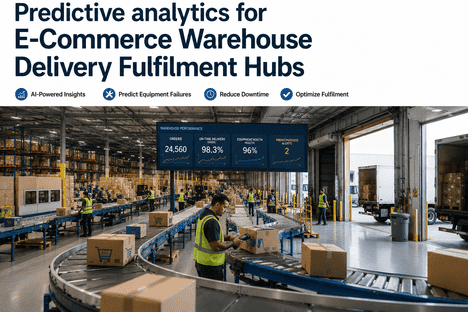
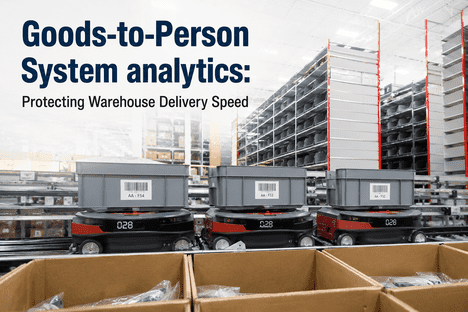
Warehouse sortation infrastructure is the throughput backbone of every high-volume distribution and fulfilment operation — and it fails without warning. A crossbelt sorter drive running hot for three weeks, a pop-up wheel divert accumulating timing lag, a scan tunnel lens fogging from condensation: none of these trigger a SCADA alarm until failure is already in progress. The consequence is not contained. A sortation stoppage during peak dispatch hours delays every order simultaneously, collapses carrier departure windows, and generates SLA penalty exposure across the entire active queue. Research across industrial AI deployments confirms that AI-powered predictive analytics detects sortation equipment faults 15 to 60 days before failure, reducing unplanned downtime by 25 to 35 percent and maintenance costs by 20 to 30 percent. Yet most warehouse operations still manage sortation uptime reactively — responding to failures after they occur rather than preventing them before they impact throughput. iFactory's AI predictive analytics platform closes this gap by fusing continuous sensor data, equipment operating history, and machine learning models to predict, detect, and prioritise every sortation integrity threat before it reaches failure threshold. Book a Demo to see how iFactory AI deploys across warehouse sortation lines within 14 days.
60 days
Advance fault detection before sorter component failure using AI sensor fusion models
35%
Reduction in unplanned sortation downtime with continuous AI predictive monitoring
92%
Fault prediction confirmation accuracy on maintenance inspection across sorter deployments
14 days
Deployment timeline from sensor installation to live AI sortation analytics go-live
What AI Predictive Analytics Actually Requires in Warehouse Sortation Operations
Sortation predictive analytics encompasses every monitoring discipline that keeps sorter drives, belt systems, divert mechanisms, induction stations, and scan tunnels operating within safe performance envelopes — vibration analysis, thermal trend monitoring, actuation timing assessment, scan rate deviation detection, and jam pattern recognition. These domains are inseparable: drive motor bearing wear that produces vibration elevation simultaneously degrades belt tracking stability, and divert mechanism timing lag that reduces sort accuracy accelerates mechanical wear on pop-up wheel assemblies.
Conventional sortation maintenance relies on fixed-interval time-based inspection schedules, periodic lubrication cycles, and end-of-shift throughput reports. The fundamental problem is timing: sorter component degradation progresses continuously with actual operating load, temperature cycling, and throughput volume — but maintenance programs are adjusted on calendar schedules, not equipment condition. iFactory's AI platform eliminates this lag by correlating continuous sensor streams, equipment operating history, and throughput data to calculate actual degradation state at every monitored component — continuously, across every lane.
Sorter Drive Motor Health Monitoring
Continuous vibration frequency, bearing temperature, and motor current draw monitoring on all sorter drives. AI models detect bearing wear, imbalance, and thermal stress patterns 15 to 60 days before failure — with prioritised maintenance alerts specifying the component, anomaly type, and recommended repair window.
Belt Tension and Tracking Analytics
Real-time belt tension sensors and tracking cameras feed iFactory's degradation models. Tension loss, edge wear progression, and tracking deviation are monitored against individually calibrated baselines — distinguishing load-induced transient changes from genuine belt wear trends requiring planned replacement.
Divert Mechanism Wear Tracking
Each divert gate and pop-up wheel mechanism is monitored for cycle count accumulation, actuation response time, and positional accuracy. AI models identify mechanisms approaching end-of-life before misroute rates climb — generating condition-based replacement schedules that eliminate the pattern of failure-driven sort accuracy degradation.
Scan Rate and Induction Performance Analytics
iFactory monitors scan success rates at every induction point and read tunnel in real time. Scan rate decline caused by scanner lens contamination, label orientation drift, or conveyor speed variance is flagged immediately — before throughput shortfalls accumulate and appear in end-of-shift reports hours after onset.
Jam Frequency Pattern Recognition
Every sorter jam event is logged and analysed across time, location, product type, and throughput rate. AI distinguishes systemic mechanical degradation signals from incidental operational jams — identifying recurring zone-specific jam patterns as degradation indicators before they escalate to full line stoppages.
WMS and SCADA Data Integration
iFactory connects directly to major WMS platforms and sorter PLC/SCADA systems. Equipment operating history, throughput records, and maintenance logs load into the AI model — enabling trend projection that predicts when any component reaches critical degradation threshold based on actual operating data, not generic industry curves.
Why Reactive Sortation Maintenance Misses What AI Catches
Time-based maintenance schedules provide component replacement at fixed intervals — but at a point in time, independent of actual equipment condition. Between scheduled services, degradation continues at a rate shaped by actual throughput volume, temperature cycling, and load profile that no calendar program can account for. The following comparison illustrates what operations teams are leaving unmanaged with conventional programs versus what continuous AI monitoring delivers.
| Sortation Function |
Reactive Maintenance — Current State |
iFactory AI Predictive Analytics |
| Drive Motor Health |
No continuous monitoring. Failure detected at breakdown, typically during peak dispatch hours with full throughput impact and unplanned stoppage. |
Continuous vibration, temperature, and current monitoring. AI detects degradation 15 to 60 days before failure with scheduled repair window output. |
| Belt Condition |
Visual inspection on fixed schedule. Tension loss and edge wear missed between cycles until jam or failure event forces emergency intervention. |
Continuous tension and tracking sensor monitoring. Wear trend identified and replacement scheduled before jam-induced secondary damage occurs. |
| Divert Mechanisms |
Replaced on time-based schedule regardless of actual wear state. Premature replacement or failure before scheduled interval both common outcomes. |
Cycle count and actuation timing monitored continuously. Condition-based replacement at actual end of useful life with misroute risk prediction. |
| Scan Rate Monitoring |
Scan success rates reviewed in end-of-shift reports. Throughput shortfalls diagnosed hours after they begin impacting dispatch performance. |
Real-time scan rate monitoring per induction station. Deviation from calibrated baseline triggers immediate alert before throughput impact accumulates. |
| Jam Management |
Jams treated as isolated operational events. No pattern analysis to distinguish incidental jams from systemic mechanical degradation signals. |
Jam frequency patterns analysed by location, time, and product type. Systemic degradation signals identified before escalation to full line stoppage. |
| Maintenance Scheduling |
Fixed-interval time-based scheduling independent of actual equipment condition. Results in over-maintenance and surprise failures between service cycles. |
AI-generated condition-based maintenance schedule. Each component replaced based on actual wear state with repairs timed to low-volume windows. |
Every Unmonitored Sortation Component Is a Throughput Risk Accumulating in Silence.
iFactory AI provides warehouse operations with 24/7 sortation equipment monitoring, real-time degradation intelligence, and automated condition-based maintenance scheduling — fully integrated with your existing WMS, PLC, and sorter control systems within 14 days.
Book a Demo to see detection accuracy against your current sortation equipment inventory.
How iFactory AI Deploys Across Warehouse Sortation Predictive Analytics Programs
iFactory follows a structured deployment process that delivers live sorter drive monitoring within the first week and full multi-lane sortation analytics by day fourteen. Each stage has defined deliverables so operations teams see measurable output — not weeks of configuration with no operational change.
Days 1–3
Sortation Equipment Baseline Audit
Existing maintenance records, PLC operating logs, throughput history, and jam incident data ingested. AI establishes per-component degradation baseline and identifies highest-risk drives, belts, and divert mechanisms for priority sensor deployment. WMS and sorter SCADA integration initiated.
Days 4–7
Sensor Installation and Live Drive Monitoring
Vibration sensors, thermal probes, and current monitoring devices installed on priority sorter drive motors. AI model begins live degradation rate computation. First drive health deviations from baseline detected and maintenance alert recommendations generated within the first operating week.
Days 8–11
Belt, Divert, and Scan Analytics Activation
Belt tension monitoring, divert mechanism cycle tracking, and real-time scan rate analytics enabled across all active sortation lanes. Jam pattern analysis begins correlating incident history with zone-specific degradation signatures. Condition-based maintenance schedule generation activated for all monitored components.
Days 12–14
Full Go-Live and Operations Dashboard
Network-wide sortation predictive monitoring live across all lanes, stations, and mechanisms. Automated remaining life assessment, maintenance work order generation, and throughput analytics dashboards enabled. Mobile maintenance team interface active with prioritised alert queue and photo-documented work order completion.
MEASURABLE OUTCOMES FROM DAY 7: DRIVE HEALTH DEVIATION DETECTION BEGINS WITHIN THE FIRST OPERATING WEEK
Warehouse operations completing iFactory's 14-day deployment report sorter drive degradation signals detected and maintenance schedules adjusted within the first week — recovering significant avoided emergency repair costs in the first 30 days, with full sortation analytics and condition-based maintenance delivering 35% downtime reduction within the first quarter.
35%
Reduction in unplanned sortation downtime within 90 days of go-live
30%
Maintenance cost reduction from condition-based versus time-based replacement
4–8 mo
Full platform payback period including recovered throughput and SLA penalty avoidance
AI Predictive Sortation Analytics: Use Cases from Live Deployments
The following outcomes are drawn from iFactory deployments at operating warehouse and distribution facilities across crossbelt sortation, sliding shoe sortation, and linear divert conveyor configurations. Each use case reflects 9 to 12 month post-deployment performance data.
A national parcel fulfilment operation running three crossbelt sortation lines at 18,000 units per hour peak throughput was managing sorter drive maintenance on a fixed 6-month service interval. Two unplanned drive motor failures in a 12-month period had each generated 4 to 6 hours of peak-hour stoppage with cascading SLA penalty exposure across tens of thousands of deferred orders. iFactory deployed vibration and thermal sensors on all 34 drive motors across the three sortation lines and integrated operating data from the facility's sorter PLC system. Within 21 days, the AI identified two drive motors exhibiting bearing wear signatures consistent with failure within 30 to 45 days — a degradation pattern invisible to the fixed service schedule. Planned bearing replacements were completed during a Saturday low-volume window. No unplanned stoppages occurred in the 14 months following deployment.
Book a Demo to see how this applies to your crossbelt or sliding shoe sortation configuration.
0
Unplanned sorter drive stoppages in 14 months post-deployment vs 2 annually before
21 days
Time from sensor deployment to first bearing degradation signal detected
38%
Reduction in total drive maintenance spend through condition-based replacement
A large apparel and textile e-commerce fulfilment centre operating sliding shoe sortation across 8 active lanes was experiencing progressive sort accuracy degradation — misroute rates climbing from 0.4 percent to 1.8 percent over a 6-month period without a clear root cause identified. The operation was replacing divert shoes on a fixed 3-month schedule regardless of actual wear state, generating both over-maintenance on low-usage lanes and wear-driven accuracy loss on high-throughput lanes between replacement cycles. iFactory deployed cycle count tracking and actuation timing monitoring on all 240 divert mechanisms across the 8 sortation lanes. AI analysis identified 31 mechanisms on the highest-volume lanes exhibiting actuation timing degradation correlated with elevated misroute probability — all outside the scheduled replacement window. Targeted replacement of the 31 identified mechanisms reduced misroute rates from 1.8 percent to 0.3 percent within two weeks. Annual divert mechanism replacement cost reduced 29 percent through lane-specific condition-based scheduling.
Book a Demo to see how iFactory monitors divert mechanism wear in your sortation configuration.
0.3%
Misroute rate post-deployment vs 1.8% before AI-guided replacement targeting
29%
Annual divert mechanism replacement cost reduction from condition-based scheduling
2 weeks
Time from AI-guided replacement to misroute rate returning to target threshold
A multi-channel retail fulfilment operation running tilt tray sortation at 22,000 units per hour had been experiencing intermittent throughput shortfalls that appeared in end-of-shift reports but resisted root cause identification. Scan success rates across the three induction stations were reviewed weekly — too infrequently to detect intra-shift scan rate decline events driven by scanner lens contamination during high-humidity operating periods. iFactory's real-time scan rate monitoring across all three induction stations detected two recurring patterns: scan rate declining below 94 percent at induction station 2 between 2 and 4 hours into afternoon shifts during high-humidity periods, and periodic label orientation drift on station 3 during transitions from apparel to boxed product streams. Both patterns were generating throughput shortfalls diagnosed as sortation system underperformance rather than as addressable induction station issues. Targeted operational interventions — scheduled lens cleaning protocol and label orientation guide adjustment — recovered 6,400 units per shift of lost throughput, equivalent to 29 minutes of full-rate sortation time per day.
Book a Demo to see real-time scan rate analytics across your induction station configuration.
6,400
Units per shift recovered from induction throughput optimisation
29 min
Equivalent daily sortation time recovered through scan rate intervention
99.1%
Post-intervention scan success rate vs 93.6% average before real-time monitoring
Industry Perspective: What Warehouse Operations Get Wrong About Sortation Maintenance
Operations Review — Warehouse Sortation Engineering Perspective
"The dominant assumption in warehouse sortation maintenance is that component condition is stable between scheduled service intervals. It is not. Throughput volume swings, temperature cycling during seasonal peaks, and product mix changes can drive bearing wear and divert timing degradation two to four times faster than fixed-interval schedules account for. The operations teams that will achieve carrier compliance targets and SLA consistency are those building continuous sortation monitoring into their maintenance programs now, not those waiting for the next stoppage event to tell them what already failed."
Sortation Systems Engineering Lead — Major UK Distribution Operation (provided via iFactory deployment reference)
This perspective is consistent with what sortation engineers working within iFactory's deployment program consistently report: the largest throughput and uptime improvements come not from more frequent scheduled maintenance, but from closing the condition-monitoring gap that fixed-interval programs cannot address. AI creates that loop by treating sortation maintenance as a real-time condition management problem rather than a calendar-driven compliance exercise. Book a Demo to speak with iFactory's sortation analytics specialists about your current maintenance program.
Real-Time Sortation Intelligence. Condition-Based Maintenance. Live in 14 Days.
iFactory gives warehouse operations continuous sorter drive monitoring, predictive divert mechanism wear scoring, AI-driven scan rate analytics, and full maintenance documentation — integrated with your existing WMS, PLC, and sorter control systems. Results are measurable within the first operating week of sensor deployment.
Conclusion: AI Predictive Analytics Is Now the Standard for Sortation Uptime, Not an Emerging Option
The case for AI sortation predictive analytics has moved beyond pilot programs and vendor demonstrations. With fault prediction accuracy exceeding 92 percent in live deployments, unplanned sortation downtime reduced 35 percent within 90 days, and condition-based maintenance delivering 30 percent cost reduction across documented operations, warehouse managers who continue managing sortation uptime through fixed-interval schedules and reactive failure response are accepting operational and commercial risk that AI eliminates.
iFactory's platform delivers the specific capabilities high-throughput sortation operations require: real-time drive motor health computation from live sensor data, condition-based maintenance scheduling that replaces calendar-driven service programs, jam pattern analysis that distinguishes systemic degradation from incidental operational events, and automated maintenance documentation aligned with equipment warranty and compliance requirements. The 14-day deployment program means measurable sortation intelligence begins within the first week — not the 6 to 12 month implementation timelines that have historically made continuous monitoring programs difficult to justify at the operations budget level. Book a Demo to receive a sortation uptime assessment specific to your facility's equipment configuration and current downtime pattern.
Frequently Asked Questions About AI Warehouse Sortation Predictive Analytics
How does AI sortation monitoring differ from what existing sorter PLC and WMS systems already provide?
Sorter PLC systems provide real-time process control data but no analytical layer to correlate that data with component degradation mechanisms or failure probability. WMS systems track throughput performance but have no visibility into equipment condition. iFactory's AI converts raw equipment operating data into actionable maintenance intelligence — degradation rate trends, failure probability scores, and condition-based replacement recommendations — that PLC and WMS systems alone cannot generate.
What sortation equipment types does iFactory support for predictive monitoring?
iFactory supports monitoring across the primary sortation system categories used in high-throughput warehouse and distribution operations: crossbelt sorters, sliding shoe sorters, tilt tray sorters, pop-up wheel divert systems, and linear sortation conveyor configurations. Sensor compatibility covers the major sorter drive and control system brands used in these environments. For multi-vendor sortation environments, iFactory's data ingestion layer handles mixed equipment configurations under a single analytics dashboard. Speak with our support team to confirm compatibility with your specific sorter model and PLC configuration.
How does iFactory distinguish genuine degradation signals from normal sortation operational variation?
iFactory's AI models address alert accuracy through individual equipment baseline calibration, multi-variable signal fusion, and pattern duration filtering. Rather than alerting when a single sensor crosses a fixed threshold, the models evaluate whether a pattern of readings across multiple sensors is consistent with a known degradation signature sustained over time. A temporary vibration spike from product loading is distinguished from a sustained vibration elevation consistent with bearing wear. Equipment-specific baseline calibration during deployment means alerts reflect genuine deviation from that specific machine's normal behaviour — producing the 92 percent prediction confirmation accuracy that maintains maintenance team confidence in the alert system over time.
What sensor infrastructure is required and how disruptive is installation?
iFactory works with existing PLC operating logs, maintenance records, and throughput data where available, supplementing with targeted sensor additions at high-risk components identified during the initial baseline audit. Vibration sensors, thermal probes, and current monitoring devices are installed on drive motors during normal maintenance windows without requiring sortation line shutdowns. Divert mechanism cycle tracking uses existing PLC actuation data in most configurations without additional sensor hardware. Full sensor installation is typically completed within the first four days of deployment.
Can iFactory monitor sortation analytics across multiple warehouse sites under one dashboard?
iFactory is built as a multi-site platform. A single deployment covers all facilities in your network under one management dashboard, with site-specific equipment configurations and degradation baselines maintained per location. Operations leadership sees cross-site sortation line availability, fault prediction status, maintenance compliance rates, and downtime trend comparison across the entire network. Site teams see location-specific alerts and work order queues for their facility. Multi-site deployments follow the same 14-day go-live timeline per site with sequential or parallel rollout depending on available maintenance team capacity.
Stop Managing Sortation Failures After They Happen. Deploy AI Predictive Analytics in 14 Days.
iFactory gives warehouse operations real-time sortation equipment health monitoring, predictive fault detection 15 to 60 days before failure, condition-based maintenance scheduling, and full operational documentation — integrated with your existing WMS, PLC, and sorter control systems in 14 days.
92% fault prediction accuracy from AI sensor fusion models
35% reduction in unplanned sortation downtime
30% maintenance cost reduction through condition-based scheduling
14 day deployment with live drive monitoring from day 7