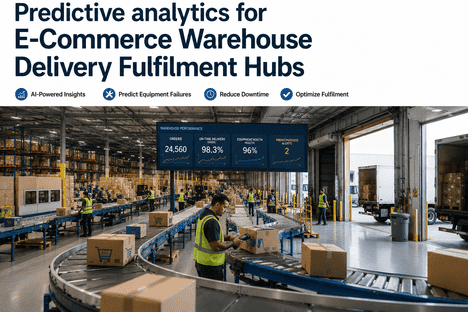
Predictive analytics for E-Commerce Warehouse Delivery Fulfilment Hubs

By Arel Dixon on June 5, 2026

warehouse-delivery-operations-predictive-analytics-e-commerce-fulfilment-url.png_optimized_300

E-commerce fulfilment hubs are the throughput backbone of modern retail processing tens of thousands of daily orders across high-speed sortation systems, conveyor networks, AGV and AMR fleets, automated picking stations, and multichannel dispatch docks. A single unplanned failure during peak dispatch hours does not stop one process it cascades through every downstream operation simultaneously, collapsing carrier departure windows, idling pick stations, and generating SLA penalty exposure across every active client contract. AI-powered predictive analytics for e-commerce fulfilment hub equipment detects developing faults in sortation drives, conveyor bearings, divert actuators, and automated material handling systems 2–6 weeks before failure giving maintenance crews actionable lead time to schedule interventions during planned windows rather than emergency shutdowns. Book a Demo to see how iFactory AI connects your warehouse automation systems to predictive maintenance intelligence.

AI Predictive Analytics · E-Commerce Fulfilment 2026
Predictive analytics for E-Commerce Warehouse Delivery Fulfilment Hubs

AI sortation drive monitoring · Conveyor bearing fault detection · AGV/AMR fleet health · Pick-to-light accuracy · Dock door analytics · All flowing into iFactory CMMS & Shift Logbook.

30–35%
Reduction in unplanned downtime across documented fulfilment deployments
2–6 wks
Advance warning on sortation drive & conveyor bearing failures
$260K
Average cost per hour of unplanned sortation or conveyor downtime
5–8x
Blended ROI within 18 months across sensor-enabled fulfilment assets

Why Traditional Fulfilment Hub Maintenance Falls Short

Most e-commerce fulfilment operations manage equipment maintenance through fixed-interval preventive schedules and reactive response after breakdown. Calendar-based PM replaces components based on hours-run, not actual condition — generating unnecessary costs on healthy equipment while missing faults that develop between service windows. A crossbelt sorter running at 8,000 parcels per hour does not fail without warning bearing temperature rises 4°C over three weeks, divert actuator response time slows by 18 milliseconds, belt tension variance increases by 6%. Each signal, in isolation, looks like normal operating drift. Together, they are a 30-day countdown to a mid-shift failure that stops the entire outbound operation. AI predictive analytics closes this gap by continuously analysing vibration, thermal, acoustic, and current data from sensors on every critical fulfilment asset detecting compound degradation patterns that no PM schedule or individual alert threshold can catch. iFactory's AI platform ingests sensor data from any OEM ifm, Banner, Sick, Balluff, Fluke, or custom IoT nodes and converts raw readings into work order triggers, trend charts, and OEE-linked ROI reports.

E-Commerce Fulfilment Predictive Analytics — The AI Monitoring Architecture
Sensing
IIoT Data Layer
Vibration · temperature · current · acoustic · scan rate · cycle time
Edge inference
Detection
Anomaly Models
Adaptive ML · sensor fusion · compound pattern correlation
2–6 wk lead time
Asset Health
Digital Twin
Sorter drive RUL · conveyor belt wear · AGV battery health
Per-asset RUL
Optimisation
Shift Logbook AI
Auto shift summaries · top-5 critical alerts · crew briefings
Zero info gaps
Action
CMMS / Work Orders
Auto work orders · WMS integration · audit trail
Auto-triggered

Three Critical Equipment Categories Where iFactory Predicts and Prevents Failure

01
High-Speed Sortation Drive & Diverter Failure
Crossbelt sorters, tilt-tray systems, and sliding shoe diverters are the highest-consequence single points of failure in e-commerce fulfilment. A sortation failure during peak dispatch stops all outbound flow simultaneously — every lane, every trailer, every shipment. iFactory monitors vibration on sorter drive motors and gearboxes, divert actuator response timing, scan tunnel read rates, and belt tension across every sortation zone. AI models detect bearing defect frequencies 2–6 weeks before catastrophic seizure the same failure signature that generated a 142 Hz inner race fault tone for 47 days before a $375,000 sortation shutdown in a major e-commerce fulfilment centre. Planned replacement during scheduled maintenance windows costs $4,200. Emergency replacement costs $375,000. iFactory gives you the 47-day warning that turns the first scenario into the second. Book a demo to see how iFactory maps to your crossbelt or tilt-tray sortation configuration.
2–6 wk advance warning Divert actuator latency Missort rate reduction
02
Conveyor Belt, Motor & Roller Degradation
Conveyor networks are the circulatory system of e-commerce fulfilment — induction conveyors feeding sorters, accumulation zones buffering between processes, and takeaway belts moving packed orders to dispatch. A single conveyor failure during peak hours stops the material flow for every downstream process simultaneously. iFactory's AI sensor fusion analyses relationships between motor torque, belt tension, roller temperature, and speed to identify anomalies that precede catastrophic belt tears or motor burnouts — often without requiring additional hardware on existing conveyor installations. The platform detects roller misalignment, belt splice degradation, and idler bearing wear, delivering predicted failure timing and replacement schedules through the iFactory shift logbook. Every conveyor prediction is traceable to the order throughput carried during the degradation window.
Motor torque + tension fusion Belt tear prevention No new hardware needed
03
AGV/AMR Fleet Health & Throughput Degradation
When a single AGV or AMR fails in a high-density e-commerce fulfilment fleet, it doesn't just stop one robot — it creates a traffic flow gap that cascades through the entire fleet routing algorithm, reducing throughput on adjacent robots by 12–18% until the failed unit is cleared. At 45 robots operating 20 hours a day across three shifts, unplanned robot stoppages cost an average of $4,100 per event in throughput loss alone. iFactory monitors drive motor current trend, wheel wear rate, battery cell balance, lidar accuracy, and navigation error frequency across the entire mixed-vendor fleet — providing a single fleet health dashboard that ranks every robot by health risk. When a predictive alert indicates a robot needs attention within the next 3–5 days, iFactory automatically schedules it for the next available charging window with zero production impact. Book a demo to see how iFactory monitors your AGV and AMR fleet health.
Cross-vendor fleet dashboard Charging-window scheduling 99.5% uptime achieved

What E-Commerce Fulfilment Operations Have Achieved with AI Predictive Analytics

Documented industry deployments confirm that AI-powered predictive analytics for e-commerce fulfilment hubs reduces unplanned sortation and conveyor downtime by 30–35% within 90 days, with leading operations reporting 99.7% sortation uptime and zero SLA breaches after 12 months. A 520,000 sq ft e-commerce fulfilment centre deployed 68 IoT sensor nodes across all sortation drive units, gearboxes, and divert actuators at a cost of $82,000 — and within 18 days the AI identified 6 developing faults, including one gearbox bearing with 35 days of remaining useful life. Annual maintenance spend decreased from $890,000 to $340,000. A national parcel hub processing 84,000 packages per day across 14 conveyor lines eliminated 70% of unplanned conveyor downtime in the first year, recovering $899,600 in direct value against a programme cost under $180,000. iFactory is the AI software intelligence layer — turning equipment telemetry from sortation systems, conveyor networks, AGV/AMR fleets, and dock equipment into predictive alerts, digital twin health models, and shift-logbook-delivered maintenance intelligence.

Equipment
AI Monitoring Method
iFactory Output
Maintenance Impact
Crossbelt / tilt-tray sorters
Vibration + acoustic + current AI
2–6 wk bearing alert · auto WO
Prevents catastrophic sortation shutdown
Conveyor systems
Torque + tension + roller fusion
Belt tear prediction · motor RUL
Eliminates emergency conveyor stoppages
AGV / AMR fleets
Motor current + battery + navigation AI
Fleet health score · charging-window WO
Zero unplanned fleet stoppages
Pick-to-light / put-to-light
Cycle time + error rate trending
Station accuracy alert · recalibration schedule
Maintains 99%+ picking accuracy
Dock doors & levelers
Cycle count + hydraulic pressure AI
Seal wear forecast · leveler RUL
Prevents dispatch-window failures

iFactory AI Predictive Analytics Use Cases in E-Commerce Fulfilment

Sortation PdM
Crossbelt & Tilt-Tray Sortation Drive & Diverter Predictive Analytics
Continuous

iFactory monitors vibration, temperature, divert actuator response timing, and scan tunnel read rates across every sortation zone. Adaptive ML models detect bearing defect frequencies, belt splice degradation, and solenoid valve wear 2–6 weeks before failure. AI sensor fusion filters operational noise (package mix variation, throughput surges) to isolate genuine fault signals. When compound degradation patterns cross the risk threshold — three or more correlated signals trending simultaneously — iFactory auto-generates a Priority 1 work order with predicted failure mode, estimated time to failure, and recommended parts. Alerts flow directly to the shift logbook so every incoming crew knows which sortation zone requires attention.

Lead Time2–6 weeks before bearing or actuator failure
IntegrationPLC · WCS · SCADA · CMMS
Book a Demo
Conveyor AI
Induction, Accumulation & Takeaway Conveyor Predictive Analytics
Continuous

iFactory's AI sensor fusion analyses motor torque, belt tension, roller temperature, and photo-eye cycle patterns across every conveyor zone in the fulfilment network. Adaptive ML models detect roller misalignment, belt splice degradation, idler bearing wear, and motor current anomalies — predicting failures 3–14 days before threshold crossing. The platform integrates with existing PLC and VFD signals, meaning many conveyor installations can begin predictive monitoring without additional sensor hardware. Every conveyor prediction event is logged in iFactory's shift logbook with traceability to the parcel throughput and order volume carried during the degradation window — enabling maintenance teams to prioritise interventions by throughput impact rather than calendar schedule.

Lead Time3–14 days before motor or belt failure
Coverage14 conveyor lines · 84K parcels/day
AGV/AMR Fleet
AGV & AMR Fleet Health Analytics & Throughput Optimisation
Continuous

iFactory provides a single fleet health dashboard across mixed-vendor AGV and AMR deployments — monitoring drive motor current trend, wheel wear rate, battery cell balance, lidar calibration drift, and navigation error frequency. The health score ranks every robot daily from highest to lowest risk, enabling maintenance teams to focus on the bottom 10% rather than inspecting on a uniform calendar schedule. When the AI detects a robot crossing the predictive threshold, it auto-generates a work order timed to the next charging window — so every inspection, wheel replacement, lidar calibration, and battery cell check happens during charging, not during a shift. In documented AMR fleet deployments, this approach achieved 99.5% fleet uptime with zero unplanned mid-shift stoppages.

Uptime99.5% fleet availability achieved
Savings$4,100 per avoided stoppage event
Book a Demo

What iFactory AI Delivers for E-Commerce Fulfilment Operations

30–35%
Unplanned sortation & conveyor downtime reduction
Within 90 days across documented fulfilment deployments
2–6 wks
Advance failure prediction on sortation drives & conveyor bearings
vs reactive shutdown response
$1.44M
Annual savings per sortation system in documented deployment
Avoided downtime · SLA penalties · emergency repairs
15–26x
First-year ROI on AI predictive maintenance for sortation
Including sensors · platform · integration

The Shift Handover Gap in E-Commerce Fulfilment — And How iFactory Closes It

The American Fuel & Petrochemical Manufacturers report that over 40% of industrial incidents occur during shift handover periods — despite accounting for less than 5% of operating time. In e-commerce fulfilment, where sortation systems, conveyor networks, and AGV/AMR fleets run 24/7 across multiple shifts, this risk is amplified by the sheer density of automated equipment and the compounding cost of every undetected degradation signal. When an incoming crew doesn't know that a sorter drive showed abnormal vibration on the previous shift, or that a divert actuator flagged rising response latency at 2 AM, they start their shift blind — and the developing fault continues unaddressed for another 8–12 hours.

iFactory's AI-powered digital shift logbook closes this gap. The platform analyses shift entries and equipment health data to auto-generate shift summaries highlighting the top 5 critical items for incoming crews — predictive maintenance alerts, equipment health status, pending work orders, and recurring fault patterns. Every incoming fulfilment crew starts with a structured briefing that ensures no critical equipment issue falls between shifts. Most fulfilment operations go live with iFactory's digital shift logbook in 1–2 weeks, with full CMMS and WMS integration completing in 3–5 days. Book a demo to see how iFactory's shift logbook integrates with your predictive analytics alerts.

FAQ

iFactory integrates with PLC and SCADA signals already present on most modern sortation systems — meaning many fulfilment operations can begin without additional hardware investment. For operations requiring enhanced monitoring, critical sensors include vibration sensors on sorter drive motors and gearboxes, thermal cameras on electrical panels, current sensors on motor drives, and acoustic sensors on high-speed bearings. iFactory is an AI software intelligence layer — not a sensor hardware vendor — and connects to your existing IIoT infrastructure via OPC UA, Modbus TCP, MQTT, and REST API. Book a demo to discuss your specific sortation sensor configuration.
In documented e-commerce fulfilment deployments, AI vibration analysis detects developing bearing faults in crossbelt and tilt-tray sortation drives 2–6 weeks before failure — sufficient lead time to schedule bearing replacement and drive maintenance during planned low-volume windows rather than emergency shutdowns. The exact lead time depends on the failure mode, bearing size, operating load, and sensor density. iFactory's digital twin models adapt continuously to your sortation system's operational history, improving prediction accuracy over the first 3–6 months of deployment.
Yes. iFactory is built for the throughput volatility of e-commerce fulfilment — processing peaks where daily volume spikes 3–5x above baseline. The platform's adaptive ML models automatically recalibrate normal operating envelopes during peak seasons, preventing false alerts from legitimate high-volume operation while maintaining sensitivity to genuine degradation signals. iFactory's mobile app works 100% offline on iOS, Android, and rugged tablets — fulfilment operators can create shift log entries, capture equipment photos, and complete handover checklists even in areas with limited connectivity. All data syncs automatically when connection is restored.
iFactory deploys in 1–2 weeks against pre-built templates covering sortation systems, conveyors, AGV/AMR fleets, pick stations, and dock equipment. Template configuration and process mapping takes 2–3 days. Integration with existing CMMS, WMS, and SCADA systems takes 3–5 days. Operator training and pilot shift testing takes 1–2 days. Initial AI models can be trained on 6–12 months of historical SCADA data already in your historian. Full enterprise rollout across multiple fulfilment hubs completes in 4–8 weeks with dedicated implementation support. Book a demo to discuss your deployment timeline.
Yes. iFactory connects to major WMS and WCS platforms — including SAP EWM, Manhattan SCALE, Blue Yonder, Oracle WMS, and Infor — via REST API, enabling maintenance events to be contextualised against operational throughput data. For sortation and conveyor automation systems, the platform integrates with Dematic, Vanderlande, Knapp, and SSI Schäfer control systems via OPC-UA and Modbus. This integration layer ensures that every predictive alert is enriched with the order throughput, SKU mix, and shift context that maintenance teams need to prioritise interventions by business impact.
Deploy iFactory AI for E-Commerce Fulfilment Predictive Analytics

AI-powered predictive analytics platform connecting IIoT sensors, adaptive ML models, digital twins, and real-time fault detection — with 2–6 week failure prediction on sortation drives, conveyor bearings, and AGV/AMR fleets, auto-generated work orders, and AI shift logbook briefings ensuring zero critical information falls between crews.
Sortation PdM Conveyor AI AGV/AMR Fleet Pick-to-Light Shift Logbook WMS Integration

Share This Story, Choose Your Platform!