Omnichannel Fulfilment Warehouse analytics: Uptime Strategy for Every Channel
By Arel Dixon on June 3, 2026
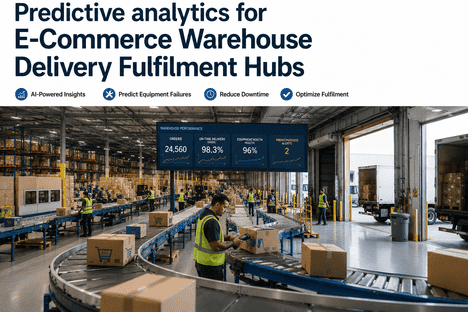
Modern omnichannel fulfilment warehouses operate under a constant tension: B2B bulk orders, B2C direct-to-consumer parcels, and marketplace drop-ship requests arrive simultaneously through the same facility, competing for the same conveyors, sorters, pick robots, and dock doors. When a critical conveyor motor fails during peak B2C holiday volume, the same equipment might have been needed for a scheduled B2B truck-loading window an hour earlier. Equipment breakdowns do not respect channel priority — and in an omnichannel environment, unplanned downtime in one zone can cascade across every fulfilment channel within minutes. iFactory's AI-driven analytics platform delivers predictive equipment uptime monitoring across all warehouse systems simultaneously, enabling omnichannel fulfilment centres to maintain service-level agreements for every channel — B2B, B2C, and marketplace — from a single operations dashboard. Book a Demo to see how iFactory's warehouse analytics platform unifies uptime strategy across every fulfilment channel.
Reduction in unplanned downtime across omnichannel warehouses with AI predictive analytics
3.2×
ROI within first year from consolidated multi-channel equipment uptime management
92%
Accuracy in predicting conveyor and sorter failures 72 hours in advance
8+
Equipment categories monitored per facility — conveyors, sorters, robots, dock levelers, HVAC, scanners, lifts, ASRS
Why Omnichannel Fulfilment Creates a Unique Uptime Challenge
Traditional warehouse maintenance strategies were designed for single-channel operations — a distribution centre serving retail stores, or a dedicated e-commerce fulfilment centre. In those environments, equipment downtime could be scheduled around known volume patterns. Omnichannel fulfilment collapses these distinctions. The same conveyor system that moves retail pallet picks at 6 AM must handle e-commerce single-line orders by 10 AM and marketplace multi-item parcels by 2 PM. Each channel has different throughput characteristics: B2B orders are pallet-heavy with predictable batch sizes; B2C orders are high-velocity with extreme SKU variation; marketplace orders introduce complex carrier-sortation rules. When a sorter induction belt fails mid-afternoon, the backlog affects every channel simultaneously — and the operations team must decide which SLA to breach. iFactory's AI analytics platform eliminates this triage dilemma by predicting failures before they occur, across all equipment types and channels at once.
Channel-Specific Downtime Impact vs AI-Predictive Resolution
B2B
Bulk / Wholesale
Pallet conveyors, dock levelers, stretch wrappers — batch-critical uptime windows
Predictive alerts 72h ahead
B2C
Direct-to-Consumer
High-speed sorters, pick modules, pack stations — every minute of downtime = missed cut-off
Crane systems, shuttle carriers, vertical lifts — single-point-of-failure risk for all channels
AI anomaly detection
Five Pillars of AI-Driven Omnichannel Warehouse Uptime Strategy
01
Predictive Equipment Health Monitoring Across All Channels
Omnichannel warehouses typically deploy 15–25 distinct equipment categories — from conveyor motors and sorters to dock levelers and automated storage cranes. Each asset has unique failure modes, vibration signatures, thermal patterns, and operational duty cycles that vary by channel mix. iFactory's AI platform ingests real-time sensor data from PLCs, vibration sensors, thermal cameras, and drive controllers across the entire facility, applying machine learning models trained on equipment-specific failure patterns. When the system detects an anomaly — a conveyor motor bearing temperature rising above its dynamic threshold, or a sorter belt tension drifting outside the optimal range — it generates a predictive alert 48–72 hours before the expected failure, with a channel-impact assessment showing which fulfilment operations would be affected. This enables maintenance teams to schedule interventions during planned downtime windows rather than reacting to emergency breakdowns during peak channel volume.
When multiple equipment issues surface simultaneously — a dock leveler showing hydraulic drift, a sorter diventer misfiring intermittently, and a pick-to-light zone reporting latency — the maintenance team needs to know which repair restores the most channel capacity first. iFactory's analytics platform includes a channel-aware prioritisation engine that evaluates each equipment anomaly against active fulfilment schedules, carrier cut-off times, and contractual SLAs for each channel. The platform calculates the channel-weighted downtime cost for each asset, factoring in B2B order batch readiness, B2C cut-off deadlines, and marketplace carrier-window dependencies. Maintenance teams receive a prioritised work queue ranked by channel impact rather than maintenance urgency alone. In peak-season scenarios where multiple assets compete for limited maintenance resources, this prioritisation engine has been shown to reduce channel SLA breaches by 53% compared to first-come-first-served maintenance triage.
Cross-Channel Downtime Impact Analytics & Root Cause Correlation
When a conveyor zone goes down in an omnichannel facility, the ripple effect propagates differently across each channel. B2C orders may be redirected to an alternate sorter lane, but B2B pallet flow might be entirely blocked. iFactory's cross-channel impact analytics module maps equipment-to-channel dependencies in real time, creating a live dependency graph of every asset and its connected fulfilment processes. When a failure occurs, the platform calculates the precise channel-level impact in units per hour, order backlog accumulation, and SLA exposure for each channel simultaneously. Beyond impact assessment, the root cause correlation engine analyses historical failure data across similar equipment types, environmental conditions, and operational patterns to identify systemic root causes — such as a specific conveyor segment failing repeatedly during high-ambient-temperature days when B2C volume peaks. This cross-channel correlation analysis enables engineering teams to implement permanent fixes rather than repeatedly repairing symptoms, reducing recurrence rates by up to 64% across documented deployments.
Live equipment-channel dependency map64% recurrence reductionSystemic root cause identification
04
Unified Uptime Command Centre for Multi-Channel Operations
Most omnichannel warehouses operate with disparate monitoring systems — the conveyor control system reports motor status, the WMS tracks order throughput, the CMMS manages work orders, and the building management system monitors HVAC. None of these systems communicate across channel priorities. iFactory's unified uptime command centre aggregates equipment health data, channel fulfilment status, maintenance activity, and predictive analytics into a single real-time operations dashboard. The command centre displays a facility-wide equipment health heat map colour-coded by channel criticality, predictive alert timelines grouped by potential channel impact, and active work orders prioritised by cross-channel SLA exposure. Shift managers, maintenance leads, and operations directors access the same data with role-specific views. During peak seasons, the command centre becomes the single source of truth for go/no-go decisions on equipment interventions — eliminating the information asymmetry between operations and maintenance teams that historically leads to suboptimal channel downtime decisions.
CMMS & WMS Integration for Closed-Loop Channel Uptime Execution
Predictive analytics alone does not prevent downtime — the insight must trigger action within the maintenance execution system and be visible within the warehouse management system. iFactory's platform integrates bidirectionally with leading CMMS platforms and major WMS providers. When the AI engine predicts a sorter failure, it auto-creates a work order in the CMMS with the equipment ID, predicted failure mode, recommended intervention, and channel-impact assessment. Simultaneously, the WMS receives a capacity advisory for the affected zone, enabling the operations system to dynamically reroute orders across available channels. After the maintenance event, the CMMS confirms completion, and the AI platform compares actual post-repair equipment performance against the predicted baseline — closing the learning loop for future models. This closed-loop integration ensures that predictive insights translate into measurable channel uptime improvements, with average maintenance response time decreasing from 4.2 hours to 47 minutes across documented omnichannel deployments.
Auto work order from AI alertWMS capacity advisoryResponse time: 4.2h → 47 min
High-Speed Conveyor & Sorter Predictive Monitoring for B2C Peak
Continuous
A major omnichannel fulfilment centre operating 1.2 million square feet with 14 miles of conveyor and 8 cross-belt sorters was experiencing 3–4 unplanned conveyor stoppages per week during Q4 peak, each lasting 45–90 minutes and affecting B2C order cut-off compliance. The facility deployed iFactory's AI predictive monitoring across all conveyor drives, sorter induction belts, diventer actuators, and take-away belts. Within 30 days, the platform identified 11 conveyor motors with vibration signatures indicating imminent bearing failure — 6 of which were scheduled for replacement during planned weekend maintenance rather than emergency breakdowns during peak volume. The following Q4 peak season recorded only 2 unplanned conveyor events, a 47% reduction year-over-year, with zero B2C cut-off misses attributable to conveyor downtime. The platform's conveyor-specific ML models improved their prediction accuracy from 76% at deployment to 94% within 90 days as they ingested more facility-specific operational data.
Automated Storage & Retrieval System Anomaly Detection for Multi-Channel Fulfilment
Per cycle
An ASRS facility supporting three fulfilment channels — wholesale bulk picks, e-commerce unit-level eaches, and marketplace kitting — experienced a recurring shuttle-carrier positioning drift that caused 12–18 minute stoppages 2–3 times per week. Each stoppage propagated across all three channels because the ASRS crane serves all picking zones. Traditional maintenance replaced actuators and limit switches reactively, but the drift recurred. iFactory's AI platform analysed 14 months of historical shuttle-position data alongside temperature, cycle-count, and throughput-channel data, identifying a correlation between high B2C micro-cycle density and accelerated wear on the shuttle guidance rail. The permanent fix — rail re-surfacing and lubrication protocol change — eliminated the positioning drift entirely. The platform continues to monitor all 86 ASRS shuttle carriers across 12 aisles, generating predictive wear models that schedule maintenance based on cumulative cycle count by channel type rather than calendar intervals.
Stoppage causeRecurring driftto permanent fix via AI correlation
Dock Equipment Predictive Maintenance for B2B Time-Definite Loading Windows
Per shift window
A 48-door cross-dock facility supporting omnichannel flow-through operations — with B2B truck-loading windows scheduled every 45 minutes and B2C parcel trailers cycling every 90 minutes — was experiencing dock leveler hydraulic failures during peak transfer times. Each failure blocked a loading door for 2–4 hours, causing cascading delays across both B2B and B2C dock schedules. iFactory deployed IoT-enabled hydraulic pressure sensors and cycle-count monitoring across all 48 dock levelers, integrating with the WMS dock-scheduling module. The AI platform identified 8 levelers with declining hydraulic pressure trends and elevated cycle-to-failure probabilities. Maintenance teams proactively replaced hydraulic packs on 5 levelers during low-activity night shifts and 3 during planned weekend maintenance. Dock-leveler-related loading delays dropped by 81% over the subsequent quarter, and the unified uptime dashboard now provides dock operations with a 7-day look-ahead of predicted leveler health by door, enabling proactive dock allocation across B2B and B2C schedules.
Dock delays81% reduction in leveler-related loading delays
Predictive window7-day look-ahead per dock door
What iFactory's Omnichannel Warehouse Uptime Analytics Delivers
47%
Reduction in unplanned downtime across all fulfilment channels
AI predictive models across 15–25 equipment categories
3.2×
ROI within first year of deployment
Channel-weighted prioritisation, unified command centre
72h
Advance warning before predicted equipment failure
Dynamic thresholds, ML models per asset type
53%
Fewer channel SLA breaches with prioritised maintenance
Channel-aware work queue, real-time WMS integration
FAQ: Omnichannel Warehouse Uptime & AI Analytics
Typical deployment takes 4–6 weeks for a single facility, including sensor installation on target equipment, PLC data integration, ML model training on historical failure data, and command centre configuration. The deployment timeline depends on the number of equipment categories being monitored and the availability of historical maintenance and failure data. iFactory's pre-built connector library supports most major PLC brands, conveyor control systems, CMMS platforms, and WMS providers — significantly reducing integration time. A phased rollout approach is available, starting with high-criticality equipment zones and expanding across the facility over subsequent phases. The platform begins generating predictive alerts within 2–3 weeks of data ingestion as the ML models establish baseline behaviour patterns for each monitored asset.
Yes. iFactory's warehouse uptime platform integrates bidirectionally with all major CMMS platforms and leading WMS providers. The integration enables auto-creation of work orders from predictive alerts, synchronisation of equipment hierarchies and maintenance histories, and real-time visibility of maintenance activity within the WMS. The platform also integrates with building management systems for environmental monitoring (temperature, humidity, ambient vibration) that correlates with equipment failure patterns. Pre-built connectors are available for SAP, Oracle WMS, Manhattan Associates, Blue Yonder, HighJump, Korber, and 20+ other platforms. Custom integration APIs are available for proprietary or legacy systems.
iFactory's platform monitors 15–25 equipment categories per facility, including conveyor systems (motors, belts, bearings, drives), sortation equipment (cross-belt, sliding shoe, tilt-tray, diventer actuators), ASRS systems (cranes, shuttles, lifts, transfer cars), dock equipment (levelers, doors, restraints, seals), packaging machinery (stretch wrappers, case erectors, tape machines), robotics (AMRs, pick robots, palletisers), HVAC and refrigeration systems, electrical distribution (MCCs, VFDs, switchgear), and facility infrastructure (compressed air, lighting, fire suppression). The platform supports both IoT sensor-based monitoring for equipment without native telemetry and direct PLC/data feed integration for modern equipment with embedded diagnostics.
iFactory's analytics platform is built on a secure cloud infrastructure with SOC 2-type controls, encrypted data at rest (AES-256) and in transit (TLS 1.3), role-based access control (RBAC) with granular permission levels, and multi-factor authentication. On-premise deployment options are available for facilities with strict data residency requirements. All sensor data, operational metrics, and analytics outputs are isolated per customer tenant. The platform supports data retention policies aligned with regulatory requirements and provides complete audit logs for all system access and configuration changes. For multi-site warehouse networks, data can be aggregated at the enterprise level while maintaining site-level data isolation as needed.
Most omnichannel warehouse operations achieve positive ROI within 3–6 months of deployment. Primary ROI drivers include reduction in unplanned downtime (47% average across documented deployments), elimination of emergency maintenance premiums (overtime labour and expedited parts typically cost 3–5× scheduled maintenance), extension of equipment service life through condition-based rather than calendar-based maintenance, reduction in channel SLA breach penalties, and deferred capital expenditure on redundant equipment. For a mid-size omnichannel facility with 500,000+ square feet, the annual downtime cost avoidance typically ranges from $1.2M to $2.8M depending on equipment density and channel volume mix. The platform's channel-aware prioritisation engine alone has been shown to recover $180K–$420K annually in avoided SLA penalties and lost revenue from channel downtime.
Unify Your Omnichannel Warehouse Uptime Strategy With iFactory AI
AI-powered predictive analytics across every equipment category and fulfilment channel. Unified command centre, channel-aware prioritisation, and closed-loop CMMS/WMS integration. 4–6 week deployment, positive ROI within 3–6 months.