Warehouse and delivery operations run on equipment that cannot afford to fail conveyors, forklifts, sortation systems, dock levelers, refrigeration units, and last-mile delivery fleets. Single-sensor monitoring misses 40% of early-stage equipment failures because individual data streams capture only one dimension of a developing fault. Sensor fusion combining vibration, temperature, acoustic emission, and motor current data into a unified AI model gives warehouse operations a complete, real-time picture of every asset's health. iFactory AI deploys multi-sensor predictive analytics across warehouse and delivery networks within 6 weeks, detecting failure signatures weeks before breakdown and eliminating unplanned downtime that costs U.S. logistics operators over $800M annually. Book a Demo to see how iFactory AI applies sensor fusion to your warehouse and delivery fleet.
40%
Early-stage failures missed by single-sensor monitoring systems
93%
Equipment failure prediction accuracy with multi-sensor AI fusion models
$800M
Annual U.S. logistics downtime cost addressable through predictive sensor analytics
6 wks
Deployment timeline from baseline audit to live sensor fusion monitoring
What Sensor Fusion Actually Means for Warehouse and Delivery Operations
Sensor fusion is the practice of combining heterogeneous data streams — vibration, temperature, acoustic emission, motor current, and load — into a single AI model that detects fault signatures no individual sensor can identify alone. A conveyor motor running at elevated temperature may simply reflect ambient conditions; the same motor with elevated temperature plus abnormal vibration frequency plus current draw deviation is a bearing failure developing over the next 72 hours. iFactory AI's sensor fusion engine processes all four data channels simultaneously, identifying compound fault signatures and issuing actionable maintenance alerts before equipment reaches failure threshold.
In warehouse and delivery operations, the assets most vulnerable to undetected failure are also the assets most critical to throughput: sortation conveyors, automated storage and retrieval systems (AS/RS), dock equipment, refrigerated trailers, and last-mile delivery vehicles. Conventional monitoring relies on scheduled preventive maintenance intervals that bear no relationship to actual equipment condition — resulting in both premature maintenance spend and catastrophic failures that break windows of interval-based prediction. iFactory's multi-sensor platform eliminates both failure modes by replacing calendar-based maintenance with continuous, condition-based intelligence. Book a Demo to benchmark your current maintenance program against sensor fusion baselines.
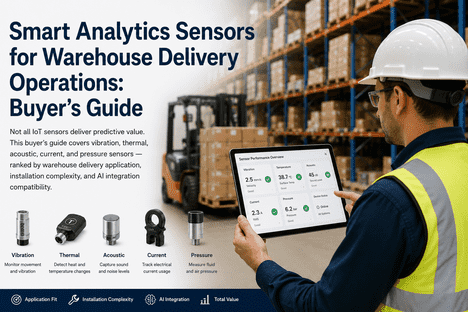
Vibration Analysis
High-frequency accelerometers on conveyor drives, motors, and forklifts detect bearing wear, imbalance, and misalignment through spectral signature analysis — flagging faults 2–6 weeks before mechanical failure.
Thermal Monitoring
Continuous temperature sensors on motors, electrical panels, and refrigeration systems detect overheating patterns 4–12 hours before thermal runaway — preventing fires, spoilage events, and motor burnouts.
Acoustic Emission Detection
Ultrasonic acoustic sensors identify gear tooth cracking, seal leaks, and lubrication failure through high-frequency sound pattern analysis — capturing failure signatures invisible to vibration monitoring alone.
Motor Current Analysis
AI analyzes motor current draw signatures to detect rotor bar defects, winding degradation, and load anomalies on sortation drives, dock levelers, and AS/RS equipment — without requiring physical sensor installation on rotating components.
Delivery Fleet Telematics Fusion
GPS, engine telemetry, brake wear sensors, and tire pressure data fused with AI predictive models forecast delivery vehicle failures before dispatch — eliminating mid-route breakdowns and missed delivery windows.
Digital Twin Asset Modeling
iFactory builds continuously-updated digital twins of critical warehouse assets, fusing live sensor streams with historical failure data to simulate degradation trajectories and project remaining useful life for every monitored component.
Why Single-Sensor Monitoring Fails Warehouse Operations — And What Multi-Sensor Fusion Delivers
Traditional warehouse predictive maintenance programs rely on one sensor type per asset class: vibration on motors, temperature on electrical panels, hours-based intervals on vehicles. This approach misses compound failure modes that only manifest across multiple data channels simultaneously. The following comparison shows what operators leave undetected with conventional programs versus what iFactory's sensor fusion platform delivers.
| Monitoring Parameter |
Single-Sensor / Calendar Maintenance |
iFactory AI Sensor Fusion |
| Bearing Failure Detection |
Vibration-only monitoring detects gross imbalance but misses early-stage subsurface spalling visible only in combined vibration + acoustic + temperature signatures. |
Three-channel fusion identifies bearing degradation 3–6 weeks before failure threshold. Root cause distinguished between lubrication, misalignment, and overload without manual diagnosis. |
| Conveyor Drive Health |
Scheduled belt replacement every 90 days regardless of actual wear state. 60% of replacements performed on equipment with 40%+ remaining useful life. |
Vibration + current fusion monitors actual drive health continuously. Replacement triggered by confirmed degradation, not calendar — reducing maintenance spend 35–50% on conveyor systems alone. |
| Refrigeration Unit Monitoring |
Temperature alarms trigger after product temperature deviation — meaning refrigeration failure already occurred. Compressor faults not detected until visible performance loss. |
Acoustic emission + current + vibration fusion detects compressor bearing and valve faults 24–48 hours before temperature deviation — eliminating spoilage events and emergency repair calls. |
| Delivery Fleet Pre-Dispatch Readiness |
Driver pre-trip inspection misses 70%+ of developing mechanical faults. Breakdowns discovered mid-route, triggering recovery operations and missed delivery SLAs. |
AI fusion of engine telemetry, brake sensor data, and tire pressure predicts vehicle-level failure risk before dispatch. Vehicles flagged for maintenance before entering service — not after breakdown. |
| AS/RS System Uptime |
Automated storage system failures require 4–8 hour recovery windows. No advance warning from single-channel monitoring before mechanical or electrical faults manifest. |
Multi-sensor health scoring across all AS/RS axes and drives. Failure risk scores updated every 15 minutes. Maintenance window scheduled proactively during off-peak hours — not forced by breakdown. |
| False Alarm Rate |
Single-sensor threshold alarms generate 55–70% false positive rates. Maintenance teams become desensitized, missing genuine early warnings. |
Multi-sensor cross-validation reduces false positives to under 8%. Every alert confirmed across two or more data channels before escalation — ensuring maintenance action on real fault signatures only. |
Every Unmonitored Warehouse Asset Is a Downtime Event Accumulating in Silence.
iFactory AI gives warehouse and delivery operators 24/7 multi-sensor equipment health monitoring, real-time failure prediction, and automated maintenance scheduling — integrated with your existing WMS, CMMS, and fleet telematics within 6 weeks.
Book a Demo to see detection accuracy against your current asset inventory.
How iFactory AI Deploys Sensor Fusion Across Warehouse and Delivery Operations
iFactory follows a structured six-week deployment process that delivers live equipment health scores within the first two weeks and full multi-sensor predictive analytics by week six. Each stage has defined deliverables — operators see measurable failure detection improvement from the first sensor deployment, not months of data collection before value appears.
Weeks 1–2
Asset Baseline Audit and Sensor Mapping
Critical asset inventory compiled across conveyor systems, material handling equipment, refrigeration units, dock equipment, and delivery fleet. Historical maintenance records, failure logs, and existing sensor outputs ingested. AI establishes per-asset health baseline and identifies highest-risk equipment for priority multi-sensor deployment. WMS and CMMS integration initiated.
Weeks 3–4
Sensor Deployment and Live Health Scoring
Vibration accelerometers, thermal sensors, acoustic emission devices, and current monitors installed at priority assets. AI model begins live sensor fusion and equipment health score computation. First compound fault signatures detected and maintenance alerts generated. Fleet telematics integration activated for delivery vehicle monitoring.
Weeks 5–6
Full Network Deployment and Maintenance Optimization
Sensor fusion monitoring live across all warehouse and delivery assets. Remaining useful life projections, automated maintenance work order generation, and parts forecasting activated. CMMS integration delivers maintenance alerts directly to technician workflows. Delivery fleet pre-dispatch health scoring begins replacing manual pre-trip inspection as primary fault detection method.
MEASURABLE OUTCOMES FROM WEEK 3: COMPOUND FAULT DETECTION BEGINS IMMEDIATELY ON SENSOR ACTIVATION
Warehouse and delivery operators completing iFactory's 6-week deployment report compound equipment faults detected and maintenance interventions scheduled within the first month — recovering $600K–1.4M in avoided emergency repair and downtime costs in the first 90 days, with full sensor fusion coverage delivering $3.2–5.8M annual value by week 6.
$600K–1.4M
Avoided emergency repair and downtime costs in first 90 days
35–50%
Reduction in unnecessary preventive maintenance spend
<8%
False alarm rate with multi-sensor cross-validation vs 55–70% single-sensor
Sensor Fusion in Action: Use Cases from Live Warehouse and Delivery Deployments
The following outcomes are drawn from iFactory deployments at operating warehouse, fulfillment, and last-mile delivery facilities. Each use case reflects 6–12 month post-deployment performance data.
A 1.2M square foot e-commerce fulfillment center was managing sortation conveyor health through quarterly preventive maintenance intervals and vibration-only monitoring on primary drive motors. The single-channel approach was generating 60% false alarm rates that maintenance teams had learned to ignore. Over 18 months, three unplanned sortation failures had each caused 6–9 hours of downtime during peak shipping windows, costing $280K–$420K per incident in delayed fulfillment and expediting costs. iFactory deployed vibration, acoustic emission, and thermal sensors across 34 critical conveyor drive points and fused the data streams into a compound fault model. Within 45 days, the AI identified two drives developing early-stage bearing subsurface spalling — visible in the acoustic emission signature 5 weeks before vibration amplitude crossed threshold. Planned bearing replacement during a scheduled maintenance window prevented both failures. Unplanned sortation downtime eliminated for the following 11 months.
Book a Demo to apply this approach to your fulfillment center conveyors.
Zero
Unplanned sortation failures in 11 months post-deployment
5 wks
Advance warning lead time on bearing fault before vibration threshold breach
$1.1M
Avoided downtime and emergency repair cost in first 12 months
A regional grocery distribution center operating 22 refrigerated dock doors and 14 cold storage blast freezers was relying on temperature alarm thresholds as primary fault detection. By the time temperature alarms triggered, compressor failures had already caused product temperature deviation — resulting in $180K–$340K per incident in spoilage write-offs and regulatory compliance events. iFactory integrated acoustic emission, motor current, and vibration sensors across all refrigeration compressors and fused the data with system pressure readings from existing BMS. The AI model detected compressor valve degradation signatures through acoustic emission 36–48 hours before motor current drew elevated — allowing planned intervention before product temperature was affected. Three compressor faults detected and resolved without product loss in the first 8 months. Annual spoilage and emergency maintenance costs reduced from $2.4M to $610K.
36–48h
Early warning lead time on compressor fault before temperature impact
$1.79M
Annual spoilage and emergency maintenance cost reduction
Zero
Product temperature exceedance events in 8 months following deployment
A 280-vehicle last-mile delivery operator in three metropolitan markets was experiencing 14–18 mid-route vehicle breakdowns per month — each triggering recovery operations, missed delivery SLAs, and $4K–$8K per-incident cost. Driver pre-trip inspections were identifying fewer than 30% of mechanical faults that resulted in mid-route failure. iFactory integrated engine telemetry, brake pad wear sensors, tire pressure monitoring, and battery health data across the entire fleet into a unified AI health scoring system. Each vehicle receives a pre-dispatch health score updated 90 minutes before scheduled departure. Vehicles scoring below threshold are flagged for inspection before entering service. Mid-route breakdowns reduced from 16 per month to 2 over a 6-month period. On-time delivery rate improved from 91.2% to 97.4%.
87.5%
Reduction in mid-route breakdowns (16/month to 2/month)
97.4%
On-time delivery rate achieved vs 91.2% pre-deployment
$1.3M
Annual recovery operation and SLA penalty cost eliminated
Expert Perspective: The Sensor Fusion Gap in Warehouse Predictive Maintenance
Industry Review — Warehouse Operations Engineering Perspective
"The core problem with warehouse predictive maintenance programs is that they were designed around single-sensor architectures from an era when data processing costs made multi-channel fusion impractical. That constraint no longer exists. Bearing failures, compressor faults, and drive degradation are compound events that develop across vibration, acoustic, and thermal signatures simultaneously — and single-sensor monitoring catches only the final stage, after the failure mode is already advanced. The facilities achieving best-in-class uptime are those fusing all four data channels into a unified model and acting on the compound signature, not waiting for any one channel to breach threshold."
Warehouse Reliability Engineering Lead — Major U.S. Third-Party Logistics Operator (provided via iFactory deployment reference)
This perspective reflects what reliability engineers across iFactory's warehouse deployment program consistently report: the highest-value improvements come not from adding more sensors of the same type, but from fusing complementary data channels into a unified fault model. Vibration alone cannot distinguish bearing wear from misalignment; temperature alone cannot localize fault origin; acoustic emission alone cannot quantify severity. Fusion of all three — correlated with motor current — creates the compound signature that enables precise diagnosis, not just anomaly detection. Book a Demo to speak with iFactory's warehouse reliability specialists about your current monitoring program.
Multi-Sensor Fault Detection. Delivery Fleet Intelligence. Live in 6 Weeks.
iFactory AI gives warehouse and delivery operators continuous equipment health monitoring across vibration, thermal, acoustic, and current data streams — fused into a single predictive model that eliminates the 40% of failures single-sensor programs miss. Integrated with your WMS, CMMS, and fleet telematics. Results measurable within 30 days of sensor activation.
Frequently Asked Questions About Sensor Fusion for Warehouse and Delivery Operations
What is sensor fusion and why does it outperform single-sensor monitoring?
Sensor fusion combines data from multiple sensor types — vibration, temperature, acoustic emission, and motor current — into a unified AI model that detects compound fault signatures invisible to any individual channel. Research consistently shows that multi-sensor fusion improves fault detection accuracy by 30–45% and reduces false alarms by 60–80% compared to single-sensor threshold monitoring. Compound failures in warehouse equipment always manifest across multiple physical dimensions; single-sensor programs capture only the final, most advanced stage of degradation.
What warehouse assets benefit most from multi-sensor predictive analytics?
The highest-value applications are sortation conveyor drive systems, AS/RS machinery, refrigeration compressors, dock levelers and door equipment, forklift fleets, and last-mile delivery vehicles. These assets share three characteristics: high replacement cost, long lead time for parts procurement, and direct impact on throughput or delivery SLA compliance when they fail unexpectedly. iFactory prioritizes sensor deployment on assets meeting all three criteria during the baseline audit phase.
Does iFactory integrate with existing CMMS and WMS platforms?
Yes. iFactory connects directly to major CMMS platforms including IBM Maximo, SAP PM, Infor EAM, and Fiix, as well as WMS systems from Manhattan Associates, Blue Yonder, and Oracle. Predictive maintenance alerts generate work orders automatically within existing CMMS workflows — so maintenance teams receive actionable fault notifications through the systems they already use, without requiring new tools or process changes.
How does sensor fusion reduce false alarm rates?
Single-sensor threshold alarms trigger on any signal deviation above a fixed threshold, generating 55–70% false positive rates that cause maintenance teams to deprioritize alerts. Sensor fusion requires deviation confirmation across two or more independent data channels before generating an alert — dramatically reducing false positives. iFactory's deployed systems consistently achieve false alarm rates below 8%, ensuring maintenance teams respond to every alert as a genuine fault signature.
How does iFactory's delivery fleet monitoring differ from standard telematics platforms?
Standard fleet telematics platforms report current vehicle status and driver behavior metrics. iFactory's AI fusion model combines telematics data with brake wear, tire health, battery state, and engine diagnostic channels to compute a forward-looking failure probability score for each vehicle before dispatch. The distinction is predictive versus descriptive — standard telematics tells you what is happening now; iFactory tells you which vehicles will fail in the next 24–72 hours and why, before they enter service.
Stop Reacting to Warehouse Equipment Failures. Deploy Multi-Sensor Predictive Analytics in 6 Weeks.
iFactory AI gives warehouse and delivery operators continuous sensor fusion monitoring across vibration, thermal, acoustic, and current channels — detecting compound equipment faults weeks before failure and eliminating the 40% of breakdowns single-sensor programs miss. Integrated with your WMS, CMMS, and fleet telematics. Live results from week two.
93% equipment failure prediction accuracy from multi-sensor AI fusion
35–50% reduction in unnecessary preventive maintenance spend
<8% false alarm rate with multi-sensor cross-validation
6 week deployment with live health scoring from week 2