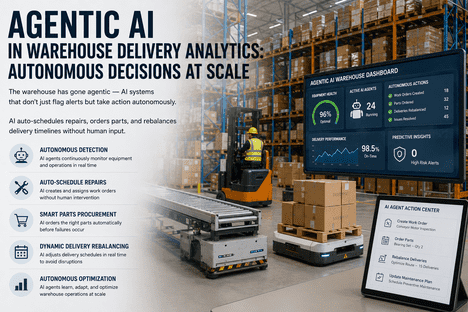
Warehouse and delivery operations generate thousands of decision events every hour a conveyor drive spiking in vibration at 2 AM, a delivery route blocked by an accident, a parts bin dropping below safety stock, a work order needing the wrong technician class. Traditional AI flags these events and waits. Someone reads the dashboard. Someone creates a work order. Someone calls a supplier. Someone updates the delivery ETA. By the time that human coordination loop closes, the window to act cheaply has already passed. Agentic AI changes the architecture entirely not an advisory layer, but an autonomous system that senses the anomaly, reasons over context, makes the decision, and executes it across your connected CMMS, WMS, ERP, and fleet systems without waiting for a human to read a notification. According to a McKinsey 2025 report, agentic AI has already cut operational costs to four-fifths of previous levels in logistics environments. iFactory AI deploys agentic warehouse and delivery analytics that auto-schedules repairs, triggers parts procurement, and rebalances delivery timelines at machine speed. Book a Demo to see how iFactory's agentic platform executes autonomous decisions across your warehouse and delivery network.
79%
Enterprises now adopting AI agents — PwC AI Agent Survey 2025
30 sec
Anomaly to executed work order — vs. 47 min with human coordination
40%+
Emergency repair cost reduction from autonomous maintenance decision loops
$16.84B
Agentic AI logistics market projected by 2030 — SupplyChainBrain 2025
What Agentic AI Actually Means for Warehouse and Delivery Operations
Predictive AI tells you what is going to happen. Agentic AI acts on it. The distinction matters enormously at warehouse scale. A predictive model that flags a conveyor bearing degrading with 91% confidence has delivered information — but the work order still needs to be created, the technician matched by certification and scheduled, parts reserved from inventory, and procurement triggered if stock is insufficient. That coordination chain takes 47 minutes on average with a human planner. Overnight, with no on-shift planner, it may not happen until morning — by which time a manageable bearing fault has become an emergency shutdown costing 3–5× the planned repair cost.
iFactory's agentic platform compresses that entire chain to under 30 seconds. The agent perceives the sensor anomaly, cross-references the asset's digital twin and CMMS history, identifies the failure mode, creates the work order, matches the right technician, and triggers parts staging or procurement — all autonomously, with a full audit trail, at any hour. Gartner projects that 33% of enterprise software applications will include agentic AI by 2028, up from less than 1% in 2024. The warehouses building this capability now are the ones that will run at full throughput through every overnight, weekend, and peak-period event. Book a Demo to see the agentic decision loop running on scenarios from your own operation.
Autonomous Work Order Generation
When sensors breach a fault-probability threshold, iFactory's maintenance agent creates a fully-formed CMMS work order — correct asset, failure mode, parts list, and priority — in under 30 seconds, with zero dashboard review required.
Intelligent Technician Scheduling
The scheduling agent matches every work order to the right technician by certification, workload, shift, and proximity — eliminating the 42% wrong-skill-match rate that defines manual unplanned repair scheduling.
Autonomous Parts Procurement
The inventory agent reads the work order BOM, reserves parts, and fires a purchase order to the preferred supplier if stock is short — before the technician is dispatched. No arrival on-site without parts pre-staged.
Delivery Timeline Rebalancing
When a warehouse fault or traffic event threatens a delivery SLA, the delivery agent autonomously resequences routes, reallocates fleet capacity, and updates customer delivery windows — without dispatcher intervention.
Inventory Replenishment Agents
Real-time stock monitoring across all warehouse zones, correlated with demand forecasts. Purchase orders generated autonomously at reorder thresholds — eliminating manual inventory review cycles and stockout events.
Closed-Loop Model Learning
When a technician closes a work order, the feedback agent ingests actual findings — failure mode accuracy, RUL estimate precision — and updates predictive models. Every completed repair makes every future prediction sharper.
Advisory AI vs. Agentic AI: What the Difference Costs in Warehouse Operations
Most warehouse AI deployments today are advisory — they generate alerts and recommendations that humans are expected to act on. Agentic AI is architecturally different: it closes the loop autonomously. The table below shows what each approach delivers across the six highest-impact warehouse and delivery decision categories.
| Decision Category |
Advisory AI (Alert + Human Action) |
iFactory Agentic AI (Autonomous Execution) |
| Equipment Fault Response |
Alert raised. Planner reviews next available shift. Work order created manually. Parts checked separately. Average: 47+ minutes. Zero overnight action without on-call planner. |
Anomaly detected. Digital twin cross-referenced. Work order created with full asset, failure mode, and parts data. Technician matched. Parts staged. All in under 30 seconds, at any hour. |
| Parts and Inventory Management |
Parts depletion noticed at cycle count or when technician arrives on-site with nothing on the shelf. Manual PO raised. Repair delayed 1–3 days. |
Inventory agent monitors real-time stock. Parts reserved at work order creation. PO autonomously triggered when projected stock falls below threshold. Technician never arrives without parts. |
| Delivery Route Disruption |
Dispatcher notified of route blockage or vehicle fault. Manual re-routing vehicle by vehicle. Customer updates made manually. Recovery time: 30–90 minutes per incident. |
Delivery agent detects route or vehicle health issue. Resequences affected routes, reallocates fleet capacity, and updates delivery windows autonomously. Recovery time: under 2 minutes. |
| Technician Assignment |
Work order assigned to available technician without certification check. 42% of unplanned repairs go to the wrong skill match. First-fix rate degraded. |
Scheduling agent checks certification, workload, proximity, and shift simultaneously. Correct technician assigned at work order creation. First-fix rate improves 25–35% across the program. |
| Off-Hours Fault Escalation |
Overnight alerts queue until morning. Minor fault progresses to advanced degradation by the time action is taken. Emergency repair costs 3–5× planned maintenance for the same failure. |
System operates continuously. Non-critical faults scheduled to next planned window. Critical faults trigger immediate escalation with full context. No alert queue. No morning backlog. |
| Model Accuracy Over Time |
Advisory AI accuracy stays static between manual retraining cycles. Same fault types recur quarterly. Root cause improvement requires analyst intervention. |
Feedback agent updates models with every closed work order. Failure mode accuracy and RUL precision improve continuously. Same fault recurrence drops 60–75% over 12 months of deployment. |
Your Warehouse Generates Thousands of Decision Events Per Hour. Agentic AI Executes Every One — Without a Human in the Loop.
iFactory AI deploys autonomous agents across equipment maintenance, delivery fleet management, inventory replenishment, and route optimization — integrated with your CMMS, WMS, ERP, and fleet telematics.
Book a Demo to see the agentic decision loop on your operation.
Five Agents Running Inside iFactory's Warehouse Agentic Platform
iFactory's agentic platform is not a single model — it is an orchestrated system of five specialized agents, each responsible for a distinct decision domain, working in real-time coordination. When the sensor agent fires, the downstream chain executes automatically: diagnosis, decision, scheduling, parts, and feedback — all within a 30-second window, all with a complete audit trail.
01
Sensor Agent
Continuous Anomaly Detection
Monitors vibration, temperature, current, acoustic, and process data streams across all connected assets at 15-second polling intervals. Detects fault-probability threshold breaches — individually or as compound multi-sensor signatures — and fires the downstream agent chain. Operates continuously including off-hours and peak periods with zero human monitoring required.
02
Diagnostic Agent
Failure Mode Identification + RUL Estimation
Cross-references the sensor anomaly against the asset's digital twin model, full CMMS maintenance history, and historical failure pattern library. Identifies the probable failure mode with confidence score and estimates remaining useful life — distinguishing bearing wear from lubrication failure, electrical degradation from mechanical overload — so the work order and parts list are specific to the actual fault.
03
Decision Agent
Work Order Creation + Priority + Timing
Evaluates the diagnostic finding against asset criticality, operational state, RUL window, and planned downtime calendar. Decides: immediate intervention, next planned maintenance window, or monitor-and-review. Creates the full work order with asset ID, failure mode, priority, parts list, and safety procedures. All decisions logged with timestamped reasoning for full audit trail and regulatory compliance.
04
Scheduler Agent
Technician Matching by Cert, Workload + Shift
Queries the technician roster for certification against the required skill set. Cross-checks current workload, active assignments, shift schedule, and physical location. Assigns the optimal technician and books the repair slot. Handles cross-shift handoffs autonomously. Eliminates the 42% wrong-skill-match rate that characterises manual scheduling of unplanned repairs.
05
Inventory Agent
Parts Reservation + Pre-Staging + Procurement
Reads the work order BOM, checks real-time storeroom inventory, and reserves the required components immediately. If stock is adequate, parts are flagged for pre-staging. If insufficient, a purchase order is autonomously created and sent to the preferred supplier at the contracted price — with the work order updated with the expected delivery date. No technician arrives on-site without parts confirmed.
MEASURABLE OUTCOMES FROM WEEK 2: AGENTIC LOOP CLOSES ITS FIRST AUTONOMOUS WORK ORDERS FROM DAY ONE OF SENSOR CONNECTIVITY
Warehouse operators completing iFactory's agentic deployment report autonomous work order execution, parts pre-staging, and delivery rebalancing within the first two weeks — recovering $800K–1.8M in avoided emergency repair and disruption costs in the first 90 days. Full multi-agent coverage delivers $4.2–7.6M annual operational value.
47 min → 30 sec
Work order response time: human coordination vs. agentic execution
40–65%
Uptime improvement from autonomous maintenance decision loops at full deployment
20%+
Logistics and inventory cost reduction from autonomous routing and replenishment agents
Agentic AI in Action: Use Cases from Live Warehouse and Delivery Deployments
The following outcomes are drawn from iFactory deployments at operating warehouse, fulfillment, and last-mile delivery facilities. Each use case reflects 6–12 months of post-deployment performance data from the fully autonomous agentic configuration.
A 900,000 sq ft e-commerce fulfillment center was losing $180K–$280K per unplanned sortation shutdown during peak processing windows. The root cause was overnight alert latency — sensor flags queued unread from midnight until the morning planning shift arrived, by which time manageable repairs had become emergency call-outs at 3–5× planned maintenance cost. Advisory AI was already deployed; the problem was not detection accuracy but action latency. iFactory's agentic layer integrated with Maximo CMMS and SAP ERP. Within 14 days of go-live, the system was executing autonomous overnight work orders: a motor winding degradation detected at 1:47 AM triggered a Priority-2 work order, matched the certified night-shift electrician, reserved the replacement motor, and pushed a confirmation to the shift manager's phone — in 22 seconds. The repair completed at 3:30 AM. The conveyor ran for the full morning sort. Over 10 months post-deployment, overnight emergency shutdowns fell from 2.1 per month to 0.2.
Book a Demo to see how the agentic overnight execution model applies to your facility.
90%
Reduction in overnight emergency shutdowns — 2.1 to 0.2/month
22 sec
Detection-to-executed work order time for first autonomous overnight repair
$2.1M
Annual avoided downtime and emergency repair cost in first 12 months
A 340-vehicle last-mile operator across four metropolitan markets was managing delivery disruptions through a dispatcher team handling route blockages, vehicle faults, and capacity exceptions manually. Each event consumed 25–40 minutes of dispatcher time. On peak days with multiple concurrent incidents, on-time delivery rates dropped to 84%. iFactory's delivery agent integrated vehicle health telemetry, real-time traffic, fleet management, and customer delivery platform. When a brake system anomaly was flagged 90 minutes before dispatch, the delivery agent autonomously redistributed 47 consignments across three vehicles with available capacity, updated all delivery windows, and triggered a maintenance work order for the affected vehicle — before a single dispatcher was aware. Average dispatcher resolution time fell from 32 minutes to 3 minutes for exceptions requiring human review. On-time delivery rate improved from 91.4% to 97.8% over 8 months.
32→3 min
Dispatcher incident resolution time: manual vs. agentic-assisted
97.8%
On-time delivery rate achieved vs. 91.4% pre-deployment
$1.6M
Annual SLA penalty and recovery cost eliminated by autonomous rebalancing
A regional grocery distribution center with 22 refrigeration systems and 140 powered assets was experiencing a 34% rate of technicians arriving on-site without the required parts — forcing job abandonment, return trips, and 1–3 day repair delays. iFactory's inventory agent integrated with the CMMS, storeroom system, and preferred supplier ordering portal. Every work order creation event triggered an automated parts check: stock available — parts reserved and pre-staged; stock insufficient — PO transmitted to supplier within the same 30-second execution window. Over 9 months, arrival-without-parts fell from 34% to 3%. Average repair cycle time reduced from 2.8 days to 0.9 days. Storeroom carrying cost reduced 22% through demand-driven replenishment replacing fixed safety stock rules.
34%→3%
Technician arrival without parts — before vs. after agentic parts staging
2.8→0.9d
Average repair cycle time reduction from autonomous parts pre-staging
22%
Storeroom carrying cost reduction from demand-driven autonomous replenishment
Expert Perspective: Why Advisory AI Has Hit Its Ceiling in Warehouse Operations
Industry Review — Warehouse Operations and AI Integration Perspective
"The fundamental limit of advisory AI is that it assumes a human planner with bandwidth to review every alert, context to make the right decision, and time to coordinate the downstream actions. In a warehouse running 24 hours with 50 assets, that assumption was already strained. In a network running multiple sites across time zones, it has completely broken down. Every alert that queues overnight is a failure that has already progressed beyond the window where it was cheap to fix. Agentic AI is not a feature upgrade — it is a different operational model. The question isn't whether your AI can predict failures. The question is whether your system can act on them when no one is looking."
Director of Warehouse Technology, Major U.S. Third-Party Logistics Operator — iFactory deployment reference
The pattern described above is consistent across iFactory warehouse deployments: the highest-value improvements do not come from improving prediction accuracy — they come from closing the gap between prediction and action. Advisory AI generating accurate alerts at 2 AM but waiting until 7 AM for a planner is delivering a fraction of its potential value. Agentic AI removes the human bottleneck from routine operational decisions — preserving human judgment for genuine exceptions and strategic oversight. Book a Demo to speak with iFactory's warehouse specialists about the agentic deployment model for your operation.
Stop Deploying AI That Waits for Humans. Deploy AI That Acts.
iFactory's agentic warehouse platform autonomously creates work orders, schedules technicians, stages parts, triggers procurement, and rebalances delivery timelines — integrated with your CMMS, WMS, ERP, and fleet systems. Full audit trail. Configurable decision boundaries. Live autonomous execution from week one.
Frequently Asked Questions About Agentic AI in Warehouse and Delivery Operations
What is the difference between predictive AI and agentic AI in a warehouse context?
Predictive AI detects anomalies and generates alerts or recommendations — it still requires a human to review the finding and initiate the maintenance or operational response. Agentic AI closes the loop: it detects the anomaly, evaluates it across operational context, makes the decision, and executes it — creating work orders, scheduling technicians, reserving parts, and triggering procurement without human intervention. The distinction is the difference between a system that informs decisions and a system that makes and executes them autonomously.
Which CMMS, WMS, and ERP systems does iFactory's agentic platform integrate with?
iFactory integrates with major CMMS platforms including IBM Maximo, SAP PM, Infor EAM, and Fiix; WMS platforms from Manhattan Associates, Blue Yonder, and Oracle; and ERP systems including SAP S/4HANA and Oracle ERP Cloud. Fleet telematics integration supports major providers for delivery fleet monitoring. All integrations are bidirectional — iFactory reads asset and operational data and writes work orders, purchase orders, and schedule updates back into connected systems.
What human oversight exists over agentic decisions? Can operators set boundaries?
iFactory's agentic system operates within configurable decision boundaries. Routine maintenance actions below a defined cost threshold execute fully autonomously. Actions above threshold, involving safety-critical systems, or requiring budget approval generate a decision prompt to the appropriate human supervisor with full context and a recommended action — compressing human decision time from 47 minutes to a single confirmation. All autonomous decisions are logged with timestamped reasoning for regulatory compliance and post-event review.
How quickly does the agentic system start delivering value after deployment?
The agentic decision loop begins executing from the first day sensor connectivity is established. Autonomous work orders are created within the first week of deployment — not after a model training period. Most operators report their first overnight autonomous repair execution within 7–10 days of go-live, and measurable reductions in emergency maintenance cost and dispatcher workload within the first 30 days. Full multi-agent coverage across maintenance, fleet, and inventory typically reaches operational maturity by week 6.
Does the agentic system improve its own decision accuracy over time?
Yes — the feedback agent is specifically designed to close the learning loop. After every completed work order, the agent ingests actual repair findings: was the predicted failure mode correct? Was the RUL estimate accurate? These outcomes update the predictive models and scheduling logic continuously. Operators consistently report that failure prediction accuracy and scheduling efficiency improve substantially over the first 12–18 months as the model learns the specific failure patterns of their asset population.
The Warehouse Has Gone Agentic. AI That Doesn't Act Is Leaving Value on the Floor.
iFactory AI gives warehouse and delivery operators a fully autonomous decision engine — five specialized agents that create work orders, schedule repairs, order parts, pre-stage inventory, and rebalance delivery timelines without human intervention. Integrated with your CMMS, WMS, ERP, and fleet systems. Full audit trail. Configurable decision boundaries. Live from week one.
47 min → 30 sec: detection to executed work order
40–65% uptime improvement from autonomous maintenance loops
34% → 3%: technician arrival without parts rate
20%+ logistics cost reduction from autonomous routing agents