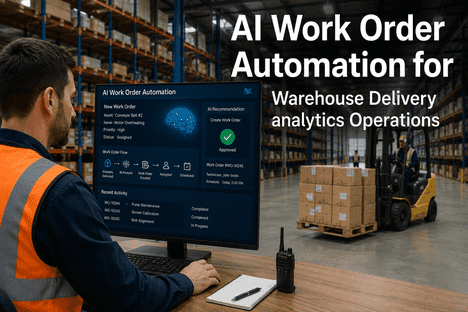
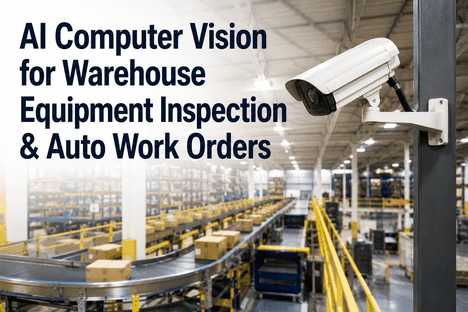
What if your AI created, assigned, and scheduled work orders automatically the moment a sensor detected an anomaly In most warehouse delivery operations today, that decision loop takes 24 to 48 hours: a sensor flags an irregularity, the alert sits in a dashboard until a technician reviews it, someone investigates the issue, parts are looked up in inventory, a work order is drafted in the CMMS, scheduling is negotiated against fulfillment volume, and a technician is finally dispatched. By then the anomaly has either escalated into unplanned downtime or grown into a more expensive repair. AI work order automation collapses this 48-hour gap to under 2 hours by closing the loop from anomaly detection to executed maintenance action autonomously creating the work order, identifying required parts, scheduling against fulfillment windows, and dispatching the right technician in seconds rather than days. Research shows technicians currently spend 6 to 10 hours weekly on work order documentation alone; agentic automation recovers 70 to 85% of that time, worth $15K–$28K annually per technician. Book a Demo to see how iFactory AI deploys work order automation across warehouse delivery hubs in 6 to 8 weeks.
48 → 2 hrs
Detection-to-repair time reduction with AI work order automation
70-85%
Technician documentation time recovered through agentic automation
90-95%
First-time accuracy on AI-generated work orders vs 50-65% manual
6-8 wks
Deployment timeline from baseline audit to live AI work order automation
What AI Work Order Automation Actually Requires in 2026
Work order automation is not the same as work order software. Most warehouse CMMS platforms have offered digital work orders for over a decade — but the work order itself is still drafted by a person, the parts are still identified by a person, the technician is still assigned by a person, and the schedule is still negotiated against operations by a person. AI work order automation removes humans from every step that does not require human judgment. When a vibration sensor on a sortation drive detects bearing stress above baseline, an autonomous agent cross-references the asset's digital twin, identifies the probable failure mode, verifies parts availability in inventory, creates a priority-tagged work order with full safety procedures, schedules it for the next planned downtime window, and dispatches the right technician — in seconds, not days.
iFactory's platform delivers this closed-loop automation by unifying IoT sensor data, asset history, parts inventory, fulfillment scheduling, and technician dispatch under a single AI intelligence layer. Every triggered work order carries the full context a technician needs: detected anomaly, probable cause, asset history, required parts, recommended procedures, and scheduling rationale. Technicians stop spending hours on documentation and parts lookup. Maintenance stops being a reactive scramble. Work order automation becomes the engine that drives warehouse delivery analytics from insight to action — automatically.
Autonomous Anomaly-to-Work-Order Loop
AI detects sensor anomalies, confirms across multiple data channels, identifies probable failure mode, and auto-creates a fully detailed work order with asset ID, fault description, parts list, and safety procedures — in seconds rather than the 2–4 hour manual draft cycle.
Fulfillment-Aware Smart Scheduling
AI cross-references work order priority with WMS dispatch schedules, peak-volume windows, and shift changeovers — scheduling repairs in planned downtime windows rather than competing with active fulfillment throughput.
Automated Parts Verification and Procurement
AI checks inventory availability for every auto-generated work order, reserves parts immediately, and triggers procurement requests when stock is insufficient — eliminating the emergency parts premium that runs 2–3x standard cost on reactive repairs.
Skill-Based Technician Dispatch
AI matches work order requirements with technician skills, current location, and shift availability — dispatching the right person automatically rather than routing through a supervisor manually triaging assignments.
AI-Powered Shift Logbook Integration
iFactory's Shift Logbook captures every auto-generated work order, technician resolution, and outstanding maintenance exception with AI summaries and photo evidence — ensuring 24/7 warehouse teams inherit full asset history across shifts without manual handover gaps.
Closed-Loop Learning from Completed Work
Every completed work order — actual fault, repair taken, time-to-resolution, parts used — feeds back into the AI model. Predictions become progressively more accurate per asset, compounding work order quality and reducing false positives over time.
Why Manual Work Order Workflows Drain Warehouse Maintenance Capacity
Industry research shows technicians spend 25 to 35% of available maintenance capacity on work order documentation, CMMS data entry, and parts lookup — administrative overhead that creates 2 to 4 hour delays between anomaly detection and dispatched response. The following comparison shows where manual workflows lose time and budget versus what AI work order automation delivers in a warehouse delivery analytics environment.
| Work Order Parameter |
Manual CMMS Workflow |
iFactory AI Work Order Automation |
| Detection-to-Dispatch Time |
24–48 hours from sensor anomaly to technician dispatch — alerts queue in dashboards, technicians manually investigate, draft work orders, and identify parts. |
Under 2 hours from anomaly detection to dispatch. Autonomous agents create the work order, identify parts, and assign technicians within seconds of detection. |
| Technician Documentation Time |
6–10 hours weekly per technician spent on work order creation, CMMS data entry, and resolution documentation. |
70–85% documentation time recovered through AI-generated work orders and natural-language completion summaries. Worth $15K–$28K annually per technician. |
| Work Order Accuracy and Completeness |
Human-created work orders contain incomplete information 35–50% of the time, requiring technician clarification and equipment manual consultation mid-repair. |
AI-generated work orders achieve 90–95% first-time accuracy with complete asset history, failure mode, parts list, and safety procedures pre-validated. |
| Parts Procurement Cost |
Emergency parts procurement on reactive repairs runs 2–3x standard cost. Stockouts cause additional downtime waiting for delivery. |
AI-verified parts availability at work order creation. Stock issues trigger procurement immediately during predictive window — eliminating emergency premium. |
| Scheduling Against Fulfillment |
Maintenance schedules negotiated manually with operations. Repairs frequently land during peak hours, competing with throughput. |
AI cross-references WMS dispatch schedules and shift patterns. Work orders auto-scheduled in planned downtime windows that protect SLA delivery. |
| Recurring Defect Pattern Detection |
Repeat failures on same asset get logged separately. Patterns invisible unless someone manually reviews work order history. |
AI flags recurring defect patterns automatically — converting one-time reactive events into updated PM schedules and root-cause investigations. |
Every Hour Between Anomaly Detection and Work Order Dispatch Is Risk Compounding.
iFactory AI gives warehouse operators autonomous anomaly-to-work-order automation, fulfillment-aware scheduling, parts verification, and skill-based dispatch — integrated with existing CMMS, WMS, and ERP in 6 to 8 weeks.
Book a Demo to see work order automation applied to your delivery hub.
How iFactory AI Deploys Work Order Automation Across Warehouse Delivery Operations
iFactory follows a structured deployment process that delivers live anomaly-triggered work orders within the first three weeks and full autonomous automation by week eight. Each stage has defined deliverables so maintenance teams see measurable workflow change — not a multi-quarter automation project that produces dashboards instead of dispatched repairs.
Weeks 1–2
Asset Inventory, CMMS Integration, and Workflow Baseline
Existing CMMS, WMS, ERP, and inventory systems integrated via OPC-UA, MQTT, BACnet, Modbus, and REST APIs. Current work order workflow baselined — manual draft time, parts lookup latency, dispatch delays measured. Digital Shift Logbook deployed for maintenance handover continuity.
Weeks 3–4
Sensor Activation and First Auto-Generated Work Orders
IoT sensors deployed on priority warehouse assets — conveyors, sortation drives, AS/RS, dock equipment, refrigeration. AI begins anomaly detection and triggers first auto-generated work orders into the existing CMMS with full failure context, parts list, and recommended procedures.
Weeks 5–6
Fulfillment-Aware Scheduling and Skill-Based Dispatch Live
AI work orders cross-reference WMS dispatch schedules and shift patterns — auto-scheduling repairs in planned downtime windows. Skill-based technician dispatch activates, matching work order requirements with technician availability and certifications automatically.
Weeks 7–8
Full Autonomous Loop and Multi-Site Rollout
Closed-loop learning activated — completed work order outcomes feed back into the AI model. Recurring defect pattern detection live. ROI dashboard tracks detection-to-dispatch latency, technician time recovered, and emergency repair cost avoided. Multi-site rollout templates configured for the network.
MEASURABLE OUTCOMES FROM WEEK 4: DETECTION-TO-DISPATCH LATENCY DROPS IMMEDIATELY
Warehouse operators completing iFactory's 6 to 8 week deployment report detection-to-dispatch time dropping from 48 hours to under 2 hours within the first month — recovering $15K–$28K annually per technician in documentation time, eliminating the 2–3x emergency parts premium, and achieving 35–65% uptime improvement on monitored assets by month 6.
96%
Reduction in detection-to-dispatch latency (48 hrs → 2 hrs)
$15-28K
Annual value of technician time recovered per person
35-65%
Uptime improvement from autonomous maintenance loop
AI Work Order Automation: Use Cases from Live Warehouse Deployments
The following outcomes are drawn from iFactory deployments at operating distribution centers and fulfillment hubs across e-commerce, 3PL, retail distribution, and cold storage operations. Each use case reflects 9 to 12 month post-deployment performance data.
A national e-commerce fulfillment operator was averaging 18 hours between sensor anomaly detection and dispatched repair on sortation systems — alerts queued in dashboards, technicians investigated manually, work orders were drafted by hand. iFactory deployed vibration and current sensors across 22 sortation drives with autonomous work order generation. In one early-deployment event, the AI detected bearing fatigue at 2:14 AM, cross-referenced the asset's digital twin, confirmed bearing stress with 91% confidence, verified two replacement bearings in inventory, created a Priority-2 work order with full procedures, scheduled it for 6 AM planned downtime, and dispatched the lead technician — all in 11 seconds. The technician arrived with parts pre-staged; repair completed in 3 hours during planned window. Across the next 12 months, mean detection-to-dispatch time dropped from 18 hours to 1.7 hours; unplanned sortation downtime reduced 71%.
Book a Demo to see work order automation applied to your sortation operation.
11 sec
Detection-to-dispatch time on AI-generated work orders
71%
Reduction in unplanned sortation downtime within 12 months
18 → 1.7 hr
Mean detection-to-dispatch time post-deployment
A multi-site distribution operator had 42 maintenance technicians across 9 warehouses, each spending an average of 8.4 hours weekly on work order documentation, CMMS data entry, and parts lookup. Annual documentation labor exceeded $1.8M with no corresponding maintenance output. iFactory deployed autonomous work order generation across all 9 sites with AI-completed natural-language resolution summaries triggered at job close. Within 6 months, technician documentation time dropped 78% — equivalent to recovering 14,700 hours annually across the network, redirected to actual maintenance work. Total work orders completed increased 31% with no headcount addition; backlog of overdue PMs eliminated.
Book a Demo to see technician productivity recovery applied to your network.
14,700 hrs
Annual technician hours recovered across 9-facility network
78%
Reduction in documentation time per technician
31%
Increase in completed work orders with no headcount added
A regional 3PL was spending $640K annually on emergency parts procurement — overnight shipping, expedited fees, and 2–3x markup on reactive repairs across conveyor, dock equipment, and refrigeration assets. Manual work order workflow gave parts teams no advance warning of upcoming maintenance demand. iFactory deployed work order automation with integrated parts verification: every AI-generated work order checks inventory and triggers procurement requests during the predictive window — 1 to 4 weeks before scheduled repair. Within 9 months, emergency procurement spend dropped 84%, parts inventory turn improved 23%, and stockout events on routine repair parts dropped to zero. Combined annual savings exceeded $720K.
Book a Demo to see predictive parts procurement applied to your operation.
84%
Reduction in emergency parts procurement spend
$720K
Annual savings from procurement and inventory optimization
23%
Improvement in parts inventory turn within 9 months
Expert Perspective: Why Work Order Automation Is the Next Frontier in Warehouse Analytics
Industry Review — Warehouse Maintenance Operations Perspective
"Most warehouses have already invested in sensors. Most warehouses are already collecting anomaly data. The bottleneck is not detection anymore — it is the gap between detection and action. A vibration alert that surfaces at 2 AM and waits in a dashboard until 9 AM is operationally identical to having no sensor at all. AI work order automation closes that gap. The next leap in warehouse analytics is not better predictions — it is autonomous execution of the work that predictions reveal. Operations leaders who automate the work order loop will see uptime improvements that pure predictive maintenance alone cannot deliver, because the prediction only matters if the response happens fast enough to prevent the failure."
Warehouse Maintenance Operations Director — Multi-Site Distribution Network (provided via iFactory deployment reference)
This perspective aligns with what maintenance leaders report across iFactory deployments: predictive analytics without automation execution leaves most of the value on the table. The shift from "AI tells me what to do" to "AI does the routine work and tells me what needs my judgment" is what separates operations capturing maximum ROI from those still treating AI as a dashboard. Book a Demo to speak with iFactory's warehouse maintenance automation specialists about your current workflow.
Autonomous Work Order Generation. Fulfillment-Aware Scheduling. Live in 6 to 8 Weeks.
iFactory gives warehouse operators anomaly-to-dispatch automation, fulfillment-aware scheduling, parts verification, skill-based technician dispatch, and AI Shift Logbook continuity — integrated with existing CMMS, WMS, and ERP without rip-and-replace. Results measurable within 30 days.
Conclusion: AI Work Order Automation Is Now the Operational Standard
The case for AI work order automation in warehouse delivery operations has moved beyond pilot status. With documented detection-to-dispatch latency reductions from 48 hours to under 2 hours, 70–85% technician documentation time recovered, 35–65% uptime improvements on autonomous-loop assets, and emergency parts premiums eliminated through predictive procurement, warehouse operators still running manual work order workflows are accepting operational drag that AI eliminates. The shift is not whether to automate, but how quickly the automation layer can be integrated with existing CMMS, WMS, and ERP infrastructure.
iFactory's platform delivers the specific capabilities warehouse delivery analytics operations require: autonomous anomaly-to-work-order generation, fulfillment-aware smart scheduling, automated parts verification and procurement, skill-based technician dispatch, AI-powered Shift Logbook continuity, closed-loop learning from completed work, and integration with existing CMMS, WMS, and ERP through OPC-UA, MQTT, BACnet, Modbus, and REST APIs. The 6 to 8 week deployment program means measurable work order automation begins within weeks — not the multi-quarter automation projects that historically delayed value capture. Book a Demo to receive a work order automation assessment specific to your warehouse maintenance workflow.
Frequently Asked Questions About AI Work Order Automation
Will AI work order automation replace our existing CMMS?
No. iFactory integrates with existing CMMS platforms via REST APIs. AI-generated work orders flow directly into your current CMMS with full failure context, parts list, and scheduling recommendations. Your maintenance team continues using the familiar interface — only now the work orders create themselves and pre-populate every required field.
How does AI know when to schedule work orders against fulfillment operations?
iFactory integrates with WMS dispatch schedules, shift patterns, and historical volume data. AI cross-references work order priority with planned downtime windows, shift changeovers, and low-volume periods — auto-scheduling repairs at the moments least disruptive to delivery throughput.
What happens if AI creates a false-positive work order?
All AI-generated work orders include confidence scores and supporting sensor data. Supervisors can review flagged work orders before dispatch on configurable priority thresholds. Completed work outcomes feed back into the model, progressively reducing false-positive rates per asset and operating condition.
Can AI work order automation handle parts procurement?
Yes. Every AI-generated work order verifies parts availability in your inventory system. If stock is insufficient, AI triggers a procurement request during the predictive window — typically 1 to 4 weeks before scheduled repair — eliminating the 2–3x emergency parts premium typical of reactive maintenance.
How does the AI-powered Shift Logbook support work order automation?
The Shift Logbook auto-captures every AI-generated work order, technician resolution, and outstanding maintenance exception with AI summaries and photo evidence. Maintenance teams running 24/7 warehouse operations inherit full asset and work order context at every handover — eliminating blind spots that traditionally cause repeat issues across shifts.
Deploy AI Work Order Automation in 6 to 8 Weeks.
iFactory delivers autonomous anomaly-to-dispatch automation, fulfillment-aware scheduling, and parts verification — integrated with existing CMMS, WMS, and ERP.
Detection-to-dispatch cut from 48 hours to under 2 hours
70–85% technician documentation time recovered
35–65% uptime improvement on monitored assets