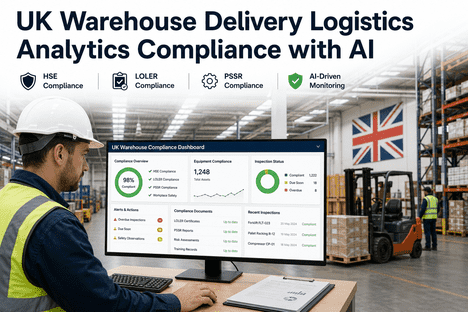
The compliance manager at a 350,000 sq ft UK distribution centre outside Birmingham opens her email to find the monthly HSE inspection report flagging three overdue LOLER thorough examinations on forklift trucks, a PSSR air receiver certification gap of 14 days, and a racking safety inspection that was documented but never uploaded to the shared drive. None of these are enforcement-level failures — yet. But each one carries the same pattern: documentation existed somewhere, but it was fragmented across paper logs, email threads, supplier portals, and local spreadsheets. The HSE inspector who conducted the last visit noted that the site could not produce a complete equipment history for any single lifting device within the requested 15-minute window. That observation alone — the inability to demonstrate systematic compliance — is the single biggest risk factor in a UK warehouse operation. iFactory's AI-driven compliance analytics platform automates LOLER scheme management, PSSR pressure system record-keeping, HSE inspection readiness, and equipment maintenance documentation across every asset in your British logistics operation — creating a single, audit-ready compliance record that never misses a deadline. Book a Demo to see how iFactory transforms UK warehouse compliance from a reactive paperwork burden into an automated, AI-driven assurance system.
Stop HSE enforcement notices before they arrive — with AI that automates LOLER, PSSR, and equipment compliance across your entire UK warehouse operation
iFactory ingests your existing equipment registers, inspection schedules, and service records and delivers automated compliance tracking, predictive inspection alerts, and audit-ready documentation — in 4–6 weeks, with full UK data residency.
Three regulations that define warehouse compliance in Britain — and why paperwork alone is failing
UK warehouse and delivery logistics operations operate under a dense regulatory framework enforced by the Health and Safety Executive. Three regulations generate the majority of compliance documentation requirements — and the majority of enforcement actions when documentation fails.
LOLER 1998 — Lifting Operations and Lifting Equipment Regulations
Every forklift, overhead crane, hoist, tail-lift, container handler, and pallet truck in a UK warehouse must undergo a LOLER thorough examination by a competent person at intervals not exceeding 6 months (or in accordance with the examination scheme). Missing a LOLER deadline by even one day leaves the operator technically using equipment without a valid examination — a criminal offence under HSWA Section 2. Most UK warehouses manage LOLER schedules across 30–80 lifting devices using paper diaries or spreadsheet trackers that depend on manual data entry and human follow-up. iFactory automates LOLER scheme creation, competent person scheduling, examination reminders, and certification document storage — with automatic escalation to management if an examination approaches its due date without a confirmed appointment.
PSSR 2000 — Pressure Systems Safety Regulations
Warehouse compressed air systems — reciprocating compressors, rotary screw compressors, air receivers, dryers, and distribution pipework — are classified as pressure systems under PSSR. Each system requires a written scheme of examination (WSE) and periodic inspections by a competent person at intervals specified in the scheme. Typical intervals range from 12 months for air receivers to 24–36 months for pipework. A UK warehouse with 4–8 compressors and associated receivers generates 8–16 inspection events per year, each requiring documented proof of examination, competent person reports, and follow-up actions on any defects identified. iFactory tracks every pressure system asset, its WSE document, examination due dates, competent person reports, and defect rectification status — all in a single, time-stamped, version-controlled compliance record.
Work at Height & Racking Safety — PUWER, WAHR & SEMA Guidelines
Warehouse racking systems, mezzanine floors, and access platforms fall under PUWER and Work at Height Regulations, with inspection guidance from SEMA (Storage Equipment Manufacturers Association). Racking inspections must be conducted weekly by trained operators and annually by a SEMA-approved racking inspector. Delivery vehicles with tail-lifts and curtain-side mechanisms add further examination requirements under PUWER. A typical UK warehouse generates 52 weekly racking inspections, 2–4 annual racking surveys, and 12–24 vehicle-mounted equipment checks per year — most of which are still recorded on paper checklists that sit in a binder until an HSE inspector asks for them. iFactory digitises every inspection with mobile-first checklists, photo capture, defect flagging, automated reporting, and instant audit retrieval — reducing the time to produce a complete racking inspection history from hours to seconds.
The HSE issued over 1,200 enforcement notices to UK warehouse and logistics operations in 2025 — 73% of which cited inadequate documentation and inspection records as a contributing factor. Book a Demo to see how iFactory closes every documentation gap before an inspector finds it.
Four steps from fragmented records to automated, audit-ready compliance
iFactory connects to your existing equipment register, supplier databases, and maintenance systems — no manual data entry, no duplicate record-keeping. The AI engine learns your compliance calendar and starts generating automated documentation within weeks.
Ingest every asset and compliance requirement
iFactory imports your complete equipment inventory — every forklift, crane, hoist, compressor, air receiver, racking bay, dock leveler, and delivery vehicle tail-lift. The platform automatically cross-references each asset against LOLER, PSSR, PUWER, and WAHR requirements and generates a compliance calendar with all statutory examination and inspection due dates.
Automate inspection scheduling and supplier coordination
The platform sends automated notifications to your nominated competent persons or third-party inspection bodies when equipment approaches its examination due date. Service providers receive digital appointment requests, confirmation acknowledgments, and post-inspection document upload links — eliminating the phone-tag and email chasing that currently consumes 3–5 hours per week per compliance manager.
Capture every inspection result digitally — photo, report, defect
When a LOLER thorough examination or PSSR inspection is completed, the competent person uploads the report directly to the iFactory platform. The AI extracts key data — examination date, next due date, defects found, actions required — and updates the compliance record automatically. Photos of equipment condition, defect annotations, and signed-off reports are stored alongside the asset record with immutable time stamps.
Produce HSE-ready compliance reports in seconds
When an HSE inspector arrives or a quarterly compliance review is due, the warehouse manager opens the iFactory compliance dashboard and generates a complete equipment history for any asset, any regulation, or any date range in under 30 seconds. The report includes every examination certificate, inspection report, defect rectification record, and competent person credential — formatted for immediate HSE presentation.
Book a Demo to see how iFactory automates your entire UK warehouse compliance workflow — from equipment register import to HSE-ready reporting.
Seven AI-driven compliance modules that cover every regulatory requirement in your warehouse
Each module is pre-configured with UK regulatory requirements, HSE inspection criteria, and SEMA inspection standards — ready to deploy against your existing asset inventory without custom configuration.
Lifting equipment thorough examination management
Automated LOLER scheme creation for every forklift, crane, hoist, and tail-lift. 6-month and 12-month examination scheduling, competent person assignment, certification document storage, and automatic escalation on overdue examinations.
Pressure system written scheme and inspection tracking
Complete PSSR compliance for every compressor, air receiver, dryer, and pressure vessel. Written scheme of examination storage, competent person inspection scheduling, defect rectification tracking, and insurance surveyor report management.
Warehouse racking safety inspection automation
Mobile-first weekly racking inspection checklists with photo capture, defect flagging, and automated reporting. SEMA-compliant annual inspection scheduling and report storage. Damage trend analysis across racking bays and zones.
Work equipment inspection and maintenance records
PUWER-compliant equipment inspection records for dock levelers, scissor lifts, mezzanine floors, conveyors, and all work equipment. Scheduled inspection reminders, defect tracking, and maintenance history linked to each asset record.
Delivery vehicle and tail-lift compliance
Vehicle-mounted equipment compliance for delivery fleets — tail-lift LOLER examinations, MOT scheduling, service history, driver daily check records, and defect reporting. Integrated with vehicle telematics for automated mileage-based service triggers.
Health, safety and environmental compliance dashboard
Centralized EHS compliance dashboard showing all regulatory examination status, inspection completion rates, open defects, and HSE inspection readiness score. Real-time compliance heat map by equipment type, zone, and regulatory standard.
Book a Demo to discuss which compliance modules your UK warehouse needs first — LOLER, PSSR, racking, or all of the above.
What UK warehouse operations achieve with iFactory in one quarter
These are real results from iFactory deployments across UK distribution centres, third-party logistics providers, and retail warehouse operations.
A turnkey compliance system built for UK warehouse and logistics operations
iFactory is an end-to-end compliance analytics platform that absorbs the administrative burden of LOLER, PSSR, PUWER, and racking safety management — no spreadsheets, no shared drives, no paper binders.
UK data residency — your data stays in Britain
iFactory offers UK-hosted cloud deployment with data centres in London and Manchester. All equipment records, inspection reports, and compliance documentation are stored within the UK in full compliance with UK GDPR and data protection requirements.
4–6 week deployment from equipment data handover
You provide your equipment register and current inspection schedule. We configure the platform, set up your compliance calendar, and train your team. Live compliance monitoring begins within one quarter.
Mobile-first inspection checklists for operators and engineers
Weekly racking checks, daily vehicle walkarounds, and LOLER pre-use inspections are completed on mobile devices with photo capture, defect flagging, and digital sign-off — no paper checklists, no transcription.
Automated supplier and competent person coordination
Third-party inspection bodies receive automated scheduling notifications, document upload invitations, and invoice processing links. No emails, no phone calls, no chasing overdue examination certificates.
HSE-ready reporting in under 30 seconds
Generate a complete LOLER, PSSR, racking, or PUWER compliance report for any asset or date range with a single click. Reports include examination certificates, inspection photos, defect history, and competent person credentials.
24x7 compliance monitoring with automated escalation
iFactory operations engineers monitor your compliance dashboard and ensure no examination deadline is missed. Automated escalation to site management and regional directors ensures visibility at every level.
Questions compliance managers ask about AI-driven warehouse compliance
Stop chasing compliance paperwork. Start iFactory's UK warehouse compliance pilot in 4–6 weeks.
Your equipment inspection records are already scattered across paper binders, spreadsheets, email attachments, and supplier portals. iFactory brings every LOLER certificate, PSSR examination, racking inspection, and PUWER record into a single, automated, HSE-ready compliance system — with UK data residency, no manual data entry, and a complete audit trail for every asset.