A Johannesburg-based third-party logistics operator running 85 vehicles across Gauteng, Durban, and Cape Town lost 22% of its monthly delivery capacity to load-shedding in Q1 2026 not from the power outages themselves, but from the cascading failures they triggered. UPS batteries on dock controllers failed after repeated deep-cycling. Generator fuel reserves ran dry mid-shift because consumption tracking was done on a clipboard. Warehouse management system instances rebooted during peak dispatch windows and took 40 minutes to come back online. The operations director had no way to correlate energy events with delivery performance because the two data streams lived in separate worlds Eskom schedules on WhatsApp groups, generator runtimes on paper logbooks, and delivery SLAs in the TMS. South African logistics operators face a convergence of stresses that no other market experiences simultaneously: load-shedding that degrades every automated system it touches, fuel price volatility that rewrites route economics weekly, port and road infrastructure that introduces delays no algorithm can predict, and a labour market where automation must augment employment rather than replace it. AI analytics for South African warehouse delivery operations must account for all of these factors not as edge cases, but as the operating baseline.
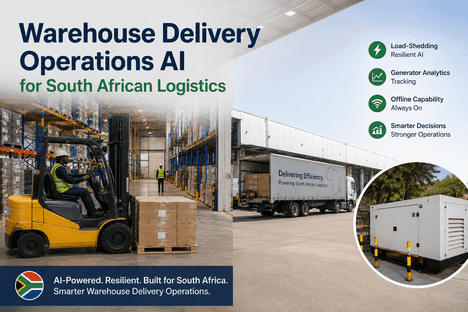
AI-powered warehouse delivery analytics built for the realities of South African logistics load-shedding, infrastructure stress, and resilient operations.
iFactory AI connects to your warehouse systems, fleet telematics, and backup power infrastructure — delivering real-time operational visibility that works through load-shedding, fuel volatility, and infrastructure disruption. On-premise deployment. Offline-capable. Built for South Africa's logistics reality.
What South African logistics operators achieve with AI-powered warehouse delivery analytics
These results are measured across South African warehouse and delivery operations running on iFactory's on-premise analytics platform — designed for the country's unique infrastructure conditions and operational constraints.
What iFactory AI does that generic logistics platforms cannot deliver in South Africa
Conventional logistics platforms assume always-on connectivity, stable grid power, and predictable infrastructure. South African operations require a fundamentally different architecture — one that treats load-shedding, fuel volatility, and infrastructure disruption as design constraints rather than exceptions.
Load-shedding-aware operations
iFactory ingests Eskom load-shedding schedules and correlates them with your shift patterns, dispatch windows, and equipment runtime data. When a stage 4 event is scheduled during the afternoon carrier wave, the system automatically recalculates dispatch priorities and flags equipment that will be impacted by the power-down sequence.
Generator and backup power analytics
Track generator runtime, fuel consumption, battery health on UPS systems, and transfer switch status — all in one view. AI models predict when diesel reserves will run dry based on current load-shedding patterns and alert procurement teams before an unplanned outage stops operations mid-shift.
Offline-capable on-premise deployment
iFactory runs on an NVIDIA appliance inside your facility network. All data processing happens locally. If the internet goes down — whether from load-shedding, fibre cuts, or infrastructure failure — the platform continues operating with zero interruption. Data syncs when connectivity resumes.
Fuel price-adaptive route optimisation
Route models ingest real-time diesel and petrol pricing data across South African fuel corridors — recalculating optimal routes as fuel costs shift. The system can prioritise distance-minimisation, fuel-minimisation, or time-minimisation based on current cost structures and delivery SLA requirements.
Infrastructure-aware delivery planning
AI models account for port congestion at Durban and Cape Town, road quality on major freight corridors (N3, N1, N2), and known construction zones. Delivery ETA windows include infrastructure buffers that adjust dynamically as conditions change — providing SLA projections that reflect South African road reality, not theoretical travel times.
Labour-augmenting AI for high-unemployment markets
In a market where labour costs are lower than automation CAPEX and unemployment exceeds 30%, iFactory AI is designed to augment the workforce rather than replace it. Voice-picking guidance, AI-optimised picking routes, and real-time performance feedback help existing staff operate at higher efficiency without headcount reduction.
Why South African logistics requires a different AI analytics architecture
In Q1 2026, South African logistics operators faced six converging stresses that no other market experiences simultaneously — and that conventional warehouse and delivery analytics platforms were never designed to handle.
Load-shedding degrades every automated system it touches
A cold storage facility in Johannesburg experienced 14 load-shedding events in February 2026. Each power-down cycle caused refrigeration compressor controllers to lose calibration, dock levelers to stop mid-cycle, and WMS terminals to reboot. The temperature excursions during generator switchover compromised three pallets of pharmaceutical product. The facility's data logging system had gaps during every transition — the monitoring platform was on the same UPS as the equipment it was supposed to monitor. iFactory's on-premise appliance runs on dedicated backup power and continues capturing sensor data through grid outages, eliminating the blind spots that standard cloud platforms introduce during load-shedding events.
Fuel price volatility rewrites route economics weekly
Diesel wholesale input costs rose 39-44% from the January 2026 baseline. For a 10-vehicle fleet operating out of a Durban distribution centre, this translated to R47,000 per month in additional fuel costs — margin that had to be absorbed or passed through. Standard route optimisation algorithms optimise for shortest distance or fastest time, neither of which accounts for fuel cost variability across different corridors. iFactory's route engine ingests real-time fuel pricing data and can optimise for fuel cost minimisation independently — enabling operators to adjust route strategies as pump prices shift.
Port and road infrastructure introduces delays no algorithm predicts
Durban port congestion in early 2026 added an average of 3.7 hours to container collection times. The N3 between Durban and Johannesburg — South Africa's busiest freight corridor — had sections operating below design speed due to road surface degradation. Standard TMS ETA calculations assume road speeds that do not exist on these corridors. iFactory's infrastructure-aware routing layer ingests port queue data, road condition reports, and construction zone information to generate ETAs that reflect actual operating conditions rather than theoretical road speeds.
Skills gap limits technology adoption velocity
More than 60% of IoT-related roles in South Africa are unfilled, and 73% of organisations report significant technology skills gaps. A warehouse deploying AI analytics cannot assume it will find the data engineers and platform administrators that the technology typically requires. iFactory's on-premise appliance is deployed and managed as a fully managed service — the facility's team does not need to configure databases, maintain ML pipelines, or manage cloud infrastructure. The platform is operational from week one with zero internal IT project requirements.
You don't need a logistics platform designed for German highways. You need one built for South African corridors. Book a Demo and see how iFactory AI deploys on your facility network — no cloud dependency, no data egress, built for load-shedding resilience.
From appliance installation to live operational analytics in six weeks
iFactory AI is designed for South African logistics operations that cannot afford 12-month implementation timelines or cloud-dependent architectures that fail during load-shedding. The platform deploys on an on-premise appliance inside your facility network and delivers measurable operational improvements within the first quarter.
Install on-premise appliance
iFactory's NVIDIA appliance is installed inside your facility network. No cloud dependency. No data egress. The appliance runs on dedicated UPS and generator backup — continuing to capture and analyse operational data through grid outages and internet disruptions.
Connect your operational systems
Pre-built connectors link to your WMS, fleet telematics platform, dock PLC network, fuel management system, generator controllers, and CMMS. All data processing stays on the local appliance. First data streams live within the first week of installation.
Calibrate AI models for SA conditions
Models are trained on your facility's specific operating patterns — load-shedding schedules, fuel supply chains, freight corridor conditions, and labour availability patterns. The AI learns that a generator fuel alert during stage 6 load-shedding requires a different response than the same alert on a green-energy day.
Go live with real-time operational dashboard
Within six weeks, your operations team has live visibility into equipment health, fleet performance, energy status, delivery SLA compliance, and fuel consumption — all from one on-premise platform that never depends on internet connectivity to function.
Industry view on AI analytics for South African logistics
"Every day a warehouse operates without digital tracking, it haemorrhages working capital in invisible ways. Stock sits idle, pickers travel unnecessary distances, and compliance is managed through paperwork that creates risk rather than reducing it. Logistics businesses can no longer afford to treat warehousing as a passive storage function. The businesses that win contracts and build sustainable margins over the next decade will be those powered by data and intelligent automation — designed for the infrastructure conditions we operate in, not imported from markets with stable grids and predictable roads."
Why cloud-dependent analytics platforms fail during South African load-shedding
A distribution centre in Midrand running 40,000 outbound shipments per week had invested heavily in a cloud-based warehouse analytics platform. When stage 6 load-shedding hit during the peak dispatch window, three things happened simultaneously: the fibre modem lost power, the cellular failover router exhausted its backup battery, and the facility's generator auto-transfer switch failed to engage because the UPS batteries that power the control circuit had degraded below startup threshold after 18 months of repeated deep-cycling. The cloud platform — designed for always-on connectivity — stopped ingesting data at the exact moment the operations team needed maximum visibility. This is not a failure of the cloud platform. It is a failure of the architecture assumption that connectivity is continuous. South African logistics requires an architecture where data collection, analysis, and alerting continue operating when the internet drops — because in this market, internet drops are not anomalies, they are the operating baseline. iFactory's on-premise appliance eliminates this architectural vulnerability entirely.
FAQ: AI warehouse delivery analytics for South African logistics
South African logistics needs AI that respects the operating reality
The global logistics technology industry builds platforms for markets where connectivity is continuous, grid power is stable, fuel prices move gradually, and roads are maintained to standard. South African logistics operators cannot adopt those platforms and expect the same results — because the operating conditions are fundamentally different. Load-shedding, fuel volatility, port congestion, road degradation, and workforce dynamics are not temporary disruptions in South Africa. They are permanent structural conditions that any analytics platform must be designed to handle from day one. iFactory AI is built for this reality — on-premise, offline-capable, energy-aware, infrastructure-adaptive, and labour-augmenting. For South African logistics operators evaluating AI analytics platforms, the first question should not be whether the technology works in a demo environment. It should be whether it keeps working when the grid goes down.
If your warehouse and delivery operation is managing load-shedding, fuel volatility, and infrastructure disruption without real-time AI analytics, iFactory can have an on-premise appliance deployed and connected to your first three data sources within two weeks. Book a Demo to see iFactory running on your facility network — no cloud dependency, no connectivity assumptions, built for South African logistics.
Ready to run logistics analytics that work through load-shedding?
You've seen what AI can do when it's built for South African operating conditions. Now see iFactory AI running on an on-premise appliance inside your facility network — no cloud dependency, no data egress, no connectivity assumptions. We'll set up a live walkthrough calibrated to your operation's energy profile, fleet size, and delivery network.