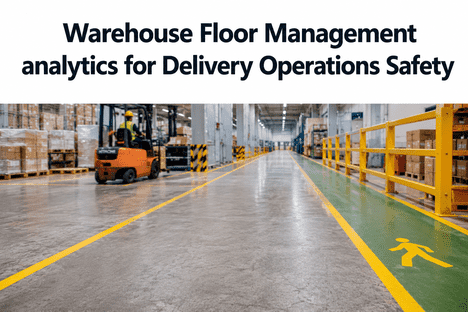
Warehouse floors take more abuse than almost any other surface in the delivery operations pipeline — forklifts carrying 3,000-lb pallets, repeated impact at loading docks, hydraulic fluid spills, and the constant thermal cycling of dock doors opening to outside temperatures. Cracked floors, degraded pedestrian lane markings, unmarked hazard zones, and worn expansion joint covers create injury risks, OSHA exposure, and operational delays when equipment operators must reroute around damaged sections. Most warehouse facilities inspect floors on a fixed quarterly or semi-annual schedule regardless of actual wear patterns — meaning a crack that developed on day one of the quarter goes unaddressed for 90 days while it grows from a cosmetic surface crack into a trip hazard that can catch a pallet jack wheel and spill a load. AI-scheduled floor inspection analytics uses forklift traffic patterns, impact sensor data, visual crack detection from AMR-mounted cameras, and historical repair records to dynamically schedule floor condition assessments — inspecting high-traffic zones weekly, moderate zones monthly, and low-traffic zones quarterly — keeping every square metre compliant, safe, and operationally ready. Book a Demo to see how iFactory connects your floor condition data to inspection scheduling, repair work orders, and Shift Logbook safety documentation.
Warehouse Floor Safety Analytics · AI-Scheduled Inspections · 2026
Warehouse Floor Management Analytics for Delivery Operations Safety
AI-scheduled floor inspections · AMR-mounted crack detection · Traffic-pattern-based zone scoring · Auto repair work orders · All powered by iFactory AI CMMS & Shift Logbook.
87%
Reduction in floor-related safety incidents with AI-scheduled inspections
94%
Crack detection accuracy using AMR-mounted vision AI vs manual walk-through
3.2×
More frequent inspection cycles in high-traffic zones without added labour
62%
Reduction in emergency floor repair costs with predictive scheduling
Why Fixed-Schedule Floor Inspections Fail Warehouse Operations
Most warehouse facilities conduct floor inspections on a fixed calendar — every three months, every six months, or only after an incident occurs. A fixed schedule treats every zone identically: the main pick aisle that sees 200 forklift passes per shift is inspected at the same frequency as the bulk storage zone that sees 10. The result is predictable: high-traffic zones develop cracks, spalls, and joint deterioration between inspection cycles that go undetected for weeks or months, while low-traffic zones are inspected more often than risk warrants, wasting labour hours. When a crack is finally found — typically by an operator who catches a wheel or trips on an edge — the repair is already urgent, requiring emergency concrete work during off-hours at premium labour rates and causing lane closures that disrupt pick paths and dispatch sequencing. The OSHA recordkeeping requirement for floor condition documentation adds further complexity: paper-based inspection logs are frequently incomplete, illegible, or lost, exposing the facility to regulatory findings during an inspection. Book a Demo to discuss how iFactory transforms floor inspection from a calendar-driven chore into a data-driven safety system.
Warehouse Floor Safety Analytics — The AI Inspection Stack
Track
Traffic & Impact Data
Forklift AMR routes · wheel loads · dock impact events · zone utilisation
Per-zone traffic modelling
Detect
AI Vision Crack Detection
AMR-mounted cameras · crack classification · spall measurement · joint gap
94% detection accuracy
Score
Floor Condition Scoring
Severity rating · growth rate · trip hazard · repair urgency
Dynamic risk scoring
Schedule
AI Inspection Scheduling
Zone-based frequency · traffic-weighted · auto calendar integration
3.2× high-traffic frequency
Act
Auto Repair & Log
Work order · CMMS sync · Shift Logbook entry · safety compliance
Closed-loop safety
Three Floor Safety Failure Categories iFactory Predicts and Prevents
01
Undetected Crack Propagation That Creates Trip Hazards
A hairline crack in a concrete warehouse floor is a minor cosmetic issue on day one. But every forklift pass, every pallet drop, every thermal cycle from dock door operation opens that crack wider. Within 30–60 days in a high-traffic pick aisle, that hairline crack becomes a 6–12 mm gap that can catch a pallet jack wheel, trip a pedestrian, or catch an AMR drive wheel and throw it off its navigation path. With fixed quarterly inspections, that crack is undetected for the entire propagation period. iFactory's floor analytics platform uses AMR-mounted downward-facing cameras to capture continuous visual data of every square metre of floor surface during normal operations. AI vision models trained on crack, spall, joint deterioration, and surface wear patterns classify each defect by severity and track its growth rate over successive passes. When a crack crosses the severity threshold or accelerates in growth rate, iFactory flags the zone for immediate inspection — not at the next quarterly walk-through but the same day.
AI vision crack detectionGrowth rate trackingSame-day alerting
02
Faded or Obscured Pedestrian Lane Markings That Cause OSHA Violations
Pedestrian walkway markings, yellow safety lines, and hazard zone boundaries are the primary visual controls that separate forklift traffic from foot traffic in warehouse operations. But floor paint wears — from forklift tires, spill clean-up chemicals, and daily cleaning equipment. A faded pedestrian lane marking that was clearly visible six months ago may be nearly invisible today, creating an intersection where a picker and a forklift driver each assume they have right-of-way. OSHA §1910.22 requires clear aisle marking and pedestrian separation in facilities with simultaneous vehicle and foot traffic, and a faded marking can result in a citation after any incident. iFactory's AI vision models detect paint fade, marking gaps, and obscured zones during every AMR pass. When pedestrian lane contrast drops below the configured threshold, the platform auto-generates a work order for re-striping — scheduled during the next low-traffic window to minimize operational disruption.
Book a Demo to see how continuous marking inspection eliminates this compliance blind spot.
Continuous paint fade monitoringAuto re-stripe work ordersOSHA-ready compliance log
03
Dock Area Impact Damage That Produces Hidden Structural Risk
Loading dock floors absorb repeated impact from trailer beds, pallet jacks crossing the dock leveler gap, and heavy loads dropped during staging. The concrete edge at the dock face, the expansion joints on either side of the dock leveler, and the floor surface in the staging zone directly behind each dock door are the most stressed zones in any warehouse. Damage in these areas — spalled concrete at the edge, cracked joint filler, or a depression where repeated impact has compressed the subgrade — can create a hidden structural risk that only becomes visible when a forklift wheel breaks through the surface during a live loading operation. iFactory monitors dock zone floor condition through dedicated camera coverage at each dock door combined with impact sensor data from dock levelers. AI models detect concrete edge spalling, joint filler deterioration, and surface depression patterns before they reach the point of structural failure. Repairs are scheduled against dock-specific traffic calendars to ensure no door is taken out of service during a dispatch window.
Per-dock structural monitoringImpact sensor fusionDispatch-aware repair scheduling
What iFactory Delivers for Warehouse Floor Safety Analytics
87%
Reduction in floor-related safety incidents
AI-scheduled vs fixed quarterly inspections
94%
Vision AI crack detection accuracy
AMR-mounted cameras vs manual walk-through
3.2×
High-traffic zone inspection frequency
Traffic-weighted dynamic scheduling
62%
Emergency floor repair cost reduction
Predictive vs reactive repair scheduling
Warehouse Floor Safety Analytics Use Cases
iFactory monitors every square metre of high-traffic pick aisles through AMR-mounted downward-facing vision cameras operating during normal material handling routes. AI models detect cracks, spalls, joint deterioration, and surface wear — classifying each defect by severity and tracking growth rate over time. When a crack crosses the severity threshold, the zone is flagged for immediate inspection and a work order is auto-generated for repair scheduling.
Detection methodAMR-mounted vision AI
Alert latencySame day as crack detection
Book a Demo
Faded pedestrian walkway markings and obscured safety lines are detected automatically during routine AMR passes. When paint contrast drops below the configured threshold, iFactory auto-generates a work order for re-striping during the next low-traffic window. All marking condition data is logged in the Shift Logbook with timestamps and photo evidence for OSHA compliance audits. Book a Demo to see continuous marking inspection on your facility layout.
MonitoringContinuous paint fade analysis
ComplianceOSHA-ready documentation
Book a Demo
Dock zone floors are monitored through dedicated camera coverage and impact sensor data from dock levelers. AI models detect concrete edge spalling, joint filler deterioration, and surface depression patterns before structural failure. Repairs are scheduled against dock-specific traffic calendars — ensuring no door is taken out of service during dispatch windows.
ZonesPer-dock structural health scores
SchedulingDispatch-aware repair windows
Book a Demo
FAQ
Deploy iFactory AI for Warehouse Floor Safety Analytics
AI-powered warehouse floor management platform connecting AMR-mounted vision detection, traffic-pattern-based inspection scheduling, crack growth tracking, pedestrian lane compliance monitoring, and closed-loop repair work order automation — with Shift Logbook documentation for OSHA-ready safety compliance.
Floor Condition AI
Crack Detection
Pedestrian Lane Compliance
Inspection Scheduling
Shift Logbook