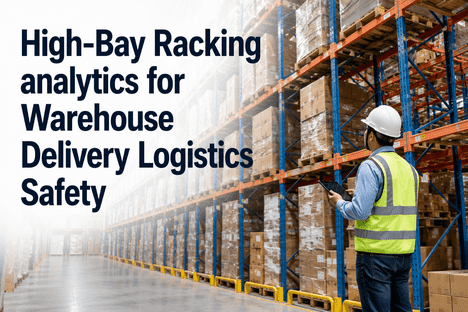
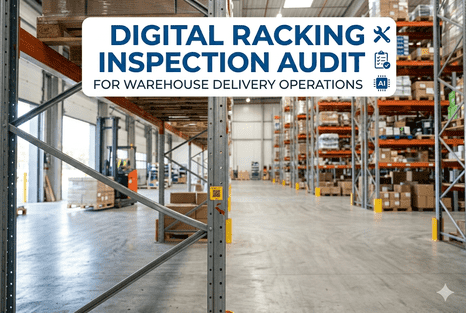
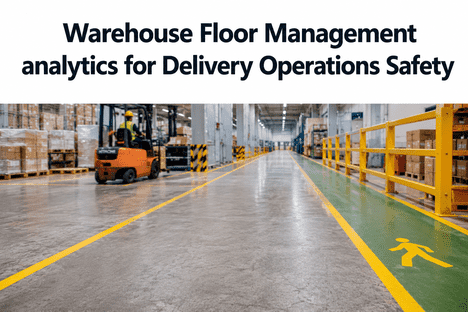
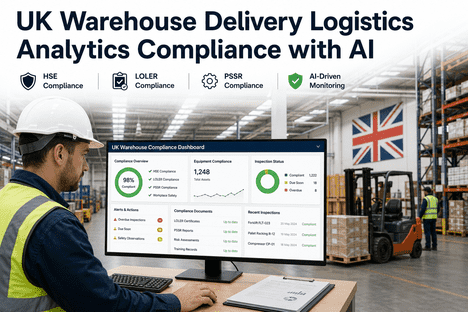
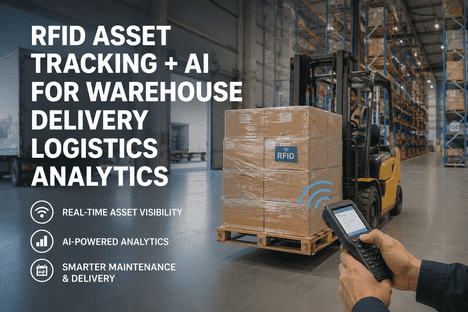
High-bay pallet racking is the structural skeleton of every modern warehouse and delivery hub. Uprights, beams, braces, anchor bolts, base plates, load placards, end-of-aisle guards, guide rails, and row spacers carry the entire weight of inventory and the entire weight of the operation's safety, compliance, and delivery commitments along with it. The brutal mathematics of racking failure are well documented. A single bent upright caused by an unreported forklift impact can reduce load capacity by 20 to 50%. The average rack collapse costs $2 to $5 million in direct and indirect expenses destroyed inventory, injured workers, fulfilment shutdown, insurance claims, and client relationships that take months to recover. OSHA citations under 1910.22 and 1910.176(b) start at $16,131 per serious violation and reach $161,323 for willful or repeated violations, with OSHA's National Emphasis Program now actively driving warehouse inspections. ANSI/RMI MH16.1 sets the engineering standard, and every rack must be inspected at three tiers — daily/shift visual checks, monthly supervisor walk-throughs, and full professional inspection at least every 12 months or immediately after any forklift impact. AI-scheduled racking analytics keeps that entire programme live, evidenced, and defensible. Book a Demo to see how iFactory AI deploys racking safety analytics within 6 weeks.
$2–5M
Average direct and indirect cost of a single high-bay rack collapse event
20–50%
Load capacity loss from a single bent upright after unreported forklift impact
$161K
OSHA penalty exposure per willful or repeated racking-related violation
4–6 wks
Deployment timeline from racking audit to live AI racking inspection analytics
What High-Bay Racking Analytics Actually Monitors in a Delivery Warehouse
A high-bay racking system is not a single asset — it is a distributed structural network. Hundreds or thousands of upright frames, horizontal and diagonal braces, beams, anchor bolts, base plates, end-of-aisle guards, guide rails, row spacers, safety netting, beam locking pins, and load placards spread across millions of cubic feet of cube storage. Each individual component carries a structural role in the load path, and a single component failure can propagate into adjacent bays. Damage from forklift impact, overloading, anchor loosening, corrosion in humid or cold zones, and unauthorised field modifications all degrade the rack's engineered capacity and most of it goes unreported in busy warehouses because the forklift operator does not stop to file a damage report at the moment of impact.
iFactory AI's high-bay racking analytics layer schedules and tracks inspections across all three RMI tiers (daily visual, monthly supervisor, annual professional), maintains a digital damage register against ANSI MH16.1 damage classification, surfaces overdue inspections automatically, captures every forklift-impact event tied to the affected bay and operator, and generates structured CMMS work orders for repair or component replacement. The compliance evidence — daily checks, monthly walk-throughs, professional reports, damage records, corrective actions, and engineer sign-offs — sits in one auditable digital trail rather than scattered across paper forms, spreadsheets, and vendor PDFs. Book a Demo to see live racking safety analytics mapped to your facility.
Three-Tier RMI Inspection Scheduling
Daily/shift visual checks by forklift operators, monthly supervisor walk-throughs, and annual professional engineer inspections — all scheduled, routed, and tracked digitally against ANSI/RMI MH16.1. Overdue inspections surface automatically. Inspection completion evidence captured at the bay level with timestamp and operator attribution.
Forklift Impact Capture and Damage Register
Every forklift-impact event captured against the affected bay, upright, beam, or anchor — tied to the operator, shift, and time stamp. Eliminates the "unreported damage" pattern that drives the documented 20 to 50% load capacity loss from a single bent upright after an unobserved impact.
ANSI MH16.1 Damage Classification
Damage findings classified automatically against the RMI three-band severity model — green (monitor), amber (repair on schedule), red (immediate offload and engineer sign-off before reload). Damage type tracked per affected component class: bent uprights, deflected beams, missing braces, loose anchors, corroded base plates, missing load placards.
Load Placard and Configuration Compliance
Every rack row monitored for posted load capacity placard presence, legibility, and accurate configuration — addressing the 34% of distribution centres found in industry survey with incomplete or missing placards, the most easily correctable violation routinely cited in OSHA inspection reports. Per-bay configuration changes flagged for engineering re-review.
AI-Scheduled Work Orders to CMMS
Damage findings push structured work orders directly into IBM Maximo, SAP PM, ServiceMax, Infor EAM, or eMaint with bay ID, component class, RMI severity band, photo evidence, recommended repair (replace upright, replace beam, anchor reinstall, repair kit application), and required engineer approval where MH16.1 mandates it.
OSHA Audit Documentation and Shift Logbook
Continuous tamper-evident records covering OSHA 1910.22, 1910.176(b), and 1910.159 — three-tier inspection completion, damage register, corrective actions, engineer sign-offs, and load placard compliance. Integrated with Manhattan, Blue Yonder, SAP EWM, and Infor WMS. The Shift Logbook captures every impact event, inspection finding, offload action, and engineer determination across handovers.
Why Paper Inspection Forms and Vendor PDFs No Longer Defend a Warehouse
The conventional model — paper inspection forms in a clipboard on the wall, monthly supervisor walk-throughs reconstructed at month-end, and annual professional inspector PDFs filed in a drawer — was built for a different generation of OSHA enforcement. With OSHA's National Emphasis Program actively driving warehouse inspections, ANSI/RMI MH16.1 explicitly cited as the recognised-hazard standard, and willful-violation penalties reaching $161,000 per incident, the documentation gap that paper systems leave is no longer survivable. The table maps where the inherited model breaks.
| Racking Safety Parameter |
Paper Forms + Vendor PDFs |
iFactory AI Racking Analytics |
| Forklift Impact Reporting |
Operators expected to self-report at the moment of impact. In busy warehouses, minor impacts routinely go unreported. The 20 to 50% load capacity loss from a single bent upright progresses silently until annual inspection or collapse. |
Impact events captured at the bay level with operator and timestamp attribution. Unreported pattern structurally eliminated; every bay with new damage flagged for inspection within the shift. |
| Three-Tier Inspection Cadence |
Daily checks rely on operator initiative; monthly walk-throughs depend on supervisor availability; annual professional inspections scheduled manually. Overdue cycles invisible until OSHA arrives. |
All three tiers scheduled, routed, and tracked digitally. Overdue inspections surface automatically with bay-level granularity. Completion evidence captured per inspection per bay. |
| Damage Classification Consistency |
Damage severity assigned by operator or inspector judgement, with subjective variation between shifts and personnel. RMI green/amber/red bands inconsistently applied. |
RMI severity classification applied consistently per finding, with auto-generated work order routing — green (monitor), amber (scheduled repair), red (immediate offload and engineer sign-off before reload). |
| Load Placard Compliance |
Placards posted at installation, then often unchecked for years. Industry survey found 34% of distribution centres with incomplete or missing placards — the most easily correctable OSHA citation. |
Placard presence, legibility, and accurate configuration monitored across every rack row. Reconfiguration events flagged for engineering re-review and updated placard issue. |
| Corrective Action Audit Trail |
Damage report filed; corrective action tracked separately; engineer sign-off in a different folder. OSHA inspector arrives and reconstruction takes hours or days. |
Every finding linked to its corrective action, technician, completion timestamp, post-repair inspection, and engineer approval where MH16.1 requires it. Audit pack exported on demand. |
| OSHA NEP and ANSI MH16.1 Posture |
Compliance evidence reconstructed during the inspection visit. Missing tiers, undated forms, and inconsistent damage classification frequently cited. |
Continuous, tamper-evident, auditable evidence across OSHA 1910.22, 1910.176(b), 1910.159, and ANSI/RMI MH16.1. Defensible against the active NEP inspection wave. |
Every Unreported Forklift Impact Is a Load-Capacity Loss Already in the Structure.
iFactory AI delivers warehouse delivery operations three-tier RMI inspection scheduling, forklift-impact capture and damage register, ANSI MH16.1 classification, load placard compliance, AI-scheduled CMMS work orders, and Shift Logbook continuity — integrated with your WMS, CMMS, and safety stack in 4 to 6 weeks.
Book a Demo to see live racking analytics against your current high-bay estate.
How iFactory AI Deploys Racking Safety Analytics
iFactory follows a structured deployment process that delivers digital inspection scheduling and impact capture within the first two weeks and full ANSI MH16.1 and OSHA audit posture by week six. Each phase produces a measurable deliverable to operations, safety, maintenance, and compliance leadership.
Weeks 1–2
Racking Audit and Bay-Level Inventory
Full high-bay racking system inventoried at the bay level — uprights, beams, braces, anchor bolts, base plates, end-of-aisle guards, guide rails, row spacers, safety netting, beam locking pins, and load placards. Existing inspection records, professional inspector reports, and damage register ingested. ANSI/RMI MH16.1 compliance baseline established. Integration initiated with Manhattan, Blue Yonder, SAP EWM, Infor WMS and IBM Maximo, SAP PM, ServiceMax, Infor EAM, eMaint CMMS.
Weeks 2–4
Three-Tier Inspection Scheduling and Impact Capture Activation
Daily/shift operator visual-check workflow deployed on mobile. Monthly supervisor walk-through scheduling activated with route optimisation across the bay estate. Annual professional inspector scheduling synchronised. Forklift-impact capture workflow activated, tied to bay, operator, and timestamp. First inspection cycles surface latent damage and overdue tiers — typically including load placards, anchor bolts, and bays with unreported impact history.
Weeks 4–6
Compliance Documentation, Work Order Automation and Shift Logbook
ANSI MH16.1 damage classification and OSHA 1910.22, 1910.176(b), 1910.159 audit documentation activated. CMMS work order automation live with bay ID, component class, severity band, photo evidence, recommended repair, and engineer approval routing where MH16.1 mandates it. Shift Logbook integrated so every impact event, inspection finding, offload action, repair completion, and engineer sign-off is captured across operations, maintenance, and safety handovers with full audit chain.
DEPLOYMENT OUTCOME: LATENT DAMAGE AND OVERDUE TIERS SURFACE WITHIN 3 WEEKS
Warehouses completing iFactory's 4–6 week racking analytics deployment consistently surface latent structural and compliance issues within the first 3 weeks of digital inspection rollout — bays with unreported impact damage, anchor bolts that have loosened over time, missing or illegible load placards, and overdue monthly or annual inspection cycles. Programmes typically address the $17,000 to $161,000 OSHA penalty exposure structurally, defend against the $2 to $5 million collapse-event tail risk, and put OSHA NEP and ANSI/RMI MH16.1 compliance posture on a continuous evidence footing.
$2–5M
Collapse-event direct and indirect cost addressed at the structural root
3 tiers
ANSI/RMI MH16.1 inspection cadences scheduled, routed, and evidenced digitally
$161K
Per-violation OSHA penalty exposure addressed through continuous audit posture
Racking Safety Analytics: Use Cases from Live Deployments
The following outcomes are drawn from iFactory racking safety analytics deployments at operating warehouse delivery hubs across 3PL, e-commerce fulfilment, FMCG distribution, and cold-storage networks. Each use case reflects 9–14 month post-deployment performance against the specific racking risk the analytics layer was deployed to address.
A 3PL operating a 320,000 sq ft high-bay facility with 6,400 pallet positions across 14 aisles had absorbed 3 partial bay collapses over 22 months — none catastrophic, but each costing $84,000 to $140,000 in inventory loss, fulfilment disruption, and emergency rack repair. Root cause investigation traced all three to unreported forklift impacts that had bent uprights months before the failure. iFactory deployed mobile forklift-impact capture and bay-level damage register across all 14 aisles. Within 5 weeks, 47 previously unreported impact events were logged by operators, 12 bays were flagged for engineering re-evaluation, and 4 uprights at RMI red severity were offloaded for replacement. Zero unplanned bay failures across the following 12 months, eliminating approximately $190,000 in annual disruption cost.
Book a Demo to see how this applies to your high-bay facility.
0 failures
Bay failures in 12 months post-deployment vs 3 in prior 22 months
47 impacts
Previously unreported forklift-impact events captured in first 5 weeks
$190K
Annual disruption cost eliminated through impact capture and intervention
An e-commerce fulfilment operator running 3 high-bay facilities had received notification of an OSHA National Emphasis Program inspection across its warehouse network. Existing rack inspection records were a mix of paper forms, supervisor spreadsheets, and vendor PDF reports — assembling a defensible audit pack against OSHA 1910.22, 1910.176(b), 1910.159, and ANSI/RMI MH16.1 would have required days of manual reconciliation per facility. iFactory was deployed across all 3 facilities within 5 weeks, with 12 months of historical inspection data ingested and ongoing three-tier scheduling activated. The follow-up OSHA inspections completed across all 3 sites with zero racking-related citations. Digital audit packs covering all three OSHA standards and ANSI/RMI MH16.1 were exported on demand during the inspections.
0 citations
OSHA racking-related citations across all 3 NEP-inspected sites
3 sites
High-bay facilities brought under unified digital inspection posture
On-demand
ANSI MH16.1 and OSHA audit packs exported during inspection visits
An FMCG distribution operator managing 5 high-bay facilities across its network had completed routine reconfiguration of approximately 1,800 bays over an 18-month period to accommodate changing SKU velocity and pallet profiles — but load capacity placards had not been systematically updated to reflect the new configurations. An internal safety audit identified the gap as a material exposure under OSHA inspection (industry surveys identify incomplete placards as the most frequently cited racking violation, with 34% of distribution centres carrying the gap). iFactory deployed continuous load placard and configuration compliance monitoring across all 5 facilities. Within 8 weeks, all 1,800 reconfigured bays had been re-evaluated, re-placarded, and signed off by a qualified rack engineer. Ongoing placard compliance is now maintained automatically against every bay reconfiguration event.
1,800 bays
Reconfigured bays re-evaluated, re-placarded, and engineer-signed within 8 weeks
5 sites
High-bay facilities brought under unified configuration compliance posture
100%
Ongoing load placard accuracy maintained against bay reconfiguration events
Expert Perspective: What the Industry Gets Wrong About Racking Safety
Industry Review — Warehouse Safety and Structural Engineering Perspective
"The single most damaging assumption in warehouse rack safety is that damage gets reported. It does not. The forklift operator brushes an upright, decides it looked fine, drives on, and that upright now carries 30% less capacity than its placard says it does. The supervisor's monthly walk-through is supposed to catch it; with 6,000 pallet positions to cover across 14 aisles, it does not. The annual professional inspection is supposed to catch it; eleven months can pass before that visit arrives. And in the meantime the load goes up because the WMS does not know the rack has been compromised. The operations that have moved to digital impact capture at the moment of the event — tied to the bay, the operator, and the timestamp — eliminate the unreported-damage pattern at the source. The 3PLs and fulfilment operators with the cleanest OSHA NEP outcomes are not the ones with the newest racks. They are the ones with a continuous digital trail across all three RMI tiers and an engineer sign-off recorded against every red-severity finding."
Head of Warehouse Safety and Structural Compliance — Major North American 3PL and Distribution Network Operator (provided via iFactory deployment reference)
The supporting data confirms it. Industry survey found 34% of distribution centres carrying incomplete or missing load placards — the most easily correctable violation that routinely appears on OSHA inspection reports. A single bent upright caused by an unreported impact reduces load capacity by 20 to 50%. Rack collapses cost $2 to $5 million on average. OSHA penalties reach $161,323 for willful or repeated violations under 1910.22, 1910.176(b), and 1910.159 — all governed engineering-wise by ANSI/RMI MH16.1. Continuous digital evidence across all three RMI inspection tiers and at the moment of every impact event is now the only defensible operating posture. Book a Demo to speak with iFactory's racking analytics specialists about your current operation.
Continuous Racking Intelligence. ANSI MH16.1 and OSHA NEP Defensible. Live in 4–6 Weeks.
iFactory gives warehouse delivery operations three-tier RMI inspection scheduling, forklift-impact capture, ANSI MH16.1 damage classification, load placard compliance, AI-scheduled CMMS work orders, and Shift Logbook continuity across operations, maintenance, and safety handovers. Results measurable within 30 days of deployment.
Conclusion: Digital Racking Analytics Is Now the Safety and Compliance Standard
The case for AI-scheduled racking analytics in high-bay warehouse and delivery hub operations has moved past pilot programmes. With OSHA's National Emphasis Program actively driving warehouse inspections, ANSI/RMI MH16.1 explicitly cited as the recognised-hazard engineering standard, willful-violation penalties reaching $161,323 per incident, the $2 to $5 million average direct and indirect cost of a single rack collapse, the 20 to 50% load capacity loss documented from a single unreported forklift impact, and the structural reality that paper inspection forms and vendor PDFs cannot evidence continuous three-tier compliance — digital racking analytics is no longer optional for any warehouse running meaningful outbound volume.
iFactory's platform delivers the specific capabilities high-bay warehouse delivery operations require: three-tier RMI inspection scheduling, forklift-impact capture with bay and operator attribution, ANSI MH16.1 damage classification, load placard and configuration compliance, AI-scheduled CMMS work orders with engineer-approval routing, OSHA 1910.22, 1910.176(b), and 1910.159 audit documentation, and a digital Shift Logbook carrying every impact event, inspection finding, offload action, repair, and engineer sign-off across handovers — integrated with Manhattan, Blue Yonder, SAP EWM, Infor WMS, IBM Maximo, SAP PM, ServiceMax, Infor EAM, and eMaint via OPC-UA, MQTT, and REST. The 4–6 week deployment timeline means measurable racking safety intelligence begins within weeks. Book a Demo to receive a racking safety analytics assessment specific to your high-bay estate and compliance profile.
Frequently Asked Questions About AI High-Bay Racking Analytics
Which racking components and standards does iFactory's analytics cover?
iFactory covers the full high-bay pallet racking estate at the bay level — uprights, beams, braces, anchor bolts, base plates, end-of-aisle guards, guide rails, row spacers, safety netting, beam locking pins, and load placards. Analytics align with ANSI/RMI MH16.1 (Specification for the Design, Testing and Utilization of Industrial Steel Storage Racks) and the underlying OSHA framework (1910.22 walking-working surfaces, 1910.176(b) materials handling and storage, 1910.159 fire safety). Coverage scope is finalised during the week 1–2 racking audit.
How does iFactory support the three-tier RMI inspection cadence?
Daily/shift visual checks by forklift operators are deployed as a mobile workflow tied to the operator's PIT and bay assignment. Monthly supervisor walk-throughs are scheduled with route optimisation across the bay estate and evidence captured at each bay. Annual professional engineer inspections are scheduled, with vendor reports ingested and damage findings tied into the digital damage register. Overdue inspections at any tier surface automatically before the cycle slips.
How does forklift-impact capture work in the field?
Operators capture impact events on mobile at the moment they occur, tied to the affected bay, upright, beam, or anchor, with photo evidence and shift/operator attribution. Where the operator's PIT carries telematics, impact-sensor events from the truck can be correlated automatically. Either way, the unreported-damage pattern — the documented root cause behind silent 20 to 50% capacity loss on bent uprights — is structurally addressed. Every flagged bay triggers a within-shift supervisor recheck workflow.
How does the platform classify rack damage severity?
Damage findings are classified automatically against the RMI three-band severity model: green = monitor on next scheduled cycle; amber = repair on schedule within the prescribed window; red = immediate offload of the affected bay, engineer sign-off required before reload. Damage type is tracked per affected component class. Red findings trigger automatic CMMS work orders with engineer-approval routing where ANSI MH16.1 mandates qualified-engineer assessment.
How does iFactory defend a warehouse against an OSHA NEP inspection?
OSHA's National Emphasis Program inspectors typically request evidence of three-tier inspection cadence, damage register, corrective actions, engineer sign-offs, load placard compliance, and forklift safety training. iFactory carries all of this on a continuous, tamper-evident, timestamped audit trail aligned with OSHA 1910.22, 1910.176(b), 1910.159, and ANSI/RMI MH16.1. Audit packs export on demand during the inspection visit, not days afterwards. The continuous digital posture is the structural defence against the $17,000 per serious and up to $161,323 per willful or repeated violation exposure.
How does the Shift Logbook fit into the racking safety workflow?
Every impact event, daily check, monthly walk-through, professional inspection finding, RMI severity classification, offload action, repair completion, and engineer sign-off is captured in iFactory's digital Shift Logbook against the affected bay. Incoming operations, maintenance, and safety shifts inherit a complete view of which bays are healthy, which are at amber severity awaiting scheduled repair, and which are at red severity offloaded pending engineer reload sign-off. Floor observations from operators and supervisors are correlated with the structural record so qualitative observation enriches the analytics layer.
Stop Running Racking Safety on Paper Forms and Vendor PDFs. Deploy AI Racking Analytics in 4–6 Weeks.
iFactory gives warehouse delivery operations three-tier RMI inspection scheduling, forklift-impact capture with bay-level attribution, ANSI MH16.1 damage classification, load placard compliance, AI-scheduled CMMS work orders, OSHA audit documentation, and Shift Logbook continuity across operations, maintenance, and safety handovers.
Three-tier ANSI/RMI MH16.1 inspection cadence scheduled and evidenced digitally
Forklift-impact capture eliminates the unreported-damage pattern at the source
$2–5M collapse-event tail risk addressed at the structural root
OSHA 1910.22, 1910.176(b), and 1910.159 audit packs exported on demand