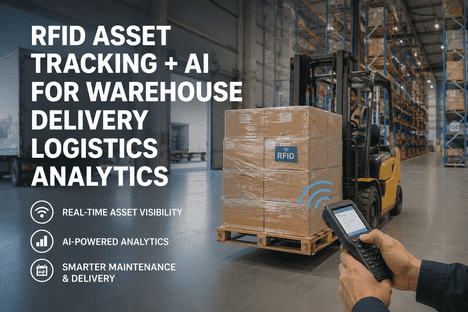
RFID-tagged warehouse assets generate continuous streams of location and usage data that most logistics operations barely use. The tags are read at dock doors, storage locations, and checkpoints — but the data typically stops at inventory visibility. iFactory AI closes that gap by feeding RFID location and utilization data directly into its AI engine, which triggers preventive maintenance schedules based on actual asset usage rather than calendar dates. The result is a warehouse where every forklift, conveyor motor, pallet jack, and dock leveler is tracked in real time — ghost assets eliminated, missed PMs prevented, and maintenance spend tied to actual utilization rather than arbitrary intervals.
RFID Asset Tracking + AI for Warehouse Delivery Logistics
RFID-tagged warehouse assets update AI location and usage data in real time — triggering PM schedules based on actual utilization, not calendar dates. Eliminate ghost assets and missed PMs with RFID-AI integration.
What RFID Solves That Barcode and Manual Tracking Cannot
Warehouse and delivery logistics operations lose millions annually to assets that exist in the system but cannot be located in the facility. RFID solves this with automated, non-line-of-sight identification that updates asset records every time a tagged asset passes a reader — without requiring workers to scan or log anything manually. The table below quantifies the gap between RFID-enabled tracking and traditional methods.
| Tracking Method | Accuracy Rate | Update Frequency | Labor Required | Ghost Asset Rate |
|---|---|---|---|---|
| Manual spreadsheet tracking | 55–70% | Weekly or monthly | High — dedicated counting staff | 20–35% |
| Barcode scanning | 75–88% | Per transaction | Medium — operator-dependent | 8–15% |
| Passive RFID portal reads | 95–99% | Every portal pass | Low — automated reads | 1–3% |
| Active RFID / RTLS | 99%+ | Continuous real-time | Minimal — fully automated | Below 1% |
RFID-to-AI Pipeline — From Tag Read to PM Trigger
iFactory AI connects RFID reader infrastructure directly to its asset management and preventive maintenance engine. Every tag read updates the asset record, and the AI evaluates utilization patterns against PM rules in real time.
Tag and Read
Assets are tagged with passive or active RFID tags. Readers at dock doors, storage aisles, charging stations, and checkpoints capture tag IDs automatically — no scanning required.
Update Location
Every tag read updates the asset's last-known location, timestamp, and movement history in iFactory's asset registry. Lost or misplaced assets are flagged immediately when they miss expected reader checkpoints.
Track Utilization
The AI engine tracks how often each asset moves, how long it stays in active zones, and how many operational hours it accumulates — building a utilization profile tied to actual usage, not shift schedules.
Trigger PM
When utilization crosses a configured threshold — every 200 operating hours for a forklift, every 500 dock cycles for a leveler — iFactory auto-generates a PM work order and dispatches it to the assigned technician.
Warehouse Assets That RFID + AI Tracks and Maintains
Every asset category above is tracked, maintained, and scheduled through iFactory AI's RFID-integrated asset management platform — without requiring manual data entry or separate tracking spreadsheets. Book a Demo to see how RFID-AI integration works in your warehouse environment.
Warehouse Asset Management: Manual vs RFID + AI
Manual / Barcode Tracking
- Physical inventory counts required weekly or monthly
- Asset location known only at last scan point
- PM scheduled by calendar date regardless of utilization
- Ghost assets discovered only during annual audit
- Lost assets replaced unnecessarily — 15–25% overspend
- No historical movement data for utilization analysis
- PM compliance below 60% in most manual operations
RFID + iFactory AI
- Asset inventory updated continuously — automated reads
- Real-time location tracking across all reader checkpoints
- PM triggered by actual usage hours or operational cycles
- Missing assets flagged within hours, not months
- Replacement spend reduced — locate before you reorder
- Complete movement history for utilization and ROI analysis
- PM compliance above 90% with auto-dispatched work orders
Measured Impact of RFID + AI Asset Management
Why Usage-Based PM from RFID Data Changes Warehouse Maintenance
The single biggest flaw in most warehouse PM programs is calendar-based scheduling. A forklift that runs 8 hours per shift across three shifts accumulates 120 hours of operating time per week. The same forklift model in a low-utilization facility running one shift accumulates 40 hours. Calendar-based PM treats both identically — an absurd approach that either over-maintains the low-use asset or under-maintains the high-use one. RFID-usage-based PM eliminates this entirely.
When RFID readers capture every movement of every tagged asset, the AI builds a precise utilization profile per asset, not per asset class. High-use forklifts trigger oil changes and brake inspections at the right operating-hour thresholds. Low-use equipment extends its PM intervals automatically. The maintenance budget shifts from calendar-based guesswork to consumption-based precision — every dollar spent on PM corresponds to actual wear.
The secondary benefit is asset recovery. In typical warehouse operations, 15–25% of tagged assets cannot be located quickly when needed. Workers spend 30–60 minutes per shift searching for equipment. RFID checkpoint reads eliminate this waste by showing the last known location and movement history of every tagged asset. iFactory AI's platform combines both capabilities — usage-based PM scheduling and real-time asset location — in a single interface that connects RFID readers, maintenance workflows, and technician dispatch.
How to Deploy RFID + AI Asset Tracking in Your Warehouse
Deploying RFID-enabled asset tracking with AI-driven PM scheduling follows a structured four-phase approach that most warehouses complete in 8–12 weeks.
Tag and Survey
Inventory all trackable assets. Apply passive RFID tags to material handling equipment, dock equipment, and mobile assets. Define reader checkpoint locations at dock doors, aisle entries, charging stations, and maintenance bays.
Configure Readers
Install fixed RFID readers at defined checkpoints. Configure handheld readers for exception-based scanning. Connect reader infrastructure to iFactory AI's asset management platform via standard API or edge gateway.
Set PM Rules
Define utilization-based PM thresholds per asset category — operating hours, cycle counts, distance traveled, or dwell thresholds. Configure automatic work order generation and technician assignment rules in the platform.
Monitor and Optimize
Go live with automated tracking and PM dispatch. Review utilization reports, PM completion rates, and asset recovery metrics. Adjust PM thresholds based on actual failure data collected through the platform.
RFID Asset Tracking + AI — Common Questions
Eliminate Ghost Assets and Missed PMs with RFID + AI
Connect your RFID readers to iFactory AI's asset management engine and get real-time location tracking, usage-based PM scheduling, and auto-dispatched work orders — all from a single platform.
RFID + AI: The Foundation of Intelligent Warehouse Asset Management
RFID asset tracking and AI-driven maintenance scheduling are independently powerful technologies. Combined, they create a warehouse asset management system that is greater than the sum of its parts. RFID provides the continuous, automated data stream that traditional asset tracking lacks. AI provides the decision engine that converts raw location and utilization data into precise maintenance actions. Together, they eliminate the two biggest sources of waste in warehouse maintenance: ghost assets that consume budget without contributing productivity, and calendar-based PM that applies the wrong maintenance at the wrong intervals. Book a demo to see how iFactory AI connects your RFID infrastructure to intelligent maintenance scheduling.
Ready to See RFID + AI in Action?
iFactory AI deploys on your warehouse network in 6–12 weeks. See every tagged asset tracked in real time, PM work orders auto-dispatched based on actual usage, and ghost assets eliminated from your operations.