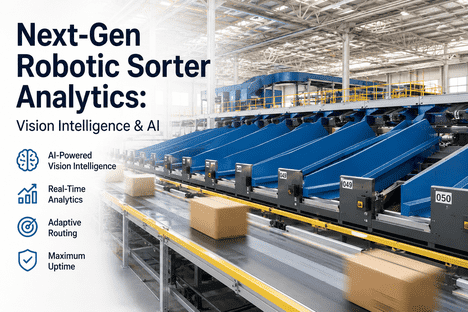
Modern robotic sorters combine neural-network vision with adaptive routing — and when vision drift occurs, sort accuracy collapses across the entire outbound pipeline. AI-scheduled vision analytics prevents this entirely. This page covers everything warehouse and logistics operations teams need to understand about next-generation robotic sorter analytics, vision intelligence systems, and how iFactory AI's platform delivers real-time uptime, accuracy, and traceability across every sort lane.
Next-Gen Robotic Sorter Analytics: Vision Intelligence & AI
Neural-network vision, adaptive routing intelligence, and AI-scheduled analytics — unified in a single platform for warehouse sort systems that cannot afford downtime or misroutes.
Why Robotic Sorter Vision Drift Destroys Outbound Accuracy
High-throughput robotic sorters — whether cross-belt, tilt-tray, bomb-bay, or sliding-shoe — operate at speeds between 1.5 and 3.5 meters per second. At those velocities, a neural-network vision model that has drifted even 2–3% in recognition confidence translates directly into misroutes, jam events, and downstream fulfillment failures. The challenge is not whether sorter vision degrades — it always does. The challenge is detecting degradation before it reaches the accuracy threshold that triggers customer-visible errors.
Causes of vision drift in warehouse robotic sorters include ambient light variation across shift cycles, lens contamination from conveyor dust and label adhesive vapor, firmware updates to camera controllers that alter image processing pipelines, seasonal packaging changes from suppliers that alter barcode contrast ratios, and model confidence decay as SKU catalogs expand beyond the original training distribution. iFactory AI's vision analytics platform monitors all of these degradation vectors in real time and dispatches calibration tasks automatically before sort accuracy is compromised.
| Vision Failure Mode | Detection Window | Sort Accuracy Impact | Downstream Cost |
|---|---|---|---|
| Lens contamination (dust/adhesive) | 4–12 hours | −3% to −8% read rate | Misroute surcharges, re-sort labor |
| Model confidence drift (SKU expansion) | 2–6 weeks | −1% to −5% gradually | Undetected misroutes, carrier claims |
| Ambient light shift (seasonal/shift) | Hours to days | −2% to −4% per shift | Exception handling backlog |
| Camera calibration matrix drift | 3–8 weeks | −5% to −15% on edge cases | Divert conveyor jams, mechanical wear |
| Barcode contrast degradation (supplier) | Batch-by-batch | Spike events: −10% to −30% | Emergency re-label operations |
What iFactory AI Delivers for Robotic Sorter Vision Analytics
iFactory AI's platform connects directly to your sorter's vision controller, PLC network, and camera systems via OPC-UA, MQTT, or REST API bridges — no proprietary hardware required. The platform ingests read-rate telemetry, confidence score distributions, divert success rates, jam event logs, and camera health parameters in real time. From this data stream, the AI engine builds a continuous performance baseline and triggers alerts, work orders, and calibration tasks the moment anomalies emerge.
Connect
Integrate with sorter vision controllers, PLCs, and conveyor management systems via standard industrial protocols — no downtime required for deployment.
Baseline
AI establishes performance baselines for read rate, confidence distribution, divert accuracy, and camera health metrics across all sort lanes and shifts.
Detect
Neural-network anomaly detection identifies vision drift, mechanical misalignment, and routing logic errors in real time — before accuracy thresholds are breached.
Dispatch
Calibration tasks and maintenance work orders auto-generate and route to technicians on mobile devices with full procedure guidance and prior-reading context.
Vision Intelligence Analytics Modules in iFactory AI
Real-Time Read Rate Monitoring
Continuous per-lane read rate tracking with statistical control limits. Alerts trigger when read rate deviates beyond 1.5σ from the rolling 7-day baseline — catching drift before it becomes a misroute event.
Confidence Score Trend Analysis
Vision model confidence scores are logged, trended, and compared against historical distributions. Confidence decay curves predict when recalibration or model retraining will be required — days in advance.
Divert Accuracy by Lane & SKU
Divert success rates broken down by individual sort lane, product category, and carrier destination. Pinpoints which lanes and SKU classes are generating the highest misroute concentrations for targeted remediation.
Camera Health & Contamination Index
Automated contamination scoring derived from image quality metrics — sharpness, contrast, and edge detection variance. Cleaning tasks dispatch when contamination index crosses configurable thresholds.
Predictive Jam & Jam-Root Analytics
Jam event history correlated with upstream vision performance, conveyor speed, and package dimension anomalies. The system identifies jam root causes and recommends mechanical adjustments before patterns escalate.
Audit Trail & Compliance Reporting
Every calibration event, read-rate anomaly, and maintenance action is timestamped and stored in a searchable audit record. One-click reports satisfy carrier SLA audits, ISO requirements, and internal quality reviews.
Managing Sorter Vision Analytics: Reactive vs. AI-Driven
Without AI Vision Analytics
- Vision drift discovered only after misroute events accumulate in WMS exception queues
- Camera cleaning scheduled by calendar date regardless of actual contamination state
- No historical confidence score data — impossible to predict recalibration needs
- Jam root cause analysis done manually from paper logs, taking hours per event
- Compliance audit reports assembled manually from multiple disconnected systems
- Sort accuracy problems escalate to carrier claims before engineering is notified
With iFactory AI Vision Intelligence
- Vision drift detected within minutes via statistical control limits on live read-rate streams
- Camera cleaning tasks auto-dispatched when contamination index breaches threshold — not on a calendar
- Confidence score trending predicts recalibration needs 3–7 days in advance
- Jam root cause correlated automatically with upstream vision and mechanical parameters in seconds
- Audit reports generated in one click with full timestamped task and measurement history
- Escalation to supervisors triggered automatically before accuracy falls below SLA threshold
iFactory AI connects to all major sorter OEMs — Vanderlande, Dematic, Beumer, Bastian Solutions, Intelligrated, and others — via standard industrial protocols. Deployment requires no proprietary hardware and goes live in 4–8 weeks. Book a Demo to see live sorter vision analytics in action.
How iFactory AI Automates Sorter Vision Calibration Scheduling
Vision calibration on robotic sorters is not a monthly event — it is a condition-triggered event that must happen as often as the operating environment demands. iFactory AI replaces fixed-interval calibration schedules with condition-based workflows driven by real telemetry from the sorter itself.
Detect Drift
AI monitors read rate, confidence distribution, and image quality metrics continuously. Anomaly detection flags deviations from baseline within minutes of onset.
Generate Work Order
A calibration or cleaning work order auto-generates with the specific camera ID, lane number, current metrics, and step-by-step procedure — no dispatcher action required.
Mobile Execution
Technician receives task on mobile device with calibration reference values, prior readings, and photo capture capability. Execution is guided and time-stamped at each step.
Verify & Close
Post-calibration read rate and confidence scores are automatically compared against pre-calibration values. Work order closes only when performance is confirmed restored.
See iFactory AI Sorter Vision Analytics Live
Watch how real-time vision drift detection, AI-dispatched calibration, and one-click audit reporting work together in a live warehouse sorter environment.
What AI-Driven Sorter Vision Analytics Delivers in Practice
Why Next-Gen Sorter Analytics Requires Vision-Native AI
The fundamental problem with first-generation sorter analytics platforms is that they treat vision as a binary subsystem — either the scanner reads or it doesn't. In practice, vision performance exists on a continuous spectrum, and the most damaging failures are the gradual ones: confidence scores that decay over three weeks, read rates that drift 1.2% per week, contamination that builds incrementally across shifts. These failures are invisible to binary-status dashboards and only surface when the WMS starts accumulating exceptions.
Next-generation sorter analytics platforms like iFactory AI treat vision performance as a time-series signal subject to the same statistical process control that governs any precision manufacturing system. Control charts, baseline deviation alerts, and confidence distribution analysis replace binary pass/fail checks with continuous intelligence. The result is that operations teams receive actionable calibration tasks before accuracy degradation is customer-visible — not after.
The adaptive routing dimension of next-gen analytics adds a second layer: when vision confidence drops on a specific lane, the routing logic should automatically shift traffic to higher-confidence lanes and flag the degraded lane for priority service. This requires tight integration between the vision analytics layer and the conveyor management system — exactly the kind of integration that iFactory AI's platform is engineered to provide. Facilities that implement this closed-loop architecture consistently report sort accuracy improvements in the 2–4 percentage point range with no increase in throughput time.
Robotic Sorter Vision Analytics — Frequently Asked Questions
Ready to Deploy Vision Intelligence on Your Sorter Fleet?
iFactory AI deploys in 4–8 weeks with no hardware replacement. See real-time read-rate monitoring, AI-dispatched calibration, and adaptive routing intelligence live in your warehouse environment.