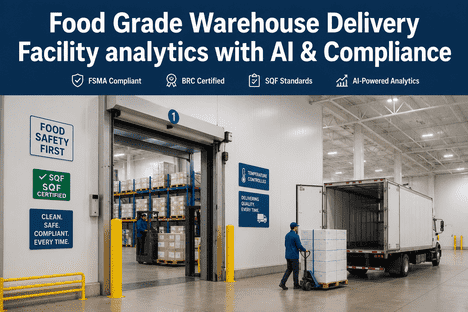
Food Grade Warehouse Delivery Facility analytics with AI & Compliance
By Arel Dixon on June 5, 2026
The quality assurance manager at a Midwest food distribution centre watched the SQF audit preparation spreadsheet grow to 47 tabs over three weeks. Temperature logs from 12 cold rooms, sanitation checklists from 22 zones, HACCP CCP monitoring records from every shift, supplier COAs from 84 approved vendors, pest control reports, allergen changeover verification forms, corrective action histories, and training records for 136 staff members all maintained in separate spreadsheets, all reconciled manually, and none of them connected to the actual sensor data streaming from the warehouse's IoT temperature probes, door sensors, and refrigeration controllers. The last SQF audit had taken six weeks to prepare for, generated 12 non-conformities — including a finding for incomplete environmental monitoring records and required 800 person-hours of QA team overtime. The manager thought: we have every sensor reading, every inspection, every log that the auditor will ask for, but none of it is organised into a single system that proves compliance at the moment of inspection.
73%
Reduction in audit preparation time reported by food distribution centres using AI-driven compliance analytics — from weeks of manual record compilation to minutes of automated report generation.
5
Major food safety frameworks a single food grade warehouse must satisfy simultaneously: FSMA Preventive Controls, SQF Edition 9, BRCGS Issue 9, FSSC 22000, and HACCP. Each requires distinct documentation from the same operational data.
Zero
Cloud dependency with iFactory on-premise deployment. Food grade facilities handling sensitive products can maintain complete data sovereignty while running AI compliance analytics behind their own firewall.
AI-Powered Compliance Analytics for Your Food Grade Warehouse
iFactory unifies temperature monitoring, sanitation tracking, HACCP CCP documentation, and GFSI audit records into a single AI-native platform — eliminating manual compliance overhead and keeping your facility inspection-ready at all times.
The Food Safety Compliance Stack What Every Food Grade Warehouse Must Manage
Food grade warehouse and delivery facilities operate under the most stringent documentation requirements in the logistics industry. FSMA Preventive Controls (21 CFR Part 117) mandates written food safety plans, preventive control monitoring, and corrective action records. SQF Edition 9 requires evidence of food safety culture, zone-classified environmental monitoring, and supplier qualification programmes. BRCGS Issue 9 demands documented traceability, allergen management, and internal audit programmes with tamper-evident records. FSSC 22000 adds food fraud vulnerability assessment and supply chain traceability. iFactory maps every data stream in your facility to the specific documentation requirements of each framework one foundation, multiple compliant outputs.
The Five Compliance Frameworks — Documentation Requirements Mapped to Facility Data
Six Core Analytics Capabilities for Food Grade Warehouse and Delivery Operations
iFactory delivers a complete suite of analytics capabilities that address the highest-impact areas of food grade warehouse and delivery operations. Each capability is production-ready, integrated with your existing systems, and proven in commercial food distribution environments.
CCP Monitoring Automation
Real-Time HACCP CCP Documentation
Continuous monitoring of every Critical Control Point — cold storage temperature, metal detector performance, sanitation verification — with automated digital logs that satisfy FSMA, SQF, BRCGS, and HACCP documentation requirements simultaneously. CCP deviations generate instant corrective action workflows with root cause analysis templates.
Cold Chain Intelligence
Predictive Temperature Excursion Prevention
ML models trained on refrigeration compressor telemetry, door-cycle frequency, ambient temperature data, and seasonal load patterns predict temperature excursions 30-60 minutes before they occur. iFactory alerts warehouse teams with enough lead time to intervene before product integrity is compromised.
Sanitation Analytics
Digital Sanitation and Environmental Monitoring
Master sanitation schedule execution tracking, ATP swab result logging, zone-classified environmental monitoring for Listeria and Salmonella, and automated corrective action workflows. iFactory maps every sanitation event to BRC zone classification requirements and FSMA sanitation control records.
Traceability Engine
FSMA 204 and GFSI Lot Traceability
End-to-end lot traceability from supplier receipt through warehouse storage to customer delivery, capturing FSMA 204 Key Data Elements at every Critical Tracking Event. One-click forward and backward traceability enables mock recall execution in minutes and satisfies SQF, BRCGS, and FSSC 22000 traceability requirements.
Supplier Quality
Supplier COA Verification and Qualification
Automated supplier certificate-of-analysis ingestion via OCR, out-of-spec flagging, and qualification status tracking. iFactory maintains FSMA supply chain verification programme records, SQF supplier approval documentation, and BRCGS incoming goods inspection logs with cryptographic data integrity.
Audit Readiness
Unannounced Audit-Ready Compliance Records
Every temperature reading, sanitation log, CCP check, corrective action, and supplier record is captured with immutable timestamps and electronic signatures. iFactory generates one-click audit packages pre-formatted for SQF, BRCGS, FSSC 22000, and FDA FSMA inspection — no preparation window required.
Reference Architecture — From Facility Sensors to Audit-Ready Compliance Records
Layer 1 — Facility Data Sources
IoT temperature probes · humidity sensors · door contacts · refrigeration controllers · handheld ATP swab devices · barcode scanners · manual inspection checklists
FSMA preventive control records · SQF audit packages · BRCGS clause-mapped documentation · FSSC 22000 compliance reports · FSMA 204 traceability records · HACCP digital logs
Real-Time CCP Monitoring
Continuous sensor data ingestion with automatic compliance record generation for every critical limit
Automated CAPA Workflows
Deviation detection triggers root cause analysis, corrective action, and effectiveness verification automatically
One-Click Audit Packages
Framework-specific documentation generated from a single compliance data foundation
Without AI Compliance Analytics
Manual temperature logs, paper sanitation checklists, disconnected spreadsheets for HACCP records. Audit preparation takes 3-6 weeks of QA team overtime. Each SQF, BRCGS, or FSSC 22000 audit requires separate documentation preparation. Non-conformities common due to incomplete records. Temperature excursions detected after product is compromised. Supplier COAs reconciled manually. Recall traceability takes hours to days.
With iFactory AI Compliance Analytics
Continuous sensor ingestion generates compliance records automatically. One data foundation produces framework-specific outputs for FSMA, SQF, BRCGS, FSSC 22000, and HACCP simultaneously. Audit-ready packages available at any time with zero preparation. Predictive temperature excursion alerts enable preventive intervention. Supplier COA verification automated via OCR with cryptographic integrity. Full lot trace in under 60 seconds.
Your Food Grade Facility Generates Compliance Data Every Second. iFactory Turns It Into Audit-Ready Evidence.
Single platform, every major food safety framework, real-time compliance analytics — built for food grade warehouse and delivery operations where audit readiness is a daily operational requirement, not an annual event.
The Compliance Data Pipeline — From Sensor Reading to Audit Record in Real Time
Food safety compliance documentation in a food grade warehouse follows a five-stage pipeline that transforms raw facility data into framework-specific audit records. Each stage depends on the one before it, and the pipeline as a whole requires seamless data flow from warehouse IoT sensors to the compliance analytics engine.
Stage 1
Sense
Stage 2
Validate
Stage 3
Correlate
Stage 4
Document
Stage 5
Certify
IoT sensors capture data
Temperature, humidity, door status, refrigeration telemetry, ATP swab results, and manual inspection inputs collected from every zone in the facility.
Threshold validation
Each reading validated against CCP critical limits, product-specific temperature ranges, and regulatory compliance thresholds in real time.
Multi-source correlation
Temperature deviations correlated with door events, equipment health, and shift patterns to identify root cause before generating compliance records.
Audit record generation
Immutable timestamped records generated in FSMA, SQF, BRCGS, FSSC 22000, and HACCP formats simultaneously from a single validated data point.
Audit-ready package
One-click framework-specific audit package with clause-mapped evidence, deviation history, corrective action records, and trend analysis.
Expert Perspective
Dr. Robert Chen
Former Director of Food Safety and Quality, Nestlé USA | Food Industry Compliance Consultant
"In 30 years of food safety leadership across CPG manufacturing and distribution, I have never seen a facility fail an audit because it had too much documentation. The failures are always the same — missing temperature logs, incomplete corrective action records, gaps in the environmental monitoring schedule, or supplier COAs that cannot be found. The common thread is not a lack of data. It is the absence of a system that captures compliance evidence as a byproduct of normal operations rather than as a separate manual activity. iFactory's approach — connecting sensor data directly to framework-specific compliance outputs — addresses the root cause of audit fatigue. When every temperature reading, sanitation event, and CCP check automatically generates the exact record format each certification body requires, the question is no longer whether you are ready for an unannounced audit. The question is why the industry accepted anything less for this long."
Frequently Asked Questions
iFactory maps every incoming data point — temperature reading, sanitation log, CCP check, supplier COA — to the specific documentation requirements of FSMA Preventive Controls (21 CFR Part 117), SQF Edition 9, BRCGS Issue 9, FSSC 22000 Version 6, and HACCP based on Codex Alimentarius. Each framework requires different record formats, clause references, and evidence structures, but they all derive from the same underlying operational data. iFactory's compliance engine generates framework-specific outputs from a single monitoring event — one temperature reading at a cold storage CCP produces the FSMA preventive control record, the SQF CCP log, the BRCGS clause 8.1 monitoring record, and the HACCP critical limit verification simultaneously. This eliminates duplicate record sets and ensures consistency across certification programmes.
iFactory connects to any sensor or data source already installed in your facility through standard protocols including OPC-UA, Modbus TCP, REST APIs, MQTT, and direct database connectors. Supported sensor types include temperature and humidity probes (PT100, thermistor, digital), refrigeration compressor telemetry, door contact sensors, ATP luminometers for sanitation verification, metal detector and X-ray system outputs, and barcode/RFID scanners for traceability. The platform also ingests manual inspection data from mobile devices and tablets, bridging the gap between automated sensor streams and operator-completed checklists. No changes to your existing sensor infrastructure or control network are required.
iFactory captures FSMA 204 Key Data Elements at every Critical Tracking Event — receiving, transformation, creation, and shipping — automatically linking each KDE to the lot code, product identifier, location, timestamps, and supply chain partner data required by the rule. The platform generates electronic sortable records that satisfy the FDA's 24-hour traceability response requirement, with one-click trace reports available at any time. Lot genealogy is maintained from supplier receipt through warehouse storage, repackaging, and customer delivery, with forward and backward traceability that supports both regulatory response and mock recall execution.
Yes. iFactory deploys entirely on-premise as a hardened appliance behind your facility firewall with zero cloud data transmission. The platform supports air-gapped environments with local sensor data ingestion, on-device AI inference for compliance analytics, and local storage for all temperature records, CCP logs, deviation reports, and audit trails. For multi-site food distributors, iFactory supports a hub-and-spoke architecture with local appliances at each distribution centre and a consolidated enterprise compliance dashboard at headquarters, with all data transmission encrypted and logged. This architecture satisfies the data sovereignty requirements of FSMA records retention rules and GFSI data integrity standards without exposing operational data to external networks.
iFactory is deployed in your food grade facility within 4-6 weeks from purchase. The first two weeks involve data source connection, sensor point mapping, network configuration, and integration with your warehouse management system and existing IoT infrastructure. Weeks three and four focus on compliance framework configuration — mapping your facility's CCPs, sanitation zones, and supplier qualification programme to the specific requirements of FSMA, SQF, BRCGS, FSSC 22000, and HACCP. By week five, your QA team has role-specific compliance dashboards with real-time monitoring and one-click audit report generation. Most facilities report their first complete audit package — covering all applicable frameworks — within 30 days of deployment. The platform requires no dedicated data science or IT resources from your team after deployment.
Stop Preparing for Audits. Start Proving Compliance Every Day.
iFactory transforms every temperature reading, sanitation log, and CCP check in your food grade warehouse into audit-ready evidence for FSMA, SQF, BRCGS, FSSC 22000, and HACCP — automatically, continuously, and without manual effort.