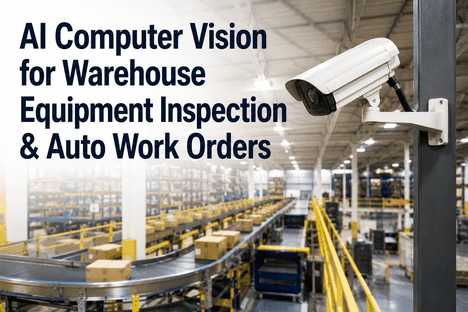
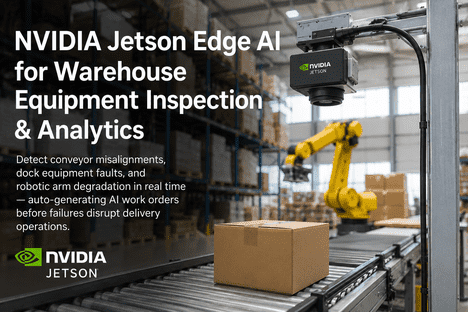
Warehouse equipment inspection has been one of the last operational disciplines to resist automation. Conveyor belts, dock levellers, robotic arms, scan tunnels, AGV chassis, and racking infrastructure all live or die by the visual integrity of their working surfaces — belt fraying, roller wear patterns, leveller hydraulic leaks, robotic-arm joint debris, scanner lens contamination, racking strut deformation yet most facilities still rely on a maintenance technician walking the floor on a fixed weekly route with clipboard. A human inspector watching a conveyor at 400 parts per minute is being asked to make 6.6 visual quality decisions every second; fatigue sets in at hour 2 and detection accuracy collapses by hour 4. AI computer vision changes the model entirely. Fixed and mobile-mounted cameras running deep-learning inference at 30 to 120 frames per second scan every belt, roller, fastener, hydraulic seal, and structural member during normal operations and the moment anomaly crosses the severity threshold, structured CMMS work order is generated automatically with defect class, location, severity score, and recommended part. Gartner now predicts that by 2027, 50% of warehouse-operating companies will have shifted to AI-powered vision systems. Book a Demo to see how iFactory AI deploys computer vision inspection and automated work orders within 6 weeks.
99.6%
Defect detection accuracy from production-grade AI computer vision systems
41%
Reduction in unplanned warehouse downtime with AI inspection and auto work orders
50%
Of warehouse operators projected on AI vision systems by 2027 (Gartner)
4–6 wks
Deployment timeline from inspection audit to live AI vision with auto work orders
What AI Computer Vision Actually Inspects on Warehouse Equipment
Warehouse inspection is not one task. It is a continuous visual audit of dozens of asset classes — each with its own failure signature and its own consequence when a defect is missed. A frayed conveyor belt becomes a torn belt becomes a 4-hour line stoppage. A leaking dock leveller hydraulic seal becomes a failed bay becomes a missed inbound delivery. A debris-contaminated robotic-arm joint becomes a calibration drift becomes a 22% mis-sort spike. Manual inspection cannot cover that surface area at the frequency or consistency the failure modes demand.
iFactory AI's computer vision inspection layer deploys fixed cameras over conveyors, dock equipment, scan tunnels, and racking — supplemented by mobile robot-mounted and AGV-mounted cameras for areas with intermittent foot-traffic visibility. Deep-learning models trained on warehouse-specific defect classes scan every frame at line speed, classify anomalies by type and severity, and trigger structured CMMS work orders the instant a defect crosses threshold. The maintenance team stops walking floors with clipboards and starts working a prioritised, severity-scored, auto-generated work order queue tied to specific equipment locations. Book a Demo to see warehouse-specific defect models running against your equipment inventory.
Conveyor Belt and Roller Inspection
Belt fraying, edge tears, splice degradation, roller wear patterns, misalignment, debris accumulation, and oil-leak signatures detected continuously at 30–120 fps. Defect classes mapped to specific belt sections, conveyor zones, and roller IDs — eliminating the manual walk-the-line inspection model.
Dock Equipment Visual Inspection
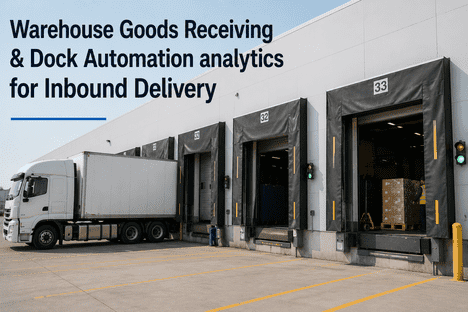
Dock leveller hydraulic-seal leaks, vehicle restraint engagement evidence, dock door panel damage, dock seal wear, and dock-area floor obstruction captured per bay. Visual evidence timestamped against each inspection event — auditable evidence ready for OSHA 1910.30 dock-access compliance review.
Robotic and AGV Asset Inspection
Robotic-arm joint debris, gripper-surface contamination, sorting robot vision-lens contamination, AGV wheel wear, and chassis damage detected continuously. Catches the 22% of robotic mis-sort events driven by lens contamination that fixed-frequency cleaning cycles miss.
Racking and Structural Defect Detection
Pallet-rack strut deformation, upright damage, beam bowing, floor-anchor failures, and aisle-protector damage detected against baseline reference imagery. Catches the structural defects that manual inspection misses until a pallet collapse, addressing ANSI MH16.1 and OSHA storage-stability requirements.
Automated CMMS Work Order Generation
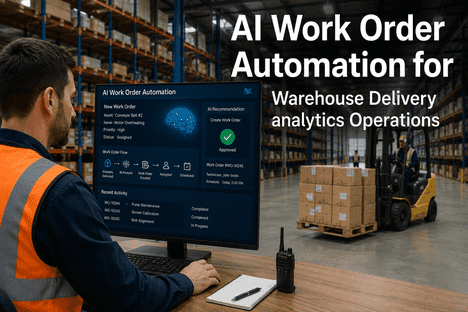
Detected anomalies above severity threshold push structured work orders directly into IBM Maximo, SAP PM, ServiceMax, Infor EAM, or eMaint — with defect class, equipment ID, location, severity score, reference image, and recommended part. Closes the detection-to-resolution gap from days to seconds.
WMS, CMMS and Shift Logbook Integration
iFactory connects to Manhattan Associates, Blue Yonder, SAP EWM, Infor WMS, and IBM Maximo, SAP PM, ServiceMax, Infor EAM, eMaint via OPC-UA, MQTT, and REST. The Shift Logbook captures every inspection event, defect detection, work order, and technician response with reference imagery across operations and maintenance handovers.
Why Manual Inspection and Calendar PM Miss What AI Vision Catches
The conventional inspection model — a maintenance technician walking the floor on a weekly route with a checklist — was built for an era when warehouses ran 8-hour shifts at modest throughput. Modern delivery operations run two and three shifts at peak velocity across hundreds of metres of conveyor, dozens of dock bays, multiple robotic fleets, and thousands of pallet positions. The math no longer works. The table maps where the inherited model breaks against what AI vision delivers.
| Inspection Parameter |
Manual Inspection + Calendar PM |
iFactory AI Computer Vision Inspection |
| Inspection Frequency |
Weekly or bi-weekly walkthrough by maintenance technician. Defects appearing in between inspections progress for 6 to 14 days before detection. Belt tears and seal failures discovered when the line stops. |
Continuous inspection at 30 to 120 fps across every monitored asset. Defects flagged within seconds of appearance. Detection-to-work-order gap collapses from days to under a minute. |
| Coverage Surface Area |
Inspector walks a fixed route. Conveyor underside, hard-to-reach roller assemblies, behind-rack zones, and elevated structural members consistently under-inspected or skipped entirely. |
Fixed and mobile-mounted cameras cover every monitored zone continuously. 100% inspection coverage of conveyors, dock equipment, robots, and racking — no skipped areas, no inspector-fatigue blind spots. |
| Defect Detection Accuracy |
Human inspector accuracy collapses with fatigue. A trained inspector watching a 400-part-per-minute conveyor is making 6.6 visual decisions per second; reliable detection becomes effectively impossible after hour 2. |
Deep-learning models trained on warehouse-specific defect classes deliver 99.6% detection accuracy regardless of shift, time-of-day, or inspector availability. Performance does not degrade with fatigue. |
| Work Order Generation |
Inspector notes defects on a paper or tablet form. Work orders typed into the CMMS hours or days later. Severity and priority assignment subjective; defect classification inconsistent across inspectors. |
Defects above severity threshold push structured work orders into the CMMS automatically with defect class, severity score, reference image, and recommended part. Consistent classification across all assets. |
| Audit and Compliance Evidence |
Inspection completion recorded on paper or tablet checklist. No visual evidence captured of the inspected asset condition. OSHA, ANSI MH16.1, and ISO 45001 audit packs assembled manually months after the fact. |
Every inspection event, defect detection, and work order tied to timestamped reference imagery. Audit packs reproduced on demand. OSHA 1910.30 dock access, ANSI MH16.1 rack safety, and ISO 45001 occupational health evidence captured automatically. |
| Downtime Outcome |
Unplanned shutdowns triggered by missed defects propagating to functional failure. Belt tears, leveller failures, and racking damage discovered when the equipment fails on-shift. 3 to 5× emergency-repair premium routinely absorbed. |
Defects intercepted at sub-failure stage; planned interventions during low-volume windows replace emergency response. Documented 41% reduction in unplanned downtime across deployments. |
Every Missed Defect Is an Unplanned Shutdown Already Accumulating.
iFactory AI delivers warehouse operations continuous computer vision inspection across conveyors, dock equipment, robotic assets, and racking — with automated CMMS work order generation, audit-ready visual evidence, and Shift Logbook continuity. Integrated with your WMS and CMMS in 4 to 6 weeks.
Book a Demo to see live AI vision running against your current equipment inventory.
How iFactory AI Deploys Computer Vision Inspection Across Warehouse Operations
iFactory follows a structured deployment process that delivers live camera-based inspection within the first two weeks and full automated work order generation by week six. Each phase produces a measurable deliverable to operations and maintenance leadership — with first auto-generated work orders typically flowing inside the first 3 weeks of telemetry activation.
Weeks 1–2
Inspection Audit and Camera Deployment
Equipment inventory captured across conveyors, dock bays, robotic fleets, AGVs, scan tunnels, and racking. Existing fixed-camera infrastructure assessed. Camera deployment scoped — overhead, side-mount, and mobile robot-mounted positions selected based on each asset's defect-visibility geometry. Integration initiated with the operator's WMS (Manhattan, Blue Yonder, SAP EWM, Infor) and CMMS (Maximo, SAP PM, ServiceMax, Infor EAM, eMaint). Tier 1 high-utilisation equipment prioritised for first-wave coverage.
Weeks 2–4
Model Calibration and Defect Detection Activation
Deep-learning vision models calibrated against the operator's specific equipment, lighting conditions, and baseline healthy-state imagery. Defect classes loaded for each asset family — belt and roller defects for conveyors, hydraulic-leak and seal-wear classes for dock equipment, lens-contamination and joint-debris classes for robotic fleets, strut-deformation and beam-bow classes for racking. First defect detections flow within the first 3 weeks; latent defects that manual inspection had missed for months typically surface immediately.
Weeks 4–6
Automated Work Orders and Shift Logbook Integration
CMMS work order generation activated with severity thresholds tuned to operations leadership priorities. Each auto-generated work order carries defect class, equipment ID, location, severity score, timestamped reference image, and recommended part. Shift Logbook integrated so every inspection event, defect, work order, and technician response is captured across operations and maintenance handovers with visual evidence. Full handover with monthly inspection-performance reporting in place.
DEPLOYMENT OUTCOME: LATENT DEFECTS SURFACE WITHIN THE FIRST 3 WEEKS
Warehouses completing iFactory's 4–6 week computer vision deployment consistently surface latent equipment defects within the first 3 weeks of camera-feed activation — belt splice degradation, leveller seal leaks, robotic-arm joint contamination, and racking strut deformation that manual inspection had missed for months. Programmes typically achieve 99.6% defect detection accuracy, eliminate the 3 to 5× emergency-repair premium, and deliver the documented 41% reduction in unplanned warehouse downtime.
99.6%
Defect detection accuracy from production-grade AI vision models
41%
Reduction in unplanned warehouse downtime through AI inspection and auto work orders
100%
Inspection coverage of monitored equipment vs partial manual route coverage
Computer Vision Warehouse Inspection: Use Cases from Live Deployments
The following outcomes are drawn from iFactory computer vision deployments at operating warehouse delivery hubs across e-commerce fulfilment, 3PL, retail distribution, and parcel sortation networks. Each use case reflects 9–14 month post-deployment performance against the specific inspection problem the AI vision layer was deployed to solve.
An e-commerce fulfilment operator running 1,200 metres of inbound and outbound conveyor across 4 receiving lines and 6 outbound lanes had logged 9 unplanned belt tears across an 11-month window — each carrying 3 to 6 hours of line stoppage, an average $42,000 in deferred outbound and emergency repair cost, and an outbound carrier cut-off miss on every event. Manual weekly inspection had passed every belt section without flagging the developing splice degradation. iFactory deployed 28 fixed overhead cameras and trained models on belt fraying, splice degradation, roller wear, and debris-accumulation defect classes. Within 4 weeks the model had flagged 7 belt sections with splice degradation and 3 rollers with developing wear patterns — all serviced during planned overnight windows. Zero unplanned belt tears across the following 12 months.
Book a Demo to see how this applies to your conveyor inventory.
0 events
Unplanned belt tears across 12 months post-deployment vs 9 prior
10 defects
Belt and roller issues flagged in first 4 weeks of camera activation
$378K
Annual unplanned-event cost eliminated through predictive intervention
A 3PL operating 22 dock bays had received an OSHA observation citing inconsistent dock leveller inspection records and absent visual evidence of restraint engagement under 1910.30 and 1910.178. Manual paper logs were inconsistently completed and carried no visual evidence of the asset condition at inspection. iFactory deployed bay-level cameras with leveller hydraulic-seal, vehicle-restraint engagement, and door-panel defect classes. Every inbound trailer event captured timestamped visual evidence of the bay's compliance state automatically; every leveller hydraulic seal anomaly pushed a CMMS work order. The follow-up OSHA review closed without further action; the operator reported a 64% drop in dock-related work-order backlog and the highest-risk leveller and restraint defects intercepted before they propagated to functional failure.
100%
Bay compliance evidence captured automatically per inbound trailer
64%
Reduction in dock-related work-order backlog over 9 months post-deployment
$16K+
Per-violation OSHA exposure addressed with structured visual evidence
A retail distribution operator with approximately 18,000 pallet positions across selective and drive-in racking had been managing rack damage on a quarterly visual inspection programme. Two near-miss pallet-collapse events in 18 months had escalated rack-safety governance under ANSI MH16.1 and exposed the operator to recordable-incident risk. iFactory deployed mobile camera platforms covering main aisles plus fixed cameras at high-impact zones, with rack defect classes covering upright deformation, beam bowing, base-plate damage, and floor-anchor failure. Within 6 weeks the model had identified 47 rack defects across the facility — 18 of which were rated above the operator's intervention threshold and prioritised for immediate repair. Zero pallet-collapse near-misses across the following 14 months and a defensible ANSI MH16.1 compliance posture established.
47 defects
Rack defects identified in first 6 weeks across 18,000 pallet positions
Zero
Pallet-collapse near-miss events across 14 months post-deployment
ANSI
MH16.1 rack-safety compliance posture established with continuous visual evidence
Expert Perspective: What the Industry Gets Wrong About Warehouse Inspection
Industry Review — Warehouse Operations and Maintenance Engineering Perspective
"The assumption that a maintenance technician walking a weekly route catches the defects that matter is comfortable, but the math does not survive contact with a modern delivery hub. A human inspector watching a conveyor at peak throughput is asked to make six visual decisions every second, and that performance falls off a cliff at hour two. Meanwhile the warehouse has hundreds of metres of belt, dozens of dock bays, multiple robot fleets, and thousands of pallet positions — far more surface area than weekly inspection was ever designed to cover. The operators moving to AI vision are not chasing a feature. They are correcting a structural mismatch between inspection capacity and equipment surface area. Continuous coverage at 100% accuracy with automated work orders is what the operations math actually requires."
Head of Warehouse Maintenance Engineering — Major North American Distribution Operator (provided via iFactory deployment reference)
The supporting market data confirms it. Gartner now predicts that by 2027, 50% of warehouse-operating companies will have shifted to AI-powered vision systems. Production-grade computer vision deployments are delivering 99.6% detection accuracy and 41% reductions in unplanned downtime. OSHA 1910.30 dock-access compliance, ANSI MH16.1 rack-safety standards, and ISO 45001 occupational-health frameworks all reward continuous visual evidence over periodic walkthrough reports. The shift is not optional — it is the structural correction the operations math has been waiting for. Book a Demo to speak with iFactory's computer vision specialists about your current inspection programme.
Continuous Visual Inspection. Auto Work Orders. Live in 4–6 Weeks.
iFactory gives warehouse operations 99.6% accuracy AI vision inspection across conveyors, dock equipment, robots, and racking — with automated CMMS work order generation, audit-ready visual evidence, and Shift Logbook continuity across operations and maintenance handovers. Results measurable within 30 days of camera activation.
Conclusion: AI Computer Vision Inspection Is Now the Operating Standard
The case for AI computer vision inspection in warehouse operations has moved well beyond pilot programmes. A documented 99.6% defect detection accuracy from production-grade vision models, the 41% reduction in unplanned downtime achieved across operating deployments, Gartner's 50% adoption projection for 2027, and the structural impossibility of manual inspection keeping pace with modern delivery hub equipment surface area have made the conventional weekly-route-with-clipboard model operationally and financially indefensible at any meaningful scale.
iFactory's platform delivers the specific capabilities warehouse operations require: conveyor belt and roller inspection, dock equipment visual inspection, robotic and AGV asset inspection, racking and structural defect detection, automated CMMS work order generation with visual evidence, and a digital Shift Logbook carrying every inspection event and intervention across handovers — integrated with Manhattan, Blue Yonder, SAP EWM, Infor WMS, IBM Maximo, SAP PM, ServiceMax, Infor EAM, and eMaint via OPC-UA, MQTT, and REST. The 4–6 week deployment timeline means measurable inspection intelligence begins within weeks. Book a Demo to receive a computer vision inspection assessment specific to your equipment inventory and compliance profile.
Frequently Asked Questions About AI Computer Vision Warehouse Inspection
What equipment classes can iFactory's computer vision inspection cover?
iFactory covers conveyor belts and rollers (fraying, splice degradation, alignment, debris, oil leaks), dock equipment (leveller hydraulic seals, vehicle restraints, dock doors), robotic and AGV assets (vision lens contamination, joint debris, gripper wear, wheel wear), pallet racking (upright deformation, beam bowing, base-plate damage), and scan tunnels and label readers. Defect classes are calibrated to the operator's specific equipment during the week 2–4 model calibration phase.
How does the automated CMMS work order generation actually work?
When the vision model detects an anomaly above the configured severity threshold, a structured work order is generated automatically and pushed into the operator's CMMS — IBM Maximo, SAP PM, ServiceMax, Infor EAM, or eMaint — with defect class, equipment ID, location, severity score, timestamped reference image, and recommended part. The detection-to-work-order gap is under a minute, compared to days or weeks under manual inspection workflows.
Do we need to install dedicated cameras, or can iFactory use our existing CCTV?
iFactory assesses existing fixed-camera and CCTV infrastructure during the week 1–2 audit. Where existing camera geometry and resolution meet the requirements of the relevant defect classes, those feeds are used directly. Where coverage gaps exist or specific defect geometries require dedicated mounting positions, additional cameras are deployed. Mobile robot-mounted and AGV-mounted cameras can also supplement fixed coverage for hard-to-reach zones.
How accurate is the AI vision model in a real warehouse environment with variable lighting?
Production-grade computer vision deployments achieve 99.6% defect detection accuracy. The models are trained on warehouse-specific imagery covering the variable lighting conditions, partial obstructions, motion blur, and operating conditions of an active facility. Lighting and environmental calibration is completed during the week 2–4 model calibration phase using baseline imagery captured from the operator's actual equipment.
Does the platform support OSHA, ANSI, and ISO compliance audit documentation?
Yes. OSHA 1910.30 dock access, OSHA 1910.178 powered industrial truck operations, ANSI MH16.1 pallet rack design, and ISO 45001 occupational health frameworks all reward continuous visual evidence of asset condition. Every inspection event, defect detection, and work order is captured with timestamped reference imagery — supporting audit packs that can be reproduced on demand for inspector review.
How does the Shift Logbook fit into the AI vision inspection workflow?
Every defect detection, auto-generated work order, technician response, and post-repair recheck is captured in iFactory's digital Shift Logbook against the affected equipment with reference imagery. Incoming operations and maintenance shifts inherit a complete view of what was inspected, what was flagged, and what interventions are pending. Floor observations from operators — unusual conveyor noise, intermittent dock issues — are correlated with vision-detected defects so qualitative observation enriches the AI-driven inspection record.
Stop Running Inspection on Clipboard Walkthroughs. Deploy AI Computer Vision in 4–6 Weeks.
iFactory gives warehouse operations 99.6% accuracy continuous computer vision inspection across conveyors, dock equipment, robotic fleets, and racking — with automated CMMS work order generation, audit-ready visual evidence aligned to OSHA, ANSI, and ISO frameworks, and Shift Logbook continuity across operations and maintenance handovers.
99.6% defect detection accuracy from production-grade vision models
41% reduction in unplanned warehouse downtime documented across deployments
100% inspection coverage replacing partial manual route coverage
4–6 week deployment with first auto-generated work orders in week 3