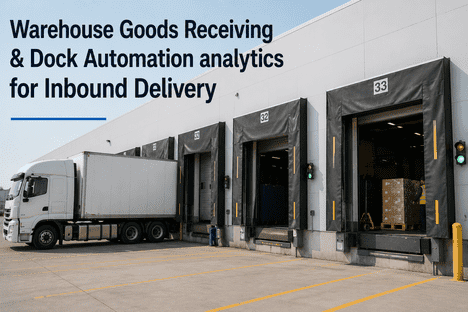
Automated receiving docks are the first — and most fragile — link in the inbound delivery pipeline. When dock equipment fails without warning, every downstream process stalls: put-away queues back up, inventory records lag, carrier appointments are missed, and fulfillment SLAs begin to slip within the same shift. Yet most warehouse operations still treat dock equipment maintenance as a reactive task — responding to breakdowns after they've already disrupted inbound flow. iFactory AI's warehouse analytics platform closes that gap by embedding continuous equipment monitoring, predictive maintenance scheduling, and inbound dock performance intelligence directly across your receiving operation — without replacing existing WMS or ERP infrastructure. Book a Demo to see how iFactory AI maps dock automation analytics to your inbound delivery workflow.
Is Your Automated Receiving Dock Ready for the Inbound Volume It Faces Every Shift?
iFactory AI connects dock equipment sensors, WMS data, shift logs, and inbound scheduling feeds into a unified analytics layer — delivering real-time equipment uptime monitoring, predictive maintenance alerts, and prescriptive dock assignment recommendations for warehouse receiving operations.
Why Automated Dock Analytics Has Become Operationally Essential for Inbound Receiving
The automated receiving dock is no longer a simple unloading station — it is a data-generating, decision-intensive asset that must keep pace with inbound delivery schedules, carrier appointment windows, and warehouse throughput targets simultaneously. What has changed in recent years is not the function of goods receiving; it is the speed at which inbound volumes, dock equipment dependencies, and fulfillment SLA expectations now shift.
Legacy maintenance approaches — reactive breakdowns, fixed calendar-based service intervals, and manual shift inspections — were designed for a slower, lower-volume operation. Today's automated inbound docks run conveyors, dock levelers, RFID tunnel scanners, barcode vision systems, and automated guided vehicles in coordinated sequences across every receiving shift. A single unplanned failure in any of these assets cascades into delayed ASN processing, inventory discrepancies, and missed put-away targets. iFactory AI addresses this structural mismatch by embedding continuous intelligence across four operational dimensions: equipment health and uptime monitoring, inbound throughput analytics, dock scheduling optimization, and predictive maintenance work order generation — each dimension compounding the value of the others.
Equipment Health & Uptime Monitoring
Continuous sensor-based monitoring across dock levelers, conveyors, RFID scanners, and dock door systems detects anomalies in real time — with SHAP-interpretable attribution that surfaces root causes before equipment failure propagates into inbound delays.
Inbound Throughput Analytics
ML models track receiving throughput per dock door, per shift, and per carrier — identifying bottlenecks in unloading, scanning, and ASN verification flows before they delay downstream put-away and inventory accuracy targets.
Dock Scheduling & Assignment Optimization
AI-powered dock assignment recommendations balance inbound carrier appointments against equipment availability, labor capacity, and dock door capability — eliminating the coordination gaps that create inbound congestion and dwell time overruns.
Predictive Maintenance Work Orders
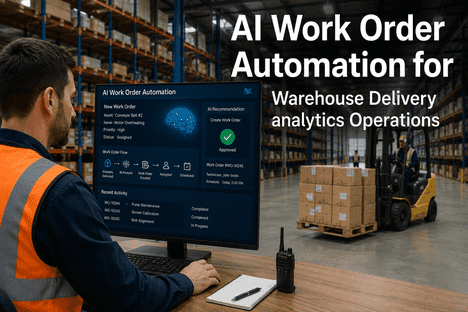
AI prescribes specific maintenance actions — replace dock seal, recalibrate conveyor belt tension, service leveler hydraulics — and generates work orders automatically within iFactory AI's CMMS, with shift logbook entries and audit trails preserved.
The Operational Gap: Reactive Dock Management vs. AI-Driven Inbound Analytics
The difference between conventional receiving dock management and an AI-integrated analytics platform is structural, not incremental. Facilities running reactive maintenance programs, manual shift inspections, and static dock scheduling accumulate uncaptured throughput and invisible equipment risk with every completed inbound delivery cycle. The comparison below maps the specific dimensions where legacy approaches generate friction and where iFactory AI systematically closes those gaps.
| Operational Dimension | Legacy Friction | AI-Driven Approach (iFactory AI) | Documented Impact |
|---|---|---|---|
| Equipment Failure Detection | Reactive breakdown response, hours of dock downtime | Continuous sensor monitoring, anomaly alerts before failure | Up to 50% reduction in unplanned downtime |
| Inbound Receiving Speed | 45–60 minutes per shipment, manual PO matching | AI-assisted ASN verification and mobile photo capture | Under 10 minutes per inbound shipment |
| Dock Scheduling | Manual appointment boards, frequent carrier conflicts | AI dock assignment with equipment availability overlay | Eliminates inbound coordination gaps per shift |
| Maintenance Planning | Calendar-based intervals, over/under-servicing dock assets | Condition-based predictive work orders from sensor data | 25–30% reduction in maintenance labor cost |
| Shift Handover Visibility | Paper-based shift logs, knowledge lost between crews | Digital shift logbook with equipment status and issue carry-forward | Zero-gap shift continuity across inbound receiving teams |
| Inventory Accuracy at Receipt | Manual count errors, discrepancy resolution taking days | AI barcode/RFID validation with real-time WMS sync | Read rates up to 99.9% with automated discrepancy alerts |
Every row in this table represents a recurring operational cost that AI-driven dock analytics closes systematically. Book a Demo to benchmark these gaps against your specific receiving dock configuration.
Three Dimensions of Measurable Impact Across Inbound Dock Operations
iFactory AI delivers value simultaneously across dock equipment availability, inbound receiving throughput, and shift-level operational continuity. These three levers compound across every inbound delivery shift — meaning early deployment captures more throughput before bottlenecks become structural. The impact framework below is structured for both logistics leadership evaluating technology investment and warehouse operations teams planning next-quarter improvements.
Continuous sensor monitoring replaces reactive breakdown response with early anomaly detection. Predictive maintenance work orders are generated automatically before dock levelers, conveyors, and scanning systems fail — keeping every inbound dock door operational across morning, afternoon, and overnight receiving windows.
- Sensor-based anomaly detection across all dock automation assets
- Predictive work orders auto-generated in iFactory AI CMMS
- Up to 50% reduction in unplanned dock equipment downtime
AI-assisted ASN verification, mobile photo capture, and automated PO matching compress inbound receiving cycle times significantly. Discrepancy patterns are analyzed automatically by supplier and carrier — turning exception management from a reactive daily task into a proactive, data-driven workflow that improves inventory accuracy at the point of receipt.
- Inbound receiving reduced from 45–60 min to under 10 min per shipment
- Automated discrepancy analysis by supplier and carrier
- Real-time WMS sync with barcode and RFID read rates up to 99.9%
iFactory AI's digital shift logbook captures every equipment status update, inbound exception, dock assignment change, and maintenance action in a structured, searchable record — ensuring incoming crews inherit full operational context rather than verbal handovers that lose critical detail. Every action is AI-timestamped and person-attributed for audit-ready compliance documentation.
- Digital shift logbook with equipment status carry-forward per dock door
- Person-attributed, AI-timestamped action trail for every receiving event
- Compliance documentation generated as a byproduct of daily operations
5-Step Deployment Roadmap: AI Inbound Dock Analytics for Warehouse Operations
Most warehouse operators do not replace existing WMS or ERP systems when adopting AI for inbound dock analytics. They layer intelligence on top in clearly defined phases that deliver measurable value before deeper integration. The roadmap below reflects the deployment pattern across distribution centers, 3PL facilities, and manufacturing receiving docks — the same sequence iFactory AI follows for production rollouts. Book a Demo to walk through this sequence applied to your specific dock configuration.
Dock Asset Inventory and Critical Parameter Mapping
iFactory AI's warehouse engineers conduct a structured operational assessment across the receiving dock — mapping every dock door, leveler, conveyor segment, RFID scanner, vision tunnel, and AGV docking station. Signal coverage priority is assigned to the highest-failure-frequency assets and the dock equipment whose downtime creates the longest inbound ripple effect across receiving, put-away, and inventory flow.
Sensor Integration and WMS/ERP Data Layer Connection
iFactory AI's IoT gateway layers on top of existing WMS, ERP, and dock management systems through standard APIs and OPC-UA/MQTT connectors. Vibration, temperature, motor current, and throughput sensors feed the analytics engine alongside inbound scheduling data, carrier appointment records, and shift logbook entries — without disrupting live receiving operations or requiring system replacement.
Equipment Digital Twin and Predictive Maintenance Activation
Real-time digital twins stand up across active dock automation assets, establishing health baselines, anomaly detection thresholds, and remaining useful life calculations per asset. The twin provides virtual instrumentation even for equipment without existing condition monitoring sensors — extending live uptime visibility across the full dock within weeks of deployment.
Inbound Analytics Dashboard and Shift Logbook Deployment
Inbound throughput analytics, dock scheduling recommendations, and predictive maintenance work orders activate across the iFactory AI platform — with shift logbook integration capturing every equipment event, exception, and action in a structured, searchable record. AI recommendations route through existing maintenance authorization workflows — AI prescribes, supervisors approve, technicians execute, with full audit trails preserved.
Validation, Documentation, and Multi-Site Portfolio Scale
Validation protocols execute for each integration point, generating documentation required for operational audits, insurance reviews, and customer compliance requirements. Once validated on the pilot dock, iFactory AI's multi-site architecture enables rapid replication of the same analytics and maintenance logic across every warehouse or distribution center in the network — without restarting the assessment cycle.
Deploy iFactory AI Inbound Dock Analytics Across Your Warehouse Network
iFactory AI's platform delivers AI-driven equipment uptime monitoring, predictive maintenance CMMS, inbound throughput analytics, and digital shift logbook — purpose-built for warehouse and distribution center operators with OT-native sensor integration and WMS/ERP connectivity included.
What 2024–2025 Warehouse Automation Research Actually Documents
The operational evidence for AI-driven inbound dock analytics has reached an inflection point. Warehouse wages grew nearly four times the national average in early 2025, with recent research showing automation can cut labor costs by up to 60%. Simultaneously, the dock scheduling software market accelerated sharply — driven by AI-powered predictive analytics for appointment scheduling and dock resource allocation, seamless WMS integration, and real-time inbound shipment visibility that reduces carrier dwell times and eliminates coordination-driven delays.
Industry analysis from 2024–2025 identifies six converging streams shaping inbound dock automation: predictive equipment maintenance, AI dock scheduling, automated ASN and PO verification, sensor-based throughput monitoring, digital shift management, and WMS/ERP native integration — covering every operational layer of the modern receiving dock.
- Condition-based maintenance replacing fixed-interval dock servicing
- AI scheduling reducing carrier conflict and dwell time overruns
- Automated PO matching cutting inbound receiving time by up to 80%
Peer-reviewed and industry research published in 2024–2025 documents consistent operational improvements where AI analytics layers on top of existing dock automation and WMS infrastructure — across distribution centers, 3PL facilities, e-commerce fulfillment centers, and manufacturing receiving operations at multiple scales.
- Up to 60% labor cost reduction through dock automation analytics
- MTBF improvement and 25–30% maintenance cost reduction documented
- Read rates of up to 99.9% at automated inbound scanning points
The global warehouse market is projected to reach $869 billion by 2025, with 4.28 million commercial robots anticipated across 50,000+ facilities. E-commerce volumes and same-day fulfillment expectations have compressed inbound processing windows to the point where a single dock equipment failure during peak receiving directly threatens downstream SLAs — validating the need for AI-level dock visibility across every shift.
- $869B global warehouse market with 30% labor task automation
- 4.28M commercial robots operating across warehouse facilities by 2025
- Single dock failure cascades to put-away, inventory, and fulfillment delays
Warehouse Dock Automation Analytics — Frequently Asked Questions
How does iFactory AI integrate with existing WMS and dock management systems?
iFactory AI layers on top of existing WMS, ERP, and dock scheduling platforms through standard APIs, OPC-UA, and MQTT connectors. Your existing systems continue to run — the AI consumes their data alongside live sensor feeds from dock equipment to produce real-time analytics and predictive maintenance recommendations. Integration typically completes in 2–3 weeks for the data layer and runs without disrupting live inbound receiving operations.
Which dock assets does iFactory AI monitor for predictive maintenance?
iFactory AI monitors the full range of inbound dock automation assets: dock levelers, dock seals and shelters, conveyor systems, RFID tunnel scanners, fixed overhead barcode readers, vision inspection tunnels, dock door motors and controls, AGV docking stations, and pallet handling equipment. The platform prioritizes monitoring signal coverage at the highest-throughput and highest-failure-risk assets first, then extends coverage across the full dock fleet as deployment progresses.
How does the iFactory AI shift logbook support inbound dock operations?
iFactory AI's shift logbook captures every equipment status change, inbound exception, dock assignment event, maintenance action, and safety observation in a structured, searchable digital record — automatically timestamped and person-attributed. Incoming shift crews inherit full operational context from the previous team without relying on verbal handovers that lose critical detail. The logbook also generates compliance documentation as a byproduct of daily operations, supporting audits and regulatory reviews without additional reporting effort. Book a Demo to see the shift logbook applied to your receiving operation.
What is a realistic ROI timeline for AI dock analytics deployment?
Predictive maintenance alerts and unplanned downtime reductions typically become measurable within the first 30–60 days after sensor integration and digital twin deployment. Inbound throughput improvements — faster ASN verification, fewer discrepancy investigations, tighter dock scheduling — become visible within the first full receiving cycle month. The compounding economic effect from continuous condition monitoring and shift logbook continuity builds over 3–6 months as the AI accumulates site-specific operational data and maintenance patterns.
Can iFactory AI support compliance documentation for inbound receiving audits?
Yes. Every AI recommendation, maintenance work order, receiving transaction, dock assignment decision, and shift logbook entry in iFactory AI is AI-timestamped and person-attributed — generating compliance documentation automatically as a byproduct of normal operations. This supports customer audits, third-party logistics compliance reviews, and internal quality management requirements without additional reporting overhead. All recommendations flow through operator authorization workflows before any control action, with full audit trails preserved.
The Automated Receiving Dock Is a Real-Time, Shift-Critical Asset Now
The automated receiving dock was once designed to be a controlled handoff point — an asset that worked best when equipment was serviced on schedule and inbound volumes were predictable. That description no longer matches the operational reality of 2025. With e-commerce volumes compressing receiving windows, same-day fulfillment expectations raising the cost of inbound delays, and dock automation assets accumulating wear across multi-shift operations, receiving docks are now real-time, decision-intensive infrastructure that requires AI-level visibility to operate without disruption.
The operators maintaining highest inbound throughput are treating dock equipment as monitored assets — backed by AI analytics layered on top of existing WMS and automation infrastructure and digital shift logbooks that preserve operational continuity across every crew change. The supporting evidence is now extensive, the implementation patterns are proven, and deployment timelines have collapsed from months to eight weeks. The question is no longer whether AI dock analytics belongs in warehouse receiving operations — it is how quickly each operator deploys it before the next peak inbound window tests their equipment availability. Book a Demo to see iFactory AI's inbound dock analytics platform applied to your receiving operation.
Deploy iFactory AI Dock Analytics at Your Warehouse — Live in 8 Weeks
Join warehouse and distribution center operators using iFactory AI to connect dock equipment sensors, WMS data, inbound scheduling feeds, and shift logbooks into a unified analytics platform — turning automated receiving docks into continuously monitored, maintenance-predictive, throughput-optimized inbound assets.