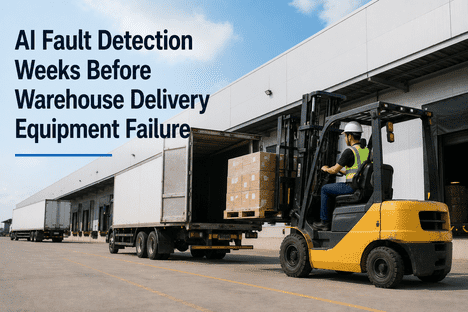
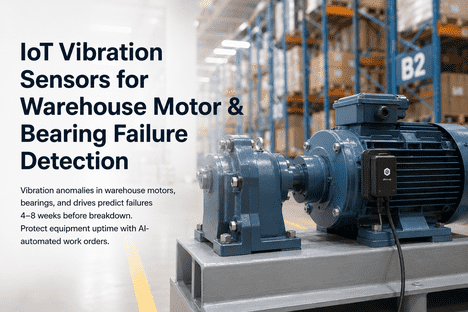
AI Fault Detection Weeks Before Warehouse Delivery Equipment Failure — iFactory AI identifies bearing degradation, motor overheating, and conveyor faults 2–8 weeks before critical failure, converting unplanned breakdowns into scheduled repairs that never miss a carrier cut-off.
Predictive Maintenance · AI Fault Detection · CMMS Work Orders · Delivery Continuity
iFactory AI Detects Equipment Faults 2–8 Weeks Before Your Warehouse Goes Down.
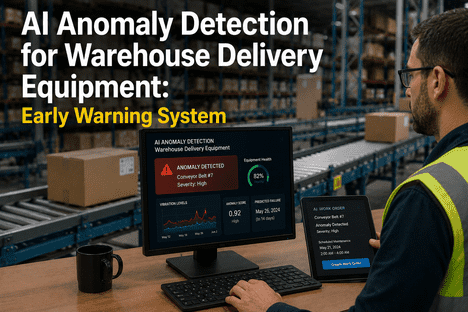
iFactory ingests vibration, temperature, motor current, and acoustic sensor data from your conveyors, forklifts, and dock equipment — running continuous AI anomaly detection and generating CMMS work orders your team acts on before a fault becomes a failure.
2–8 wks
Advance warning before bearing and motor failures reach critical stage
$10K/hr
Cost of unplanned downtime in a 750,000 sq ft warehouse or distribution centre
80%
Of industrial facilities cannot accurately estimate their own downtime cost
$4B+
Annual cost of non-fatal injuries in warehousing and transportation to employers
The Real Cost of Waiting for Equipment to Break
Warehouse and delivery operations run on uptime. A conveyor line that stops during peak fulfilment hours doesn't just generate a repair bill — it triggers a chain of missed carrier cut-offs, SLA penalties, emergency overtime, and customer-facing delivery failures. The average unplanned stoppage in a fulfilment operation costs $18,000–$35,000 in direct and indirect losses by the time the event is fully accounted for. Yet 80% of facilities still operate on reactive maintenance: waiting for equipment to fail before acting.
AI fault detection changes the equation entirely. Instead of responding after the breakdown, iFactory AI monitors the continuous health of every critical asset — reading vibration signatures, temperature trends, motor current draw, and acoustic emissions — and flags degradation weeks before it reaches a failure threshold. The result: your maintenance team is booking a planned repair during the next scheduled low-volume window, not scrambling for emergency parts at 2× standard cost while a sortation line sits idle.
Reactive Maintenance — What Happens
Bearing degrades over weeks — no signal captured, no action taken
Conveyor stops mid-shift during peak fulfilment window
Required part not in stock — emergency supplier call at 2–3× standard price
Outbound orders miss carrier collection window — SLA penalties triggered
Total event cost: $18,000–$35,000 direct + downstream SLA consequence
iFactory AI Fault Detection — What Changes
Bearing degradation flagged 3 weeks prior via vibration signature shift
CMMS work order auto-generated with component ID, parts list, and repair window
Repair scheduled during Sunday off-peak window at standard parts cost
No carrier cut-off missed — zero SLA penalties generated
Total cost: standard repair parts + planned labour — no emergency premium
Which Warehouse Delivery Equipment iFactory AI Monitors — and What It Detects
iFactory's predictive maintenance platform monitors every category of material handling and delivery equipment that carries operational risk in a warehouse or distribution centre. The AI model for each asset type is calibrated to the specific failure physics of that equipment — bearing wear, belt tension loss, motor thermal runaway, and hydraulic system degradation all manifest differently in sensor data and require different detection logic.
| Equipment |
Faults Detected |
Typical Lead Time |
| Conveyor & Sortation Lines |
Belt tension loss, bearing wear, roller misalignment, motor current anomaly, gearbox vibration |
2–5 weeks before stoppage |
| Forklifts & Reach Trucks |
Hydraulic pressure drop, mast chain elongation, battery state-of-health, brake wear, tyre condition |
3–8 weeks before failure |
| Loading Dock Equipment |
Leveller hydraulic degradation, dock seal wear, vehicle restraint actuator faults |
2–4 weeks before operational failure |
| Automated Storage & Retrieval Systems |
Shuttle motor derating, rack guide rail wear, drive belt elongation, positioning encoder drift |
3–6 weeks before system fault |
| Delivery Vehicle Fleet (Last Mile) |
Engine thermal anomaly, brake fade, suspension wear, battery degradation (EV fleet), DTC code trend analysis |
2–8 weeks before breakdown |
How iFactory AI Detects Faults Weeks Before Failure
The detection capability is built on continuous multi-signal monitoring, not periodic inspections or threshold-based alarms. Traditional alarm systems trigger only when a reading exceeds a fixed limit — by which point the equipment is often hours from failure. iFactory AI instead monitors trend trajectories across multiple simultaneous signals, identifying the characteristic degradation pattern of each fault type weeks before any individual reading crosses a threshold.
From Sensor Signal to CMMS Work Order — The iFactory AI Detection Pipeline
1
Continuous sensor ingestion
Vibration, temperature, motor current, acoustic, and hydraulic pressure data collected from IoT sensors on every monitored asset — streamed to iFactory AI in real time
2
AI baseline comparison and anomaly scoring
Live readings compared against asset-specific baselines every second. Multi-signal confirmation prevents single-sensor noise from triggering false positives — the AI requires corroborating evidence across signals before escalating
3
Staged alert with time-to-failure estimate
Trend degradation triggers Watch → Warning → Action alerts, each with a predicted time-to-failure estimate. Your team has weeks, not hours, to plan the response
4
Auto-generated CMMS work order delivered to technician mobile
Work order includes component ID, fault description, recommended parts list, and a suggested repair window aligned to your fulfilment schedule. Completion data feeds back into the model — improving prediction accuracy over time
Predictive Maintenance · AI Anomaly Detection · CMMS Integration · Delivery Operations
See How iFactory AI Turns Your Sensor Data Into a Fault-Free Delivery Schedule.
Book a demo and see the detection pipeline running on warehouse delivery equipment data — from sensor ingestion to CMMS work order in a single connected workflow.
What Warehouse Operations Teams Gain From iFactory AI Fault Detection
The impact is felt across every tier of warehouse operations — from the technician receiving a specific, actionable work order on their mobile device to the operations director whose delivery SLA performance no longer depends on whether a bearing holds out through peak season.
1
Zero carrier cut-off misses due to equipment failure
Every repair is scheduled in advance against your fulfilment calendar. Planned maintenance never overlaps with a carrier collection window — unplanned breakdown during outbound is eliminated.
2
Emergency parts premium eliminated
With 2–8 weeks of advance notice, your procurement team orders parts at standard cost through normal supply channels. The 2–3× emergency surcharge — standard for reactive breakdown scenarios — disappears from your maintenance P&L.
3
Maintenance team productivity — from firefighting to planning
Technicians receive specific work orders with component ID, fault description, and parts list — not a vague call to investigate an alarm. This shift from reactive scramble to planned execution reduces per-repair labour time significantly.
4
Extended asset lifespan through condition-based care
AI condition scoring lets maintenance teams intervene at the optimal point — before damage cascades to adjacent components. This prevents secondary failures that typically multiply repair cost by 3–5× versus catching the primary fault early.
5
Full audit trail and safety compliance documentation
Every sensor reading, alert, and work order is logged with timestamp and asset ID. OSHA and insurance compliance documentation is generated automatically — no manual record assembly required.
6
Model accuracy improves with every confirmed prediction
Each repair completion feeds outcome data back into the AI model. Detection lead time extends and false positive rate drops as the model learns the specific failure patterns of your equipment fleet — accuracy compounds over time.
"
We were averaging three unplanned conveyor stoppages per month during peak fulfilment periods. After deploying iFactory's predictive maintenance across our sortation and pick conveyor lines, we have gone seven months without a single unplanned stoppage. Our maintenance team now plans every repair — we haven't missed a carrier cut-off in two quarters.
— Head of Warehouse Engineering, E-commerce Fulfilment Centre — 280,000 sq ft, 14 conveyor zones
iFactory AI Integrates With Your Existing Warehouse Systems
iFactory's predictive maintenance platform is designed to connect to the sensor infrastructure, CMMS, and WMS tools your operation already runs — not to replace them. Sensor data flows in via standard IoT protocols; classified fault data and work orders flow out to your existing maintenance management and operations platforms. Deployment does not require a wholesale technology replacement.
Sensor & IoT
MQTT, OPC-UA, Modbus, REST API — compatible with all major industrial IoT sensor and PLC protocols
CMMS & EAM
IBM Maximo, Infor EAM, SAP PM, and custom REST API endpoints for work order push and completion feedback
WMS & OMS
Repair window scheduling aligned to fulfilment calendar data — maintenance never conflicts with peak dispatch periods
Ready to see the integration in action for your equipment profile? Book a demo and the iFactory team will map the detection pipeline to your specific assets and sensor infrastructure within the session.
Frequently Asked Questions
Want to understand how the ROI calculation applies to your specific facility? Book a demo and the iFactory team will work through the numbers with you based on your asset inventory and current maintenance data.
Stop Absorbing the Cost of Breakdowns You Could Have Predicted 6 Weeks Ago.
iFactory AI connects to your warehouse and delivery equipment, runs continuous multi-signal fault detection, and delivers CMMS-ready work orders before failures reach your carrier schedule. Book a demo to see the platform running on your asset profile — or talk to an expert to discuss your specific fault detection requirements.