Warehouse delivery equipment failures rarely happen without warning bearings degrade over weeks, motors draw more current as resistance builds, and belts drift millimeters at a time before catastrophic seizure. Yet most facilities still discover these failures when a conveyor line stops mid-shift, a dock leveler collapses under load, or a sortation system throws parcels into the wrong chute at 8,000 units per hour. The problem is not that failure signals do not exist. The problem is that no human can read 14 days of vibration trends, correlate motor current drift with temperature rise, and match the compound signature against known failure patterns across a fleet of 200 assets. AI-driven root cause analysis reads every signal, correlates every trend, and surfaces the actionable diagnosis before the failure occurs turning reactive emergency repairs into planned interventions that protect throughput and eliminate the 2 AM phone call.
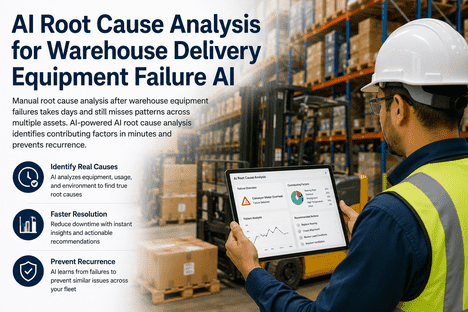
Identify contributing factors in minutes, not days. Prevent recurrence with AI-driven failure diagnostics that correlate sensor data, maintenance history, and operational context across every conveyor, sorter, dock leveler, and robotic system in your facility.
Why Manual Root Cause Analysis Fails in High-Throughput Warehouse Operations
Warehouse delivery environments present unique challenges for failure diagnosis that manual processes cannot address systematically. A typical facility operates conveyors spanning thousands of feet, sortation systems processing 8,000+ parcels per hour, dock levelers cycling hundreds of times per shift, and an expanding fleet of autonomous mobile robots and robotic palletizers. When a failure occurs, maintenance teams face a wall of unknowns: Did the bearing degrade from normal fatigue or from a seal breach that let contaminants in? Was the motor current spike caused by a load imbalance upstream or by drive train wear? Did the divert actuator fail from solenoid aging or from pneumatic supply pressure dropping due to a compressor issue elsewhere in the building? Each question requires correlation across data sources vibration history, temperature trends, maintenance records, shift logs, and production data that exist in separate systems with no unified query layer. Manual RCA takes 3–5 days for complex multi-asset failures and still misses contributing factors 30% of the time. iFactory's AI root cause analysis platform ingests all these data sources into a single failure correlation engine, identifying the causal chain in minutes rather than days and ensuring the same failure mode does not repeat across the fleet.
How iFactory Converts Sensor Data Into Root Cause Diagnosis
iFactory's AI root cause analysis platform is the software intelligence layer that connects existing warehouse sensor infrastructure — vibration sensors, thermocouples, current transducers, acoustic microphones, and camera feeds — with maintenance history, shift logs, and operational context to deliver structured failure diagnosis for every equipment anomaly. The platform integrates with PLC/DCS systems (Siemens, Rockwell, Schneider), robotic controllers (FANUC, ABB, KUKA), conveyor control systems, dock equipment telemetry, and CMMS platforms already deployed across your facility.
AI Root Cause Analysis Use Cases for Warehouse Delivery Operations
iFactory classifies bearing degradation into three stages — early, moderate, and critical — based on vibration frequency analysis (FFT) of inner race, outer race, and roller damage signatures. Each stage triggers a different work order response: early stage generates a watch notification and parts pre-order; moderate stage schedules replacement within the next maintenance window; critical stage escalates to an immediate intervention plan. The platform cross-references failure stage across adjacent bearings to identify cascade risk.
Response time from sort command to divert completion increases by milliseconds per day as solenoid valves age or pneumatic supply pressure drops. iFactory tracks actuator response time per divert location, establishing a baseline and flagging when latency exceeds 18ms above normal. The platform correlates actuator latency with pneumatic system pressure trends across the facility — distinguishing between local valve wear and building-wide pneumatic supply issues that affect multiple sortation zones simultaneously.
Hydraulic dock leveler failures typically begin as slow pressure drop detectable through pressure transducer trending weeks before the leveler fails to deploy or collapses under load. iFactory analyzes pressure decay rate, cycle count, and hydraulic fluid temperature to classify failure mode — seal wear, valve leakage, pump degradation, or fluid contamination. The platform recommends specific corrective actions per diagnosis, from seal replacement to fluid flush, and tracks repair history per leveler for recurring pattern detection.
Robotic palletizer gearbox degradation follows a predictable sequence — rising vibration amplitude at gear mesh frequency, followed by elevated drive motor current, then thermal increase as friction builds. iFactory monitors all three signals per gearbox, correlating the compound signature against a failure mode library trained on thousands of industrial robotic assets. When the platform detects gear wear progression, it generates a work order with the specific gearbox position, predicted remaining useful life, recommended spare parts, and a replacement window aligned to the palletizer's next scheduled changeover.
ROI — What Facilities Achieve with AI Root Cause Analysis
Manual vs AI Root Cause Analysis — Diagnosis Speed and Accuracy Comparison
The operational and financial impact of AI-driven RCA becomes clear when manual and AI-based diagnosis metrics are compared side by side. The comparison below presents per-incident metrics for a mid-size warehouse facility operating 150,000+ sq ft with conveyors, sortation, dock equipment, and robotic systems.
Manual RCA Process
- Time to diagnosis: 3–5 days for complex multi-asset failures
- Root cause identified: 50% of work orders remain "Undetermined"
- Data sources consulted: 2–3 (visual inspection, basic CMMS notes, operator interview)
- Recurring failures detected: Rarely — unless same technician handles both events
- Cross-asset pattern detection: Manual review requires dedicated analyst days
- Corrective action precision: Generic — "replace bearing" without context
- Repeat failure rate: 22–30% for same root cause within 12 months
AI-Driven RCA Process
- Time to diagnosis: 5–15 minutes from anomaly detection to structured report
- Root cause identified: 94% classification rate with confidence scoring
- Data sources consulted: 10+ (vibration·temp·current·acoustic·pressure·CMMS·shift log·production data·weather·SKU mix)
- Recurring failures detected: Automatic — fleet-wide pattern matching across all assets
- Cross-asset pattern detection: Real-time — AI identifies clusters of similar degradation signatures
- Corrective action precision: Specific — "inner race fatigue bearing Z-12, upstream load imbalance from sorter S-03 at 112% capacity for 6 days"
- Repeat failure rate: 3–5% for same root cause within 12 months
AI Root Cause Analysis Deployment Checklist
Implementing AI-driven RCA requires preparation across five areas — sensor infrastructure, data integration, baseline calibration, workflow integration, and team readiness. The checklist below covers the essential elements iFactory's implementation team reviews during deployment at each facility.
Sensor infrastructure audit
Assess current sensor coverage across conveyor systems, sortation equipment, dock levelers, and robotic systems. Identify critical assets without condition monitoring and specify minimum viable sensor set (vibration, temperature, motor current) for each asset class.
Data integration and connectivity
Verify that PLC, SCADA, CMMS, and shift log systems are accessible and collecting production and maintenance data. iFactory connects to existing systems via OPC-UA, Modbus, MQTT, and REST APIs — most facilities already generate the data needed for AI RCA.
Baseline learning calibration
AI establishes healthy-state baseline per asset within 14 days of data ingestion. Shadow mode runs for 2 weeks to calibrate anomaly thresholds before live alerts are enabled — ensuring false positive rates are minimized before technicians see alerts.
Workflow integration and auto work order creation
Configure RCA-to-CMMS integration so every AI diagnosis auto-generates a structured work order with asset ID, failure mode, confidence score, contributing factors, recommended action, and required spare parts — landing on the right technician's mobile device.
Team training and feedback loop setup
Train maintenance technicians to validate AI diagnosis findings through the platform's feedback interface. Technician confirmations or corrections train the model for improved accuracy over time — creating a continuous improvement cycle that reduces false positives with every completed work order.
Fleet-wide pattern detection rollout
Enable cross-asset RCA correlation across the entire equipment fleet. AI identifies when the same degradation signature appears on multiple assets, enabling coordinated intervention windows that prevent failure cascades and reduce total maintenance cost per event.
What Warehouse Maintenance Leaders Say About AI Root Cause Analysis
I have managed maintenance operations across three large distribution centers over eleven years, and the most persistent operational cost I have seen is not the unexpected failure itself — it is the failure that repeats because nobody diagnosed the real root cause the first time. At my previous facility, we had a conveyor zone that seized a bearing every four months like clockwork. Each time, we replaced the bearing, wrote up the work order as bearing failure unknown cause, and moved on. After the third occurrence, I pulled the maintenance history and realized the failure was limited to one zone out of twenty-four. I spent two days cross-referencing vibration data, shift logs, and throughput records before I found the cause: the upstream sorter was running at 112% of its design capacity for six consecutive hours every shift, overloading the downstream conveyor. No manual diagnosis process could have connected those dots across three different data systems in the 30 minutes we had between repair and restart. We replaced the bearing three times at $5,100 per emergency event before we found the root cause that a properly trained AI could have identified after the first failure. At my current facility, iFactory's RCA platform flagged a similar pattern — three adjacent conveyor zones showing early-stage bearing degradation with the same load-correlated vibration signature — within 48 hours of completing baseline learning. We replaced all three bearings during a planned weekend window at a total cost of $2,550. One event paid for the platform. The fleet-wide pattern detection capability prevents the recurring failures that silently drain maintenance budgets across every shift.
— Maintenance Operations Manager, Tier-1 Logistics Provider — 11 Years Distribution Center Experience — CMRP — MHI MemberCommon Questions About AI Root Cause Analysis for Warehouse Equipment
AI Root Cause Analysis Transforms Warehouse Equipment Reliability — From Reactive Emergency to Planned Precision
Every warehouse conveyor, sortation system, dock leveler, and robotic palletizer is already generating the data needed for AI-driven root cause analysis — vibration trends, temperature profiles, motor current signatures, and operational context that together contain the complete story of every failure before it happens. The barrier to reliable equipment is not the absence of failure signals. It is the absence of a system that can read every signal simultaneously, correlate the compound patterns that manual diagnosis misses, and deliver a structured diagnosis — failure mode, contributing factors, and corrective actions — in minutes rather than days.
iFactory's AI Root Cause Analysis platform provides warehouse maintenance and operations teams with the diagnostic intelligence to eliminate the 50% "Undetermined" root cause rate, prevent recurring failures through fleet-wide pattern detection, and convert every equipment anomaly from a reactive emergency into a planned, precision intervention. The result is 30–50% less unplanned downtime, 20–40% lower maintenance costs, and a facility where the same failure never repeats twice.
AI-powered root cause diagnosis platform connecting conveyor, sortation, dock, and robotic equipment data into one unified failure classification engine — with structured work order generation, fleet-wide pattern detection, and continuous model improvement through technician feedback. Pre-built warehouse deployment templates go live in weeks, not months. Stop diagnosing failures after they stop your operations.