Preventing Equipment Failure Cascades in Warehouse Delivery Operations
By Arel Dixon on June 4, 2026
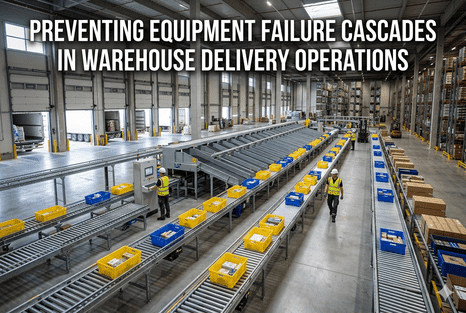
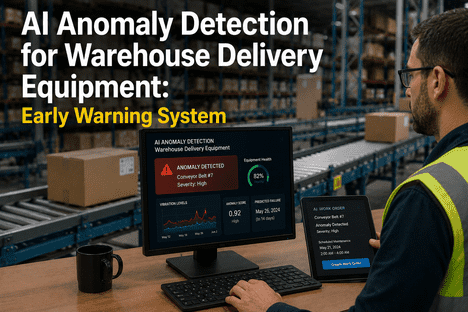
In an automated warehouse, equipment failures are rarely isolated events. A single conveyor fault at a merge junction does not stop only that conveyor it cascades: upstream induction lanes back up within 90 seconds, the sortation system starves of inbound parcels within 3 minutes, downstream dock doors sit empty waiting for loads that never arrive, and outbound dispatch misses its cutoff window. The cost of that single initial fault multiplies by 8–12× through the cascade before any operator sees the root cause. Traditional maintenance monitoring uses fixed-threshold alarms on individual assets — a motor current spike here, a photoeye timeout there and triggers a work order for each symptom independently. No system connects the upstream conveyor fault to the downstream sorter starvation or the missed dispatch window. iFactory AI's predictive maintenance and Shift Logbook platform monitors equipment dependencies across the material flow path and detects cascade-triggering failure patterns before the first downstream impact occurs converting a facility-wide disruption into a scheduled intervention that protects outbound delivery performance. Book a Demo to see how iFactory prevents equipment failure cascades in automated warehouse delivery operations.
Cascade Prevention · Warehouse Delivery 2026
Preventing Equipment Failure Cascades in Warehouse Delivery Operations
Cost multiplier from single fault through downstream cascade
90 sec
Time for upstream conveyor fault to starve downstream sortation
15 min
Average cascade detection delay with single-asset threshold alarms
65%
Reduction in cascade-related dispatch failures with dependency-aware monitoring
Why Equipment Failure Cascades Are the Highest-Impact Blind Spot in Automated Warehouses
A modern automated warehouse is a tightly coupled system of conveyors, sortation loops, merges, diverters, lifts, and dock stations operating in sequence. Material flows from receiving through put-away to storage, then from storage to picking, sorting, and dispatch with every step dependent on the step before it. When a single asset in this chain fails, the effect propagates upstream and downstream through the entire material flow path. A sorter induction conveyor fault does not starve only that induction point it reduces the sorter's throughput, causing the sorter to run below its rated capacity, causing downstream divert chutes to receive fewer parcels, causing dock staging areas to accumulate incomplete pallets, causing dispatch trucks to leave with partial loads or miss their departure windows entirely. Traditional maintenance systems cannot see this cascade because they monitor assets in isolation each asset has its own alarm threshold, its own work order history, and its own maintenance schedule. iFactory's dependency-aware monitoring maps every asset's position in the material flow path and correlates anomalies across dependent assets to detect cascade-triggering failure patterns before the first downstream impact materialises. The platform models each asset's operational dependencies which upstream feeds it, which downstream it feeds and monitors the combined health of each material flow corridor.
Three Cascade Failure Patterns iFactory Detects Before They Reach Dispatch
01
Merge Junction Degradation That Cascades Into Sorter Starvation
In a warehouse induction system, multiple conveyor lanes merge into a single sorter induction conveyor. When one merge lane's drive motor shows bearing wear — detectable as a 12% vibration increase over baseline — the conveyor control system gradually reduces its speed to protect the motor, decreasing the merge lane's throughput by 15–25%. The sorter, designed to operate at 180 parcels per minute, receives 135 instead. The sorter's downstream divert chutes fill 25% slower, causing parcels to accumulate in the staging area. Within 12 minutes of the initial bearing degradation, the outbound dispatch dock has three incomplete pallets awaiting sorter throughput that never arrives. iFactory's cascade monitoring module tracks the merge lane motor vibration, compares it against the sorter's actual throughput, and flags the bearing degradation with a cascade risk score that includes the predicted downstream impact on dispatch completion rate. The maintenance team receives a single alert: replace the merge lane drive motor bearing within 72 hours — preventing 12–18 incomplete dispatch pallets per shift.
Dock Door & Staging Area Congestion That Blocks Outbound Flow
Dock staging areas are the final material buffer before outbound dispatch. When a sorter divert chute's pusher mechanism slows due to pneumatic cylinder wear, parcels accumulate on the chute and the staging area fills. The dock worker clearing the chute cannot build pallets fast enough, and the chute eventually reaches full capacity, triggering a sorter pause that stops all induction. The cycle time from initial pusher degradation to full sorter stop is 7–14 minutes. iFactory monitors each divert chute's pusher cycle time, staging area fill rate, and dock door departure schedule. When pusher cycle time increases by 15% or more above baseline, the platform cross-references the staging area fill rate and forecasts the dock door loading completion time. If the model predicts that the chute will reach capacity before the next truck's scheduled departure, it escalates the alert with the specific dock door, chute ID, and estimated impact on dispatch time. The maintenance team replaces the pusher pneumatic cylinder during the next scheduled low-activity window — before the staging area fills and the sorter pauses.
Cycle time anomalyFill rate forecastingDock departure protection
03
Lift & Vertical Conveyor Slowdown That Blocks Multi-Level Material Flow
Multi-level warehouses depend on vertical conveyors and goods lifts to move material between floors. A vertical conveyor's drive chain stretch of 3–5% above specification causes the system to run at 80% speed as the controller compensates for position drift. On the mezzanine level, pick stations on the feed conveyor run dry 40 minutes earlier each shift, reducing pick-face utilisation from 92% to 71%. On the ground floor, completed pallets queue at the lift infeed, blocking the sortation outfeed conveyor. Within 25 minutes, the ground-floor sortation area back-fills to the induction zone, cascading the slowdown to receiving. iFactory monitors vertical conveyor drive chain tension, motor current, and position encoder deviation as a combined health index. When the index crosses the cascade threshold, the platform generates a drive chain inspection work order with the specific chain section identified — enabling replacement during the next scheduled maintenance window rather than responding to a multi-floor material flow collapse during peak dispatch.
Combined health indexMulti-floor dependency modelPlanned chain replacement
How iFactory Models Equipment Dependencies and Predicts Cascades
iFactory is the AI software intelligence layer — not a conveyor or sortation equipment vendor. The platform integrates with your existing PLC telemetry, SCADA, CMMS, and WMS data to build a dependency model of every material flow path in your warehouse. The Shift Logbook captures operator observations — unusual conveyor noise, sorter jam frequency, dock staging congestion — alongside the continuous sensor stream, creating a cascade detection data fabric that no single-asset monitoring system can match.
Cascade Zone
Monitoring Sources
iFactory Detection Output
Downstream Impact Protected
Induction & Merge
Motor current · vibration · photoeye cycle · speed
Merge lane throughput drift · sorter starvation forecast
Prevents sorter induction loss and missorted parcels
Sortation Loop
Divert actuation time · chute fill rate · pusher cycle
Pallet build rate · dock door schedule · chute fill
Dock completion time forecast · missed departure risk
Protects outbound dispatch SLA attainment
Vertical Transport
Chain tension · encoder deviation · motor current · speed
Vertical conveyor health index · multi-floor cascade alert
Prevents multi-level material flow collapse
Receiving to Storage
Infeed conveyor status · put-away lane availability · lift cycle
Receiving-to-storage flow bottleneck detection
Prevents receiving dock back-up and trailer detention
Cascade Prevention Use Cases in Automated Warehouse Delivery
Merge & Sort
Merge-to-Sorter Cascade Detection & Prevention
Continuous
iFactory monitors each merge lane drive motor's vibration, current, and speed alongside the sorter's actual throughput. When a merge lane motor shows a 12% vibration increase — too small for a fixed-threshold alarm but detectable by the adaptive ML model — the platform cross-references the sorter's throughput deviation from rated capacity. If sorter throughput has dropped by 10% or more and one merge lane shows degrading motor health, the platform generates a cascade alert with the specific merge lane ID, the predicted throughput loss, and the estimated impact on outbound dispatch (incomplete pallets per shift). The maintenance lead receives a single action: inspect and replace the merge lane drive motor bearing within 72 hours. The cascade alert logs automatically to the Shift Logbook with full traceability.
DetectionMerge lane vibration + sorter throughput correlation
Outcome72-hr bearing replacement · 12–18 pallets per shift saved
Divert Chute Pusher Wear & Dock Congestion Forecasting
Continuous
iFactory tracks each divert chute's pusher actuation time, cycle count, and staging area fill rate. When pusher cycle time increases by 15% or more above baseline — indicating pneumatic cylinder or solenoid wear — the platform forecasts the time until the chute reaches full capacity based on the current fill rate. If the model predicts chute capacity saturation before the next scheduled dock door departure, a cascade alert is generated with the chute ID, the affected dock door, and the estimated departure delay. The alert includes a recommended part (pusher cylinder kit) from the equipment BOM. The maintenance team schedules replacement during the next break window, preventing the sorter pause that occurs when a full chute triggers the system's safety stop.
ForecastPusher cycle time + fill rate = chute capacity time
OutcomeSorter pause prevented · dock departure on time
Vertical Conveyor Chain Stretch & Multi-Floor Material Flow Protection
Continuous
iFactory monitors each vertical conveyor's drive chain tension sensor, position encoder deviation, motor current, and speed as a combined cascade health index. When the index crosses the threshold indicating 3–5% chain stretch, the platform models the downstream effect: mezzanine pick station utilisation will drop from 92% to 71% within 40 minutes as feed conveyor throughput declines, and ground-floor sortation outfeed will back-fill to induction within 25 minutes. The cascade alert specifies the vertical conveyor ID, the estimated time to material flow collapse on each affected floor, and the recommended chain section replacement part. The maintenance work order is generated automatically with the chain part number and required tools, enabling a planned replacement during the next low-activity window.
Reduction in cascade-related outbound dispatch failures
Dependency-aware monitoring vs single-asset threshold alarms
8–12×
Cascade cost multiplier prevented per root-cause intervention
Single bearing replacement prevents $35K–$85K in cascade costs
42 min
Average cascade detection time improvement vs single-asset alarms
From 15 min after downstream impact to 27 min before it occurs
1–2 wk
Platform deployment with pre-built cascade zone templates
Induction · sortation · dock staging · vertical · receiving
FAQ
The platform builds a dependency map automatically by analysing material flow data from your WMS and control system telemetry during the first week of deployment. Conveyor run states, photoeye sequences, motor current patterns, and divert actuation timing reveal which assets feed which downstream processes. The dependency model is refined as the Shift Logbook captures operator observations of material flow issues. No manual site survey or equipment reconfiguration is required for the initial cascade model — the platform learns dependencies from operational data.
No. iFactory is the AI software intelligence layer — not a sensor hardware vendor. The platform integrates with existing PLC telemetry, VFD data, photoeye signals, motor current sensors, and WMS data already streaming in your facility. For facilities without motor current or vibration sensing on every conveyor drive, the cascade model begins generating value from operator observations logged through the Shift Logbook — operators noting conveyor noise, sorter jam frequency, or dock congestion can trigger cascade alerts. Additional sensors can be added for higher detection precision but are not required for initial deployment.
A standard predictive maintenance alert reports that a single asset shows a degradation pattern — bearing wear on conveyor drive motor XYZ. A cascade alert reports that the degradation on asset XYZ will cause specific, measurable downstream impacts within a predicted time window — for example, "bearing wear on merge lane 3 drive motor will reduce sorter throughput to 135 ppm and cause 18 incomplete dispatch pallets within 12 hours." The cascade alert includes the root cause asset, every downstream asset affected, the estimated time to each downstream impact, and the recommended intervention. This enables maintenance to prioritise based on total operational impact rather than single-asset health scores.
Yes. iFactory connects to leading WMS platforms (Manhattan, Blue Yonder, SAP EWM, Oracle WMS), CMMS systems (Maximo, UpKeep, Fiix, Maintenance Connection), and SCADA platforms (Rockwell, Siemens, Wonderware) via REST API, flat file, or database connector. The cascade model ingests WMS throughput data, CMMS work order history, and SCADA telemetry simultaneously. Integration is completed during the first week of deployment with no rip-and-replace of existing systems. Every cascade alert is logged in the Shift Logbook with full traceability for root-cause analysis and continuous model improvement.
Deploy iFactory for Equipment Failure Cascade Prevention
AI-powered cascade detection platform that monitors equipment dependencies across your entire warehouse material flow path — induction, sortation, dock staging, vertical transport, and receiving. Dependency-aware anomaly detection converts a facility-wide disruption into a scheduled intervention that protects outbound delivery performance. Deploys in 1–2 weeks with no new sensor hardware required.