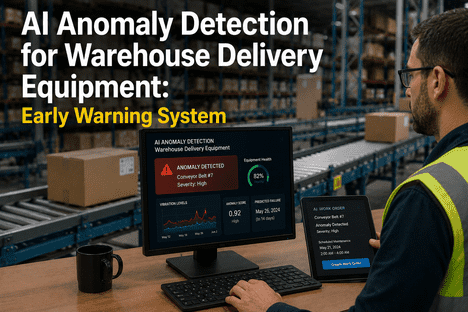
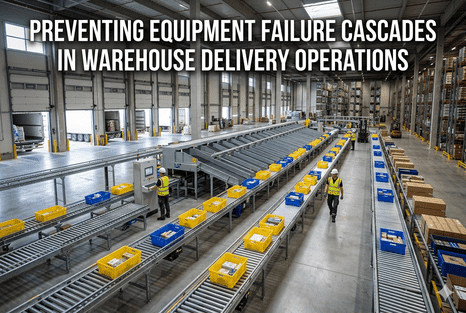
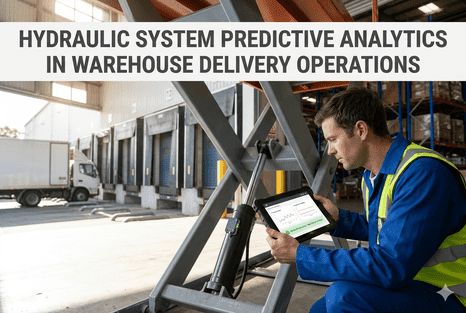
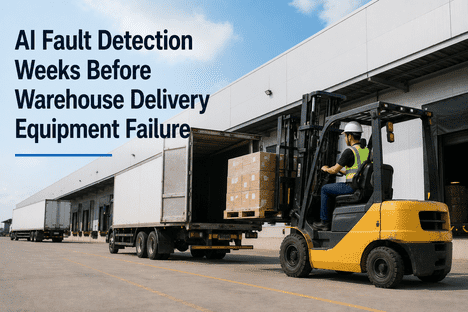
The vibration sensor on the conveyor section had been installed correctly. The data streamed past on a local HMI screen every second of every overnight shift for 11 days. Bearing degradation progressed through every textbook failure stage increased radial clearance, cage wear, rolling element pitting, outer race spalling and at 6:14 AM on a Sunday during peak holiday fulfillment volume, the bearing seized. 340 packages piled up behind the stoppage in under 90 seconds. Three connected sort lanes went down in the emergency shutdown cascade. The DC lost 6.5 hours of sortation capacity during the single busiest shipping weekend of the year. Emergency bearing replacement cost $4,200. Lost throughput, overtime labor, and carrier re-routing penalties represented $287,000 in single-event damage. The vibration data predicting this exact failure had been available the entire 11 days. The signal was there. No one was listening. AI anomaly detection closes this gap completely ingesting vibration, temperature, motor current, and acoustic data from warehouse conveyors, dock systems, and sortation equipment; learning what "normal" looks like for each individual asset; detecting subtle deviations weeks before failure; and auto-creating CMMS work orders during planned low-volume windows so technicians fix equipment on their schedule, not the equipment's. Book a Demo to see how iFactory AI deploys anomaly detection across warehouse delivery hubs in 6 to 8 weeks.
2-4 wks
Early warning lead time AI surfaces before equipment breakdown
$20K/hr
Fulfillment center cost during unplanned conveyor downtime events
2/3
Of industrial operators experience at least one unplanned downtime event monthly
6-8 wks
Deployment timeline from baseline audit to live AI anomaly detection
What AI Anomaly Detection Actually Does for Warehouse Delivery Equipment
Conveyor systems, dock equipment, and sortation lines generate enormous volumes of sensor data every second: vibration frequencies, motor current draws, belt speed variations, temperature readings, load cell measurements, and acoustic signatures. This data contains early warning signals for every mechanical failure mode — bearing degradation, belt misalignment, gearbox wear, roller seizure, motor stress, splice fatigue, and structural looseness. Traditional threshold-based monitoring generates too many false alarms (which operators learn to ignore) or too few alerts (which miss developing faults until catastrophic failure). The data is there. The problem is interpretation.
AI anomaly detection solves this by learning what normal looks like for each individual asset. Vibration amplitude increasing 2-5% per week over 4 weeks, bearing temperature rising 4°C over three weeks, divert actuator response time slowing 18 milliseconds, belt tension variance increasing 6% — each signal looks like normal operating drift in isolation. Together, AI recognizes them as a 30-day countdown to mid-shift failure. iFactory's anomaly detection engine ingests the data, runs continuous multi-signal correlation calibrated to actual failure physics, and auto-generates CMMS work orders during planned low-volume windows so the failure never happens.
Continuous Per-Asset Baseline Learning
AI learns the unique "normal" signature of every conveyor section, divert actuator, sorter, and dock leveler — capturing the subtle vibration, temperature, and current patterns that distinguish a healthy asset from one trending toward failure.
Multi-Signal Correlation Eliminates False Positives
Vibration, temperature, motor current, and acoustic signals correlated continuously — multi-signal confirmation prevents single-sensor noise from creating false alerts that operators learn to ignore. Staged watch/warning/action thresholds with predicted time-to-failure.
Failure-Physics-Calibrated Detection Models
AI models trained on actual failure libraries — bearing inner/outer race defects, cage wear, roller wobble, belt splice degradation, gearbox tooth wear — recognize specific frequency signatures weeks before seizure. Not generic anomaly detection but failure-mode-specific intelligence.
Auto-Generated Work Orders to Planned Windows
Action-threshold alerts auto-create CMMS work orders with component ID, fault description, recommended parts list, and suggested repair window aligned to fulfillment schedule data. Technicians repair during planned low-volume windows, not during peak fulfillment.
AI-Powered Shift Logbook Continuity
iFactory's Shift Logbook captures every anomaly detected, work order dispatched, and resolution outcome with AI summaries — ensuring 24/7 maintenance teams inherit full equipment health context across shift handovers without manual data entry.
Self-Tuning Model Feedback Loop
Every completed work order trains the model — fault confirmation, false-positive correction, and resolution outcomes feed back into the AI engine, improving detection accuracy over time. The system gets sharper at predicting failures as it learns your specific facility patterns.
Why Threshold Alarms and Calendar Maintenance Cannot Catch What AI Anomaly Detection Catches
Conveyors, dock systems, and sortation equipment generate failure signals 2-4 weeks before they break. Threshold-based monitoring misses these signals because individual readings remain within tolerance until catastrophic failure. Calendar maintenance misses them because actual condition varies daily with throughput, ambient temperature, and component age. The following comparison shows where traditional approaches fail versus what AI anomaly detection delivers.
| Detection Parameter |
Threshold Alarms + Calendar PMs |
iFactory AI Anomaly Detection |
| Bearing Degradation Detection |
Temperature alarm triggers only after bearing crosses absolute threshold — often hours before seizure. Vibration data discarded as "within range" throughout 11-day degradation cycle. |
AI recognizes vibration amplitude increasing 2-5% per week over 4 weeks as bearing-failure signature. Work order generated 14-21 days before seizure with specific defect type identified. |
| Belt and Splice Failures |
Visual inspection on monthly cycle. 90% of in-operation belt failures originate at splice points — undetectable from external observation until separation begins. |
AI tracks splice integrity, surface wear progression, and thickness changes through acoustic signatures and load cell variance — flagging splice degradation 2-3 weeks before visible failure. |
| Motor and Drive Stress |
Motor current alarms trigger only at overload threshold. Sustained 6-10% current increase over weeks looks like "normal load variation" until failure. |
Current draw trend rate-of-change monitored continuously. Multi-signal correlation with vibration and temperature identifies bearing-induced motor stress, belt drag, or gearbox tooth wear before motor failure. |
| Divert Actuator Health |
Response time tested only during scheduled functional checks. 18-millisecond actuator slowdown invisible to operators during normal operation; misroutes cascade until manual investigation. |
Actuator response time and cycle count tracked continuously. AI flags slowdown trends 30-60 days before failure mode reaches misroute threshold. Maintenance scheduled before sort accuracy degrades. |
| Multi-Sensor False Positive Management |
Single-sensor alarms produce hundreds of alerts per shift. Operators learn to ignore alarms; real failures missed when buried in noise. |
Multi-signal confirmation requires vibration + temperature + current correlation before action alert. False positive rate reduced 85-95% versus threshold alarms; operators trust and act on every alert. |
| Repair Window Optimization |
Emergency repairs during peak fulfillment hours at 2-3x standard labor cost and full throughput loss. Overtime authorization automatic. |
Work orders auto-routed to planned low-volume windows. Repair labor at standard rate, zero throughput loss, full parts availability. Emergency premium eliminated. |
Your Sensors Are Already Talking. AI Anomaly Detection Listens — and Acts.
iFactory AI ingests vibration, temperature, motor current, and acoustic data from your warehouse delivery equipment; runs continuous anomaly detection calibrated to actual failure physics; and auto-generates work orders that land on technician mobile devices during planned low-volume windows.
Book a Demo to see live anomaly detection applied to your equipment.
How iFactory AI Deploys Anomaly Detection Across Warehouse Delivery Equipment
iFactory follows a structured deployment process that delivers live anomaly detection within the first three weeks and full predictive work order automation by week eight. Each stage has defined deliverables so maintenance and operations teams see measurable improvement — not consulting cycles that produce dashboards no one acts on.
Weeks 1–2
Asset Audit, Sensor Survey, and CMMS Integration
Conveyor sections, dock equipment, sortation lines, and divert actuators catalogued by criticality and failure history. Existing sensor infrastructure surveyed; retrofit-mount IoT sensors specified for unmonitored high-priority assets. CMMS, WMS, and ERP integrations established via OPC-UA, MQTT, BACnet, Modbus, REST APIs. Digital Shift Logbook deployed.
Weeks 3–4
Baseline Learning and First Anomaly Alerts
Vibration accelerometers, temperature probes, current transformers, and acoustic sensors active. AI begins learning per-asset baseline behavior. First condition scores generated within 24-48 hours. Staged watch/warning/action alerts activate as the model gains confidence in per-asset patterns.
Weeks 5–6
Multi-Signal Correlation and Work Order Automation
Multi-signal correlation models active — vibration + temperature + current + acoustic signals fused for failure-mode identification. AI-generated work orders flow into CMMS with component ID, fault type, parts list, and recommended repair window aligned to WMS fulfillment schedule data.
Weeks 7–8
Self-Tuning Models Live and Multi-Site Rollout
Completion feedback loop active — every resolved work order trains the model for improved accuracy. Hub-wide anomaly detection live across conveyors, dock systems, sortation lines, and dispatch equipment. Multi-site rollout templates configured for additional fulfillment facilities.
MEASURABLE OUTCOMES FROM WEEK 4: FIRST ANOMALY DETECTION TYPICALLY PREVENTS A FAILURE WORTH ANNUAL PLATFORM COST
Warehouse operators completing iFactory's 6 to 8 week deployment report the first AI-prevented failure within 60-90 days — at $287K typical cost per prevented sortation outage event, that single detection covers annual platform cost immediately. By month 12, deployments report 40-65% reduction in unplanned downtime, 85-95% reduction in false-positive alarm fatigue, and emergency repair premium spend cut 70-85% as planned-window repairs replace reactive responses.
40-65%
Unplanned downtime reduction within first 12 months
85-95%
Reduction in false-positive alarm fatigue
70-85%
Emergency repair premium spend elimination
AI Anomaly Detection: Use Cases from Live Warehouse Deployments
The following outcomes are drawn from iFactory deployments at operating fulfillment centers and distribution hubs across e-commerce, 3PL, retail distribution, and parcel sorting operations. Each use case reflects 9 to 12 month post-deployment performance.
A national e-commerce hub running 80,000 parcels per peak shift deployed iFactory's anomaly detection across 18 sortation drives and 42 conveyor sections. Within 6 weeks, the AI flagged Drive 7 — vibration amplitude trending 3.2% increase per week over 4 weeks, paired with bearing temperature rising 0.4°C per week. Multi-signal correlation identified outer race defect with predicted seizure window 14-18 days out. Auto-generated work order scheduled bearing replacement during planned Sunday low-volume window for $4,200 labor and parts cost. Without detection, the same failure pattern would have caused the documented $287K sortation cascade scenario during peak fulfillment. Single prevented event covered full annual platform cost in week 6 of deployment.
Book a Demo to see bearing fault detection applied to your equipment.
$287K
Cascade cost avoided through 14-day early bearing detection
$4.2K
Planned-window repair cost vs reactive emergency baseline
68x
Cost ratio of reactive vs AI-detected repair on same failure
A regional distribution operator was generating 1,400+ threshold-based alarms per facility per week — overwhelmingly false positives from vibration spikes during normal load events, temperature swings from HVAC cycles, and current variations from soft-start motors. Maintenance teams across 12 facilities had stopped responding to non-critical alerts, missing actual developing faults buried in noise. iFactory deployed multi-signal correlation across the network. Within 90 days, alert volume dropped 91% to 124 alerts per facility per week — every one a confirmed developing fault. Operator trust restored; mean-time-to-acknowledge dropped from 4.2 hours to 11 minutes. Unplanned downtime reduced 54% network-wide within 12 months.
Book a Demo to see alarm noise reduction applied to your network.
91%
Reduction in weekly alarm volume across 12 facilities
4.2 hr → 11 min
Mean-time-to-acknowledge improvement
54%
Network-wide unplanned downtime reduction in 12 months
A 3PL parcel sorting operation was experiencing gradual sort accuracy degradation — read rates fine at 99.6%, but misroute rates creeping from 0.2% to 0.7% across peak season. Investigation traced the cause to divert actuator response time slowing 18-22 milliseconds over 60 days — invisible to threshold alarms, undetected by scheduled functional checks. iFactory deployed actuator response-time monitoring with AI trend analysis across 84 divert points. Within 30 days, the system identified 11 actuators trending toward misroute threshold. Replacement work orders scheduled during planned windows; sort accuracy restored to 99.8% and held through peak season. Annual misroute cost reduced $620K.
Book a Demo to see actuator analytics applied to your sortation operation.
11
Divert actuators trending toward failure identified in 30 days
$620K
Annual misroute cost eliminated through early detection
99.8%
Sort accuracy restored and held through peak season
Expert Perspective: Why the Failure Signal Was Always There — and What Changed
Industry Review — Warehouse Reliability Engineering Perspective
"Every catastrophic warehouse equipment failure I've investigated had the predictive data available before the event. The vibration trend. The temperature creep. The current draw signature. The data was on a sensor, in a historian, scrolling past a screen. What was missing was not the signal — it was the interpretation. Threshold alarms cannot interpret a 2.5% weekly trend; they only fire when the absolute value crosses a line. By then it's too late. AI changes the equation because it learns what the trend means before the line is crossed. The operators capturing real reliability gains are the ones who stopped trying to set better thresholds and started using AI to read the patterns thresholds cannot see."
Warehouse Reliability Engineering Director — Multi-Site Distribution Network (provided via iFactory deployment reference)
This perspective aligns with what reliability engineers consistently report across iFactory deployments: the highest-ROI gains come from interpretation, not from more sensors. The signals are already there in the existing instrumentation; AI makes them readable as failure predictions weeks before breakdown. Book a Demo to speak with iFactory's anomaly detection specialists about the patterns hidden in your existing sensor data.
Failure Signals 2-4 Weeks Ahead. Auto-Generated Work Orders. Live in 6 to 8 Weeks.
iFactory gives warehouse operators continuous AI anomaly detection across conveyors, dock equipment, sortation lines, and dispatch automation — with multi-signal correlation, failure-physics-calibrated models, planned-window work order generation, and Shift Logbook continuity, integrated with existing CMMS, WMS, and ERP without rip-and-replace.
Conclusion: AI Anomaly Detection Is Now the Standard for Warehouse Delivery Equipment Reliability
The case for AI anomaly detection in warehouse delivery operations has moved beyond evaluation. With fulfillment centers losing $20K per hour during unplanned conveyor outages, two-thirds of industrial operators experiencing at least one unplanned downtime event monthly, and failure signals demonstrably available 2-4 weeks before breakdown in existing sensor data, operators continuing to rely on threshold alarms and calendar-based maintenance are accepting cost and reliability risk that AI eliminates. Insurance carriers, customer SLA contracts, and corporate reliability programs increasingly expect AI-driven early warning as the baseline expectation, not an advanced capability.
iFactory's platform delivers the specific capabilities warehouse delivery operations require: per-asset baseline learning, multi-signal correlation eliminating false positives, failure-physics-calibrated detection models, auto-generated work orders aligned to fulfillment schedule data, AI-powered Shift Logbook continuity, self-tuning model feedback loop — integrated with existing CMMS, WMS, ERP, and sensor infrastructure through OPC-UA, MQTT, BACnet, Modbus, and REST APIs. The 6 to 8 week deployment program means measurable anomaly detection begins within weeks. Book a Demo to receive an AI anomaly detection assessment specific to your warehouse delivery operation.
Frequently Asked Questions About AI Anomaly Detection for Warehouse Equipment
What sensor data does iFactory's anomaly detection ingest?
Vibration (accelerometers), temperature (probes and thermal cameras), motor current (current transformers), acoustic emission, belt tension (load cells), and divert actuator response time. Existing sensor infrastructure is used wherever available; retrofit-mount IoT sensors are added only where high-priority assets are currently unmonitored.
How does multi-signal correlation eliminate false positives?
AI requires confirmation across multiple sensor streams before triggering action alerts. A vibration spike alone does not generate a work order; a vibration spike + temperature trend + current draw increase + matching failure-physics signature does. This reduces false-positive alarm volume 85-95% compared to threshold-based systems, restoring operator trust in alerts.
How quickly does AI anomaly detection show measurable results?
First condition scores typically generate within 24-48 hours of sensor activation. Staged anomaly alerts begin in weeks 2-3. First AI-prevented failure event typically detected within 60-90 days — usually covering annual platform cost in that single event. Full benefits (40-65% downtime reduction, 70-85% emergency premium elimination) compound by month 12.
What equipment types does iFactory anomaly detection cover?
The complete warehouse delivery equipment chain: induction conveyors, crossbelt carriers, tilt-tray units, divert actuators, scan tunnels, label readers, gap control systems, discharge chutes, dock levelers, dock seals, vehicle restraints, and palletizing equipment. Specific failure modes covered include bearing degradation, belt and splice failure, gearbox wear, motor stress, actuator slowdown, and structural looseness.
How does the AI-powered Shift Logbook support anomaly detection operations?
The Shift Logbook auto-captures every anomaly flagged, work order dispatched, repair completed, and false-positive correction with AI-generated summaries and photo evidence. Maintenance teams running 24/7 warehouse operations inherit full equipment health context at every shift handover — eliminating the blind spots that allow developing faults to escalate undetected across multiple shifts.
Deploy AI Anomaly Detection for Warehouse Equipment in 6 to 8 Weeks.
iFactory ingests vibration, temperature, current, and acoustic data — surfacing failure signals weeks ahead and auto-creating work orders in planned windows.
2-4 weeks early warning lead time
85-95% false positive reduction
40-65% unplanned downtime reduction