Every RaaS subscription comes with a promise: the provider handles uptime, maintenance, and software updates. What that promise quietly leaves out is the blind spot it creates inside your own facility — the gap between what the robot vendor's dashboard tells you and what your operations team actually needs to act on. When 23 AMRs, 4 collaborative palletizers, and a goods-to-person shuttle system each report health telemetry to three separate provider portals, your warehouse AI sees none of it. iFactory AI closes that gap by ingesting every RaaS robot's health stream — regardless of vendor — and orchestrating end-to-end uptime visibility in a single on-premise analytics engine.
Your RaaS Provider Manages the Robots. iFactory AI Manages the Uptime Gap They Leave Behind.
RaaS subscriptions shift maintenance responsibility to the vendor — but your AI platform still needs to see robot health data, orchestrate cross-fleet performance, and alert your team before SLA breaches cascade into missed shipments. iFactory connects every RaaS robot stream into one predictive operations layer. On-premise. No rip-and-replace. Live in 6–10 weeks.
The RaaS Uptime Problem Nobody Talks About
The global RaaS market is on track from $924 million in 2025 to nearly $9 billion by 2035 — logistics leads every segment, driven by warehouses deploying AMR fleets, autonomous mobile robots, collaborative palletizers, and goods-to-person shuttle systems on subscription contracts. The model works: no capital expenditure, instant scalability, built-in SLAs, and providers like Locus Robotics, Geek+, and InVia Robotics handling all hardware maintenance through their own cloud platforms.
But there is a structural problem every warehouse operations manager eventually confronts. Your RaaS provider's dashboard shows you their robots. Your CMMS shows your fixed assets. Your WMS shows order flow. None of them show you the interaction between all three — the AMR that's running at 78% battery efficiency because the dock charger hasn't been flagged, the palletizer that's cycling 0.4 seconds slower than its baseline because a conveyor infeed is misaligned, or the shuttle aisle that's logging micro-stalls nobody has connected to a pending bearing replacement. The provider's SLA guarantees 95–99% uptime on their hardware. It doesn't guarantee that your warehouse AI sees what's actually happening.
iFactory AI is the orchestration layer that connects every RaaS robot's telemetry — battery discharge curves, motor current signatures, navigation error rates, task completion latency — into the same predictive analytics engine that watches your dock equipment, racking sensors, and conveyor VFDs. One pane of glass. One alert queue. One shift-level dispatch view for your operations team.
Four Blind Spots RaaS Vendor Dashboards Create — and How iFactory Closes Each One
Cross-Fleet Correlation Is Invisible to Any Single Provider
When you operate Locus AMRs alongside Geek+ sorters and a third-party cobot palletizer, each provider sees only their own hardware. iFactory ingests all three telemetry streams simultaneously and runs cross-asset correlation models — detecting, for example, that your AMR throughput drops every time a conveyor photo-eye fault clears slowly, a pattern invisible to any single vendor dashboard. This cross-fleet intelligence is the difference between a reactive SLA claim and a proactive dispatch order issued 12 hours before the slowdown occurs.
SLA Uptime Percentages Hide the Hours That Cost You Most
A 99% uptime SLA sounds robust until you calculate that it permits 7–44 hours of downtime annually — and that providers are not contractually obligated to time those outages away from your peak shipping windows. iFactory monitors robot health in real time and surfaces degradation patterns 8–14 days before a threshold is breached, giving your team a window to negotiate scheduled maintenance during planned downtime rather than absorbing an unplanned outage during a Q4 peak. The vendor's SLA protects the vendor. iFactory protects your operations schedule.
Robot Health Data Doesn't Flow Into Your CMMS or WMS Automatically
Your RaaS provider's fleet management portal tracks task counts, error codes, and maintenance logs — but that data doesn't automatically generate work orders in your CMMS, adjust task allocation in your WMS, or flag a charging infrastructure issue to your facilities team. iFactory bridges all three systems: it ingests robot telemetry via OPC-UA, MQTT, or REST API, maps anomalies to your existing asset hierarchy, and auto-generates work orders in your CMMS the moment a robot health deviation exceeds its learned baseline. No manual data entry. No missed handoffs between the robot vendor and your internal maintenance team.
Seasonal Fleet Scaling Creates Analytics Gaps That Compound Over Time
One of the defining advantages of RaaS is the ability to scale your fleet up during peak season and down during slow periods. What that flexibility creates for your analytics platform is a model-retraining problem: when 15 additional AMRs join your floor for Q4, your baseline models don't know what normal looks like for the expanded fleet, and anomaly detection degrades precisely when throughput pressure is highest. iFactory's 200+ pre-trained machine learning models include fleet-scaling protocols that automatically re-baseline within 72 hours of a new robot onboarding event, maintaining predictive accuracy across every fleet configuration change your RaaS contract enables.
From Multi-Vendor Robot Streams to Unified Warehouse Intelligence in Four Steps
Ingest
iFactory connects to your RaaS provider APIs — Locus, Geek+, InVia, Fetch, 6 River, or any open-API platform — via native REST, MQTT, or OPC-UA. Battery telemetry, motor current, navigation error rates, task completion latency, and charging cycle data stream in at sub-second resolution.
Correlate
iFactory maps robot health data to your existing asset hierarchy — dock equipment, conveyor zones, charging infrastructure, racking bays — and runs cross-asset correlation models that detect interaction effects invisible to any single vendor dashboard.
Predict
Our library of 200+ pre-trained ML models learns the normal operating envelope for your specific fleet composition, facility layout, and shift pattern within 72 hours. Models detect degradation 8–14 days before failure thresholds, including bearing wear signatures, battery discharge curve deviations, and navigation latency drift.
Dispatch
iFactory auto-generates prioritized work orders in your CMMS, pushes alerts to your floor supervisor's tablet, and adjusts WMS task allocation to route around degraded robots — all before your RaaS provider's monitoring system flags an SLA event.
RaaS vendor SLAs protect the vendor's hardware. iFactory AI protects your warehouse throughput — by seeing what every robot in your facility is doing, regardless of provider. Book a Demo and we'll map your current RaaS provider APIs to a live pilot in under two hours.
Five RaaS Analytics Capabilities in One On-Premise Platform
Autonomous Mobile Robot Analytics
Monitors battery discharge curves, motor current trends, drive wheel wear indicators, and navigation error frequency across your entire AMR fleet — regardless of OEM. iFactory predicts which robot needs service next and schedules PMs during your planned maintenance windows, not during a peak shipping run.
Collaborative Robot Cycle Analytics
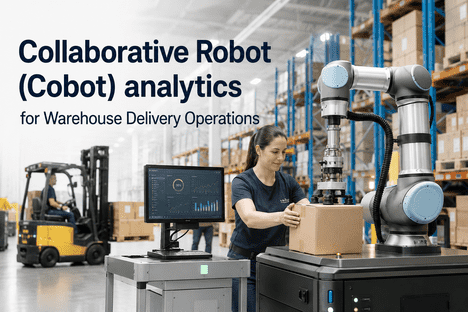
Tracks cycle time drift, payload variance, joint torque trends, and end-effector wear patterns on every cobot in your facility. A cobot palletizer running 0.4 seconds slow doesn't trigger a vendor alert — but it compounds into 90 minutes of lost throughput per 10-hour shift. iFactory catches it in hour one.
Shuttle & GTP System Uptime
Ingests shuttle vibration signatures, rail alignment sensor data, and motor current draw from goods-to-person systems across every aisle. iFactory detects the harmonic frequency that precedes a bearing failure 14 days before the manufacturer's recommended replacement interval, and adjusts pick scheduling to isolate the affected aisle.
Robot Charging & Power Analytics
AMR and AGV uptime depends not just on the robots but on the charging stations, power distribution circuits, and floor layout that sustains them. iFactory monitors charging cycle efficiency, dock power draw, and battery temperature trends — surfacing infrastructure failures that your RaaS provider's SLA never covers because they're your assets, not theirs.
Dynamic Fleet Re-Baselining
When your RaaS contract scales up for peak season — adding 10, 15, or 20 robots to your floor — iFactory automatically re-baselines its predictive models within 72 hours of each onboarding event. Anomaly detection stays accurate across every fleet configuration change, without manual model retraining or an IT project.
Robot Safety System Monitoring
Cross-references AMR e-stop activations, collision sensor triggers, and speed-zone violations with production schedules and facility traffic patterns. iFactory surfaces recurring safety events — like the 2:45 PM AMR-forklift conflict at bay 12 — so you can address the root cause in layout or scheduling before it becomes a near-miss report.
Why RaaS Analytics Orchestration Is Now a Warehouse Operations Requirement
The RaaS market for logistics alone is projected to grow from $924 million in 2025 to $8.93 billion by 2035 at a 25.46% CAGR — the fastest-growing segment in industrial automation. By 2024, nearly half of surveyed warehouses were already using some form of robots, up from just 23% in 2022. As multi-vendor RaaS deployments become the norm rather than the exception, the operational complexity of managing robot health data across provider silos grows proportionally.
Without iFactory
- Three provider dashboards, zero cross-fleet correlation
- SLA uptime metrics that hide peak-hour failure risk
- Robot health data stranded in vendor portals, never reaching your CMMS
- Manual re-baselining required every time fleet scales up or down
- Charging infrastructure failures invisible to RaaS provider SLAs
- Safety event patterns identified after the incident report, not before
With iFactory
- Single pane of glass across every RaaS vendor, every robot class
- Degradation alerts 8–14 days before SLA threshold is breached
- Auto-generated CMMS work orders from robot telemetry anomalies
- 72-hour automatic re-baselining on every fleet scaling event
- Charging and power infrastructure analytics included in the same platform
- Safety pattern detection before the near-miss, not after
What iFactory Delivers on Your RaaS Investment in the First Year
Your RaaS Robots Are Generating Health Data Your Warehouse AI Has Never Seen
Every AMR, cobot, and shuttle in your facility is already broadcasting telemetry your operations team can't act on because it's locked in a vendor portal. iFactory connects every stream, correlates every signal, and surfaces the failures before your next peak window. On-premise, no cloud dependency, live in 6–10 weeks.
Questions Operations Leaders Ask Before Connecting Their RaaS Fleets to iFactory
Connect Your RaaS Fleet Data to iFactory in 6–10 Weeks
Map every provider API, every robot class, and every supporting asset to a single predictive analytics engine — on-premise, no cloud, no rip-and-replace. We'll connect to your live RaaS telemetry in under two hours during a demo and show you the cross-fleet patterns your vendor dashboards have never surfaced.