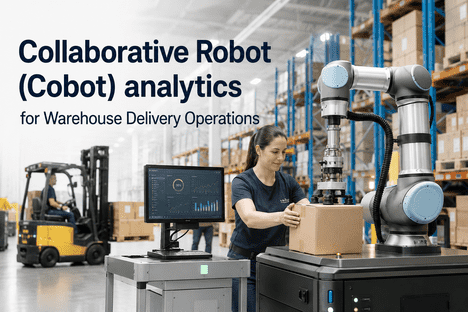
Collaborative robots — cobots — are now deployed in over 34% of large distribution and fulfillment centers globally, working shoulder-to-shoulder with warehouse staff on picking, packing, palletizing, and goods-to-person delivery tasks. But unlike fully autonomous systems that operate in segregated zones, cobots operating in shared human workspaces generate a fundamentally different category of analytics challenge: every performance metric, every safety interaction, every throughput deviation, and every collaborative cycle must be tracked, analyzed, and acted on in real time — because in a human-robot shared environment, an uncorrected cobot drift is not just a productivity problem, it is a safety incident waiting to happen. Traditional warehouse management systems were designed for human workers and fixed automation. They have no native capability to track cobot collaborative cycle times, monitor force-limiting sensor drift, correlate human-robot handoff efficiency with shift composition, or predict when a cobot's payload calibration is degrading before it causes a mis-pick or collision near-miss. iFactory AI's on-premise platform fills this gap — delivering cobot-native analytics that tracks collaborative performance, predicts mechanical degradation, and surfaces operational insights that keep your human-robot teams running at peak throughput without compromising worker safety. Book a Demo to see how iFactory AI tracks, analyzes, and optimizes cobot performance across your warehouse delivery operations.
Cobot Analytics for Warehouse Delivery Operations: AI-Tracked Human-Robot Collaboration That's Safe, Calibrated, and Measurably Productive Every Shift
iFactory AI monitors collaborative robot performance, safety sensor health, handoff efficiency, and cycle time drift in real time — predicting mechanical degradation 48–72 hours before it causes a safety event or throughput loss. On-premise. No cloud dependency. Works with all major cobot OEMs.
Cobots in shared human workspaces need a fundamentally different analytics strategy than fully autonomous systems
A fully autonomous robot operating in a segregated zone fails in one of two ways: it stops working, or it produces incorrect output. Either way, humans are not in the blast radius. A cobot operating in a shared human workspace can fail in a third way that autonomous systems cannot: it can drift — in payload calibration, in force-limit sensitivity, in collaborative cycle timing — in ways that are invisible to the human operator standing two feet away until the moment of contact.
Standard warehouse analytics platforms track orders per hour, pick accuracy, and conveyor throughput. None of them track the 23 parameters that determine whether a collaborative robot operating in ISO/TS 15066 power-and-force-limiting mode is operating within safe contact force thresholds at the start of the night shift versus the end of it. iFactory AI does.
Force-Limit Sensor Drift Creates Invisible Safety Risk in Shared Workspaces
Cobot force-torque sensors used for ISO/TS 15066 power-and-force-limiting (PFL) mode calibrate within ±2% on installation. After 6–9 months of continuous operation in a warehouse environment — temperature cycling, vibration from conveyor infrastructure, and repeated payload variation — sensor drift of 8–14% is common. At that level, the cobot's force-limiting response is operating outside the design envelope. The robot still passes its daily self-check, because the drift is below the self-check threshold. But it is no longer limiting contact force to the 140N transient limit specified in ISO/TS 15066. No standard WMS alert surfaces this. iFactory AI does — detecting force sensor drift through statistical deviation analysis 48–72 hours before it crosses the safety-critical threshold.
Collaborative Cycle Time Drift Erodes Throughput Invisibly Over Weeks
A goods-to-person cobot cell operating at 420 collaborative cycles per shift on day one of deployment may be running at 371 cycles per shift six months later — an 11.7% throughput loss that appears in no individual shift report as an alarm, because the degradation is gradual. The causes are multiple: joint lubrication thinning increases cycle time by 0.3 seconds per motion segment; handoff zone micro-positioning errors require human partners to reposition before acceptance; payload gripper compliance increases re-grasp rates. iFactory AI tracks cumulative cycle time drift at the sub-second level and correlates it with specific mechanical indicators — surfacing root cause before the loss compounds into a capacity shortfall that misses peak season throughput targets.
Human-Robot Handoff Efficiency Varies by Shift Composition — No One Is Measuring It
A cobot cell staffed with experienced operators achieves 94% handoff acceptance rate on the first pass. The same cell on a high-turnover overnight shift with newer staff achieves 78% — meaning 16% of all collaborative cycles require a re-present or re-grasp that adds 4–7 seconds to each transaction. Over a 10-hour shift at 420 cycles per hour, that 16% acceptance gap represents 67 minutes of lost throughput per cobot per shift. Without analytics that correlate handoff acceptance rate with operator ID, shift composition, and task type, warehouse managers cannot identify the training gaps or cobot configuration changes that would recover that capacity.
Joint Wear and Gearbox Degradation in Cobots Goes Undetected Until Positioning Errors Appear
Collaborative robots operating in warehouse picking applications execute 800,000–1,200,000 joint cycles per year. At that duty cycle, strain wave gearbox wear begins to manifest as positioning repeatability degradation — increasing from ±0.03mm at installation to ±0.12mm at 18 months. In a pick-and-place application with a 6mm target zone, that degradation reduces pick success rate by 7–12% before the cobot's internal fault detection triggers any alarm. iFactory AI detects this degradation through joint current signature analysis and cycle time micro-variance tracking — alerting maintenance 48 hours before positioning errors begin affecting pick accuracy.
Cobot Utilization Data Exists in OEM Systems That Don't Talk to Warehouse Operations
Universal Robots, FANUC CRX, KUKA iiwa, ABB GoFa, and Doosan cobots each generate rich operational telemetry — joint torques, cycle counters, error logs, TCP force data, and program runtime statistics. But this data lives in the OEM's proprietary controller interface and is never integrated with the warehouse's order management, shift scheduling, or production monitoring systems. Warehouse managers make cobot deployment and staffing decisions without access to the data that would tell them which cobot cell is underutilized, which shift composition drives the highest handoff rejection rates, and which cobot is 200 operating hours away from a joint service interval.
Cobot analytics is not an OEM feature — it is a systems-level capability that requires integrating robot telemetry with warehouse operations data, shift management, and predictive maintenance intelligence. Book a Demo and see how iFactory AI brings all of this together on a single on-premise platform.
What changes when your warehouse cobot fleet gets AI-native analytics and predictive monitoring
Without iFactory Cobot Analytics
- Force sensor drift goes undetected until a contact event triggers an incident report — by which time the cobot has been operating outside its safety envelope for weeks
- Cycle time degradation shows up as a throughput shortfall at the quarterly OEE review — six weeks after the root cause could have been addressed
- Human-robot handoff acceptance rates are never measured — training gaps and configuration mismatches persist across hundreds of shifts
- Cobot joint service intervals are calendar-based — some joints over-serviced, others allowed to wear beyond optimal condition
- OEM telemetry data is trapped in proprietary controller interfaces with no connection to warehouse operations or shift management systems
With iFactory Cobot Analytics
- Force sensor drift is detected through statistical deviation analysis 48–72 hours before crossing safety thresholds — maintenance is scheduled proactively, zero contact incidents from sensor drift
- Cycle time micro-variance is tracked at sub-second resolution — root cause identified and corrected within the same shift it begins to manifest
- Handoff acceptance rates are tracked by operator, shift, cobot cell, and task type — training interventions and configuration changes are data-driven and specific
- Joint service intervals are condition-based — each joint serviced exactly when its wear signature indicates it is needed, extending gearbox life 20–35%
- OEM telemetry from all cobot brands is unified in iFactory's analytics layer — warehouse managers see fleet-wide cobot performance alongside order throughput, shift composition, and maintenance status
From cobot controller integration to live predictive analytics in 4–8 weeks — no OEM lock-in, no rip-and-replace
iFactory AI connects to your existing cobot fleet through standard robot communication protocols and OEM APIs — ingesting joint telemetry, force-torque data, cycle logs, and program runtime statistics from every collaborative robot in your facility. This data is unified with your warehouse operations data, shift management records, and order management system to deliver the cross-system intelligence that drives actionable cobot analytics.
Cobot Fleet Integration
iFactory connects to Universal Robots (UR+), FANUC CRX, KUKA iiwa, ABB GoFa, Doosan, Techman, and any MQTT or OPC-UA compatible cobot controller — ingesting joint torques, TCP force data, cycle counters, and error logs over your plant network.
Baseline & Signature Learning
AI models learn each cobot's normal operating signature — joint current profiles, cycle time distributions, handoff acceptance patterns, force-limit response curves — establishing the baseline against which drift and degradation are measured.
Real-Time Anomaly Detection & Prediction
Continuous monitoring detects force sensor drift, joint wear signatures, gripper compliance degradation, and handoff timing anomalies — surfacing predictive alerts 48–72 hours before performance or safety thresholds are breached.
Operations & Shift Integration
Cobot performance data is correlated with shift composition, operator assignments, order volumes, and task mix — giving warehouse managers the cross-system context to optimize human-robot team deployment, not just individual cobot performance.
Ready to add AI-native analytics to your warehouse cobot operations?
iFactory AI integrates with your existing cobot fleet in 4–8 weeks — no hardware changes, no OEM lock-in. You get real-time safety sensor monitoring, predictive maintenance, handoff efficiency analytics, and fleet-wide performance visibility across all cobot brands. Start with your highest-utilization cobot cell and see measurable throughput improvement within the first month.
Cobot analytics capabilities built into iFactory AI's warehouse operations platform
These capabilities are native to iFactory AI's on-premise platform — not a separate cobot monitoring tool that requires its own integration, licensing, and support relationship. Cobot analytics runs alongside iFactory's predictive maintenance, production monitoring, shift logbook, and work order management modules on the same infrastructure.
Force-Limit Sensor Drift Detection & Safety Monitoring
iFactory continuously monitors cobot force-torque sensor outputs against ISO/TS 15066 power-and-force-limiting thresholds. Statistical deviation analysis detects calibration drift 48–72 hours before it crosses safety-critical boundaries — triggering a maintenance alert and, if drift exceeds a configurable threshold, an automatic speed-reduction recommendation to keep collaborative operations within safe contact parameters pending service.
Joint Wear & Gearbox Degradation Prediction
Joint current signature analysis and cycle time micro-variance tracking detect strain wave gearbox wear, joint bearing degradation, and lubrication depletion 48 hours before positioning repeatability deteriorates enough to affect pick accuracy. Condition-based service alerts replace calendar-based joint service intervals — extending gearbox life 20–35% while eliminating both premature servicing and run-to-failure events.
Human-Robot Handoff Efficiency Analytics
Every collaborative handoff event is tracked — acceptance rate, re-grasp frequency, handoff zone dwell time, and operator response latency — by operator ID, shift, task type, and cobot cell. Handoff efficiency dashboards identify training gaps, configuration mismatches, and ergonomic issues that reduce acceptance rates, giving operations managers data-specific interventions rather than general retraining mandates.
Collaborative Cycle Time Tracking & Throughput Optimization
Collaborative cycle times are tracked at sub-second resolution for every cobot in the fleet. Cumulative drift is detected before it manifests as a reportable throughput loss — root causes (joint stiffness, gripper compliance, handoff zone positioning) are identified automatically and routed to the appropriate team (maintenance vs. operations vs. training) with specific recommended actions.
Gripper & End-Effector Health Monitoring
Gripper actuator current, grip force consistency, and cycle count data feed iFactory's predictive models. A pneumatic gripper seal wear trend or servo gripper compliance increase triggers an alert before mis-picks begin accumulating — preventing the pick accuracy degradation that typically goes undiagnosed for 2–3 days before appearing as a damage or mis-shipment report.
Fleet-Wide OEM-Agnostic Cobot Dashboard
Telemetry from Universal Robots, FANUC CRX, KUKA iiwa, ABB GoFa, Doosan, and Techman cobots is unified in a single iFactory AI dashboard — eliminating the OEM-by-OEM portal switching that prevents warehouse managers from seeing fleet-wide performance patterns. Cobot utilization, health status, active alerts, and throughput contribution are visible across every cell from a single interface.
Cobot analytics connected to iFactory's Shift Logbook — every shift, every cobot, every handover documented automatically
iFactory AI's Shift Logbook module captures cobot performance data automatically at every shift handover — no manual entry required. Outgoing shift supervisors see a complete cobot health summary: cycle counts, active alerts, force sensor status, any anomalies detected during the shift, and maintenance actions taken or pending. Incoming shift supervisors receive the same data as a structured handover briefing, ensuring that no cobot safety or performance issue is lost in the shift transition.
Automated cobot health summary at every shift handover
Cycle counts, force sensor status, active predictive alerts, and maintenance actions are automatically compiled into the Shift Logbook entry — zero manual data entry from supervisors at shift end.
Alert continuity across shift boundaries
Predictive alerts that are open at shift end are automatically carried forward in the Shift Logbook — incoming supervisors see pending cobot maintenance items without relying on verbal handover that misses critical safety context.
Shift-level cobot throughput and handoff efficiency reporting
Each Shift Logbook entry includes cobot utilization rate, collaborative cycle count, handoff acceptance rate, and throughput contribution — giving shift managers a quantified picture of human-robot team performance for every shift.
Everything included in iFactory AI's cobot analytics deployment for warehouse delivery operations
Multi-OEM cobot fleet integration
iFactory connects to all major cobot brands via standard protocols — UR+, FANUC, KUKA, ABB, Doosan, Techman — with no OEM lock-in and no rip-and-replace of existing robot infrastructure.
ISO/TS 15066-aware safety sensor monitoring
Force-limit sensor drift detection is calibrated against ISO/TS 15066 power-and-force-limiting thresholds — the standard that governs collaborative robot safety in shared human workspaces.
Predictive maintenance for joints, grippers, and end-effectors
Condition-based service alerts for every wear-prone cobot component — replacing calendar-based maintenance with data-driven interventions timed to actual degradation.
Handoff efficiency analytics by operator, shift, and task
Granular handoff acceptance rate tracking that identifies specific training gaps and configuration adjustments — not just aggregate throughput numbers.
Shift Logbook integration — automated cobot health handovers
Every shift handover includes an automatically generated cobot health summary — cycle counts, active alerts, sensor status, and pending maintenance — with zero manual entry required from supervisors.
100% on-premise — no cloud egress, full data sovereignty
The entire cobot analytics platform runs on your infrastructure. No robot operational data leaves the facility. Full compliance with warehouse cybersecurity and data governance requirements.
Questions warehouse operations and robotics teams ask about AI-native cobot analytics
Your Cobots Are Generating Data. iFactory AI Turns It Into Safety, Throughput, and Maintenance Intelligence.
iFactory AI connects to your entire cobot fleet — regardless of OEM — and delivers real-time force sensor monitoring, joint degradation prediction, handoff efficiency analytics, and automated Shift Logbook integration. Deploy in 4–8 weeks. Zero hardware changes. Start seeing cobot intelligence on your warehouse operations dashboard from day one.