Predictive analytics as a Competitive Advantage in Warehouse Delivery
By Arel Dixon on May 28, 2026
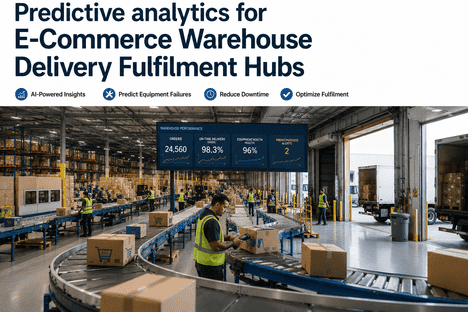
The warehouse delivery operations winning market share in 2026 are not just moving faster — they are maintaining smarter. Every SLA breach your competitor absorbs, every conveyor stoppage that pushes their outbound window past carrier cutoff, every forklift failure that forces a shift reallocation: these are not just their operational problems. They are your market opportunities — but only if your own operation runs on predictive analytics rather than reactive guesswork. iFactory AI's platform transforms warehouse analytics from a cost center into a strategic competitive advantage, integrating predictive maintenance, AI vision, production monitoring, and real-time OEE dashboards into the same system your team already uses. Book a Demo to see how predictive analytics fits into your delivery operations today.
200–400%
ROI achievable within the first year of predictive analytics deployment
20–50%
Reduction in forecast errors with AI-driven analytics (McKinsey)
40%
Fewer unexpected equipment failures with predictive maintenance
$17B
Predictive analytics market size by 2026, growing at 21.36% CAGR
Why Predictive Analytics Is the Real Competitive Moat in Warehouse Delivery
Warehouse delivery operations are no longer differentiated by speed alone. In 2026, the operations that win long-term contracts are the ones that deliver reliably — shift after shift, regardless of demand spikes, equipment wear, or carrier variability. Predictive analytics is what makes that reliability systematic rather than accidental. According to McKinsey's 2025 research, AI-driven forecasting reduces forecast errors by 20–50%, cuts lost sales and product unavailability by up to 65%, and lowers warehousing costs by 5–10%. For a 3PL, a distribution center, or an in-house delivery operation, those are not incremental improvements — they are the difference between winning a contract and watching a competitor take it. The organizations implementing predictive analytics today are building a structural cost and service advantage that compounds. Those waiting for a "right time" are falling further behind each quarter.
Analytics Use Case
What It Solves
Measurable Impact
iFactory AI Module
Demand Forecasting
Overstock, stockouts, poor shift planning
10–30% reduction in inventory carrying costs
Production Monitoring + Analytics Reporting
Predictive Maintenance
Unplanned conveyor, forklift, dock equipment failures
20–40% fewer unexpected breakdowns
Predictive Maintenance + Work Order Management
Labor Scheduling
Overstaffing, burnout, peak under-resourcing
15–25% improvement in labor efficiency
Team Management + Shift Logbook
Route & Carrier Optimization
Delivery delays, freight overspend, missed SLAs
25% improvement in shipping performance
OEE Analytics + Delivery Operations
Quality & Order Accuracy
Fulfillment errors, returns, customer complaints
Up to 99% order accuracy in fulfillment
Quality Control + AI Vision Camera
Five Predictive Analytics Capabilities That Separate Leaders From Laggards
Predictive analytics in warehouse delivery is not a single tool — it is a stack of capabilities that, when integrated, create compounding operational advantage. The five areas below represent where leading delivery operations are seeing the clearest ROI in 2026, and where iFactory AI's platform delivers measurable value from day one.
01
Demand-Driven Inventory Forecasting
Traditional warehouses plan on last month's data. Predictive analytics shifts the model to "what is likely to happen next" — integrating point-of-sale data, seasonal patterns, supplier lead times, and market signals into a unified forecast. iFactory AI's Production Monitoring and Analytics Reporting modules feed this forecast directly into replenishment workflows, eliminating manual intervention and reducing inventory carrying costs by 10–30% in the first year.
Every unplanned conveyor stoppage, every forklift hydraulic failure that forces a shift reallocation, every dock leveler that takes a loading bay offline at peak hours — these events are predictable if you have the right sensor data and analytics layer. iFactory AI captures IIoT telemetry from forklifts, conveyors, dock equipment, and refrigeration units, running it through predictive maintenance models that surface failure risk 48–72 hours before breakdown. Most facilities see their first prevented failure within 60–90 days of deployment.
IIoT sensor integration48–72hr early warningMcKinsey 10:1–30:1 ROI
03
Intelligent Labor & Shift Scheduling
Labor is the largest controllable cost in most warehouse delivery operations — and the most poorly predicted. iFactory AI's Shift Logbook and Team Management modules use historical throughput data, inbound order volumes, and seasonal demand patterns to generate shift plans that match staffing to actual workload. This avoids both underutilization and the burnout cycle that drives attrition in high-churn operations, while ensuring smooth handovers at every shift boundary.
Shift Logbook integrationDemand-matched staffing15–25% labor efficiency gain
04
Last-Mile Delivery & Route Intelligence
Predictive carrier selection and route optimization go beyond basic GPS routing. AI-powered systems analyze historical delivery logs, carrier performance data, traffic feeds, weather patterns, and vehicle health telemetry to recommend the best carrier for each shipment — not just on cost, but on reliability and ETA accuracy. Locus's routing engine processes 180+ variables simultaneously, compared to 20–30 in legacy TMS platforms. The result: AI-powered routing improves fleet efficiency by ~45% and delivery efficiency by up to 20%.
Fulfillment errors are the silent margin killer in warehouse delivery. Each mis-pick, damaged item, or incorrect label that reaches a customer costs 5–10× the original order value in reverse logistics, customer service, and reputational damage. iFactory AI's AI Vision Camera module validates every pick, placement, and package before it leaves the dock — delivering up to 99% order accuracy and closed-loop feedback to the warehouse management system for continuous improvement.
Real-time pick validationUp to 99% order accuracyClosed-loop feedback
06
SLA & Performance Analytics Dashboards
Predictive analytics without visibility is just data. iFactory AI's OEE Analytics and Automated Analytics Reporting give warehouse and delivery managers a single dashboard showing on-time delivery rate, fill rate, inventory turnover, equipment availability, and labor utilization — all updated in real time. Pre-miss SLA alerts reduce dispatch errors from 2–3% to under 0.3%, eliminating the SLA failures that generate customer complaints, re-dispatch costs, and penalty exposure before they happen.
Want to see how iFactory AI's predictive analytics platform maps to your specific warehouse and delivery operation? Book a Demo with our industrial analytics team for a use-case walkthrough built around your asset base.
How Predictive Analytics Deployment Works in Practice
The gap between "we have data" and "we have operational intelligence" is where most warehouse analytics projects stall. iFactory AI closes that gap by connecting your existing equipment, MES records, shift logs, and delivery data into a unified analytics layer — without requiring a data science team or months of IT development. The deployment pattern below reflects how leading warehouse delivery operations in 2026 are moving from reactive to predictive operations.
Scroll to see full deployment flow
Phase 1
Data Architecture Audit
Map existing data sources: WMS, ERP, sensor feeds, shift logs, carrier data. Identify gaps. iFactory AI integrates via OPC-UA, MQTT, BACnet, Modbus, and REST APIs — no rip-and-replace required.
Foundation
Phase 2
Sensor & IIoT Onboarding
Retrofit wireless IIoT sensors on forklifts, conveyors, dock equipment, and refrigeration in under 2 hours per asset. Existing BAS and SCADA connections activate immediately. Telemetry begins Day 1.
Quick win
Phase 3
Predictive Model Training
Predictive maintenance, demand forecasting, and SLA alert models begin training on your historical data. Basic routing and operational visibility improvements deliver measurable ROI within the first 90 days — before models reach full maturity.
90-day ROI
Phase 4
Dashboard & Alert Activation
Real-time OEE dashboards, pre-miss SLA alerts, labor scheduling intelligence, and AI Vision quality validation go live. Plant managers see robot-level, line-level, and facility-level KPIs in one view.
Operational visibility
Phase 5
Continuous Optimization
Models self-improve as more operational data flows in. Prescriptive recommendations replace descriptive reports. Autonomous decision loops adjust inventory buffers, reroute pickers, and preempt failures — compounding ROI each quarter.
Recurring value
Turn Your Warehouse Data Into a Competitive Advantage
iFactory AI's Predictive Maintenance, Production Monitoring, AI Vision Camera, Shift Logbook, and OEE Analytics platform connects your existing equipment and data into one operational intelligence layer — so your delivery operation runs reliably, every shift, without reactive firefighting.
Where U.S. Warehouse and Delivery Operations Should Focus First
Not every warehouse is ready for full-stack predictive analytics on day one. The operations that see the fastest ROI focus their initial investment on the two or three use cases where their current pain is most acute and their data is most structured. The following four areas represent where iFactory AI clients in warehouse and delivery operations see the clearest value within the first 90 days.
A
Equipment Uptime Is Your First Priority
A single unplanned conveyor failure during peak hours can cost more than a full year of predictive maintenance software. Start with IIoT sensors on your highest-criticality assets — forklifts, sorters, dock levelers, refrigeration — and let iFactory AI's predictive maintenance models build failure risk profiles from the first shift of data. Most clients prevent their first failure event within 60–90 days, which alone typically covers the platform's annual cost.
B
Shift Intelligence Before Labor Cuts
Labor analytics delivers faster ROI than headcount reduction. iFactory AI's Shift Logbook and Team Management modules use historical throughput data to match staffing to actual inbound and outbound volumes — reducing overtime costs during slow periods and eliminating under-resourcing during peaks. The shift handover record alone eliminates the verbal briefing gaps that cause the most avoidable errors in warehouse delivery operations.
C
SLA Analytics Before You Lose a Contract
Pre-miss SLA alerts are the single highest-leverage capability for operations with contract performance clauses. iFactory AI's OEE Analytics module tracks on-time delivery rate, dispatch error rate, and fill rate in real time — surfacing SLA risk before the breach occurs, not after the penalty invoice arrives. Reducing dispatch errors from 2–3% to under 0.3% eliminates 1–1.5 SLA failures per day for a 50-order facility, removing the customer complaints and re-dispatch costs that erode margins silently.
D
Quality Validation at the Dock, Not the Return Center
Fulfillment errors caught at the customer end cost 5–10× more than errors caught at the dock. iFactory AI's AI Vision Camera module validates every pick and package before it leaves the facility — delivering up to 99% order accuracy and generating a closed-loop quality record that feeds back into the WMS and training workflows. For operations shipping 500+ orders per day, this is the difference between a 0.5% return rate and a 3% return rate — a meaningful margin impact at any scale.
Ready to identify which predictive analytics use case delivers fastest ROI in your specific operation? Book a Demo and iFactory AI's team will build a use-case map against your current asset base and pain points.
Expert Perspective
"The warehouse delivery operations winning contracts in 2026 are not the ones with the lowest cost per pick — they are the ones with the most predictable cost per pick. Predictive analytics is what converts a warehouse from a reactive operation into a reliable delivery system. McKinsey's data is clear: AI-driven forecasting reduces errors by 20–50%, cuts product unavailability by up to 65%, and lowers warehousing costs by 5–10%. Those aren't incremental gains — they are structural competitive advantages that compound quarter over quarter. The operations that build their analytics layer now are the ones that will absorb the next demand spike, equipment failure, or carrier disruption without an SLA breach. The ones that wait will keep absorbing the cost of being reactive."
— Warehouse Operations & Industrial AI Analysis, 2026
65%
Reduction in lost sales and product unavailability with AI forecasting (McKinsey)
90 days
Typical time to first measurable ROI from predictive maintenance deployment
99%
Order fulfillment accuracy achievable with AI Vision quality validation
How iFactory AI Connects Predictive Analytics to Your Existing Stack
Predictive analytics is only as good as the software layer that connects it to operations. iFactory AI's platform is built specifically for industrial and delivery environments — integrating IIoT telemetry, shift records, quality data, and delivery performance metrics into one operational intelligence system that works alongside your existing WMS, ERP, and CMMS without rip-and-replace projects.
01
Predictive Maintenance
IIoT sensor integration with forklifts, conveyors, dock equipment, and refrigeration. Failure risk models surface 48–72 hours before breakdown, with automated work order generation so maintenance happens on your schedule, not the equipment's.
IIoT integrationAuto work ordersFailure prevention
02
Production Monitoring
Real-time throughput visibility across every line, bay, and zone. Track picks per hour, dock utilization, outbound volume, and inbound receiving speed against target — with alerts when any metric drifts before it becomes an SLA risk.
Structured shift handover records that eliminate the verbal briefing gaps responsible for the most avoidable errors in warehouse delivery. Every handover becomes a data record — feeding shift performance analytics and labor scheduling intelligence.
Digital handoversShift analyticsLabor scheduling
04
OEE Analytics
Per-asset and per-line OEE dashboards — availability, performance, quality — updated in real time. Pre-miss SLA alerts fire before a breach occurs. Delivery performance trends surface the systemic issues that cause recurring failures, not just the individual events.
Pre-miss SLA alertsPer-asset OEETrend analysis
05
AI Vision Camera
Real-time quality validation at the pick, pack, and dispatch stage. Every outbound order is checked for pick accuracy, labeling correctness, and packaging integrity before it leaves the dock — with closed-loop feedback to the WMS for continuous improvement.
Dock-level QC99% accuracy targetWMS feedback
06
Analytics Reporting
Automated monthly and weekly reports covering equipment health, delivery performance, labor efficiency, and quality metrics — generated without manual data extraction. Client SLA reporting pulls directly from live operational data, with no spreadsheet assembly required.
Build the Predictive Analytics Layer Before Your Competitors Do
Whether you are starting with predictive maintenance on your most critical assets, activating SLA alerts across your dispatch workflow, or deploying AI Vision quality validation at the dock — iFactory AI's platform gives you the data infrastructure and operational intelligence that turns a warehouse into a competitive delivery engine.
How quickly does predictive analytics deliver ROI in warehouse delivery operations?
Most warehouse and delivery operations see the first measurable ROI within 60–90 days of deployment. Basic routing optimization and operational visibility improvements — including reduced dock processing time and improved shift handovers — typically deliver measurable gains within the first 90 days, before predictive models reach full maturity. McKinsey data shows leading organizations achieve 10:1 to 30:1 ROI ratios within 12–18 months. For predictive maintenance specifically, a single prevented failure event within the first 60–90 days typically covers the platform's full annual cost. Predictive analytics can deliver 200–400% ROI within the first year, depending on your scale and current operational inefficiencies.
What data does iFactory AI need to start building predictive models for warehouse operations?
iFactory AI integrates with your existing WMS, ERP, BAS, SCADA, and fleet telematics systems via OPC-UA, MQTT, BACnet, Modbus, and REST APIs — no rip-and-replace required. For equipment without existing sensors, wireless IIoT sensors can be retrofit-mounted on any warehouse asset — forklifts, conveyors, dock equipment, HVAC, refrigeration — in under two hours per asset. Predictive models typically achieve optimal performance after 6–12 months of historical data, but basic analytics and SLA visibility improvements are live from Day 1. The platform is designed so that clean, structured data builds from the first shift — every gate event, receiving transaction, dispatch decision, and shift handover becomes a structured, timestamped record.
What is the difference between predictive analytics and reactive maintenance in warehouse delivery?
Reactive maintenance means your team fixes what already broke — after the conveyor stops, after the forklift hydraulic fails, after the SLA breach occurs. Predictive analytics surfaces failure risk and performance drift before the event, giving your team 48–72 hours of lead time to schedule maintenance, reroute workflows, and prevent the downstream impact. In warehouse delivery operations, the difference is not just maintenance cost — it is the SLA performance that determines whether you keep a contract or lose it. Every equipment failure during peak hours that your competitor absorbs is a market opportunity for your operation — but only if your own facility is running on predictive intelligence rather than reactive repair.
Which warehouse and delivery use cases should be prioritized for predictive analytics deployment first?
The highest-ROI starting points are typically: predictive maintenance on your most critical assets (conveyors, forklifts, dock equipment), pre-miss SLA alerts on your highest-penalty delivery contracts, and AI Vision quality validation at the dock for operations with a high return rate. iFactory AI's deployment approach starts with a data architecture audit to identify which of your existing data sources are structured enough to support immediate analytics value — then builds from there. Most clients start with one or two high-impact use cases and expand to full-stack analytics within 6–12 months as the platform's value compounds.
How does iFactory AI's platform differ from a standalone WMS analytics module?
A standalone WMS analytics module gives you historical reporting on what already happened — it cannot surface predictive risk, connect equipment telemetry to operational outcomes, or generate closed-loop feedback between quality validation and picking workflows. iFactory AI integrates predictive maintenance, production monitoring, shift intelligence, AI vision quality control, and OEE analytics into one platform — so your warehouse and delivery operation has a single operational intelligence layer that covers equipment health, labor performance, quality, and delivery reliability in one view. This integration is what converts data into competitive advantage, rather than just management reporting.