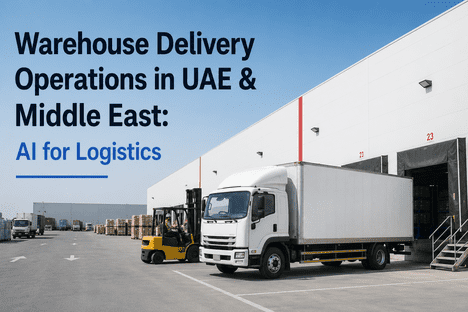
UAE and GCC warehouse and delivery operations are scaling at a pace that manual analytics simply cannot match. Noon's dark stores in Dubai and Abu Dhabi now promise 12-minute delivery windows. JAFZA hosts over 7,000 companies across 57 square kilometres — the largest free zone warehouse cluster in the Middle East. Dubai South processes 2.7 million tonnes of air cargo annually. More than 30% of all trade through Dubai moves as re-exports, touching GCC markets, Europe, Africa, and the US in a single corridor. The infrastructure is world-class. What is lagging behind is the operational intelligence layer — the platform that turns daily warehouse activity, shift handovers, delivery records, fleet compliance events, and asset maintenance logs into structured, searchable, analytics-ready data. Without that layer, scaling a UAE or GCC warehouse and delivery operation means scaling the risk of failure at the same rate as the revenue. iFactory AI gives Middle East logistics leaders the AI-powered analytics, digital shift logbooks, predictive maintenance, delivery operations management, and compliance documentation tools that keep every warehouse and every delivery fleet audit-ready and operationally visible — without replacing the systems already running. Book a Demo to see how iFactory AI fits your UAE or GCC operation.
Why UAE and GCC Warehouse Operations Can No Longer Rely on Manual Analytics
The GCC's logistics transformation is structural, not cyclical. Dubai CommerCity, JAFZA, Dubai South, DAFZA, and the growing network of free zones across the UAE have made the country the undisputed regional hub for trade between Asia, Europe, and Africa. Saudi Arabia's Vision 2030 logistics parks around Riyadh and Jeddah are adding capacity at scale. Same-day delivery has moved from differentiator to baseline expectation in UAE cities. This growth environment creates a specific operational challenge that manual analytics cannot solve: as order volumes, warehouse footprint, fleet size, and cross-border re-export complexity increase simultaneously, the documentation burden, compliance exposure, and maintenance risk scale at the same rate. UAE warehouse operators face a multi-layered compliance environment — licensing under DET, JAFZA, DAFZA, or DMCC jurisdiction, UAE Fire and Life Safety Code of Practice obligations, RTA fleet and vehicle dimension regulations, UAE customs and VAT reporting requirements, and for free zone operators, dual-layer federal and free zone compliance. Each of these frameworks requires structured, searchable, timestamped records. Manual systems — paper gate passes, handwritten shift notes, spreadsheet maintenance logs — cannot produce that documentation standard at speed.
The Five Operational Gaps Costing UAE Warehouse and Delivery Operators Most
Across UAE and GCC warehouse and delivery operations, the same five structural gaps appear repeatedly — in JAFZA multi-tenant 3PL facilities, in Dubai South distribution centres, in mainland depot networks, and in last-mile delivery fleets running 12-minute windows. Each gap is addressable. Each carries measurable operational and compliance cost if left open.
From Daily Operations to Continuous Intelligence: The iFactory AI Pipeline for GCC Logistics
iFactory AI's platform covers the full operational lifecycle for UAE and GCC warehouse and delivery operations — from asset maintenance and shift handovers through to delivery event analytics, inventory control, EHS incident management, and compliance documentation. Every module generates structured, timestamped records that meet the evidence standard that UAE regulatory frameworks require. The platform integrates with existing WMS, TMS, ERP, and SCADA systems — adding the analytics and compliance layer without replacing what already works.
iFactory AI Platform Modules for UAE and GCC Warehouse Operations
Every module in the iFactory AI platform is vendor-neutral and integrates into your existing operations stack. The platform is designed for staged deployment — go live with shift logbooks and asset management first, expand to delivery analytics, EHS, and inventory control as each module proves out ROI.
| iFactory AI Module | What It Does in UAE Warehouse Operations | Compliance Coverage |
|---|---|---|
| Digital Shift Logbook | Structured templates for every shift — equipment status, safety events, delivery activity, handover notes. Digital acknowledgement by incoming crew. AI summaries surface open items. | UAE WHS obligations, JAFZA/DAFZA operational records, safety audit documentation |
| Predictive Maintenance & EAM | Asset register for all forklifts, MHE, conveyor systems, dock equipment, and delivery fleet. AI-driven failure prediction 48+ hours ahead. Immutable maintenance records retained for asset lifetime. | Dubai Civil Defence fire safety, UAE plant maintenance obligations, RTA vehicle compliance records |
| Delivery Operations Management | Unified delivery analytics across all carriers and routes. SLA tracking, on-time performance scoring, route efficiency analysis, and automated alerts before delivery KPI breaches occur. | RTA fleet compliance documentation, UAE vehicle dimension and routing regulations, carrier due diligence records |
| Parts, Inventory & Stock Control | Multi-location inventory tracking across JAFZA, Dubai South, mainland depots, and GCC stock positions. Barcode and RFID integration. Full forward and backward lot traceability. AI-driven replenishment alerts. | UAE customs traceability, GCC re-export documentation, bonded warehouse inventory records |
| EHS & Incident Management | Structured incident reporting with photo attachments, corrective action tracking, and automated escalation. Integrates with safety zoning data and shift logbook entries to create a complete safety evidence trail. | UAE Federal Labour Law safety obligations, Dubai Municipality, JAFZA HSE requirements |
| Analytics & Audit Reporting | On-demand compliance evidence packages — structured, searchable, timestamped — covering every safety record, maintenance log, shift handover, delivery event, and inventory movement. OEE dashboards per facility. | DET licensing audits, JAFZA/DAFZA operational reviews, UAE corporate tax and VAT reporting support |
What the UAE and GCC Market Demands From Warehouse Analytics in 2026
The GCC's location — the natural crossroads between Asia, Europe, and Africa — means that warehouse and delivery operations here face a complexity profile that operations in single-corridor markets do not. The same UAE warehouse may be fulfilling domestic e-commerce orders on 12-minute windows, processing re-exports bound for Saudi Arabia under GCC rules of origin, managing bonded stock for a free zone tenant, and running a delivery fleet subject to RTA truck-safe route restrictions, all simultaneously. The analytics platform that serves this environment has to cover all of those scenarios from a single interface.
The UAE logistics market is fundamentally different from European or North American operations — we run 24/7, across multiple regulatory jurisdictions, with delivery windows that were considered impossible five years ago. The platform gap we had wasn't the warehouse management system — we had that. It was the analytics layer between operations software and the compliance evidence our free zone authority expected. Paper shift records and spreadsheet maintenance logs worked when the operation was smaller. At the scale we're running now, you need every shift handover, every maintenance action, and every delivery event generating a structured digital record automatically. The alternative is weeks of manual preparation before every audit cycle — and in this market, you don't have weeks.
— Head of Warehouse Operations, GCC 3PL Operator — JAFZA multi-tenant facilityThe ROI Case: What iFactory AI Pays Back in a UAE Warehouse and Delivery Operation
The return on an analytics and maintenance intelligence platform in a UAE logistics operation comes from four directions simultaneously — reduced equipment downtime, faster compliance preparation, fewer SLA breaches driven by operational data gaps, and the compounding operational improvement that comes from having accurate shift and delivery records informing management decisions in real time.
Conclusion: The UAE Logistics Opportunity Requires an Intelligence Layer, Not Just an Operations System
The GCC logistics transformation underway in 2026 is structural — driven by e-commerce growth, Vision 2030 infrastructure investment, Dubai South and JAFZA expansion, and the increasingly aggressive delivery expectations of UAE consumers. The operations systems — WMS, TMS, ERP — are largely already in place. What is lagging behind is the analytics and documentation layer that turns daily operations into the compliance evidence, maintenance intelligence, and delivery performance data that management decisions and regulatory audits actually require.
iFactory AI exists for exactly that gap — giving UAE and GCC warehouse and delivery operators the digital shift logbooks, predictive maintenance alerts, delivery analytics, inventory traceability, EHS documentation, and audit reporting that make compliance a byproduct of daily operations rather than a separate quarterly exercise. The platform integrates with your existing stack in 1–2 weeks. Book a Demo to walk through how iFactory AI applies to your UAE or GCC operation specifically.