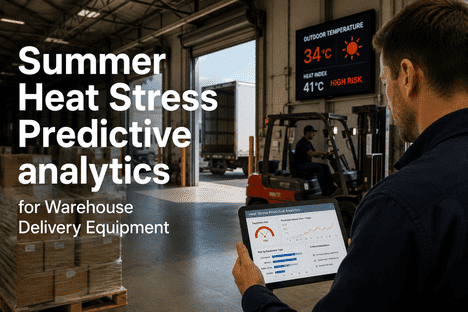
Summer heat is not just a comfort issue for warehouse delivery operations — it is a structural accelerator of equipment degradation that rewrites the failure timeline for every bearing, motor, belt, and drive component in the facility. When ambient temperatures in non-climate-controlled warehouse and delivery hub environments push past 95°F, the Arrhenius-based thermal acceleration of mechanical and electrical failure modes shifts predictive maintenance baselines that were calibrated during cooler months. A bearing that would run 18 months through fall, winter, and spring can fail in 6 to 8 months of continuous summer operation at elevated temperatures. A motor winding insulation system rated for 20-year life at 80°F ambient loses half its design life for every 15°F sustained temperature increase above the rated operating point. Conveyor belts in warehouse delivery sortation systems experience increased friction, elongation, and edge wear rates that triple during sustained summer heat exposure compared to winter baseline measurements. U.S. warehouse delivery hubs — parcel sortation centers, cross-dock terminals, last-mile delivery depots, and e-commerce fulfillment warehouses supporting same-day and next-day delivery networks — operate their highest-throughput months during the same calendar period when ambient heat stress on equipment is at its annual peak. The convergence of peak operational demand with peak thermal stress creates a failure window that generic, seasonally-naive predictive maintenance models systematically underestimate. iFactory AI's summer heat stress predictive analytics module applies seasonal thermal adjustment factors to every predictive model in the platform — automatically recalibrating failure probability estimates, maintenance interval recommendations, and alert thresholds based on real-time ambient temperature data and forecasted heat wave events — so warehouse delivery operators catch heat-accelerated failures before they strike during the highest-demand shipping periods of the year.
Is Your Warehouse Delivery Equipment Protected Against Summer Heat-Accelerated Failures?
iFactory AI delivers seasonal predictive analytics with thermal adjustment factors for bearings, motors, belts, drives, and HVAC systems — purpose-built for warehouse delivery hub equipment operating under peak summer heat conditions.
Why Summer Heat Demands Seasonal Predictive Analytics for Warehouse Delivery Equipment
Standard predictive maintenance models — deployed without seasonal thermal adjustment — assume that equipment failure rates are approximately constant across the operating year. In warehouse delivery hub environments where ambient temperature swings by 40°F or more between winter and summer peaks, that assumption generates systematically wrong failure probability estimates during the months when equipment is most likely to fail and most needed for production. The mechanism is well-understood in reliability engineering: the Arrhenius model establishes that chemical reaction rates — including oxidation of lubricants, degradation of insulation materials, and corrosion of metal surfaces — approximately double for every 15°F increase in operating temperature. For warehouse delivery equipment operating in unconditioned or partially conditioned spaces, the 90°F to 105°F summer ambient temperatures represent a fundamentally different operating regime than the 40°F to 60°F winter conditions under which many PM schedules and replacement intervals were originally established.
The operational consequence is that facilities running generic, non-seasonal predictive maintenance programs experience a statistically significant spike in equipment failures during July, August, and September — the exact months when parcel volume in U.S. warehouse delivery networks peaks by 18 to 35 percent above annual average due to back-to-school, e-commerce seasonal demand, and holiday inventory pre-positioning. The failure spike is not random bad luck; it is the predictable outcome of applying winter-calibrated maintenance intervals to summer operating conditions. iFactory AI's summer heat stress module solves this structural problem by integrating real-time ambient temperature data from on-site weather stations, NOAA heat forecast APIs, and facility HVAC zone sensors into every predictive model — automatically applying thermal acceleration factors to bearing wear estimates, motor insulation life projections, belt fatigue calculations, and lubricant degradation timelines. When a heat wave is forecast, the platform proactively adjusts inspection intervals, alerts maintenance teams to high-risk assets, and recommends pre-emptive interventions before temperature-driven failures occur. Facilities deploying iFactory AI's seasonal heat stress analytics achieve 32 to 48 percent reduction in heat-related equipment failures during summer peak months and extend the service life of temperature-sensitive components by 18 to 26 percent through thermally-informed maintenance scheduling. Book a Demo to see how seasonal thermal adjustment transforms your summer maintenance program.
The Four Equipment Types Most Vulnerable to Summer Heat Stress in Warehouse Delivery Hubs
Warehouse delivery hub equipment falls into four categories where summer heat stress produces distinct and measurable acceleration of failure modes. Each category requires a different thermal adjustment approach within the predictive analytics model — and each represents a specific value-protection opportunity when seasonal analytics are applied correctly.
Bearing and Roller Heat Acceleration
Warehouse conveyor systems contain thousands of bearings and rollers operating under continuous load. Summer heat accelerates lubricant degradation in bearing housings — grease oxidizes and loses viscosity faster at elevated temperatures, reducing its protective film thickness and allowing metal-to-metal contact that generates localized heating and rapid failure propagation. The result is a summer failure rate for conveyor bearings that is 2.5 to 4 times the winter baseline in unconditioned warehouse environments.
iFactory AI's thermal adjustment model applies an Arrhenius-based acceleration factor to every bearing in the asset hierarchy — automatically recalculating remaining useful life estimates based on real-time ambient temperature at the bearing location and adjusting inspection intervals from quarterly to monthly during sustained heat wave conditions.
- Lubricant oxidation rate doubles per 15°F above baseline operating temperature
- Bearing failure rate increases 2.5–4x in summer vs. winter in unconditioned spaces
- iFactory adjusts inspection intervals automatically based on real-time temperature data
- Pre-emptive bearing replacement during planned summer maintenance windows
- Vibration analysis baselines recalibrated for summer thermal conditions
- Heat-accelerated grease degradation tracked per bearing location in CMMS
Electric Motor and Drive Heat Acceleration
Electric motors powering warehouse delivery equipment — sortation drives, conveyor motors, hoists, and dock levelers — are the single largest category of heat-accelerated failure in summer operations. Motor winding insulation life follows a well-documented thermal degradation curve: for every 15°F sustained temperature increase above the rated insulation class operating point, insulation life is reduced by approximately 50 percent. In unconditioned warehouse environments where summer ambient temperatures are 90°F to 105°F, motor internal temperatures can exceed the Class B or Class F insulation rating by 25°F to 40°F on extended operating cycles.
Variable frequency drives are equally vulnerable — their power semiconductor junction temperatures rise with ambient conditions, and electrolytic capacitor life in VFD DC bus sections is directly temperature-dependent, halving for every 18°F temperature increase above rated operating conditions. iFactory AI's motor and drive heat stress module integrates motor-mounted temperature sensors, VFD internal temperature data, and ambient temperature monitoring to generate asset-specific thermal stress scores that determine when inspection, cleaning, or pre-emptive maintenance is required.
- Motor insulation life reduced by 50% per 15°F above rated operating temperature
- VFD capacitor life halves per 18°F above rated ambient temperature
- Internal motor temperatures can exceed insulation class rating by 25–40°F in summer
- Thermal stress scoring triggers pre-emptive maintenance before winding failure
- Motor cleaning and ventilation inspection scheduled based on heat accumulation data
- Drive parameter adjustment recommendations for high-ambient conditions
Conveyor Belt and Pulley Heat Acceleration
Conveyor belts in warehouse delivery sortation systems face a triple heat stress vector during summer months. Elevated ambient temperature increases belt elongation and reduces friction coefficient between belt and pulley surfaces — requiring higher tension to maintain drive traction, which in turn increases bearing loads at every pulley and idler station. Belt splice integrity is temperature-sensitive: hot vulcanized and mechanical splice strength degrades measurably above 100°F operating temperature, with splice failure rates increasing by 60 to 80 percent during sustained summer heat conditions.
Edge wear accelerates as belts track differently in heat-expanded conveyor frames, and belt carcass stiffness changes with temperature, affecting troughing and tracking behavior. iFactory AI's belt heat stress module correlates conveyor belt tension monitoring data with ambient temperature trends to predict when thermal conditions are creating elevated belt stress — enabling pre-emptive tension adjustment, splice inspection scheduling, and belt replacement planning before heat-driven failure stops a sortation line during peak shipping hours.
- Belt splice failure rate increases 60–80% during sustained summer heat conditions
- Thermal belt elongation requires tension adjustments that impact bearing loads
- Edge wear accelerates as heat-expanded frames affect belt tracking
- Belt carcass stiffness changes with temperature affecting troughing angles
- iFactory correlates tension data with ambient temp for pre-emptive adjustment
- Summer-specific belt inspection and replacement planning in predictive model
HVAC and Cooling System Heat Acceleration
HVAC systems in warehouse delivery hubs are both victims of summer heat stress and the first line of defense against it. As ambient temperatures rise, HVAC systems operate at peak load during the same period when their own failure susceptibility is highest — compressor motor winding temperatures rise, refrigerant pressures increase, condenser coil efficiency degrades, and the entire system operates closer to its design limits for longer continuous cycles. HVAC failure during summer peak operation not only creates a comfort issue but directly affects equipment reliability in the conditioned spaces it protects — control cabinets, motor control centers, and sensitive electronics that depend on ambient temperature control for their own thermal management.
iFactory AI's HVAC heat stress module integrates condenser temperature, compressor discharge pressure, evaporator superheat, and indoor-outdoor temperature differential data to generate a real-time HVAC thermal stress score — alerting maintenance teams when a system is operating outside its design envelope and predicting the remaining useful life of compressor, fan motor, and drive components under current and forecast thermal conditions.
- Compressor motor winding temperature rise accelerates during peak summer load
- Refrigerant pressure increases stress on system components at high ambient temps
- Condenser coil efficiency degrades as outdoor temperature rises above design point
- Control cabinet cooling failure directly affects motor drive and PLC reliability
- Real-time thermal stress scores predict compressor and fan motor remaining life
- Pre-emptive condenser cleaning scheduled based on summer ambient temperature accumulation
The True Cost of Summer Heat-Accelerated Equipment Failures in Warehouse Delivery Hubs
Most warehouse delivery operations track summer maintenance costs as a line item without distinguishing between normal wear and heat-accelerated failure. The cost distinction matters because the two categories respond to different management actions — and the heat-accelerated portion is the part that seasonal predictive analytics can prevent. Understanding the full cost stack of summer heat stress on warehouse delivery equipment is the foundation for building the investment case for iFactory AI's seasonal predictive analytics deployment.
Emergency motor rewinds, conveyor belt splice repairs, bearing replacements, and HVAC compressor failures during summer months carry 50 to 80 percent cost premiums over planned maintenance because of expedited parts procurement, after-hours labor rates, and the operational pressure to restore sortation capacity within hours rather than days.
Summer heat failures during peak shipping periods — when sortation capacity is already stretched to meet SLAs — create a compounding cost of lost throughput, missed delivery windows, and customer penalty fees that far exceeds the direct repair cost. A single conveyor bearing failure during a 40,000 parcel-per-hour sortation peak can trigger $15,000 to $45,000 in cascading operational losses.
Each summer of unmanaged heat stress permanently shortens the service life of motors, bearings, and belts — even for components that survive the summer without failing. A motor that runs five summers without seasonal thermal analytics may need replacement after 7 years instead of its 15-year design life, carrying a replacement capital cost that never appears in the maintenance budget.
Heat-stressed motors operate at reduced efficiency as winding resistance increases and cooling degrades, drawing higher current for the same mechanical output and increasing facility energy costs across every operating hour of summer peak production. The incremental energy cost of a motor fleet operating 5 to 8 percent less efficiently during the four highest-production months of the year adds up to tens of thousands of dollars per facility.
A conveyor belt failure that damages pulleys, idlers, and support structure; a motor winding failure that takes out the VFD and downstream controls; a compressor failure that leaks refrigerant and damages the entire HVAC system — secondary damage costs from cascading heat-related failures routinely exceed 3 to 5 times the cost of the initiating component failure and are almost entirely preventable with properly timed seasonal interventions.
Reactive vs. Calendar-Based Preventive vs. Seasonal Predictive Maintenance for Summer Heat Stress
Warehouse delivery operations typically address summer heat stress through one of three approaches — each with dramatically different cost and reliability outcomes. Understanding where your operation currently stands on this maturity scale is the starting point for building the seasonal predictive analytics program that matches your facility's risk profile and investment capacity.
| Dimension | Reactive — Fix on Failure | Calendar-Based Preventive | Seasonal Predictive with iFactory AI |
|---|---|---|---|
| Trigger | Heat-related failure event | Fixed calendar PM schedule (same intervals year-round) | Real-time ambient temp + forecast + asset-specific thermal model |
| Summer Failure Rate | 3–6x winter baseline — uncontrolled heat acceleration | 2–3x winter baseline — intervals not adjusted for thermal conditions | 1.1–1.4x winter baseline — thermal factors applied to all intervals |
| Repair Cost per Event | Emergency premium — 50–80% above planned maintenance cost | Standard rates — but failures still occur between scheduled PM intervals | Lowest — interventions scheduled before failure, standard procurement |
| Peak Season Impact | High — failures occur during highest throughput periods | Moderate — scheduled PM may conflict with peak production windows | Minimal — maintenance scheduled around production peaks using heat forecasts |
| Asset Life Impact | Shortened — cumulative heat damage across multiple summer cycles | Extended — but still losing life between fixed PM intervals during heat | Maximized — condition-based intervention before cumulative damage threshold |
| Energy Efficiency | Degrading — heat stress increases motor current draw system-wide | Stable — but temporary dips between summer PM cycles | Optimized — thermal condition maintained within design envelope year-round |
| Maintenance Labor | High — emergency callouts, overtime, weekend work during summer peaks | Moderate — scheduled but may over-service or under-service based on thermal load | Efficient — data-driven intervention timing matches actual thermal stress conditions |
| iFactory AI Support | Work order management, failure logging, cost tracking | PM scheduling, equipment-specific checklists, interval management | Thermal sensor integration, seasonal model adjustment, heat wave alerting, RUL prediction |
The gap between reactive and seasonal predictive maintenance widens during summer months — when the consequences of inadequate thermal management are amplified by peak production demand. iFactory AI moves facilities from reactive or calendar-based heat management to seasonal predictive analytics without requiring new sensor infrastructure or extended implementation timelines.
How iFactory AI's Summer Heat Stress Predictive Analytics Platform Protects Warehouse Delivery Equipment
iFactory AI's platform is designed specifically for the thermal reality of warehouse delivery operations — where non-climate-controlled environments, seasonal temperature swings, and peak-summer production pressure create a failure risk profile that generic predictive maintenance platforms do not address. The platform delivers unified seasonal analytics across every temperature-sensitive asset category in the facility.
Real-Time Thermal Monitoring Integration
iFactory AI integrates with on-site weather stations, facility zone temperature sensors, motor winding RTDs, bearing housing thermocouples, and VFD internal temperature probes — ingesting real-time thermal data at every level of the equipment hierarchy and correlating ambient temperature with asset-specific operating temperature for precise thermal stress calculation.
Seasonal Model Adjustment Engine
Every predictive model in the platform — bearing remaining useful life, motor insulation wear, belt fatigue accumulation, lubricant degradation — is automatically adjusted by seasonal thermal factors computed from real-time and forecast ambient temperature data, ensuring failure probability estimates remain accurate across the full annual temperature range.
Asset Hierarchy with Thermal Sensitivity Classification
Every asset in the equipment hierarchy receives a thermal sensitivity score — reflecting the component's documented failure acceleration rate with temperature. Motors, bearings, belts, drives, and HVAC components are classified by their Arrhenius acceleration factor and prioritized for seasonal analytics attention based on criticality and thermal risk.
Heat Wave Predictive Alerting
When NOAA heat forecast data or on-site temperature trends indicate an approaching heat wave, iFactory AI automatically generates asset-specific alerts identifying the equipment at highest thermal risk, recommending pre-emptive inspection actions, and adjusting maintenance schedules to protect critical assets before the heat event arrives.
Thermal OEE Analytics and Reporting
The platform correlates equipment thermal stress exposure with OEE data to generate summer-specific performance reports — quantifying the production impact of heat-related downtime events, documenting the cost avoidance achieved through seasonal predictive interventions, and providing the data foundation for next summer's maintenance planning cycle.
Thermally-Adjusted Work Order Generation
When thermal conditions cross pre-configured thresholds for any asset class, iFactory AI automatically generates preventive work orders with thermally-adjusted inspection checklists — ensuring maintenance teams execute the right tasks at the right frequency based on actual heat stress exposure rather than a static calendar schedule.
5-Step Summer Heat Stress Predictive Analytics Deployment with iFactory AI
Implementing seasonal predictive analytics for summer heat stress does not require a multi-year digital transformation project or a complete overhaul of existing maintenance programs. iFactory AI's deployment approach is designed for warehouse delivery operations — connecting to existing equipment, sensors, and data sources to deliver thermally-adjusted predictive models within weeks rather than months. Book a Demo to walk through this roadmap applied to your facility's specific equipment mix and thermal risk profile.
Thermal Sensitivity Asset Classification and Data Connection
Every temperature-sensitive asset in the warehouse delivery hub is classified by thermal sensitivity score — motors, bearings, belts, drives, and HVAC components receive documented Arrhenius acceleration factors based on OEM specifications and reliability data. On-site weather stations, facility zone temperature sensors, and existing equipment temperature probes are connected to the iFactory AI platform through standard industrial protocol interfaces.
Seasonal Model Configuration and Baseline Calibration
Predictive models for each thermal asset class are configured with seasonal adjustment factors — bearing life models calibrated with lubricant oxidation acceleration curves, motor insulation models with winding temperature degradation coefficients, belt fatigue models with thermal elongation and splice strength degradation parameters. Baseline failure probability distributions are established for winter, spring, summer, and fall operating conditions.
Heat Wave Alert Thresholds and Work Order Automation
Heat wave alert thresholds are configured for each thermal asset class — defining the temperature duration and magnitude combination that triggers pre-emptive inspection notices, accelerated PM scheduling, or immediate intervention recommendations. Automated work order templates with thermally-adjusted inspection checklists are built for each alert level and asset type, ensuring consistent maintenance response to heat events.
Maintenance Team Training and Seasonal Workflow Activation
Warehouse maintenance teams are trained on the thermally-adjusted work order workflow — understanding how to interpret heat stress severity indicators, execute summer-specific inspection and maintenance tasks, and document thermal condition data through the mobile interface. Seasonal workflows are activated with team-specific notification preferences and escalation paths for heat wave events.
Summer Performance Benchmarking and Continuous Model Refinement
After the first summer operating cycle with full seasonal analytics deployment, iFactory AI generates a validated performance report comparing heat-related failure rates, maintenance costs, and equipment availability against historical summer baselines. Model calibration adjustments are made based on the observed correlation between thermal stress exposure and actual failure events, refining accuracy for subsequent summer seasons.
Expert Review: What Reliability Engineering Research Documents About Summer Heat Acceleration in Warehouse Equipment
The reliability engineering and industrial maintenance research communities have accumulated substantial field data on the relationship between ambient temperature and equipment failure acceleration — from IEEE motor insulation life testing standards to bearing manufacturer lubricant degradation studies to conveyor belt OEM application engineering guidance. The consensus that emerges from this body of knowledge is clear: seasonal temperature variation is not a minor adjustment to predictive maintenance models — it is a first-order variable that determines whether failure probability estimates are accurate or systematically misleading during the months when equipment is most relied upon.
IEEE 841 establishes the thermal degradation curve for electric motor winding insulation that has been the foundation of motor reliability engineering for decades. The standard's Arrhenius-based model documents that motor insulation life is reduced by approximately 50 percent for every 15°F sustained temperature increase above the insulation class rated operating point. For warehouse delivery hub motors operating in unconditioned spaces where summer ambient temperatures add 25°F to 40°F to internal winding temperatures, the implication is that each summer month causes insulation damage equivalent to 3 to 5 winter months — a heat acceleration factor that seasonal predictive analytics must account for to generate accurate remaining life estimates.
- Motor insulation life halves per 15°F above rated temperature per IEEE data
- Summer ambient adds 25–40°F to motor internal winding temperature in unconditioned spaces
- Seasonal thermal adjustment prevents 3–5x underestimation of insulation wear rate
Bearing manufacturer SKF's lubrication engineering documentation provides detailed data on the relationship between operating temperature and grease life in rolling element bearings. The standard SKF grease life model shows that for mineral oil-based greases commonly used in conveyor bearings, grease life at 185°F is approximately 15 percent of grease life at 130°F — a thermal acceleration factor of 6 to 7x over a 55°F temperature range. In warehouse delivery hub conveyor systems where summer bearing housing temperatures can reach 160°F to 190°F during sustained operation, the acceleration of lubricant degradation means that bearings need grease replenishment at 2 to 4 times the winter frequency to maintain adequate lubrication film thickness.
- SKF grease life at 185°F is 15% of grease life at 130°F — a 6–7x acceleration
- Summer bearing housing temps of 160–190°F require 2–4x winter grease frequency
- Thermally-adjusted lubrication schedules prevent bearing failures from grease starvation
Conveyor belt OEM application engineering data, published by manufacturers including Continental, Fenner Dunlop, and Goodyear Engineered Products, documents the temperature sensitivity of belt splice integrity and belt carcass mechanical properties. Hot vulcanized splice strength — which depends on the chemical cross-linking of rubber compounds — degrades progressively at sustained operating temperatures above 100°F, with splice strength retention dropping from 95 percent at 80°F to approximately 65 to 75 percent at 120°F operating temperature. Belt elongation increases by 0.5 to 1.5 percent across the same temperature range, requiring take-up adjustment and increasing belt edge wear from frame thermal expansion effects.
- Splice strength retention drops from 95% at 80°F to 65–75% at 120°F operating temp
- Belt elongation increases 0.5–1.5% between winter and summer temperature ranges
- Frame thermal expansion affects belt tracking and edge wear rate during summer
Summer Heat Stress Predictive Analytics — Frequently Asked Questions
iFactory AI applies Arrhenius-based thermal acceleration factors to every predictive model in the platform — bearing remaining useful life, motor insulation wear, belt fatigue accumulation, lubricant degradation, and VFD capacitor aging — with adjustment factors computed from real-time ambient temperature data at each asset location. Unlike standard models that assume constant failure rates year-round, iFactory AI's seasonal engine recalibrates failure probability estimates daily based on actual temperature conditions and NOAA heat forecast data, generating asset-specific risk scores that reflect the current thermal environment rather than an annual average. For example, a conveyor bearing that shows 18 months remaining useful life in January will show 6 to 8 months remaining if that bearing operates through a sustained summer heat wave at 100°F+ ambient — and the platform automatically adjusts maintenance intervals, inspection frequencies, and alert thresholds to match the thermally-accelerated timeline.
iFactory AI integrates temperature data from four layers. Facility-level ambient temperature is sourced from on-site weather stations, facility HVAC zone sensors, and NOAA/NWS forecast API data for the facility location. Equipment-level temperature data is ingested from motor winding RTDs, bearing housing thermocouples, VFD internal temperature sensors, and conveyor belt surface temperature sensors where installed. Process-level temperature data from sortation system control cabinets, motor control center ambient sensors, and conveyor gearbox oil temperature probes provides additional granularity. Finally, historical temperature data from previous summer seasons is used to establish baseline thermal profiles and calibrate seasonal adjustment curves before the first summer of operation.
iFactory AI connects to existing temperature sensing infrastructure wherever available — PLC temperature input modules, building management system zone sensors, motor protection relay RTD inputs, VFD internal temperature data available through fieldbus communications, and conveyor system controller sensor networks. For facilities without existing temperature sensor coverage in critical areas, iFactory AI can deploy wireless temperature sensor nodes that communicate through LoRaWAN or Bluetooth mesh networks — typically installed in a single day without production interruption. The platform is designed to start delivering value with whatever temperature data is currently available and to improve model accuracy as additional sensor coverage is added over time.
The full iFactory AI summer heat stress predictive analytics deployment for a warehouse delivery hub — including thermal sensitivity asset classification, seasonal model configuration, temperature sensor integration, heat wave alert setup, maintenance team training, and workflow activation — typically completes in 6 to 8 weeks. For facilities already running iFactory AI's core predictive maintenance platform, the seasonal analytics module can be activated in 2 to 3 weeks since the asset hierarchy, sensor connections, and maintenance workflows are already in place. The deployment timeline is designed to ensure facilities are fully operational with thermally-adjusted predictive models before the start of summer peak season.
Comparable warehouse delivery operations deploying iFactory AI's summer heat stress predictive analytics achieve 32 to 48 percent reduction in heat-related equipment failures during summer peak months, 18 to 26 percent extension in temperature-sensitive component service life, 40 to 60 percent reduction in emergency repair cost premiums associated with summer failure events, and an average ROI of 5 to 8 times the annual platform investment within the first summer operating cycle. The most significant value driver is typically the avoidance of production-impacting failures during peak shipping periods — where each avoided sortation line stoppage during a 40,000 parcel-per-hour peak shift preserves $15,000 to $45,000 in cascading operational losses that would otherwise be attributed to maintenance-related downtime.
Summer Heat Stress Predictive Analytics: The Seasonal Intelligence Gap That Costs Warehouse Delivery Operations Millions
The convergence of peak summer temperatures with peak shipping demand creates a failure window that generic, seasonally-naive predictive maintenance programs systematically underestimate — not because the models are wrong, but because they were calibrated for average conditions that do not exist during the months when equipment is most stressed and most relied upon. The 2.5 to 4x increase in bearing failure rates, 50 percent reduction in motor insulation life per 15°F temperature rise, and 60 to 80 percent increase in belt splice failures during sustained summer heat are not hypothetical reliability concerns — they are documented, measurable, and predictable consequences of operating industrial equipment without thermal-aware maintenance analytics.
iFactory AI's summer heat stress predictive analytics module closes the seasonal intelligence gap by applying Arrhenius-based thermal adjustment factors to every predictive model in the platform — automatically recalibrating failure probability estimates, maintenance intervals, and alert thresholds based on real-time ambient temperature data and forecast heat wave events. The 32 to 48 percent reduction in heat-related equipment failures, 18 to 26 percent service life extension, and 5 to 8x ROI documented at comparable facilities are the outcomes of treating seasonal temperature variation as a first-order predictive variable rather than a background condition. Book a Demo to see iFactory AI's summer heat stress predictive analytics module configured for your warehouse delivery hub's specific equipment fleet, thermal risk profile, and peak season operational requirements.
Deploy iFactory AI Seasonal Predictive Analytics — Thermally-Adjusted Models Live in 6 to 8 Weeks
Join warehouse delivery hub operators using iFactory AI's summer heat stress predictive analytics to protect bearings, motors, belts, drives, and HVAC systems from heat-accelerated failures during peak shipping months — with Arrhenius-based thermal adjustment, real-time heat wave alerting, and automatically recalibrated maintenance intervals.