You're evaluating AI platforms for your warehouse delivery operation. Every vendor says the same things: "real-time visibility," "predictive analytics," "seamless integration." You have a shortlist of five platforms and a decision to make. The problem? Most comparison guides are written by software reviewers who have never managed a shift, never dealt with a carrier cutting off at 11:45 PM, never watched a conveyor go down during peak fulfilment. This guide is different. It's written for warehouse delivery operators — the people who care about equipment uptime, SLA compliance, fulfilment accuracy, and whether the platform actually works on a warehouse floor or just looks good in a demo. iFactory AI is built specifically for industrial operations, not generic logistics SaaS. Book a Demo to see how iFactory AI compares against the platforms on your shortlist.
WAREHOUSE DELIVERY OPERATIONS · AI PLATFORM COMPARISON · IFACTORY AI
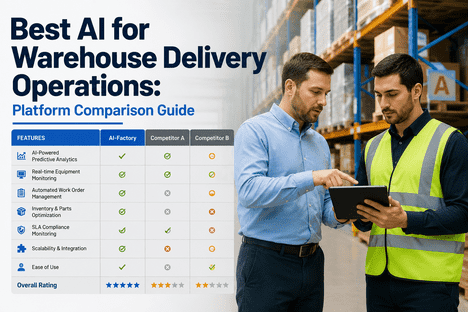
Best AI for Warehouse Delivery Operations: Platform Comparison Guide
Not all analytics platforms are built for warehouse delivery logistics. See how AI-powered platforms compare on equipment uptime, fulfilment accuracy, SLA compliance, predictive maintenance, and shift-level operational intelligence — the features that actually drive results at scale.
40%Faster Order Fulfilment
95%+Inventory Accuracy
–35%Equipment Downtime
30%Operational Cost Reduction
What Most Comparison Guides Get Wrong About Warehouse AI
Most AI platform comparison guides rank software on feature checklists: Does it have route optimization? Yes. Does it have real-time tracking? Yes. Does it have analytics dashboards? Yes. Every platform checks every box. That's not how warehouse delivery operations actually work.
What matters on the floor is different. When your conveyor stops at 9:30 PM on a Tuesday during peak fulfilment, you don't need a dashboard. You need an alert that fired 48 hours ago telling you the bearing was failing. When your SLA deadline is at 11:00 PM and three dock doors are backed up, you don't need a route map. You need prescriptive dock assignment that saw the congestion building an hour ago. When your auditor asks for 12 months of receiving records, you don't need a report generator. You need documentation that was auto-created for every single inbound event, timestamped, complete, and searchable in seconds. This guide evaluates warehouse delivery AI platforms on the operational dimensions that separate platforms that help you run a better warehouse from platforms that give you better charts about your already-broken operation.
The Five Dimensions That Actually Matter
After reviewing what operations teams consistently report as the highest-value capabilities: (1) Equipment uptime and predictive maintenance — does the AI prevent failures or just record them? (2) Fulfilment accuracy and dock throughput — does it improve inbound and outbound flow in real time? (3) SLA compliance intelligence — does it predict SLA breaches before they happen? (4) Shift-level operational continuity — does it keep knowledge intact across crew changes? (5) Integration depth — does it connect to your actual OT environment or just your ERP?
The Platform Comparison: What Each Category of AI Actually Delivers
Warehouse AI platforms fall into three broad categories. Understanding which category each platform belongs to tells you more than any feature comparison table.
Category 1: Generic Logistics SaaS
Platforms built for route optimization and last-mile delivery visibility. Strong on carrier management, customer tracking, and shipment notifications. Weak on warehouse floor intelligence: no equipment monitoring, no predictive maintenance, no shift logbook, no CMMS. Works well for 3PL coordination. Fails at operational uptime.
Category 2: Enterprise WMS with AI Bolt-On
Large ERP-connected platforms (Oracle, Manhattan, Blue Yonder) with AI features added to existing WMS architecture. Strong on inventory and order management. AI adds demand forecasting and labour planning. Predictive maintenance is typically an add-on module, not native. Implementation takes 12–18 months. ROI often delayed beyond 2 years.
Category 3: Industrial AI-Native Platform
Platforms built from the ground up for industrial operational intelligence — connecting OT sensor data, WMS feeds, shift records, and equipment health into a unified AI layer. Predictive maintenance is core, not add-on. Shift logbook is integrated. Equipment digital twins run continuously. This is where iFactory AI sits. Deployment in 8–12 weeks, not 18 months.
The Critical Difference: OT vs. IT Integration
Generic logistics SaaS integrates with your IT stack (ERP, TMS, OMS). Industrial AI platforms integrate with your OT environment — PLCs, conveyors, dock equipment sensors, RFID tunnels, AGVs. If your platform can't read equipment sensor data in real time, it cannot prevent unplanned downtime. Full stop. That's the line that separates operational platforms from reporting platforms.
Deployment Speed as a Quality Signal
If a platform requires 12+ months to deploy, it means the integration is complex, brittle, or dependent on consulting services. iFactory AI's OT-native connector architecture integrates with warehouse sensor infrastructure, WMS, and ERP through standard OPC-UA and MQTT protocols — live in 8 weeks. Faster deployment means faster value and lower implementation risk.
The Shift Logbook Problem Nobody Talks About
Every comparison guide evaluates AI analytics dashboards. Nobody evaluates shift logbooks. Yet shift handovers are where operational knowledge evaporates — and where compliance documentation gets lost. iFactory AI's digital shift logbook auto-captures every equipment event, inbound exception, and corrective action with timestamps and person attribution. No competing platform in the generic logistics category includes this natively.
Feature-by-Feature: iFactory AI vs. Generic Logistics Platforms
This comparison maps the operational capabilities that warehouse delivery managers consistently identify as highest priority against what each category of platform actually delivers in production environments.
| Capability |
Generic Logistics SaaS |
Enterprise WMS + AI |
iFactory AI |
| Equipment Predictive Maintenance |
✗ Not included |
△ Add-on module |
✓ Core, OT-native |
| Real-Time Sensor / IoT Integration |
✗ IT systems only |
△ Limited OT scope |
✓ PLC, OPC-UA, MQTT |
| Inbound Dock Throughput Analytics |
△ Basic reporting |
△ WMS-level visibility |
✓ Per-door, per-shift, per-carrier |
| SLA Breach Prediction (Pre-Breach Alerts) |
△ Post-breach alerts |
△ Rule-based triggers |
✓ AI pre-breach, fires before SLA closes |
| Digital Shift Logbook |
✗ Not available |
✗ Not available |
✓ Integrated, auto-timestamped |
| CMMS Work Order Auto-Generation |
✗ Not available |
△ Separate CMMS required |
✓ Native, triggered by AI anomaly |
| Fulfilment Accuracy Monitoring |
△ Carrier-level only |
✓ Order-level accuracy |
✓ Order + equipment + dock level |
| Audit-Ready Documentation (Auto) |
✗ Manual export |
△ Partial, manual effort |
✓ Auto-generated, person-attributed |
| Deployment Timeline |
△ 3–6 months |
✗ 12–18 months |
✓ 8 weeks |
| Delivery Fleet Predictive Maintenance |
△ GPS/telematics only |
✗ Not in scope |
✓ OBD-II + sensor-based AI |
The rows where generic platforms score ✗ are not minor gaps — they are the failure modes that cause unplanned downtime, missed SLAs, and failed audits. Book a Demo to see how iFactory AI fills each of these gaps for your specific warehouse and delivery operation.
The Three Scenarios Where Platform Choice Decides the Outcome
Abstract feature comparisons are useful. Real operational scenarios are more useful. Here are three situations that happen in warehouse delivery operations every month — and how each platform category responds.
Generic Platform Response
Scenario 1: Conveyor Failure During Peak Dispatch
The platform has no visibility into conveyor sensor data. Failure is detected when throughput drops on the dashboard — after the failure has already occurred. Operations team gets a notification: "Fulfilment rate below target." By this time, 90 minutes of sortation capacity is already lost. Carrier cut-off is missed for 340 orders.
Scenario 2: SLA Breach at 10:45 PM
Platform sends an alert: "SLA deadline in 15 minutes, 47 orders at risk." Operations manager sees the alert. There's nothing actionable at 15 minutes' notice. The orders miss the carrier window. The platform records the breach and generates a report. The same breach happens next week.
Scenario 3: Compliance Audit — 12 Months of Inbound Records
Platform provides shipment-level tracking data. Receiving documentation is in a separate WMS. Equipment maintenance records are in a separate CMMS. Deviation logs are on paper. Audit prep takes 3 weeks of manual aggregation across 4 systems. Auditor still finds documentation gaps.
iFactory AI Response
Scenario 1: Conveyor Failure During Peak Dispatch
48 hours before failure: iFactory AI detects bearing temperature +14°C above baseline and motor current drift. AI auto-generates a CMMS work order: "Conveyor Zone 3 bearing — schedule replacement within 36 hours." Maintenance team replaces bearing during a low-volume window. No unplanned stoppage. Carrier cut-off protected. Zero orders affected.
Scenario 2: SLA Breach at 10:45 PM
At 9:12 PM — 1 hour 48 minutes before cut-off — iFactory AI fires a pre-breach alert: "47 orders at risk based on current dock throughput and remaining pick time. Recommended: reallocate 2 pickers to Zone B, reassign dock door 6 to outbound." Operations manager approves. Orders ship. SLA met. Intervention window: 108 minutes, not 15.
Scenario 3: Compliance Audit — 12 Months of Inbound Records
iFactory AI auto-documented every inbound receiving event, dock assignment, equipment status change, and corrective action for 12 months — timestamped and person-attributed across a single searchable platform. Audit prep: 45 minutes. Auditor navigates directly to any date, any dock door, any event. Zero documentation gaps. Zero findings.
The difference between a reactive platform and iFactory AI is not a feature — it is the operational window between failure and prevention. Generic platforms measure what already happened. iFactory AI acts before it does.
IFACTORY AI · WAREHOUSE DELIVERY OPERATIONS · INDUSTRIAL AI PLATFORM
Stop Comparing Features. Start Comparing Operational Outcomes.
iFactory AI connects OT sensor data, WMS feeds, CMMS, shift logbooks, and delivery fleet telemetry into a single industrial AI platform — delivering predictive maintenance, SLA pre-breach intelligence, and audit-ready documentation for warehouse delivery operations. Deploy in 8 weeks.
iFactory AI: What the Platform Actually Includes for Warehouse Delivery
This is not a feature checklist. This is what iFactory AI delivers in a deployed warehouse delivery operation — the modules that run together as a unified platform, not separately licensed bolt-ons.
01
Predictive Maintenance & Equipment CMMS
Continuous OT-native monitoring across conveyors, dock levelers, RFID tunnels, AGVs, and forklifts. AI detects anomalies before failure and auto-generates CMMS work orders with component ID, fault description, and repair window based on fulfilment schedule data. Fleet vehicle predictive maintenance included via OBD-II and sensor integration — reducing delivery vehicle downtime by up to 35%.
02
Inbound Dock Throughput Analytics
Per-door, per-shift, per-carrier receiving analytics with AI-powered dock assignment recommendations. ASN verification and PO matching compressed from 45–60 minutes to under 10 minutes per inbound shipment. Discrepancy patterns analyzed automatically by supplier. Real-time WMS sync with barcode and RFID read rates up to 99.9%.
03
SLA Pre-Breach Intelligence
AI SLA-priority dispatch sequencing fires pre-breach alerts before delivery windows close — giving operations teams an actionable intervention window of 60–120 minutes, not 15. Error rates drop from 2–3% (manual dispatch) to under 0.3%. Every pre-breach alert includes specific recommended actions: reallocate pickers, reassign dock door, accelerate sortation sequence.
04
Digital Shift Logbook
Auto-captures every equipment status change, inbound exception, dock assignment event, maintenance action, and safety observation — timestamped and person-attributed. Incoming crews inherit full operational context without relying on verbal handovers. Compliance documentation generated automatically as a byproduct of daily operations. No competing platform in the logistics category includes this natively.
05
Production & OEE Analytics
Overall Equipment Effectiveness (OEE) monitoring across warehouse automation assets — conveyors, sortation systems, pick-and-pack lines. Availability, performance, and quality tracked continuously. Identifies hidden capacity losses in fulfilment equipment that throughput-only metrics never surface. Operators see exactly which assets are throttling their dispatch rate.
06
Delivery Fleet Operations Management
AI-powered pre-arrival scheduling, intelligent dock assignment, and gate event management for outbound delivery fleets. Every gate event, dispatch decision, and vehicle status update is AI-timestamped and traceable. Fleet predictive maintenance alerts integrate with the same CMMS used for warehouse equipment — one platform for the full delivery operation, not two separate systems.
The Questions to Ask Every Vendor on Your Shortlist
When you're evaluating platforms, these are the questions that separate operational platforms from reporting platforms. Any vendor that can't answer these directly is in the generic logistics SaaS category — regardless of what their demo looks like.
Q1: How does your platform connect to warehouse equipment sensors — not just WMS and ERP?
Generic platforms connect to IT systems. Industrial platforms connect to OT — PLCs, SCADA, vibration sensors, conveyor motor controllers. If the answer is "we integrate with your WMS," the platform has no visibility into equipment health. It can tell you throughput dropped. It cannot tell you why before the failure happens. iFactory AI connects via OPC-UA, MQTT, and direct PLC integration — reading sensor data in real time, not from downstream WMS records.
Q2: When an SLA breach is predicted, how far in advance does the alert fire?
Post-breach alerts are useless. Alerts that fire 15 minutes before cut-off give you time to escalate — not to fix. iFactory AI's pre-breach intelligence fires 60–120 minutes before the window closes, with specific recommended actions. Ask every vendor: what is your median pre-breach alert lead time? If they don't have an answer, their alerts are reactive, not predictive.
Q3: How is shift handover documentation captured — and how is it stored for compliance audits?
Most platforms have no answer to this question. Shift knowledge transfer is manual — verbal briefings, paper forms, WhatsApp messages. iFactory AI's digital shift logbook auto-captures every operational event with timestamps and person attribution. Ask: "Show me how a compliance auditor would retrieve 12 months of shift records for Dock Door 4." If the answer involves manual export from multiple systems, that's your gap.
Q4: What is your actual deployment timeline for a 300,000 sq ft distribution center?
Enterprise WMS platforms typically quote 12–18 months for full deployment. Generic SaaS quotes 3–6 months but excludes OT integration scope. iFactory AI deploys in 8 weeks from integration kick-off to live operational intelligence — because OT-native connectors are pre-built, not custom-coded. Ask for references from deployments that went live in under 3 months at comparable facilities.
Q5: Is predictive maintenance included in your base platform, or is it a separate module?
If predictive maintenance requires a separate purchase, a separate integration, or a separate vendor, your equipment monitoring will always be an afterthought to the platform's core roadmap. In iFactory AI, predictive maintenance and CMMS are core modules — not add-ons. Equipment health, work order generation, and operational analytics share the same data layer, so a bearing anomaly automatically surfaces in your fulfilment throughput forecast, not in a separate maintenance dashboard that nobody checks during peak shift. To compare iFactory AI against your current shortlist, Book a Demo with our warehouse operations team.
ROI Comparison: What the Numbers Look Like Across Platform Categories
ROI in warehouse delivery AI comes from four sources: equipment uptime, fulfilment speed, labour efficiency, and compliance cost reduction. The comparison below uses documented 2025–2026 industry benchmarks.
Generic Logistics SaaS ROI Profile
- Route optimisation: 8–12% fuel/mileage saving
- Carrier visibility: reduced exception management time
- No equipment uptime contribution (zero OT integration)
- No fulfilment floor improvement (WMS-layer only)
- Compliance documentation: manual, high cost
- Typical payback: 18–24 months
- Risk: platform adds analytics but not operational capacity
iFactory AI ROI Profile
- Equipment uptime: up to 50% reduction in unplanned downtime
- Fulfilment speed: 40% improvement via intelligent routing and dock analytics
- Inventory accuracy: 95%+ maintained continuously
- Operational cost reduction: up to 30% through predictive maintenance
- Compliance documentation: auto-generated, zero manual cost
- Typical payback: 6–18 months (leading cases under 6 months)
- Deployment: live operational intelligence in 8 weeks
Organizations running single-platform AI systems across warehouse and delivery operations report 40% fulfilment speed gains, inventory accuracy exceeding 95%, and 30% cost reductions — often achieving positive ROI in six months. The gap between AI-powered and traditional warehouse operations widens every quarter.
Frequently Asked Questions
Does iFactory AI replace our existing WMS or ERP?
No. iFactory AI layers on top of your existing WMS, ERP, and TMS through standard APIs and OT connectors. Your current systems continue running — iFactory AI adds an intelligence layer above them that connects equipment sensor data, shift records, and operational analytics into a unified platform. Most deployments complete integration without disrupting live warehouse operations.
How does iFactory AI's predictive maintenance differ from the maintenance module in our WMS?
WMS maintenance modules track scheduled service intervals — calendar-based PM. iFactory AI's predictive maintenance reads live OT sensor data (vibration, temperature, motor current, pressure) and detects failure signatures weeks before equipment stops. The difference: WMS tells you when to service based on time. iFactory AI tells you when to service based on actual equipment condition. Unplanned stoppages drop because AI prevents failures, not just schedules maintenance.
Can iFactory AI monitor both warehouse equipment and our delivery fleet vehicles?
Yes. iFactory AI covers the full delivery operation: warehouse equipment (conveyors, dock levelers, AGVs, RFID systems) via OT-native sensor integration, and delivery fleet vehicles via OBD-II and telematics integration. Both asset classes share the same CMMS, the same work order system, and the same predictive maintenance AI — giving you a single platform for warehouse uptime and fleet uptime, not two separate vendor contracts.
How long does it actually take to deploy iFactory AI at a distribution center?
Eight weeks from integration kick-off to live operational intelligence for a standard distribution center deployment. Week 1–2: OT sensor mapping and WMS/ERP data layer connection. Week 3–4: Digital twin deployment and predictive maintenance baseline establishment. Week 5–6: Shift logbook, CMMS, and SLA analytics activation. Week 7–8: Validation, documentation, and operator onboarding. Live production intelligence at week 8.
Book a Demo to get a deployment timeline specific to your facility size and existing infrastructure.
What makes iFactory AI's SLA pre-breach alerts different from standard threshold alerts?
Standard threshold alerts fire when a metric crosses a limit — after the problem exists. iFactory AI's pre-breach intelligence models the trajectory of your fulfilment operation against carrier cut-off windows, factoring in current dock throughput, active order volumes, equipment availability, and labour assignment. It predicts the breach 60–120 minutes before the window closes and fires an alert with specific recommended actions — not just a warning. This is the difference between having time to act and having time to escalate.
How does the shift logbook integration help with compliance audits?
iFactory AI's shift logbook auto-captures every operational event — equipment status changes, inbound exceptions, dock assignments, maintenance actions, safety observations — with AI timestamps and person attribution. When an auditor asks for 12 months of operational records for a specific dock door or delivery route, you retrieve them in seconds from a single searchable platform. Compliance documentation is generated as a byproduct of daily operations — zero manual export, zero reconstruction from memory, zero missing records.
READY TO COMPARE IFACTORY AI AGAINST YOUR SHORTLIST?
See iFactory AI Applied to Your Warehouse Delivery Operation — Live in 8 Weeks
Join warehouse and distribution center operators using iFactory AI to connect OT sensors, WMS data, delivery fleet telemetry, and shift logbooks into a single industrial AI platform — delivering equipment uptime, SLA pre-breach intelligence, and audit-ready documentation across the full delivery operation.