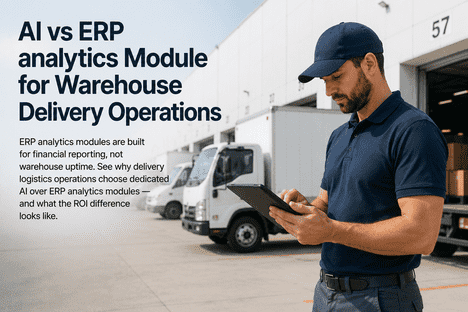
The maintenance and operations module bundled with an ERP looks attractive on paper one vendor, one login, one contract, one finance integration. But warehouse delivery operations that have actually run their uptime programs through an ERP module tell a different story. Industry benchmarks now show that manufacturing and logistics teams using purpose-built AI platforms report 40–60% better maintenance ROI than those relying on generic ERP maintenance modules, while ERP-bound teams report 34% higher integration difficulty and significantly lower rates of achieving predictive maintenance capability. The reason is structural: ERP modules are designed by financial system architects for accounting and compliance not by operations engineers for warehouse uptime. Book a Demo to see how iFactory AI replaces the ERP maintenance gap across warehouse delivery operations within 4 weeks.
WAREHOUSE OPERATIONS BENCHMARK · 2026
What the ERP-vs-AI Numbers Actually Look Like
40–60%
Better maintenance ROI with purpose-built AI vs generic ERP modules
34%
Higher integration difficulty reported by ERP-module maintenance teams
9–18 mo
Typical ERP module deployment vs 3–4 weeks for dedicated AI
$200K+
Average ERP maintenance module implementation cost before any usage
Why ERP Maintenance Modules Were Never Built for Warehouse Uptime
An ERP system exists to give finance, procurement, and HR a single source of truth — general ledger, accounts payable, purchase orders, headcount, vendor master. When ERP vendors bolt on a maintenance module, that module inherits the design assumptions of the ERP core: hierarchical approval flows, calendar-based scheduling, and integration with cost centers. None of those assumptions match how a warehouse delivery floor actually operates, where conditions change minute-by-minute, technicians work offline behind racking, and the cost of a missed PM is measured in deferred shipments, not journal entries.
iFactory AI was built from the warehouse floor outward. Its core data model is the shift, the asset, the work order, and the technician — not the cost center. Its scheduling engine reads runtime, cycle counts, and condition signals — not just calendar dates. Its mobile experience is voice-first, glove-friendly, and offline-tolerant. And its integration layer feeds the ERP back with clean, auditable cost data — without forcing operations to live inside the ERP's UX.
ERP MAINTENANCE MODULE
Designed for finance, retrofitted for operations
✕
Calendar-only PM scheduling. No condition triggers, no runtime-based intervals, no cycle-count adjustments.
✕
Shallow mobile experience. Often a responsive web wrapper that fails behind racking or in cold storage.
✕
No native IoT or PLC ingestion. Sensor data requires custom middleware or stays unused entirely.
✕
9–18 month deployments. Operations wait while IT, finance, and procurement coordinate the rollout.
✕
Low technician adoption. Floor teams default to WhatsApp, spreadsheets, and paper around the module.
iFACTORY AI PLATFORM
Designed for warehouse operations, integrated with finance
✓
Dynamic, condition-aware PM. Intervals adjust per asset with runtime, cycles, vibration, and current draw.
✓
True offline-first mobile. Voice logging, photo capture, and scans work without signal, sync on reconnect.
✓
Native sensor and PLC ingestion. No middleware required for vibration, temperature, or runtime feeds.
✓
3–4 week deployments. Live mobile work orders in week 1; full AI scheduling by week 4.
✓
90%+ technician adoption. Voice-first UX means floor teams use it instead of working around it.
The Six Operational Gaps an ERP Module Cannot Close
Even when an ERP maintenance module is fully implemented, configured, and integrated, there are six specific operational capabilities that warehouse delivery teams need but the module cannot deliver. iFactory AI was built to close each one.
01
Condition-Based PM Triggers
ERP modules trigger PM on calendar dates only. iFactory triggers PM from real runtime, cycle counts, vibration, temperature, and motor current — so the schedule reflects what each asset actually experienced.
02
Mobile Work Orders That Work Offline
ERP mobile is a web shim that breaks in dead zones. iFactory's offline-first app captures voice notes, photos, and scans without signal and syncs automatically when connectivity returns.
03
AI Route and Task Sequencing
ERP modules dispatch by ticket arrival or manual assignment. iFactory's AI sequences each technician's shift by zone, priority, parts availability, and skill — cutting walking time 35%.
04
Native IoT and PLC Connectivity
Adding sensor data to an ERP module typically requires custom middleware and IT projects. iFactory ingests PLC tags, vibration, current draw, and runtime counters natively — no middleware.
05
Real-Time Operations Dashboard
ERP reporting refreshes overnight on financial close cycles. iFactory's operations dashboard updates live — wrench time, first-time fix rate, work orders open, and parts availability per shift.
06
Bi-Directional ERP Integration
iFactory does not replace the ERP — it feeds it. Clean cost data, parts consumption, and labor hours flow back to SAP, Oracle, or Microsoft Dynamics on a defensible audit trail.
FIELD-READY · WAREHOUSE-NATIVE
Your ERP Was Built to Close the Books. iFactory AI Was Built to Close the Work Order.
Stop forcing warehouse operations into a financial system that does not understand uptime. iFactory deploys in 4 weeks alongside your existing ERP and feeds it cleaner cost data than the maintenance module ever could.
Book a Demo to see the integration architecture.
Side-by-Side: Where the Two Approaches Diverge
The clearest way to evaluate ERP modules against a dedicated AI platform is to compare them on the operational capabilities that actually drive warehouse uptime, technician productivity, and cost recovery. The table below shows the divergence across nine decision-critical dimensions.
| Decision Dimension |
ERP Maintenance Module |
iFactory AI Platform |
| Primary Design Purpose |
Financial reporting and procurement workflows |
Warehouse uptime and technician productivity |
| PM Scheduling Logic |
Fixed calendar intervals only |
Dynamic per-asset, condition and runtime based |
| Mobile Experience |
Responsive web wrapper, often online-only |
Native offline-first app with voice and photo capture |
| IoT and Sensor Ingestion |
Custom middleware required |
Native ingestion of PLC, vibration, current, runtime |
| Deployment Timeline |
9 to 18 months |
3 to 4 weeks |
| Technician Adoption |
Frequently bypassed for WhatsApp and spreadsheets |
90%+ daily active use within first month |
| Reporting Cadence |
Overnight on financial close cycle |
Live operations dashboard, seconds to minutes |
| Maintenance ROI Reported |
Baseline — limited improvement on prior workflow |
40 to 60% better than ERP-module operations |
| Position Relative to ERP |
Embedded inside ERP, inherits all ERP friction |
Integrates with ERP, feeds clean cost data back |
What Warehouse Operations Recover by Moving to a Dedicated AI Platform
Warehouses that have moved from an ERP maintenance module — or attempted module rollout — to a dedicated AI platform consistently report three categories of recovered value. These are not theoretical: they show up in the first quarter post-deployment.
Reclaimed Technician Wrench Time
Voice-driven logging, offline-first capture, and AI route sequencing recover 60–90 minutes of productive time per technician per shift. On a 40-technician operation, that is roughly 60 productive technician-hours added daily — without any hiring.
+22% work orders closed per shift
Eliminated Unnecessary PM Work Orders
Dynamic per-asset scheduling drops 35–50% of PM work orders generated by the ERP module's flat calendar — without increasing failure risk. Low-utilization assets get serviced later, high-utilization assets sooner.
-35 to -50% unnecessary PMs
Between-Interval Failure Catches
Condition-triggered work orders catch degradation that develops inside the ERP module's fixed 30 or 90 day windows — cutting between-interval failures by more than half on conveyors, sorters, and high-duty rotating equipment.
-52% between-interval failures
Decision Scorecard: When Each Approach Is the Right Choice
An ERP maintenance module is not always wrong. For warehouses with very small asset counts, light duty cycles, and no downtime cost pressure, it may be sufficient. The scorecard below is the framework iFactory uses with prospective customers to evaluate which path fits.
Operational Criterion
ERP Module Fit
Dedicated AI Fit
Downtime cost above $5K per hour
Low
High
More than 100 maintainable assets
Low
High
Technicians need mobile + offline access
Low
High
IoT or PLC sensor data available
Low
High
Light, calendar-only PM is acceptable
High
Medium
Need first-time fix rate above 90%
Low
High
If three or more rows score "High" on the right column, a dedicated AI platform will outperform an ERP module on both ROI and adoption. Book a Demo to walk through this scorecard against your warehouse profile.
Frequently Asked Questions
If we already own an ERP maintenance module, are we wasting it by adding iFactory AI?
No. iFactory complements the ERP rather than replacing it. The ERP continues to own financials, procurement, and master data. iFactory owns the operational execution layer — work orders, mobile, scheduling, IoT — and feeds the ERP clean, auditable cost and labor data automatically.
How long does integration with SAP, Oracle, or Microsoft Dynamics actually take?
Most ERP integrations complete within 2 to 3 weeks. iFactory provides pre-built bi-directional connectors for SAP S/4HANA, Oracle Fusion, Microsoft Dynamics 365, and major WMS platforms (SAP EWM, Manhattan, Blue Yonder). Operations can begin using iFactory on day one while integrations finalize in parallel.
Why do technicians adopt iFactory but bypass our ERP module?
ERP UX is designed for office-based finance and procurement workflows — multi-step forms, hierarchical approvals, online-only. iFactory's mobile UX is designed for the floor — voice-first input, large touch targets, glove-friendly buttons, offline-tolerant. The difference shows up immediately in daily active use rates above 90%.
Does iFactory work for both maintenance and broader warehouse field operations?
Yes. iFactory covers maintenance work orders, analytics technician field workflows, shift logbook entries, parts crib visibility, and supervisor dashboards in one platform. Operations leaders avoid running three separate tools for what the ERP module covered shallowly.
What kind of ROI do warehouses see by moving from ERP module to dedicated AI?
Industry benchmarks show 40–60% better maintenance ROI than ERP-module operations. Warehouses report 6–9 month payback driven by reclaimed wrench time, eliminated unnecessary PMs, and avoided downtime from between-interval failures the ERP module would have missed.
Keep the ERP. Replace the Maintenance Module With AI Built for Warehouses.
iFactory deploys in 4 weeks alongside your existing ERP — and gives warehouse operations the dynamic PM scheduling, offline-first mobile, native IoT, and live dashboards the ERP module was never built to deliver.