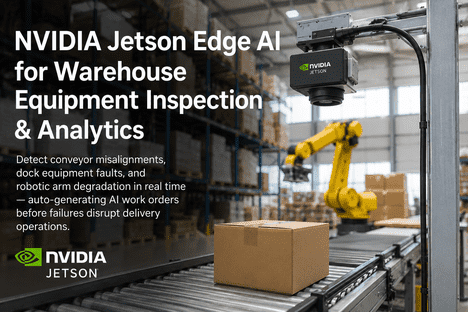
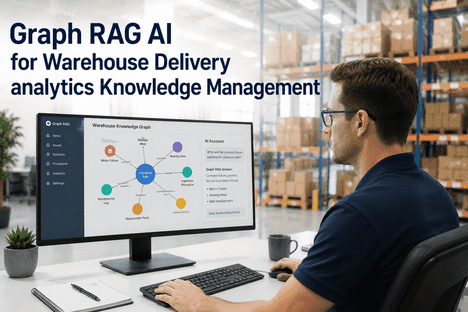
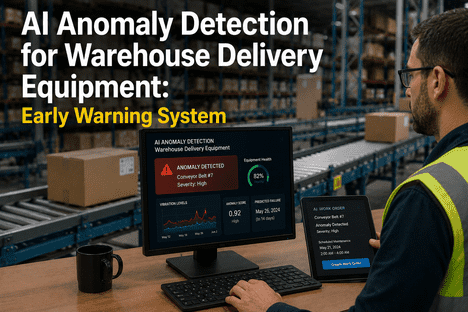
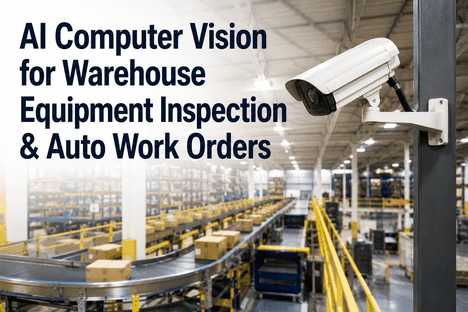
Warehouse operations run on equipment that never stops — conveyor systems moving tens of thousands of parcels per shift, loading dock mechanisms cycling hundreds of times per day, robotic arms executing millions of pick-and-place movements per week. When any of these assets degrades or fails, the downstream impact hits every outbound order in the queue. Traditional camera-based monitoring uploads video to cloud servers for analysis, adding 800 to 1,200 milliseconds of processing latency per inspection cycle — a delay that is fundamentally incompatible with real-time fault intervention. NVIDIA Jetson edge AI eliminates that latency by running AI inference directly on the warehouse floor: processing visual data from multiple cameras simultaneously in under 40 milliseconds, detecting conveyor misalignments, dock equipment faults, and robotic arm degradation in real time, and auto-generating work orders in your CMMS before failures disrupt a single delivery window. iFactory AI deploys NVIDIA Jetson-powered edge inspection across warehouse networks within 6 weeks. Book a Demo to see live fault detection accuracy against your current warehouse asset inventory.
<40ms
Edge AI inference latency on NVIDIA Jetson vs 800–1,200ms for cloud-based vision
92%
Power consumption reduction on Jetson Orin Nano vs cloud inference while maintaining 30 FPS
$4.2M
Annual cloud compute cost avoided per 200-asset warehouse by deploying Jetson edge AI
6 wks
Deployment timeline from baseline audit to live edge AI inspection monitoring
What NVIDIA Jetson Edge AI Actually Delivers for Warehouse Equipment Inspection
NVIDIA Jetson modules — including Jetson AGX Orin, Jetson Orin NX, and the refreshed Jetson Orin Nano Super delivering 67 TOPS of AI performance — are purpose-built edge computing platforms that run complex neural network inference locally on the device, without cloud dependency. In a warehouse environment, this means a single Jetson module can process simultaneous video feeds from up to eight cameras, run object detection and anomaly classification models at 30 frames per second, and generate fault alerts with asset location, defect type, and severity score — all within 40 milliseconds of event onset, entirely on the warehouse floor.
When integrated with iFactory AI's inspection software layer, NVIDIA Jetson modules become autonomous equipment health sentinels across every conveyor zone, loading dock bay, robotic work cell, and storage aisle in your facility. The AI processes visual streams, vibration data, and thermal feeds continuously — detecting conveyor belt misalignment, dock leveller hydraulic faults, robotic arm positional drift, and sortation mechanism wear — and pushes structured work orders directly into your CMMS the moment a fault signature crosses the alert threshold. Book a Demo to see what your warehouse asset fault map looks like through Jetson-powered edge AI.
Conveyor Misalignment and Belt Fault Detection
NVIDIA Jetson processes overhead and side-angle camera feeds to detect belt tracking drift, edge fraying, splice degradation, and roller misalignment in real time — flagging faults before they escalate into jams, belt snaps, or product damage on live fulfilment lines.
Dock Equipment Fault Identification
Edge AI vision monitors loading dock levellers, dock seals, vehicle restraint systems, and dock door mechanisms for hydraulic leaks, alignment faults, seal damage, and actuator degradation — auto-generating work orders before a dock bay goes out of service during an inbound or outbound window.
Robotic Arm Positional Drift and Degradation
Jetson-powered vision models monitor pick-and-place robotic arms for joint misalignment, gripper wear, end-effector positional drift, and cycle time anomalies — detecting the early signatures of mechanical degradation 12 to 21 days before a robotic cell failure halts fulfilment throughput.
Sortation System Visual Inspection
AI models running on Jetson edge devices inspect tilt-tray, cross-belt, and sliding-shoe sorters for divert mechanism wear, tray damage, carrier alignment faults, and induction anomalies — detecting degradation patterns that cause sort accuracy errors and downstream mis-ship events before they affect customer SLAs.
Automated Work Order Generation
When Jetson edge AI detects a fault signature above threshold, iFactory automatically generates a structured CMMS work order with asset ID, location, fault classification, visual evidence frame, severity score, and recommended action — eliminating the manual detection and reporting cycle entirely.
WMS, WCS and CMMS Integration
iFactory connects Jetson edge AI output directly to Manhattan Associates, Blue Yonder, SAP EWM, and Infor WMS platforms, as well as IBM Maximo, SAP PM, and ServiceMax CMMS systems — creating a closed-loop from visual fault detection to scheduled repair without any manual data transfer between systems.
Why Cloud-Based Warehouse Vision Systems Cannot Match Edge AI Performance
The fundamental limitation of cloud-dependent vision inspection is latency. Uploading video frames to AWS, Azure, or Google Cloud for AI inference, receiving results, and issuing a corrective response adds 800 to 1,200 milliseconds per cycle — in a warehouse conveyor environment running at 1 to 2 metres per second, that latency means a fault-affected item has already travelled 80 to 240 centimetres past the detection point before any corrective action is possible. NVIDIA Jetson eliminates that gap by processing everything locally. The comparison below shows what warehouse operators accept under cloud vision versus what Jetson edge AI delivers on the same asset population.
| Inspection Parameter |
Cloud-Dependent Vision Inspection |
iFactory NVIDIA Jetson Edge AI |
| Inference Latency |
800–1,200ms round-trip from camera capture to alert receipt. Equipment has already progressed past fault point before any corrective signal is issued. Real-time intervention impossible. |
Sub-40ms inference on Jetson hardware. Fault detected, classified, and alert issued within the same conveyor cycle — fast enough to trigger robotic corrections before the next assembly or sort cycle begins. |
| Network Dependency |
Full functionality requires consistent high-bandwidth network connectivity. Network degradation or outage eliminates all inspection capability across every monitored asset simultaneously. |
All AI inference runs locally on Jetson hardware. Full inspection capability maintained with zero network connectivity — only lightweight structured alerts sent upstream when connectivity is available. |
| Data Transfer and Compute Cost |
A 200-asset warehouse streaming video to cloud generates $4.2M+ annually in transfer and compute costs. Costs scale linearly with camera count and frame rate. |
Jetson processes video locally — zero cloud transfer cost for raw video. Only structured alert payloads (kilobytes, not gigabytes) transmitted. 92% power consumption reduction vs cloud inference at equivalent accuracy. |
| Conveyor Misalignment Detection |
Cloud latency means misalignment detected after product has passed inspection point. Mis-sort or jam event already in progress before alert reaches operations team. |
Edge AI detects belt tracking drift, splice anomalies, and roller misalignment in real time at the point of occurrence — enabling conveyor zone stop before jam propagation or product damage. |
| Robotic Arm Fault Detection |
Positional drift and gripper degradation detected only at failure or scheduled inspection. Unplanned robotic cell downtime averages 4 to 8 hours including fault diagnosis, parts sourcing, and repair. |
Continuous vision monitoring detects positional drift, cycle time anomalies, and end-effector wear 12 to 21 days before failure — enabling planned replacement during maintenance windows with zero production impact. |
| Work Order Generation |
Fault discovered manually or via system alarm. Technician creates work order manually in CMMS. Average time from fault onset to work order creation: 45 to 180 minutes depending on shift. |
Jetson edge AI auto-generates structured CMMS work order within seconds of fault threshold breach — including asset ID, location, fault classification, visual evidence, severity score, and recommended action. |
Every Warehouse Camera Without Edge AI Is a Fault Accumulating Unseen Between Inspection Rounds.
iFactory deploys NVIDIA Jetson edge AI across warehouse conveyor zones, dock bays, and robotic work cells — delivering sub-40ms fault detection, automated CMMS work order generation, and zero cloud dependency, integrated with your WMS and CMMS within 6 weeks.
Book a Demo to see detection accuracy mapped against your current warehouse camera infrastructure.
How iFactory Deploys NVIDIA Jetson Edge AI Across Warehouse Inspection Programmes
iFactory follows a structured deployment process that delivers live edge AI inspection from existing warehouse cameras within the first two weeks and full multi-zone coverage by week six. Each phase has defined deliverables so operations and maintenance teams see measurable fault detection output — not months of hardware configuration with no change on the warehouse floor.
Weeks 1–2
Warehouse Asset and Camera Infrastructure Audit
Full audit of existing camera infrastructure, conveyor zone layout, dock bay configuration, and robotic work cell positions completed. Historical downtime records and fault logs ingested. AI establishes per-asset criticality scoring based on throughput impact and failure frequency. Jetson module placement plan developed for highest-criticality zones. WMS, WCS, and CMMS integration initiated with Manhattan Associates, Blue Yonder, SAP EWM, IBM Maximo, and SAP PM systems.
Weeks 3–4
Jetson Module Deployment and Live Fault Detection Activation
NVIDIA Jetson AGX Orin or Jetson Orin NX modules installed at priority conveyor zones, dock bays, and robotic work cells. Existing IP cameras connected via PoE — no camera replacement required in most deployments. iFactory AI inspection models loaded and calibrated against facility-specific asset configurations. First real-time fault detections generated within days of activation. Maintenance teams trained on alert interpretation and CMMS work order response workflows.
Weeks 5–6
Full Network Coverage, CMMS Integration and OEE Dashboard Activation
Edge AI inspection live across all warehouse zones with automated CMMS work order generation active. OEE dashboard enabled with real-time availability and fault frequency tracking by zone and asset type. Peak window protection alerts configured to flag any high-risk asset ahead of critical carrier cut-offs and inbound receiving windows. Full handover to operations and maintenance leadership with monthly inspection performance reporting.
MEASURABLE OUTCOMES FROM WEEK 3: FIRST REAL-TIME FAULT DETECTIONS GENERATED WITHIN DAYS OF JETSON ACTIVATION
Warehouse operators completing iFactory's 6-week Jetson edge AI deployment report first actionable fault detections within days of module activation — with facilities monitoring 200 assets saving $4.2M annually in cloud transfer and compute costs while achieving sub-40ms fault detection latency that cloud-based inspection cannot match at any price point.
$4.2M
Annual cloud compute cost avoided per 200-asset warehouse deployment
<40ms
Edge AI fault detection latency vs 800–1,200ms for cloud inspection pipelines
6–12 mo
Typical ROI payback through avoided downtime, reduced cloud spend, and maintenance optimisation
NVIDIA Jetson Edge AI Warehouse Inspection: Use Cases from Live Deployments
The following outcomes are drawn from iFactory deployments at operating warehouse and fulfilment facilities using NVIDIA Jetson edge AI for equipment inspection across e-commerce, 3PL, grocery distribution, and retail distribution centre networks. Each use case reflects 9 to 14 month post-deployment performance data.
A 580,000 sq ft e-commerce fulfilment centre had been relying on manual inspection rounds for conveyor belt condition monitoring, with technicians completing visual checks every 4 hours across 38 conveyor zones. Belt tracking drift and splice degradation events were typically discovered only after a jam or belt-edge damage had already disrupted throughput. iFactory deployed NVIDIA Jetson Orin NX modules across 14 highest-criticality zones, each processing feeds from 6 to 8 overhead cameras simultaneously. Within 21 days of activation, edge AI detected belt tracking drift on three zones before any visible damage had occurred — the most critical showing a 14mm lateral deviation from centreline that would have reached jam threshold within an estimated 18 hours. Conveyor stopped during overnight maintenance window, belt realigned and tracking roller replaced. Zero jam events attributable to belt misalignment in the 11 months following deployment.
Book a Demo to see how this applies to your conveyor inspection programme.
21 days
Time from Jetson activation to first belt misalignment fault detection
0
Belt misalignment jam events in 11 months post-deployment
8 cams
Simultaneous camera feeds processed per Jetson module at sub-40ms latency
A national 3PL operating 24 goods-to-person robotic pick arms across two fulfilment shifts had experienced four unplanned robotic cell failures in 18 months, each requiring between 5 and 9 hours of downtime for fault diagnosis, parts sourcing, and repair. Positional drift on joint assemblies and gripper wear were the underlying cause in three of the four failures — both conditions invisible to the scheduled monthly inspection regime. iFactory deployed NVIDIA Jetson AGX Orin modules at each robotic work cell, processing continuous camera feeds to monitor joint alignment, gripper closure accuracy, end-effector positional deviation, and cycle time consistency. Within 60 days, edge AI identified developing positional drift on two robot arm joint assemblies — one showing 2.4mm deviation from nominal pick position trending at 0.08mm per day, indicating failure threshold within 30 days. Both units serviced during a planned overnight window. Zero unplanned robotic cell failures in the 12 months following Jetson deployment. Annual unplanned robotic failure costs reduced from £340,000 to £22,000.
£318K
Annual robotic downtime cost reduction from 4 failures to zero post-deployment
0
Unplanned robotic cell failures in 12 months vs 4 in prior 18 months
30 days
Advance warning of joint failure generated from positional drift trend analysis
A regional retail distribution centre operating 22 loading dock bays across inbound receiving and outbound despatch functions was experiencing 8 to 12 dock equipment fault events per month — dock leveller hydraulic failures, vehicle restraint malfunctions, and dock seal damage — each requiring 45 to 90 minutes of dock bay downtime to diagnose and repair. iFactory deployed NVIDIA Jetson Orin NX modules with camera feeds covering each dock bay, running AI models trained to detect hydraulic fluid pooling, leveller geometry anomalies, restraint arm positional faults, and seal compression irregularities. Within 45 days, edge AI identified early-stage hydraulic seal degradation on four dock leveller units showing fluid seepage patterns below the visual threshold of manual inspection rounds. All four units serviced before hydraulic failure. Dock equipment fault events reduced from 10 per month to 2, and dock bay availability during outbound despatch windows improved from 87% to 97%.
80%
Reduction in dock equipment fault events from 10 per month to 2
97%
Dock bay availability during despatch windows vs 87% pre-deployment
45 days
Time from Jetson activation to first hydraulic fault detection below manual inspection threshold
Expert Perspective: What the Industry Gets Wrong About Warehouse Vision Inspection
Industry Review — Warehouse Automation and Reliability Engineering Perspective
"The assumption that cloud-based vision inspection is equivalent to edge AI is wrong in any real-time intervention context. When your conveyor is running at 1.5 metres per second and the cloud round-trip is 1,000 milliseconds, the fault has already moved 1.5 metres past the detection point before any alert is issued. NVIDIA Jetson changes the fundamental architecture — the intelligence lives at the asset, inference happens in 40 milliseconds, and by the time the cloud even receives the alert packet, the edge AI has already issued the corrective signal. For robotic arm drift, dock fault detection, and conveyor misalignment, that latency difference is the difference between catching a fault and reacting to a failure."
Head of Warehouse Automation Engineering — Major UK Fulfilment and Distribution Operator (provided via iFactory deployment reference)
This perspective aligns precisely with what NVIDIA's own engineering teams have demonstrated: NVIDIA Jetson Orin Nano maintains 30 FPS object detection while reducing power consumption by 92% compared to equivalent cloud inference — delivering superior real-time performance at a fraction of the operating cost. For warehouses with hundreds of monitored assets, the combination of latency advantage and cost reduction makes edge AI the only architecturally sound choice for real-time equipment inspection. Book a Demo to speak with iFactory's warehouse edge AI specialists about your current inspection infrastructure.
Conclusion: NVIDIA Jetson Edge AI Is Now the Standard for Warehouse Equipment Inspection
The case for NVIDIA Jetson-powered edge AI in warehouse equipment inspection has moved beyond pilot deployments. With sub-40ms inference latency that cloud inspection cannot match, $4.2M annual cloud compute savings documented per 200-asset facility, 92% power consumption reduction on Jetson Orin Nano vs cloud equivalents, and the unforgiving throughput demands of modern same-day and next-day fulfilment eliminating any tolerance for undetected fault progression, warehouse operators who continue relying on cloud-dependent vision systems or manual inspection rounds are accepting latency, cost, and reliability risk that edge AI directly eliminates.
iFactory's NVIDIA Jetson integration delivers the specific capabilities warehouse operations require: real-time conveyor misalignment detection, dock equipment fault identification, robotic arm positional drift monitoring, and automated CMMS work order generation — all running at the edge with zero cloud dependency, integrated with your existing WMS, WCS, and CMMS programme in 6 weeks. The deployment timeline means measurable fault detection output begins within days of Jetson activation — not the multi-month implementation programmes that have historically made edge AI inspection difficult to justify to operations leadership. Book a Demo to receive a warehouse edge AI inspection assessment specific to your facility layout and asset profile.
Frequently Asked Questions About NVIDIA Jetson Edge AI for Warehouse Equipment Inspection
Do we need to replace existing warehouse cameras to deploy NVIDIA Jetson edge AI?
In the majority of deployments, existing IP cameras can be connected to Jetson modules via PoE without replacement. iFactory's deployment audit in weeks 1 to 2 assesses existing camera positions, resolution, and frame rates to determine which zones can leverage current infrastructure and where targeted camera additions would improve fault detection coverage. Full camera replacement is not required.
Which NVIDIA Jetson modules does iFactory deploy for warehouse inspection?
iFactory deploys NVIDIA Jetson AGX Orin for high-camera-count zones requiring maximum simultaneous feed processing and Jetson Orin NX for standard conveyor zone and dock bay monitoring. The refreshed Jetson Orin Nano Super, delivering 67 TOPS AI performance at significantly reduced power draw, is deployed in lower-criticality monitoring positions. Module selection is determined during the baseline audit based on camera count, required inference throughput, and environmental conditions at each deployment location.
How does edge AI fault detection connect to our CMMS for work order generation?
iFactory integrates Jetson edge AI output directly with IBM Maximo, SAP PM, ServiceMax, Infor EAM, and eMaint CMMS platforms via standard REST APIs. When the AI detects a fault signature above threshold, a structured work order is automatically generated with asset ID, zone location, fault classification, visual evidence frame, severity score, and recommended corrective action — delivered to the CMMS within seconds of fault detection, without any manual reporting step.
Can Jetson edge AI operate in warehouse environments without consistent network connectivity?
Yes. All AI inference runs locally on the Jetson hardware — conveyor misalignment detection, robotic arm monitoring, dock fault identification, and work order generation all function fully without network connectivity. Structured alert payloads are queued locally and synchronised to the CMMS when connectivity is restored. This is a fundamental architectural advantage over cloud-dependent inspection systems, which lose all detection capability during network outages.
How far in advance does Jetson edge AI detect warehouse equipment faults?
Detection lead times depend on fault type and degradation rate. Belt misalignment and tracking drift are typically detected 18 to 48 hours before jam threshold is reached. Robotic arm positional drift is detected 12 to 21 days before failure threshold. Dock leveller hydraulic degradation is typically flagged 1 to 3 weeks before functional failure. In all cases, the detection window is sufficient to schedule planned maintenance without impact to live fulfilment operations.
Real-Time Warehouse Fault Detection at the Edge. Zero Cloud Dependency. Live in 6 Weeks.
iFactory deploys NVIDIA Jetson edge AI across your warehouse conveyor zones, loading dock bays, and robotic work cells — delivering sub-40ms fault detection, automated CMMS work order generation, and $4.2M+ in annual cloud cost avoidance per 200-asset facility. Results are measurable within days of Jetson module activation.
Stop Discovering Warehouse Equipment Faults After They Disrupt Delivery. Deploy NVIDIA Jetson Edge AI in 6 Weeks.
iFactory gives warehouse operators real-time conveyor misalignment detection, dock fault identification, robotic arm degradation monitoring, and automated CMMS work order generation — powered by NVIDIA Jetson at the edge, integrated with your existing WMS, WCS, and CMMS in 6 weeks.
Sub-40ms fault detection latency at the edge vs 800–1,200ms cloud round-trip
$4.2M annual cloud cost avoidance per 200-asset warehouse
92% power reduction on Jetson Orin Nano vs cloud inference
6 week deployment with live fault detection from week 2