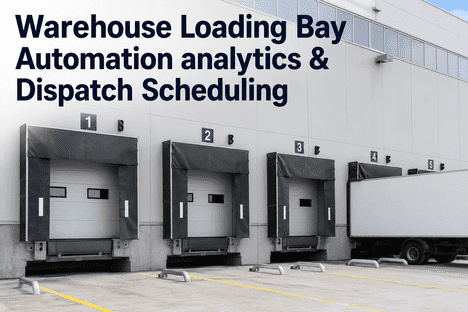
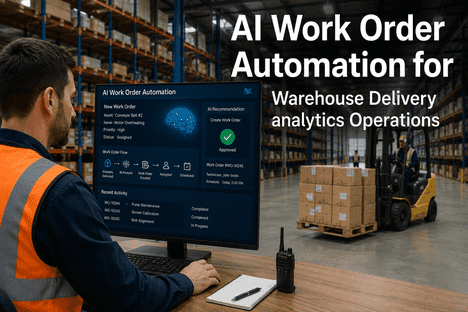
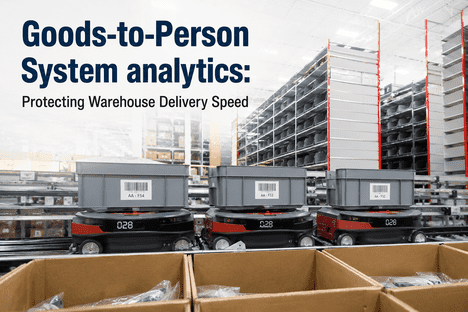
The outbound loading bay is where every outbound order in a despatch wave gets concentrated into a single chain of automated equipment telescoping boom conveyors, automated truck loading systems (ATLS), AMR-based load carriers, dock levellers, vehicle restraints, dock doors, and the dispatch scheduler that ties carrier appointments to bay availability. When any one of those automated assets fails during an outbound window boom conveyor that won't extend, an ATLS robot that loses navigation inside the trailer, a leveller that locks out a bay just as the carrier arrives the cascade is brutal. A failed bay during peak despatch holds back not one shipment but every order routed through that bay; carrier detention accrues at $75 to $100 per hour per trailer; 40% of delayed appointments exceed two hours of detention; and the documented direct cost of a single 4-hour bay failure event on a 6-bay warehouse reaches $4,200 to $8,500 before factoring downstream carrier-cut-off misses on every order in the affected wave. Automated loading bay equipment was supposed to make outbound predictable. It only does that when the equipment is healthy, the dispatch schedule reflects real bay availability, and the dispatcher sees a failure forming before the carrier rolls onto the apron. Book a Demo to see how iFactory AI deploys loading bay automation analytics within 6 weeks.
$4.2–8.5K
Direct cost per single 4-hour automated bay failure event during outbound despatch
70%
Truck turnaround improvement with dispatch scheduling tied to real bay availability
$75–100
Per-hour carrier detention per trailer when a bay locks out at outbound peak
4–6 wks
Deployment timeline from bay audit to live AI loading-bay analytics and dispatch sync
What Loading Bay Automation Analytics Actually Monitors on the Outbound Side
An automated loading bay is not a single asset. It is an integrated outbound system telescoping boom conveyors, ATLS automated case loaders with vision-guided robotic arms, AMR-based pallet carriers (Slipbot-class and Agilox OFL-class autonomous loaders), dock levellers, vehicle restraints, dock doors, dock seals, bay-side pack-out conveyors, and the dispatch scheduler tying carrier appointments to that hardware. A single failing actuator on a telescoping boom delays the entire trailer load. A single AMR with degraded SLAM confidence stops the outbound wave at that bay. A dock leveller that locks out at 06:50 cascades into a missed 07:00 carrier appointment that propagates through every subsequent slot for the next four hours.
iFactory AI's loading bay automation layer monitors every automated asset on the outbound dock independently, ties asset health directly into the dispatch scheduling decision, and surfaces failure risk before the carrier slot commits. The dispatcher works against actual live bay capacity — not the bay roster as the WMS assumes it. Maintenance gets condition-triggered work orders 2 to 6 weeks ahead of functional failure. Operations gets pre-wave readiness reporting that flags the specific bay, the specific automated asset, and the specific carrier slot at risk before the despatch wave commits. Book a Demo to see live loading bay analytics against your specific automation estate.
ATLS and Telescoping Boom Conveyor Analytics
Automated truck loading systems monitored for motor current, drive-belt tension, extension-mechanism wear, hydraulic pressure, and end-effector calibration. Degradation flagged 2 to 6 weeks ahead of functional failure so intervention happens during scheduled overnight windows, not at the start of a peak outbound wave.
AMR Loader and Robotic Arm Health
SLAM confidence, LiDAR detection range, distance-measurement sensor accuracy, drive-motor current, gripper actuation, and end-effector cycle counts tracked per AMR loader and trailer-loading robot. Navigation drift inside trailers detected before pallet placement errors or load-stop events propagate.
Dock Leveller, Restraint and Door Health
Hydraulic pressure trends, leveller cycle count, door open/close timing, motor current draw, and restraint actuation patterns tracked per bay across major OEM hardware (Rite-Hite, Kelley, McGuire, Serco, Pentalift, 4Front). Seal degradation, spring fatigue, and motor wear flagged before a lockout takes the bay offline at peak.
Dispatch Scheduler Synchronisation
Live bay-health and load-cycle data pushed into the dispatch scheduler so carrier slots are assigned against actual capacity — not assumed capacity. AI re-sequencing on any predicted bay risk, with automatic carrier notification and WMS outbound plan update before the trailer rolls onto the apron.
Automated CMMS Work Order Generation
Telemetry signatures above threshold push structured work orders into IBM Maximo, SAP PM, ServiceMax, Infor EAM, or eMaint with bay ID, failed component, severity score, predicted failure window, and recommended part. Parts procured at standard lead time — eliminating the 3 to 5× emergency-repair premium that reactive bay maintenance routinely absorbs.
WMS, TMS, Dispatch and Shift Logbook Integration
iFactory connects to Manhattan Associates, Blue Yonder, SAP EWM, Infor WMS, Oracle TMS, BluJay, and Descartes via OPC-UA, MQTT, and REST — plus IBM Maximo, SAP PM, ServiceMax, Infor EAM, eMaint CMMS. The Shift Logbook captures every bay alert, automated-asset event, dispatch re-sequence, restraint exception, and intervention across operations, maintenance, and despatch handovers.
Why Standalone Dispatch Schedulers and Calendar PM Miss What AI Catches
A standalone dispatch scheduler assumes every bay on the roster is operational. A calendar PM programme on dock equipment assumes wear accumulates uniformly between visits. Modern outbound delivery operations — same-day, next-day, carrier-cut-off-driven — survive neither assumption. The table maps where the inherited model breaks against what AI-driven loading bay analytics synchronised with dispatch scheduling delivers.
| Loading Bay Parameter |
Standalone Scheduler + Calendar PM |
iFactory AI Loading Bay Analytics |
| Bay-Health Visibility for Dispatch |
Dispatcher schedules against fixed bay roster. Bay-equipment health unknown until a trailer arrives and the bay locks out. The despatch wave commits before anyone knows which bay is structurally at risk. |
Live bay-health telemetry pushed into the dispatch scheduler. Carrier slots assigned against actual operational capacity. Pre-wave readiness reporting flags at-risk bays 90+ minutes ahead. |
| ATLS and AMR Loader Health |
ATLS and AMR loaders assessed at quarterly OEM service. Between visits, motor wear, hydraulic degradation, and SLAM drift progress invisibly. First sign of failure is typically a load-stop event mid-wave. |
Per-asset motor current, hydraulic pressure, SLAM confidence, and end-effector cycle analytics. Degradation flagged 2 to 6 weeks ahead with predicted failure window pushed into the CMMS. |
| Dispatch Cascade Risk |
A single bay failure at 06:50 cascades into the 07:00 slot, then the 07:45 slot, then the 08:30 slot. Cascade discovered slot-by-slot as carriers arrive. Detention accrues throughout. |
AI re-sequencing on predicted bay risk before the wave commits. Affected carriers notified automatically; alternative bay assignment pushed to the WMS; cascade structurally prevented. |
| Maintenance Trigger Logic |
Calendar PM at fixed quarterly intervals. Heavy-utilisation outbound bays under-serviced; lower-utilisation bays over-serviced. Emergency repairs running at 3 to 5× preventive cost. |
Condition-based PM triggered by actual cycle count, current draw, and degradation signature per asset. High-utilisation bays serviced at the right interval; emergency-repair premium effectively eliminated. |
| Carrier Cut-Off Protection |
Operations leadership sees outbound cut-off miss risk when the carrier rolls onto the apron and the wave is already behind. Post-event attribution to specific bay or equipment requires manual reconciliation. |
Predicted carrier cut-off risk surfaced 90+ minutes ahead with the specific bay, automated asset, or capacity gap driving it. Pre-event intervention possible; cut-off miss rate reduced materially. |
| OSHA and Audit Posture |
Paper restraint logs, vendor PM records, manual incident reporting. OSHA 1910.30 dock-access and 1910.178 PIT exposure carries penalties exceeding $16,000 per violation; audit packs assembled manually after the fact. |
Restraint engagement, leveller inspection, automated-asset event, and intervention records captured automatically with timestamp and bay attribution. Audit packs reproduced on demand on the inspector's question. |
Every Misaligned Outbound Slot Is a Carrier Cut-Off Already at Risk.
iFactory AI delivers warehouse delivery hubs continuous loading bay automation telemetry, dispatch-scheduler synchronisation, ATLS and AMR loader health analytics, and automated CMMS work orders — integrated with your WMS, TMS, dispatch scheduler, and CMMS in 4 to 6 weeks.
Book a Demo to see live loading bay analytics against your current outbound operation.
How iFactory AI Deploys Loading Bay Automation Analytics
iFactory follows a structured deployment process that delivers live bay-equipment telemetry within the first two weeks and full dispatch-scheduler synchronisation by week six. Each phase produces a measurable deliverable to operations, maintenance, and despatch leadership.
Weeks 1–2
Bay Inventory, Automated Asset Audit and System Integration
Outbound bay equipment inventoried — telescoping boom conveyors, ATLS automated case loaders, AMR loaders (Slipbot, Agilox OFL, or operator-specific), dock levellers, vehicle restraints, dock doors. Existing telemetry capability scoped per OEM (Rite-Hite, Kelley, McGuire, Serco, Pentalift, 4Front). Integration initiated with WMS (Manhattan, Blue Yonder, SAP EWM, Infor), TMS (Oracle, BluJay, Descartes), dispatch scheduler, and CMMS (Maximo, SAP PM, ServiceMax, Infor EAM, eMaint). Tier 1 bays running peak outbound waves prioritised.
Weeks 2–4
Telemetry Activation and Predictive Model Calibration
Motor current, hydraulic pressure, cycle count, SLAM confidence, and actuation-timing telemetry brought online across the automated bay estate. Machine-learning models calibrated to per-asset healthy baseline under representative load. First predictive alerts on ATLS motor wear, AMR SLAM drift, leveller seal degradation, and door spring fatigue typically surface within the first 3 weeks — including latent issues that quarterly PM had missed.
Weeks 4–6
Dispatch Synchronisation, Cascade Prevention and Shift Logbook
Live bay-health pushed into the dispatch scheduler. AI re-sequencing on any predicted bay risk activated, with automatic carrier notification and WMS outbound plan update. Pre-wave readiness reporting live with 90-minute look-ahead. Shift Logbook integrated so every bay alert, automated-asset event, dispatch re-sequence, restraint exception, and intervention is captured across operations, maintenance, and despatch handovers. Full handover with monthly bay performance reporting in place.
DEPLOYMENT OUTCOME: BAY FAILURE PREVENTION DELIVERS 70% OUTBOUND TURNAROUND IMPROVEMENT
Warehouses completing iFactory's 4–6 week loading bay automation deployment consistently surface latent bay-equipment issues within the first 3 weeks of telemetry flow — ATLS motors past their service window, AMR navigation drift, leveller seals degrading, doors with rising motor current trends. Programmes typically deliver the documented 70% truck turnaround improvement when dispatch scheduling integrates with live bay availability, eliminate the $4,200 to $8,500 direct cost per single 4-hour bay failure event, and address the carrier detention exposure at $75 to $100 per hour per trailer at the source.
2–6 wks
Predictive warning window across ATLS, AMR, leveller, door, and restraint failure modes
3–5×
Emergency dock repair premium eliminated through predictive intervention
90 min
Outbound cut-off cascade risk look-ahead for pre-wave dispatch intervention
Loading Bay Automation Analytics: Use Cases from Live Deployments
The following outcomes are drawn from iFactory loading bay analytics deployments at operating warehouse delivery hubs across e-commerce fulfilment, retail distribution, FMCG, and 3PL networks. Each use case reflects 9–14 month post-deployment performance against the specific outbound problem the analytics layer was deployed to solve.
An e-commerce fulfilment operator running 8 outbound bays equipped with telescoping boom conveyors and ATLS automated case loaders had logged 11 unplanned boom-conveyor and ATLS failures across a 13-month window. Each event carried 3 to 5 hours of bay lockout, averaged $6,800 in direct cost, and cascaded into a documented 9 to 16% outbound carrier cut-off miss rate on the affected day. iFactory deployed motor current, hydraulic pressure, drive-belt tension, and end-effector cycle telemetry across all 8 bays. Within 5 weeks the analytics layer flagged developing motor wear on 3 ATLS units and rising hydraulic pressure on 2 telescoping booms — all serviced during planned overnight windows with parts ordered at standard lead time. Zero unplanned bay failures across the following 12 months.
Book a Demo to see how this applies to your outbound bay automation.
0 events
Unplanned bay failures across 12 months post-deployment vs 11 in prior 13 months
5 wks
Time from telemetry activation to first 5 automated assets flagged for service
$74K
Direct unplanned-event cost eliminated annually through predictive intervention
A retail distribution operator running 14 outbound bays had a standalone dispatch scheduler assigning carrier slots against the bay roster with no visibility into actual bay-equipment health or automated-asset readiness. Monthly carrier detention spend averaged $52,000 and the outbound cut-off miss rate sat at 7.3%. iFactory integrated the dispatch scheduler with live bay-health telemetry from all 14 bays, plus trailer ETA from the operator's Oracle TMS. AI re-sequencing on any predicted bay risk activated. Average outbound truck turnaround improved from 44 minutes to 14 minutes — a 68% reduction in line with the documented 70% benchmark. Monthly detention spend fell to $14,500 by month 4. Outbound cut-off miss rate dropped to 1.8%.
68%
Truck turnaround improvement, from 44 min to 14 min average
$450K
Annual carrier detention spend recovered across 14 outbound bays
75%
Reduction in outbound carrier cut-off miss rate, from 7.3% to 1.8%
An FMCG distribution operator had deployed 18 AMR-based pallet loaders across 12 outbound bays to replace manual forklift loading — successfully cutting in-trailer load times to under 5 minutes per trailer in line with industry benchmarks. Within 9 months, intermittent SLAM-confidence drift had begun causing load-stop events that the operator was absorbing as "expected AMR behaviour." iFactory deployed continuous SLAM confidence, LiDAR detection range, distance-measurement sensor accuracy, drive-motor current, and end-effector cycle analytics across all 18 AMR loaders. Within 6 weeks the model identified 5 AMRs with developing SLAM drift and 2 with degraded distance-measurement sensors — all recalibrated during planned overnight windows. Load-stop events on the affected bays dropped 84% across the following quarter, fully restoring the under-5-minute trailer load benchmark.
84%
Reduction in AMR load-stop events post-deployment
7 AMRs
SLAM or sensor degradation issues identified in first 6 weeks
<5 min
Per-trailer load benchmark fully restored across the AMR fleet
Expert Perspective: What the Industry Gets Wrong About Loading Bay Automation
Industry Review — Warehouse Outbound Operations and Automation Engineering Perspective
"The mistake most operations leadership makes is treating loading bay automation as a hardware project and dispatch scheduling as a software project. They are the same project. A telescoping boom conveyor and an ATLS robot cut trailer load times from 40 to 90 minutes down to under five — but only when the equipment is healthy and the dispatcher can see that it is healthy in real time. The 70% truck turnaround improvement that the industry talks about does not come from buying automation. It comes from operating automation against a dispatch schedule that reflects actual bay capacity, with predictive analytics surfacing the failure before the carrier rolls onto the apron. Without that synchronisation, the automated bay just fails faster than the manual one did, and the cascade is worse because the dispatcher built tighter slots assuming the automation would hold."
Head of Outbound Operations and Warehouse Automation — Major North American 3PL and Distribution Operator (provided via iFactory deployment reference)
The supporting data confirms it. Automated truck loading systems and AMR-based loaders deliver in-trailer load times under 5 minutes versus 40 to 90 minutes for forklift loading — but only when the equipment is operational. The documented 70% truck turnaround improvement that integrated dispatch-and-bay-health architecture delivers, the $4,200 to $8,500 direct cost per single 4-hour bay failure event, the $75 to $100 per hour carrier detention exposure, and the 25% of warehouse accidents OSHA tracks at the loading dock are all addressable through the same analytics layer — not three different systems. Book a Demo to speak with iFactory's loading bay automation specialists about your current outbound operation.
Live Bay Intelligence. Synchronised Dispatch. Cascade Prevention. Live in 4–6 Weeks.
iFactory gives warehouse delivery hubs continuous loading bay automation telemetry, ATLS and AMR health analytics, live dispatch-scheduler synchronisation, AI cascade prevention, automated CMMS work orders, and Shift Logbook continuity. Results measurable within 30 days of telemetry activation.
Conclusion: AI-Synchronised Loading Bay Automation Is the Standard for Outbound Dispatch
The case for AI-driven loading bay automation analytics synchronised with dispatch scheduling has moved beyond pilot programmes. The 70% truck turnaround improvement that live bay-availability scheduling delivers, the $4,200 to $8,500 direct cost per single 4-hour bay failure event, the $75 to $100 per hour carrier detention exposure when slots cascade, and the unforgiving carrier cut-off windows of same-day and next-day delivery have made standalone dispatch schedulers and calendar-PM bay maintenance operationally and financially indefensible at any meaningful outbound volume.
iFactory's platform delivers the specific capabilities outbound warehouse operations require: ATLS and telescoping boom conveyor analytics, AMR loader and robotic arm health, dock leveller and restraint and door health, dispatch scheduler synchronisation, automated CMMS work order generation, OSHA 1910.30 and 1910.178 compliance evidence, and a digital Shift Logbook carrying every bay alert and dispatch re-sequence across handovers — integrated with Manhattan, Blue Yonder, SAP EWM, Infor WMS, Oracle TMS, BluJay, Descartes, IBM Maximo, SAP PM, ServiceMax, Infor EAM, and eMaint via OPC-UA, MQTT, and REST. The 4–6 week deployment timeline means measurable bay intelligence and dispatch synchronisation begins within weeks. Book a Demo to receive a loading bay automation assessment specific to your outbound operation and carrier profile.
Frequently Asked Questions About AI Loading Bay Automation Analytics
Which automated loading bay equipment classes does iFactory cover?
iFactory covers telescoping boom conveyors, automated truck loading systems (ATLS) with vision-guided robotic arms, AMR-based pallet loaders (Slipbot-class, Agilox OFL-class, and operator-specific platforms), dock levellers, vehicle restraints, dock doors, dock seals, and bay-side pack-out conveyors. Coverage scope is finalised during the week 1–2 audit based on the operator's specific automation estate and OEM mix.
Does iFactory replace our existing dispatch scheduler?
No. iFactory AI sits as a live data layer on top of the operator's existing dispatch scheduler. It enriches the scheduler with real bay-health telemetry, automated-asset readiness signals, and predictive failure forecasts so carrier slots are assigned against actual capacity rather than assumed capacity. The dispatcher's existing workflow stays intact; the inputs become structurally more reliable.
Which dock OEMs and software platforms does iFactory integrate with?
iFactory integrates with major dock OEMs including Rite-Hite, Kelley, McGuire, Serco, Pentalift, and 4Front. WMS coverage includes Manhattan Associates, Blue Yonder, SAP EWM, and Infor; TMS coverage includes Oracle TMS, BluJay, and Descartes; CMMS coverage includes IBM Maximo, SAP PM, ServiceMax, Infor EAM, and eMaint. Protocols supported include OPC-UA, MQTT, Modbus, and REST. Integration scope is finalised during the week 1–2 audit.
How does the platform prevent outbound dispatch cascade failures?
Cascades happen when a single bay failure ripples through subsequent carrier slots because the scheduler keeps committing trailers to a bay that is no longer operational. iFactory prevents the cascade by detecting bay-equipment risk 2 to 6 weeks ahead of functional failure, surfacing 90-minute pre-wave readiness reporting, AI re-sequencing affected carriers to alternative bays automatically, and pushing the WMS outbound plan update before the trailer rolls onto the apron.
How does the platform support OSHA dock-safety compliance?
OSHA 1910.30 dock access and 1910.178 powered industrial truck requirements both apply directly to outbound bay operations. iFactory captures continuous restraint engagement records, leveller inspection completion under cycle-based PM, structured incident logging through the Shift Logbook, and the immutable audit trail OSHA inspectors expect during a recordable event review. Penalties exceeding $16,000 per serious violation are an exposure that structured digital evidence directly addresses.
How does the Shift Logbook fit into the loading bay automation workflow?
Every bay alert, ATLS or AMR event, dispatch re-sequence, restraint exception, leveller inspection, carrier delay, and intervention is captured in iFactory's digital Shift Logbook against the affected bay or carrier. Incoming operations, maintenance, and despatch shifts inherit a complete view of which bays are healthy, which automated assets are flagged, and which interventions are pending. Floor observations from dock operators — unusual ATLS noise, intermittent AMR navigation hesitation, slow door cycles — are correlated with telemetry so qualitative observation enriches the analytics layer.
Stop Running Outbound Dispatch on Disconnected Bay and Scheduler Tools. Deploy AI Loading Bay Analytics in 4–6 Weeks.
iFactory gives warehouse delivery hubs continuous loading bay automation telemetry, ATLS and AMR health analytics, live dispatch-scheduler synchronisation, AI cascade prevention, automated CMMS work orders, restraint and OSHA compliance evidence, and Shift Logbook continuity across operations, maintenance, and despatch handovers.
2–6 week advance warning on ATLS, AMR, leveller, door, and restraint failure modes
Up to 70% truck turnaround improvement with live bay-availability dispatch scheduling
90-minute outbound cascade risk look-ahead for pre-wave dispatch intervention
OSHA 1910.30 and 1910.178 audit-ready evidence captured automatically