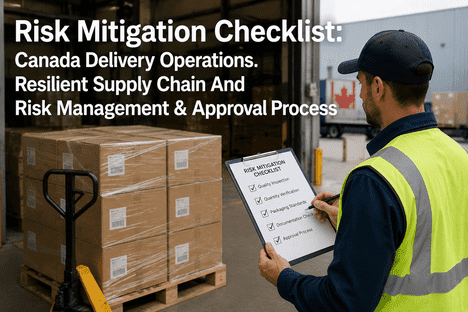
Japan's logistics sector faces a structural challenge that no incremental improvement to manual delivery operations can solve. The country moves approximately 4.3 billion tons of freight annually across a distribution network constrained by labor shortages — the Japan Trucking Association reports a driver shortage exceeding 200,000 in 2025, with the average driver age at 52.4 years and less than 5% of new entrants under 30. Simultaneously, e-commerce penetration in Japan has reached 12.8% of total retail sales and is projected to grow at 8.2% CAGR through 2028, driven by Rakuten, Amazon Japan, and local omnichannel retailers expanding same-day and next-day delivery commitments. The result is a delivery operations system under dual pressure: rising shipment volumes and a shrinking, aging workforce capable of managing picking, packing, quality inspection, and dispatch workflows. Robotics and warehouse automation augmented by AI-powered delivery operations management offer the only scalable path forward. Japan's manufacturing and logistics leaders — including Toyota's logistics subsidiary, Nippon Express, Sagawa Express, and Yamato Transport — are deploying robotic pick-and-pack systems, automated guided vehicles, AI-driven quality inspection stations, and integrated delivery operations platforms to close the labor gap while achieving zero-defect shipping. iFactory AI's delivery operations management platform, purpose-built for industrial logistics and manufacturing dispatch environments, unifies robotics orchestration, quality inspection workflows, quantity verification, packaging compliance, and documentation validation into a single command center that ensures every outbound shipment meets customer specifications before it leaves the facility. Book a Demo to see how iFactory AI powers Japan's next-generation delivery operations with robotics integration and AI quality assurance.
Why Manual Delivery Operations Cannot Meet Japan's Logistics Demand
Japan's delivery operations ecosystem — spanning manufacturing plant outbound docks, third-party logistics warehouses, e-commerce fulfillment centers, and cold chain distribution hubs — has relied on manual processes for quality inspection, quantity counting, packaging verification, and documentation review since the post-war industrial expansion. These manual workflows, while deeply embedded in Japan's culture of precision (monozukuri), face four structural limitations that prevent them from scaling to meet modern e-commerce and just-in-time manufacturing demands. The Japan Institute of Logistics Systems estimates that manual delivery operations processes account for 22–35% of total logistics cost per shipment, with error rates of 1.2–3.8% in quantity verification and 4.1–7.3% in documentation accuracy depending on shipment complexity. For a facility shipping 5,000 orders daily, a 2% quantity error rate translates to 100 customer complaints and $12,000–$28,000 in monthly return processing and restocking costs.
What AI-Powered Delivery Operations Management Detects at Every Outbound Stage
Every outbound shipment passes through four inspection gates before clearance: quality inspection, quantity verification, packaging compliance check, and documentation validation. AI-powered delivery operations management automates each gate using computer vision, sensor fusion, and rule-based document processing — reducing end-to-end inspection time from 8–15 minutes per shipment to under 60 seconds while eliminating human-error-driven defects. The table below documents the four inspection gates, their AI detection methods, typical defect rates before automation, and cost impact per defect category in Japan's logistics environment.
| Inspection Gate | What AI Detects | Detection Method | Manual Error Rate | Cost per Defect (JPY) |
|---|---|---|---|---|
| Quality Inspection | Product damage, surface defects, missing components, incorrect variants, and foreign object contamination in outbound shipments | AI computer vision with CNN-based anomaly detection trained on thousands of labeled product images; compares each item against approved reference image | 2.1–4.5% | ¥15,000–45,000 |
| Quantity Verification | Under-count and over-count errors in multi-SKU shipments, mixed pallets, and kitted assemblies; verification against packing list and order line items | Deep learning object counting with bounding-box detection per SKU; weight correlation check; barcode/RFID cross-reference per item class | 1.2–3.8% | ¥8,000–22,000 |
| Packaging Compliance | Carton dimension violations, weight exceedance, inadequate cushioning, improper pallet configuration, and carrier-specific packaging rule violations | 3D depth camera dimensional scanning + load cell weight verification + rule-based carrier compliance engine (Sagawa, Yamato, Japan Post, FedEx, DHL) | 4.1–7.3% | ¥5,000–18,000 |
| Documentation Validation | Missing shipping labels, incorrect recipient address, incomplete customs forms, mismatched packing list vs order, expired certificates, and regulatory non-compliance in documentation | OCR + NLP document parsing against order management system; automated cross-reference of shipping slip, packing list, certificate of origin, and hazardous goods declaration per shipment | 4.1–7.3% | ¥12,000–60,000 |
The integration of robotics — pick-and-pack arms, autonomous mobile robots (AMRs), and automated sortation systems — with AI delivery operations management creates an end-to-end automated dispatch pipeline: robots pick and pack orders from storage locations, AMRs transport completed shipments to inspection stations where AI performs the four-gate clearance process in under 60 seconds, and approved shipments receive a digital clearance pass that authorizes carrier pickup or loading. iFactory AI's platform acts as the orchestration layer between robotics hardware and inspection AI, managing exception workflows — rejected shipments are automatically routed to a correction station with specific defect details displayed on operator dashboards, approved shipments trigger carrier notification and loading documentation generation. Book a Demo to see the iFactory delivery operations platform in action with robotics integration.
How iFactory AI Unifies Robotics, Inspection, and Dispatch into a Single Command Center
iFactory AI's delivery operations management platform processes every outbound shipment through a five-stage pipeline that transforms raw order data into a fully inspected, documented, and carrier-ready shipment with zero manual touch. The platform integrates with existing warehouse management systems (WMS), enterprise resource planning (ERP) systems, robotic pick-and-pack controllers, AMR fleet managers, and carrier APIs — working with Japan's leading logistics technology ecosystem including Mitsubishi Logisnext, Daifuku, Murata Machinery, and Fanuc robotics through standard REST API and MQTT interfaces.
iFactory's Shift Logbook captures every dispatch event — order ID, inspection results per gate, clearance pass certificate, carrier handoff timestamp, and any exception events — creating a complete audit trail per shipment. Operations managers review real-time dashboard metrics including inspection throughput (shipments per hour), first-pass yield percentage, reject rate by defect category, and carrier acceptance rate. Trend analysis identifies recurring defect patterns — a specific SKU with chronic packaging non-compliance, a pick zone with elevated quantity errors, or a documentation type with recurring form incompleteness — enabling root cause correction before those defects impact customer satisfaction. Book a Demo to see iFactory's dispatch command center dashboard and inspection analytics.
The ROI of Robotics and AI-Powered Delivery Operations for Japan's Manufacturers
The business case for automating delivery operations with robotics and AI-driven inspection is compelling across Japan's industrial landscape. A single major customer complaint from a defective, miscounted, or incorrectly documented shipment — particularly in automotive, electronics, or pharmaceutical verticals where defect tolerance is zero — can trigger penalty clauses, return logistics costs, and reputational damage that far exceeds the automation investment. Book a Demo to see a personalized ROI projection for your facility's shipment volume, defect rates, and labor cost profile. Facilities deploying iFactory AI's delivery operations platform alongside robotics integration report measurable improvements across five key metrics within the first quarter of operation.
Application Coverage: Which Facilities Benefit Most from Delivery Operations Automation
Not every shipping facility needs the full robotics-and-inspection automation stack. The highest-ROI candidates share three characteristics: high shipment volume (1,000+ outbound orders daily), low error tolerance (automotive, electronics, pharmaceutical, or food verticals), and multi-SKU or multi-destination complexity that amplifies manual error risk. iFactory AI's delivery operations practice has developed deployment templates for the five highest-value facility types based on field data across Japan's manufacturing and logistics landscape.
- Just-in-sequence parts dispatch to assembly lines — wrong part or wrong quantity halts production. AI quality inspection verifies part number, surface condition, and quantity against production sequence schedule
- Parts kitting for export — multi-SKU kits with documentation for customs clearance. AI documentation validation checks certificate of origin, packing list, and hazardous goods declarations per destination country
- Service parts logistics — low-volume, high-variety dispatch with zero error tolerance. Robotics pick-and-pack combined with AI quantity verification ensures every service order ships complete
- Supplier parts receiving and cross-docking — inbound quality inspection before cross-dock dispatch. AI detects damage and quantity discrepancies at receipt before they propagate to dispatch
- ESD-sensitive component shipping — AI packaging compliance check verifies ESD packaging, moisture barrier bags, and desiccant presence per JEDEC and IPC standards
- High-value, low-tolerance shipments — AI quality inspection detects microscopic surface defects, incorrect component orientation, and foreign particle contamination before dispatch
- Multi-destination split shipments — one order split across multiple carriers and destinations. AI quantity verification ensures each shipment segment has correct allocation per customer purchase order
- Regulatory documentation for chemical and material shipments — AI NLP document parsing validates SDS (Safety Data Sheet), customs classification (HS code), and export license per METI regulations
- Cold chain validation — AI packaging compliance check verifies refrigerated packaging configuration, temperature data logger presence, and cold chain label compliance per GDP (Good Distribution Practice) standards
- Serial number and lot tracking — AI quantity verification reads and cross-references every serialized unit against GS1 barcode and lot record per PMDA traceability requirements
- Expiry date management — AI documentation validation checks that all shipped units have expiry dates within customer-acceptable range (typically >12 months) before dispatch clearance
- Regulatory documentation for controlled substances — AI NLP parsing validates narcotic/controlled substance permits, temperature excursion contingency plans, and chain of custody forms per MHLW guidelines
- Multi-SKU pallet building — mixed-SKU pallets for convenience store and supermarket distribution centers. AI quantity verification ensures each pallet has correct SKU mix per retailer order
- Best-before date scanning — AI documentation validation reads best-before or use-by dates on every case and rejects shipments where any unit falls below customer-specified shelf-life threshold
- Packaging integrity for fragile goods — AI packaging compliance check verifies carton stacking pattern, pallet wrap tension, and load stability for Sagawa and Yamato carrier acceptance
- Food safety documentation — AI NLP parsing validates temperature logs, allergen declarations, and traceability records per Japan's Food Sanitation Act Article 8 documentation requirements
Expert Perspective: Why Robotics and AI Inspection Are the Only Answer to Japan's Logistics Crisis
I have spent 19 years designing and managing outbound logistics operations for three of Japan's largest manufacturing and logistics organizations — Toyota Tsusho, Nippon Express, and a major electronics OEM that ships 85,000 orders daily across 34 countries. The single most persistent operational challenge across all three environments has been the same: manual outbound inspection and documentation processes that cannot scale with volume growth and workforce decline. At the electronics OEM, we deployed a pilot AI inspection station on one of eight shipping lines in 2024. The results were unambiguous — the AI station achieved 99.3% defect detection rate versus 82.1% for manual inspection on the same line, processed shipments at 4.7x the throughput per labor hour, and reduced documentation errors to near zero through automated cross-referencing against carrier requirements. Within six months, the pilot proved that the technology works, the ROI is measurable in months not years, and the only barrier to full deployment across all shipping lines was organizational change management — training dock workers to oversee automated inspection rather than performing every inspection manually. Japan's logistics sector does not need another incremental efficiency program. It needs a fundamental redesign of the outbound process — and robotics combined with AI delivery operations management is the design blueprint. Book a Demo to discuss how iFactory AI can help your facility implement this fundamental redesign.
Frequently Asked Questions
Facilities deploying AI four-gate inspection — quality, quantity, packaging, and documentation — report an 85–92% reduction in shipment defects reaching customers, with first-pass yield (percentage of shipments passing all four gates on first attempt) improving from 78–85% to 96–99% within the first 30 days of operation. The most significant improvement occurs in documentation validation, where manual processes typically miss 4–7% of errors and AI reduces that to under 0.5%. Quantity verification errors drop from 1.2–3.8% to under 0.3%. The end-to-end inspection time per shipment falls from 12–18 minutes manually to under 60 seconds with AI automation, enabling facilities to process higher volumes without additional dock labor.
No. AI delivery operations management automates repetitive, high-volume inspection and documentation tasks that are difficult to staff consistently, especially during peak periods and night shifts. It does not eliminate the need for human operators, quality engineers, logistics supervisors, or maintenance technicians. What it delivers is labor rebalancing: the same workforce that previously performed manual inspection of every shipment transitions to exception handling (investigating and correcting the 2–4% of shipments that fail AI inspection), continuous improvement analysis (reviewing defect trends and implementing root cause corrections), and robotics fleet supervision (monitoring pick-and-pack robot and AMR performance). Facilities typically report a 35–50% reduction in outbound dock labor requirements through automation, with affected workers retrained for higher-value roles in exception management, process engineering, and quality assurance.
iFactory AI's delivery operations platform integrates with Japan's leading robotics and warehouse automation systems through REST API and MQTT interfaces. Supported robotics include Daifuku (automated storage and retrieval systems, sortation systems), Murata Machinery (AGVs, automated guided forklifts), Mitsubishi Logisnext (reach trucks, automated guided vehicles, palletizers), Fanuc (articulated arm robots for case picking and palletizing), Yaskawa Motoman (cobot arms for piece picking and kitting), Hitachi Industrial Equipment Systems (sortation and conveyance), and Toyota Material Handling (automated forklifts and tow tractors). Additionally, the platform integrates with major WMS providers used in Japan including SAP EWM, Oracle WMS, HighJump (Körber), and local providers such as DCS (Daifuku's WMS), Mitsubishi Logisnext's WMS, and Yamato Transport's dispatch management system. Custom integration to proprietary or legacy systems is available through iFactory's integration framework.
Japan's domestic carriers — Yamato Transport, Sagawa Express, Japan Post, and Fukuyama Transporting — each enforce unique packaging specifications, label formats, dimensional limits, and documentation requirements that vary by service class (standard, express, refrigerated, oversized). iFactory's carrier compliance engine embeds the published rule sets for all major Japanese carriers, updating them as carriers revise their standards. For international shipping, the platform supports Japan Customs NACCS (Nippon Automated Cargo and Port Consolidated System) integration for electronic customs declaration, METI export license validation for controlled goods, and destination-country-specific documentation templates. The platform's documentation validation engine parses shipping slips (hinagata/nakadashi), packing lists, certificates of origin (including Japan's Form A for ASEAN and Form D for Japan-Mexico EPA), hazardous goods declarations per UN Model Regulations and Japan's Fire Service Act, and food export certificates per Japan's Food Sanitation Act. All documentation is validated against both carrier requirements and destination country regulatory requirements before clearance is issued.
For a mid-size facility with 1,000–5,000 daily outbound orders on 2–4 shipping lines, a full robotics and AI delivery operations deployment runs ¥18,000,000–¥55,000,000 ($120,000–$380,000) total investment over a 6–10 week implementation timeline. The cost breakdown is approximately: AI inspection stations with cameras, sensors, and edge computing devices (¥5,000,000–¥12,000,000 per line), robotics integration middleware for pick-and-pack and AMR orchestration (¥4,000,000–¥10,000,000), iFactory platform configuration including WMS/ERP integration, carrier compliance engine, and dispatch dashboard setup (¥5,000,000–¥18,000,000), and installation, commissioning, operator training, and go-live support (¥4,000,000–¥15,000,000). The implementation timeline breaks into Stage 1 (weeks 1–2): system design, hardware installation, and network integration; Stage 2 (weeks 3–4): platform configuration, WMS/ERP integration testing, and carrier compliance engine setup; Stage 3 (weeks 5–6): AI model training on facility-specific products, packaging types, and documentation templates; Stage 4 (weeks 7–8): go-live on one shipping line with parallel manual inspection for validation; Stage 5 (weeks 9–10): full go-live across remaining lines and continuous improvement tuning. ROI is typically demonstrated within 3–6 months through eliminated defect costs, labor savings, improved carrier acceptance rates, and reduced customer complaint resolution expenses.