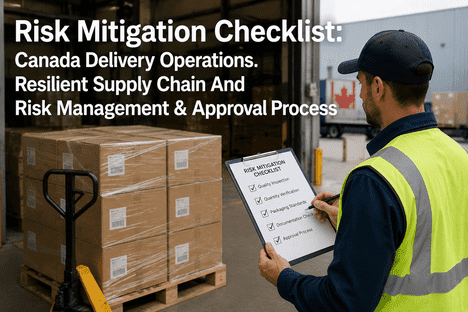
Risk Mitigation Checklist: Canada Delivery Operations Resilient Supply Chain And Risk Management & Approval Process
By Arel Dixon on June 11, 2026
Every shipment that leaves your facility carries risk. The risk that the wrong quantity was picked. The risk that packaging was compromised during staging. The risk that a required document was omitted from the paperwork package. The risk that the carrier handover was not properly recorded. And the risk that a supply chain disruption a winter storm on the Trans-Canada Highway, a rail stoppage affecting the Port of Vancouver, a wildfire closing the Coquihalla will disrupt delivery before the shipment reaches its destination. In Canada's geographically dispersed and regulatory-intensive delivery environment, these risks are not hypothetical. They are daily operational realities that every logistics manager, supply chain director, and warehouse operations lead must manage. This checklist is a practical, step-by-step framework for implementing AI-driven risk mitigation across every stage of the dispatch process from order picking through carrier handover and in-transit monitoring. Each item represents a verification point that, when automated with AI vision inspection, digital documentation validation, and intelligent clearance workflows, eliminates the detection gap between when a risk emerges and when it is caught. Use this checklist to audit your current dispatch process, identify the gaps where manual verification is failing, and build a deployment roadmap for AI-powered risk mitigation that ensures every shipment that leaves your facility is inspected, verified, documented, and cleared for error-free dispatch.
AI Vision Inspection · Digital Documentation · Clearance Pass · In-Transit Risk Monitoring
The Complete Risk Mitigation Checklist for Canada's Delivery Operations Implement AI-Driven Inspection, Documentation, and Approval Workflows to Eliminate Dispatch Errors and Build Supply Chain Resilience
iFactory's AI-powered delivery operations platform gives Canadian logistics teams a practical checklist-based approach to risk mitigation with AI vision quantity and packaging inspection at every dispatch checkpoint, automated documentation validation for Health Canada and CFIA compliance, digital clearance passes that ensure only verified shipments leave the facility, and real-time disruption monitoring that protects in-transit shipments from Canada's unique geographic and climate risks.
Phase 1: Pre-Dispatch Quality and Quantity Verification
The first line of defence against delivery failures is verifying that every shipment matches the order specification before it leaves the picking area. In manual operations, this verification relies on visual inspection and paper checklists that are time-consuming, error-prone, and rarely capture all failure modes. AI vision inspection automates this phase, completing every check in under five seconds per pallet with detection accuracy that exceeds the human eye.
Implementation guide: Install the AI vision camera at the stretch wrapper station or pallet staging area. Configure the model for your unit types — cases, totes, mixed pallets — during a one-hour calibration session. Train operators to pause the pallet in the inspection zone for three seconds while the count verification runs. Review discrepancy alerts at the end of each shift to identify root causes in the picking process.
Risk mitigated: Quantity discrepancies — the most frequent cause of customer complaints and chargebacks in Canadian distribution operations. iFactory's AI vision quantity verification achieves 99.5%+ accuracy on standard pallet configurations. Talk to an expert about configuring the count verification model for your specific product types and pallet formats.
Implementation guide: The packaging inspection model requires a one-time configuration to your packaging formats — stretch wrap colours, label sizes and positions, case seal types, temperature indicator models. Configure alert thresholds during the initial calibration, and define which defect types require immediate correction versus logging for trend analysis. Train operators on the defect alert display so they can identify and correct issues at the inspection point without delaying the dispatch flow.
Risk mitigated: Packaging-related damage claims and regulatory non-compliance incidents due to missing or illegible labels on Health Canada-controlled products. iFactory's AI vision packaging inspection reduces packaging-related claims by up to 85%. Talk to an expert about configuring packaging inspection for your specific formats and regulatory requirements.
Implementation guide: Map your document types to the WMS/ERP shipment categories during the initial platform configuration. Define the validation rules for each document type — field matching, expiry date checking, permit number validation. Configure the notification workflow so that documentation gaps are routed to the correct team member based on document type and urgency. Conduct a test run with 50 historical shipments to validate the document rules before going live.
Risk mitigated: Documentation-related shipment holds at destination, carrier detention fees, regulatory non-compliance findings. iFactory's automated documentation validation achieves 100% completeness for shipments processed through the digital workflow. Talk to an expert to see the documentation workflow configured for your regulatory environment.
AI Vision Quantity Check · Packaging Inspection · Documentation Validation
Phase 1 Complete — Every Shipment Now Verified for Quantity, Packaging Integrity, and Documentation Compliance Before It Leaves the Picking Area. Three Risks Eliminated Before the Pallet Reaches the Loading Dock.
iFactory's pre-dispatch verification platform — AI vision quantity counting, packaging defect detection, and automated documentation validation — running in under five seconds per pallet with zero operator data entry. Ready for the clearance pass and carrier handover phase.
Phase 2: Digital Clearance Pass and Carrier Handover
Once the pre-dispatch verification is complete — quantity confirmed, packaging inspected, documentation validated — the shipment is ready for the carrier handover. This phase is the final control point before the shipment leaves your facility, and it is the moment where digital clearance workflows replace paper-based release processes that are slow, error-prone, and non-auditable. Implementing the items in this phase ensures that every shipment that departs has a verified digital record of what was handed over, when, and to whom.
Implementation guide: Define the clearance pass rules during platform configuration — what combination of passes is required for each shipment type (standard, cold-chain, controlled substance, cross-province). Configure the QR code format and data payload to match your carrier and customer requirements. Test the clearance pass generation with a pilot shipment flow before rolling out to full production. Train loading dock staff on the clearance pass display and the procedure for handling blocked shipments.
Risk mitigated: Shipments departing with unresolved quantity, packaging, or documentation issues. iFactory's digital clearance pass ensures 100% of verified conditions are met before departure. Talk to an expert about configuring clearance pass rules for your specific shipment types and regulatory requirements.
Implementation guide: Provide mobile devices or fixed QR scanners at the dispatch gate for carrier drivers. Configure the handover data capture fields — driver ID, carrier, trailer number, seal numbers — to match your operational requirements. Train the dispatch team on the QR code handover workflow and the process for handling exceptions (missing QR code, scanner failure, unregistered driver). Establish the dispute resolution process that relies on the digital record as the single source of truth.
Risk mitigated: Carrier handover disputes, missing proof of delivery documentation, liability gaps when shipments are damaged in transit. iFactory's QR code handover reduces carrier disputes by up to 90%. Talk to an expert about integrating the QR code handover workflow with your carrier partners' systems.
Phase 3: In-Transit Risk Monitoring and Disruption Response
The shipment has departed with verified quantity, inspected packaging, complete documentation, and a digital clearance pass. But the risk journey is not over. Canada's unique geography, climate, and infrastructure create in-transit risks that can disrupt even the most carefully prepared shipment. This phase ensures that your operation has real-time visibility into in-transit risks and a structured response process that protects your customers and your compliance standing when disruptions occur.
Implementation guide: Configure the data source integrations for your specific shipping lanes and risk profile — Environment Canada API for weather alerts, provincial transport feeds for highway closures, carrier API integrations for GPS tracking. Define the risk level thresholds and notification rules for each type of disruption event. Set up the customer notification templates for delay communications. Train the logistics team on the disruption response workflow, including escalation paths for compliance-critical shipments.
Risk mitigated: Supply chain disruptions that are detected too late for proactive response. iFactory's real-time disruption monitoring compresses detection-to-response time from hours to under five minutes. Talk to an expert to see the disruption monitoring dashboard configured for your shipping lanes and product categories.
Implementation guide: Configure notification templates for each type of disruption event and customer segment. Define the approval workflow — which notifications require manager approval before sending and which can be sent automatically. Set up the compliance team escalation path with specific criteria for regulatory deadline risks. Train customer service and logistics teams on the notification workflow and the response process for customer follow-up inquiries.
Risk mitigated: Reactive customer communication that damages trust and creates compliance exposure. iFactory's automated notification system ensures proactive, consistent, and documented communication for every disruption event. Talk to an expert about configuring notification templates for your customer base and regulatory environment.
Phase 4: Continuous Improvement — Audit and Analytics
Risk mitigation is not a one-time implementation. It is a continuous process that improves as you collect more data, identify patterns, and refine your verification workflows. This final phase ensures that your risk mitigation system evolves with your operation, using the data generated by the first three phases to drive measurable improvement in dispatch accuracy, compliance performance, and supply chain resilience.
Implementation guide: Schedule the weekly discrepancy review as a recurring meeting on the logistics team calendar. Configure the analytics dashboard to show failure trends by category, shift, product, and operator. Define the corrective action process for the top three failure types each week, with assigned owners and follow-up dates. Track the month-over-month trend in total discrepancy rate as the primary metric for process improvement.
Risk mitigated: Recurring failure patterns that are not identified or addressed because inspection data is not analysed systematically. iFactory's discrepancy analytics dashboard enables continuous improvement that reduces failure rates by 15-25% quarter over quarter. Talk to an expert to see the analytics dashboard with your inspection data.
Implementation guide: Configure the monthly report template during platform setup, selecting the regulatory categories and data fields that apply to your operation. Define the distribution list for the automated monthly report — quality manager, compliance officer, supply chain director. Establish the annual audit preparation process that uses the monthly reports as the primary evidence source. Train the quality team on navigating the digital audit trail so they can respond to auditor questions in real time during on-site audits.
Risk mitigated: Audit preparation time and compliance gaps that are discovered during regulatory inspections. iFactory's automated compliance reports reduce audit preparation from days to minutes and ensure every shipment record is searchable and verifiable. Talk to an expert about configuring the compliance report for your specific regulatory requirements and audit standards.
Risk Mitigation Checklist Summary — All Nine Check Items
Each check item represents a specific risk mitigation capability that can be implemented incrementally, starting with the highest-impact items and building toward full coverage across all four phases. iFactory's delivery operations platform supports phased deployment so you can begin with Phase 1 and add capabilities as your team builds confidence with the AI-driven inspection and digital clearance workflow.
Conclusion
Canada's delivery operations face a unique combination of risks — geographic scale, climate variability, infrastructure constraints, and stringent regulatory requirements across multiple provinces and product categories. Managing these risks through manual inspection processes, paper-based documentation, and reactive disruption response is no longer sustainable for operations that need to deliver consistent on-time, in-full performance while maintaining Health Canada and CFIA compliance.
This nine-item checklist provides a practical implementation roadmap for AI-driven risk mitigation across every stage of the dispatch process. Starting with AI vision quantity verification and packaging inspection in Phase 1, building through digital clearance and QR code carrier handover in Phase 2, extending to real-time disruption monitoring and automated customer notification in Phase 3, and closing the loop with continuous improvement analytics in Phase 4 — each item delivers measurable risk reduction and a clear return on investment through avoided failure costs, reduced labour requirements, and improved regulatory compliance standing.
The technology to implement this checklist across your delivery operation is available today. The question is not whether your operation will adopt AI-driven risk mitigation — it is whether you will be the one to lead that transformation or play catch-up after your competitors have already closed the detection gap and built the compliance infrastructure that the Canadian market will require within the next regulatory cycle.
iFactory's AI-powered delivery operations management platform is purpose-built for Canadian supply chains — with AI vision quantity and packaging inspection at the loading dock, automated documentation validation for Health Canada and CFIA compliance, digital clearance passes that ensure only verified shipments depart, real-time disruption risk monitoring, and continuous improvement analytics that drive measurable reductions in failure rates over time. Book a Demo to see the platform configured for your facility and product types, or talk to an expert about a live walkthrough on your shipment data and compliance requirements.
Nine Check Items. Four Phases. One Platform. Your Complete Risk Mitigation Framework for Canada's Delivery Operations Starts Here.
iFactory's delivery operations platform — AI vision quantity and packaging inspection, automated documentation validation, digital clearance passes, real-time disruption monitoring, and continuous improvement analytics. Configured for your facility, product types, and regulatory requirements. Start with Phase 1 and build toward full coverage.