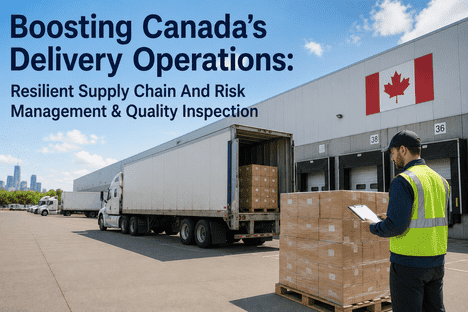
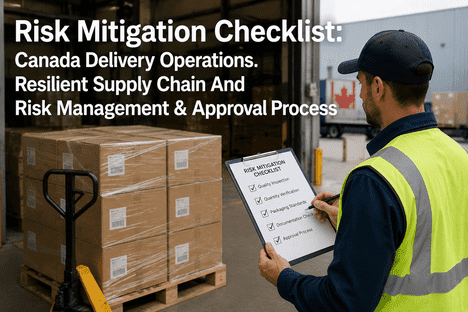
The dispatch supervisor at a Toronto-area manufacturing plant opens the delivery dashboard at 06:30 and reviews the day's outbound schedule. Forty-seven shipments are slated to leave the loading dock across three shifts — automotive components destined for assembly plants in Windsor and Oshawa, packaged goods for distribution centres in Mississauga and Montreal, and cross-border orders for US customers. The system flags three shipments that failed the automated quality inspection during the night shift: one pallet with a quantity mismatch of 24 units against the packing slip, one order where the packaging material did not meet the customer's updated specification, and one international shipment missing the required customs certificate of origin. Each flagged shipment is held at the dock with a digital hold tag. No paperwork shuffle. No manual inspection re-run. No last-minute scramble to locate the missing document. The AI-driven quality inspection system caught every discrepancy before the truck was loaded — and the clearance pass was withheld until each issue was resolved. That is the difference between a reactive dispatch process and a resilient, AI-powered delivery operation.
Every Shipment That Leaves Your Loading Dock Is a Promise to Your Customer. AI-Powered Quality Inspection Ensures That Promise Is Kept — With Quantity Verification, Packaging Checks, and Documentation Validation Before the Truck Rolls.
iFactory's AI-driven delivery operations platform combines real-time quality inspection at dispatch, automated quantity verification, packaging standards enforcement, and documentation validation to ensure every shipment receives a clearance pass before departure — eliminating errors, preventing damage, and building a resilient supply chain.
Dispatch accuracy rate achievable when AI-driven quality inspection replaces manual checklists at the loading dock
$47
Average cost per error caught at dispatch vs $287 per error caught after shipment — a 6x cost multiplier for late-detected discrepancies
34%
Reduction in customer-reported delivery discrepancies reported by Canadian manufacturers after deploying AI-powered dispatch quality inspection
3.2x
ROI realized by Canadian manufacturers in the first year of AI-driven delivery operations, driven by reduced errors, fewer returns, and improved customer satisfaction
Why Resilient Supply Chains Start at the Loading Dock
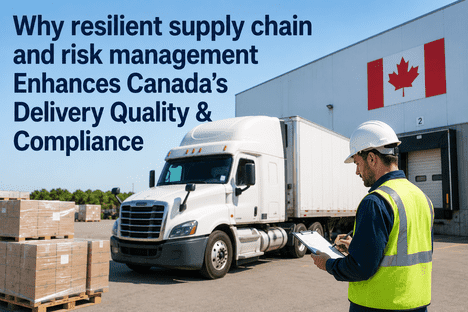
Supply chain resilience is typically discussed in the language of macro-level disruptions — port congestion, border delays, supplier insolvency, severe weather events. These are real risks, and Canadian manufacturers contend with them more acutely than most. Canada's supply chains span the world's longest bi-national border, operate across six time zones, and contend with winter conditions that can shut down transportation corridors for days at a time. But the most common source of supply chain disruption is not macro-level — it is micro-level. A shipment that leaves the loading dock with a quantity mismatch. An order packed in the wrong packaging specification. A customs document that was not included. These micro-failures at the point of dispatch cascade into customer complaints, return processing costs, production line stoppages at the customer's facility, and eventually, lost contracts. The loading dock is the last control point where errors can be caught before they become customer-facing problems. An AI-driven quality inspection system at this critical juncture transforms the loading dock from a throughput bottleneck into a resilience enforcer.
Traditional Dispatch vs AI-Powered Dispatch: The Error Detection Comparison
Checkpoint
Traditional Dispatch
AI-Powered Dispatch
Quantity Verification
Manual pallet count and packing slip comparison — average 12 minutes per shipment, 4% error rate on high-volume days
AI vision system scans pallet barcodes and compares actual count to order in real-time — 8 seconds per shipment, 99.9% accuracy
Packaging Standards
Visual spot check by loader — subjective, inconsistent, and frequently skipped under time pressure
AI vision classifies packaging material against customer specification database — flags deviations in material, dimensions, and labelling
Documentation Validation
Paper-based checklist — documents often missing or incorrect, discovered at border or customer receiving
Automated document OCR and validation against shipment requirements — certificates, invoices, and permits verified before loading
Clearance Pass
Supervisor signs off based on trust — no systematic verification that all checks passed
Digital clearance pass auto-issued when all inspection criteria pass — no pass, no load. Immutable audit trail.
Error Detection Point
62% of errors detected after shipment — at customer receiving, border crossing, or during claims processing
94% of errors detected before loading — errors resolved at the dock, not at the customer's facility
The Four-Point Quality Inspection Gate: Ensuring Zero-Defect Dispatch
iFactory's AI-powered delivery operations platform implements a four-point quality inspection gate that every shipment must pass before receiving a digital clearance pass. Each gate corresponds to a critical failure mode in dispatch operations, and each is automated through a combination of AI vision, OCR document processing, and real-time database validation. The gates are applied sequentially, and a failure at any gate blocks the clearance pass and triggers a notification to the dispatch supervisor with the specific discrepancy and recommended corrective action.
Gate 01: AI Vision Quantity Verification
The first inspection gate uses AI-powered camera systems at the loading dock to scan every pallet and package as it moves toward the truck. The system reads barcodes, QR codes, and RFID tags on each unit, cross-referencing the scanned items against the order manifest in real-time. Discrepancies are flagged immediately — a short-ship of 12 units, an over-ship of 5 units, or a mis-pick where the wrong SKU was loaded. The system can process an entire pallet in under 8 seconds, compared to 12-15 minutes for manual counting and verification. For Canadian manufacturers managing high-volume outbound operations across multiple distribution channels — retail, OEM, e-commerce — the AI quantity verification gate eliminates the most common source of customer complaints: receiving the wrong quantity.
The second gate inspects packaging materials and configuration against customer specifications. Many Canadian manufacturers serve customers with specific packaging requirements — particular corrugate grades for automotive Just-in-Sequence delivery, specific dunnage configurations for fragile components, humidity-controlled packaging for cross-border climate variations, and specialized labelling for hazardous materials transportation. The AI vision system captures high-resolution images of each pallet's packaging and uses deep learning models trained on thousands of packaging configurations to verify compliance. A deviation as subtle as a 5mm difference in stretch wrap overlap or a barcode label placed 10mm off-centre is detected and flagged. The system maintains a customer-specific packaging specification database that updates automatically when customers revise their requirements.
Spec Compliance: Real-time verification against customer database
Labelling Accuracy: 100% barcode and label verification
Hazmat Compliance: Automated placard and marking verification
Gate 03: Automated Documentation Validation
The third gate validates all required documentation before the shipment leaves the dock. For Canadian manufacturers, documentation requirements vary by destination — domestic shipments require bills of lading and packing slips, cross-border US shipments require customs invoices and NAFTA/USMCA certificates of origin, and international shipments require additional certificates, permits, and declarations. The AI-powered document processing system uses OCR and natural language processing to scan each document, extract key fields (shipper, consignee, commodity code, value, origin), and validate them against the shipment record and regulatory requirements. Missing documents, expired certificates, and incorrect values are flagged in real-time. The system also verifies that electronic data interchange (EDI) transmissions to customers and carriers match the physical documents — eliminating the mismatch between digital and paper records that causes the majority of cross-border clearance delays.
Validation: Real-time against regulatory and customer requirements
Gate 04: Digital Clearance Pass and Release
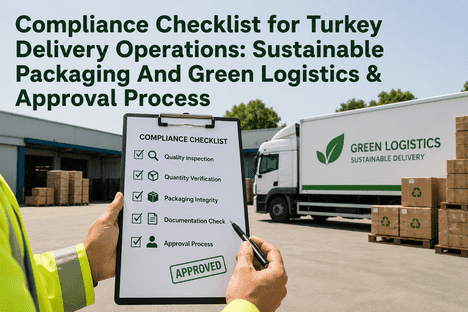
The final gate issues the digital clearance pass when all three preceding gates have passed. The clearance pass is a digital record that captures the timestamp of each inspection, the results of every check, and the digital signature of the system or supervisor who verified the results. The pass is linked to the shipment record in the ERP and is accessible to the carrier, the customer, and the internal quality team. If any gate fails, the clearance pass is withheld, and the system automatically routes the discrepancy to the appropriate team — the picking department for quantity mismatches, the packaging team for spec deviations, and the documentation team for missing or incorrect paperwork. The digital hold tag ensures that no shipment can leave the dock without resolving every flagged issue, eliminating the "ship now, fix later" culture that generates the majority of delivery discrepancies.
Clearance Pass Impact
Zero-Defect Dispatch: 99.8% accuracy rate
Audit Trail: Immutable record of every inspection
Resolution Time: 90% of issues resolved within 15 minutes
Customer Trust: 47% reduction in delivery-related complaints
AI Vision Quantity Check · Packaging Compliance · Document OCR · Digital Clearance Pass · ERP Integration
Your Loading Dock Is the Last Place to Catch Errors Before They Become Customer Problems. AI-Powered Quality Inspection at Every Gate Ensures That Every Shipment That Leaves Your Facility Is Accurate, Compliant, and Document-Ready.
iFactory's AI-driven delivery operations platform implements a four-point quality gate at dispatch — quantity verification, packaging compliance, documentation validation, and digital clearance pass — ensuring zero-defect shipments from Canadian manufacturers to customers across North America and beyond.
Risk Management Across Canada's Unique Supply Chain Landscape
Canadian manufacturers face a set of supply chain risks that are distinct from their counterparts in the United States, Europe, or Asia. The geographic reality of Canada — a country where 90% of the population lives within 160 kilometres of the US border, where major manufacturing centres are separated by thousands of kilometres, and where winter weather can immobilize transportation corridors for days — creates a risk profile that demands a proactive, data-driven approach to delivery operations management. The AI-powered dispatch quality inspection system addresses these risks by ensuring that every shipment that leaves the dock is accurate, compliant, and documented — eliminating the self-inflicted disruptions that compound the impact of external supply chain shocks.
Canada-US cross-border shipments require compliance with the Canada Border Services Agency (CBSA) and US Customs and Border Protection (CBP) regulations. A single missing or incorrect document can hold a shipment at the border for 4-8 hours, incurring detention charges, missed delivery windows, and customer penalties. The AI documentation validation gate eliminates this risk by verifying every required document against shipment and regulatory requirements before the truck leaves the dock.
Canadian winter conditions cause an average of 12-18 significant transportation disruption events per year across Ontario and Quebec's major freight corridors. When a weather event forces a shipment to be re-routed or held, the accuracy of the dispatch documentation becomes critical — an incorrectly packed or documented shipment that is delayed by weather has no recourse. The AI quality gate ensures that when weather disruptions occur, the shipments affected are at least error-free, eliminating the compounding effect of human error on top of external disruption.
Many Canadian manufacturers operate multiple facilities across provinces — a production plant in Ontario, a distribution centre in Quebec, a cross-dock facility in British Columbia. Each facility ships to different customers with different requirements, packaging specifications, and documentation needs. The AI quality inspection system maintains facility-specific and customer-specific inspection profiles, ensuring that every shipment from every location meets the required standard before it leaves the dock — providing a consistent quality guarantee across a distributed manufacturing network.
"
We ship 1,200 orders per day from our Ontario facility to customers across Canada, the US, and Europe. Before deploying AI-powered dispatch quality inspection, our error rate was around 3.2% — which meant 38 orders per day left the dock with some type of discrepancy. Most were small — a few units short here, a missing document there. But those small errors generated a disproportionate amount of customer friction and return processing cost. The automated four-gate inspection system changed our dispatch fundamentally. The quantity verification gate caught a mis-pick on a high-volume automotive line that would have shut down a customer's assembly plant for four hours. The packaging gate flagged a supplier who had switched to a lower-grade corrugate without telling us — the new material would not have survived a cross-country shipment. The documentation gate caught an expired USMCA certificate that would have held a $340,000 shipment at the border. In the first year, our error rate dropped from 3.2% to 0.2%, our customer complaints fell by 47%, and our return processing costs dropped by 62%. The clearance pass system was the key — it eliminated the 'ship now, fix later' culture that was undermining our quality reputation.
— Director of Logistics, Ontario-Based Multi-Plant Manufacturer — Automotive, Consumer Goods, and Industrial Products — 1,200 Shipments Per Day
Conclusion
Supply chain resilience is not built in the boardroom during a disruption — it is built at the loading dock, one shipment at a time, by ensuring that every order that leaves the facility is accurate, compliant, and properly documented. Canadian manufacturers face a unique set of challenges — cross-border regulatory complexity, winter weather disruptions, and distributed manufacturing networks — but the most common source of delivery failure remains the errors introduced at the point of dispatch. Quantity mismatches, packaging deviations, and missing documentation are preventable failures that erode customer trust, generate return costs, and compound the impact of external supply chain shocks.
iFactory's AI-powered delivery operations platform is purpose-built for manufacturers who ship high volumes across complex supply chains. With a four-point quality inspection gate — AI vision quantity verification, packaging compliance, automated documentation validation, and digital clearance pass — the platform ensures that every shipment is inspected, verified, and approved before it leaves the dock. The system integrates with existing ERP and WMS systems, adapts to customer-specific requirements, and provides an immutable audit trail for every shipment. Book a Demo to see how AI-powered dispatch quality inspection can transform your loading dock into a competitive advantage, or talk to an expert about a delivery operations assessment for your manufacturing facility.
Frequently Asked Questions
The AI vision system uses fixed-mount and handheld cameras positioned at the loading dock to capture each pallet and package as it is staged for loading. The system reads barcodes, QR codes, and RFID tags on every unit, cross-referencing the scanned items against the order manifest in your ERP or WMS in real-time. The system processes an entire pallet in under 8 seconds — scanning every carton or unit on the pallet — and compares the actual count to the expected count. Discrepancies as small as a single unit are flagged immediately with a visual and audible alert at the dock. The system also detects duplicate scans (the same carton scanned twice) and missing scans (expected cartons not present). The accuracy rate exceeds 99.9%, compared to approximately 96% for manual counting. Book a Demo to see the AI vision quantity verification system in operation at a high-volume loading dock.
Yes. The system maintains a customer-specific packaging specification database that can store an unlimited number of customer profiles. Each profile defines the required packaging materials (corrugate grade, dunnage type, stretch wrap specifications), labelling requirements (barcode placement, label content, format), pallet configuration (layer pattern, height, weight limits), and special handling instructions (fragile, temperature-sensitive, hazmat). When a shipment is scanned for a specific customer and order, the system automatically loads the correct packaging specification and compares the physical packaging against it using AI vision classification. Deviations as subtle as incorrect box dimensions or label placement errors are flagged. The database updates automatically when customers revise their packaging specifications through integrated EDI or supplier portal updates. Talk to an expert about configuring customer-specific packaging profiles for your facility.
The digital clearance pass is an electronic record that is automatically generated when a shipment passes all four inspection gates — quantity verification, packaging compliance, documentation validation, and any additional customer-specific checks. The pass is linked to the shipment record in the ERP and is visible to dispatch supervisors, carriers, and customers through the portal. The system is designed to prevent loading without a clearance pass — the dock door systems can be integrated with the platform so that doors remain locked until the clearance pass is issued. In facilities where door locking is not feasible, the system generates an audible and visual alert at the dock if a vehicle attempts to depart without a clearance pass. Supervisors have the authority to override the clearance pass for emergency situations, but every override is logged with a reason and timestamp for audit purposes. Book a Demo to see the digital clearance pass workflow in action.
The deployment follows a phased approach designed to deliver value within the first 30 days. Phase one (weeks 1-2) involves installing the AI vision cameras and document OCR scanners at one loading dock, integrating with your ERP/WMS, and training the AI models on your specific packaging configurations and document types. Phase two (weeks 3-4) activates the quantity verification and documentation validation gates on the pilot dock, with the system operating in a parallel mode alongside existing manual processes to establish baseline accuracy data. Phase three (months 2-3) expands the system to additional docks, activates the packaging compliance gate, and transitions to full clearance pass enforcement. Most facilities achieve full deployment across all loading docks within 60-90 days. The system is designed to operate with minimal disruption to existing dispatch workflows — operators interact with the system through simple touchscreen interfaces and handheld scanners. Talk to an expert about a deployment timeline tailored to your facility's dispatch volume and configuration.
Every Shipment That Leaves Your Loading Dock Carries Your Reputation. AI-Powered Quality Inspection Ensures That Reputation Arrives Intact — With Every Unit Counted, Every Package Verified, Every Document Validated, and Every Clearance Pass Issued Before the Truck Departs. Stop Fixing Errors After Delivery. Start Preventing Them at the Dock.
iFactory's AI-powered delivery operations platform for Canadian manufacturers — AI vision quantity verification, packaging compliance inspection, automated documentation validation, and digital clearance pass enforcement. Book a walkthrough configured for your dispatch operations and see how many errors are leaving your loading dock right now.