Turkey's manufacturing sector sits at the crossroads of Europe, the Middle East, and Central Asia — a strategic hub where over 40,000 manufacturing facilities produce everything from automotive components and white goods to textiles and packaged food for global export. Yet the country's delivery operations have long faced a persistent challenge: how to ensure that every shipment leaving the factory floor reaches its destination with zero defects in product quality, quantity accuracy, packaging integrity, and documentation compliance. As Turkish manufacturers scale exports and supply chains grow more complex, AI-powered delivery operations management has emerged as the solution that transforms the loading dock from a bottleneck into a strategic asset. iFactory AI's comprehensive platform applies artificial intelligence, computer vision, and multivariate analytics to every outgoing shipment — automating quality inspection, quantity verification, packaging checks, and documentation validation — ensuring that only approved shipments receive clearance, minimizing errors, preventing damage, and enabling smooth logistics operations from Istanbul to İzmir and beyond.
Turkey's manufacturing export volume exceeded $250 billion in 2025, with shipments departing daily from organized industrial zones in Bursa, Kocaeli, Gaziantep, Manisa, and Denizli. Each outbound shipment must clear multiple quality gates — product condition, quantity accuracy, packaging integrity, labeling compliance, and customs documentation — before it can leave the facility. In traditional manual operations, these checks are performed by dock workers and quality inspectors using paper checklists, visual inspection, and manual counting. The result is inconsistent inspection coverage, human error in quantity verification, missed packaging defects, and documentation errors that trigger costly return shipments, customs delays, and customer penalties. Turkish manufacturers lose an estimated 3-5% of export revenue annually to dispatch errors that could have been prevented with automated inspection and verification at the loading dock. Book a Demo to see how AI-powered inspection eliminates these losses for your operation.
| Inspection Domain | Traditional Manual Approach | AI-Powered Automated Inspection | Impact on Delivery Operations |
|---|---|---|---|
| Product Quality | Visual inspection by dock workers — inconsistent coverage, fatigue-related misses, subjective pass/fail criteria | AI vision cameras inspect every item for damage, defects, and dimensional conformity at line speed | 100% inspection coverage — zero-defect shipping with objective, repeatable quality standards |
| Quantity Verification | Manual counting and weigh-checking — prone to human error, especially in high-volume dispatch windows | Automated count verification and weight reconciliation against manifest data | 99.7%+ quantity accuracy — elimination of shorts and overs that trigger chargebacks and returns |
| Packaging Integrity | Spot-check visual inspection of carton condition, seal integrity, and stretch wrap security | AI vision assesses carton condition, seal integrity, stretch wrap tension, labeling accuracy, and barcode legibility on every carton | Elimination of in-transit damage caused by packaging failure — reduced returns and insurance claims |
| Documentation Validation | Paper-based cross-checking of shipping docs, customs paperwork, and regulatory compliance — error-prone and time-consuming | Automated document validation against shipment data; AI flags missing, expired, or non-compliant documents before dispatch | Zero documentation-related customs holds — faster border clearance and reduced demurrage penalties |
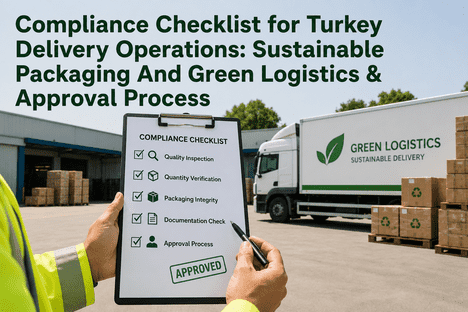
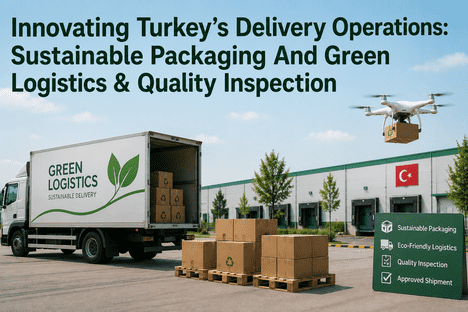
Turkey's commitment to the European Green Deal and its own net-zero targets by 2053 places sustainable packaging and green logistics at the center of manufacturing strategy. Turkish exporters shipping to EU markets must comply with the Packaging and Packaging Waste Regulation (PPWR), Germany's Verpackungsgesetz, and an expanding web of national extended producer responsibility (EPR) schemes. Beyond compliance, every defective shipment generates 2-3 times the carbon emissions of a successful delivery — the original outbound transport, the return logistics, and the re-dispatch. Eliminating dispatch defects is therefore the single highest-impact carbon reduction lever available to delivery operations managers. iFactory AI's platform enforces sustainable packaging compliance at the loading dock, verifies eco-friendly material usage, and provides per-shipment carbon footprint data that is CSRD and ESRS compliant — audit-ready for sustainability reporting. Book a Demo to explore how green logistics integration works for your manufacturing operation.
AI Vision Verification: The platform uses AI-powered cameras at the packaging line and loading dock to verify that every carton, crate, and pallet meets regional packaging regulations. For shipments bound for Germany, the system checks Verpackungsgesetz compliance — ensuring packaging materials are recyclable, registered with the central agency, and carry the correct licensing marks. For other EU destinations, PPWR compliance is verified, including recyclability design, recycled content percentage, and labeling requirements.
Eco-Friendly Material Support: For manufacturers using biodegradable, compostable, or recycled-content packaging materials, the platform integrates IIoT thermal sensing (±1.5°C accuracy) for low-melting-point films, digital changeover recipes with 20+ parameters auto-set via OPC-UA, and predictive maintenance tuned to material-specific wear patterns. This ensures that sustainable packaging materials perform reliably at line speed without compromising throughput.
Carbon Waste Elimination: iFactory AI's core green logistics thesis is that zero-defect dispatch is the highest-impact emissions reduction lever available to delivery operations. Every defective shipment generates 2-3x the carbon footprint of a clean delivery: outbound transport, return logistics, inspection and rework, and re-dispatch. By eliminating defects at the loading dock, the platform prevents this carbon waste before it occurs.
Emissions-Minimized Route Optimization: The platform's AI routing engine optimizes for minimum CO₂ per delivery while meeting all customer time windows and delivery constraints. Route optimization considers vehicle type, load weight, traffic patterns, and delivery density to reduce fuel consumption and emissions across the delivery fleet. Per-shipment carbon tracking provides CSRD/ESRS-compliant audit data for every dispatch.
Per-Shipment Carbon Footprint: The platform automatically calculates the carbon footprint of every outgoing shipment based on vehicle type, distance, load weight, and route profile. The data is captured in a CSRD and ESRS-compliant format, ready for audit and integration into corporate sustainability reports. Turkish manufacturers exporting to EU markets can satisfy carbon border adjustment mechanism (CBAM) reporting requirements with data generated directly from the dispatch system.
ESG Data Capture via Shift Logbook: The integrated digital shift logbook captures energy consumption, emissions, waste generation, and safety events on a per-shift basis — feeding Scope 1, 2, and 3 calculations for comprehensive ESG reporting. The logbook replaces paper-based sustainability tracking with immutable, timestamped digital records that satisfy GRI, CSRD, and ISSB reporting standards.
Delivery operations directors and logistics managers evaluating AI-powered inspection and verification technology need a clear understanding of the platform capabilities that directly enable zero-defect shipping and sustainable logistics. The following capabilities distinguish iFactory AI's production-grade delivery operations platform from basic quality check tools.
| Capability | Description | Impact on Delivery Operations |
|---|---|---|
| AI Vision Quality Inspection | Computer vision system inspects every item for damage, defects, and dimensional conformity at line speed — no sampling, no gaps | Zero-defect shipping — defective items identified and diverted before dispatch; root cause analysis initiated automatically |
| Automated Quantity Verification | Camera-based count verification combined with weigh-scale reconciliation against the packing manifest ensures every carton count is accurate | Elimination of short-shipments and over-shipments — preventing customer chargebacks, return logistics costs, and reputational damage |
| Packaging Integrity Assessment | AI vision evaluates carton condition, seal integrity, stretch wrap security, labeling accuracy, and barcode legibility on every package | Elimination of in-transit damage caused by packaging failure — reduced insurance claims, returns, and customer complaints |
| Documentation Validation Engine | Automated cross-checking of shipping documents, customs paperwork, certificates of origin, and regulatory compliance against shipment data | Zero documentation-related customs holds — faster border clearance and elimination of demurrage and detention penalties |
| Green Logistics Compliance | Packaging regulation compliance (PPWR, Verpackungsgesetz), eco-material support, emissions-minimized routing, and CSRD-ready carbon tracking | Full regulatory compliance for EU exports — audit-ready sustainability data without manual collection and reporting |
Deploying AI-powered delivery operations management for Turkish manufacturers follows a phased implementation roadmap designed to deliver measurable quality improvements and carbon savings within the first operating quarter. The approach prioritizes rapid value demonstration while building the institutional capability for continuous process improvement.
- Audit current dispatch inspection processes
- Integrate with WMS, TMS, and ERP systems
- Baseline defect rate and carbon footprint measurement
- Install AI vision cameras at packaging lines and loading docks
- Configure inspection models for product types
- Validate accuracy against manual inspection baseline
- Real-time inspection with automated pass/fail decisions
- Dashboard deployment for operations directors
- Alert and quality hold workflow configuration
- Model refinement based on inspection outcomes
- Cross-facility deployment for multi-site operations
- Continuous defect rate and carbon KPI monitoring
AI-powered delivery operations deployments across Turkish manufacturing facilities have demonstrated consistent quality improvement through automated inspection, quantity verification, packaging assessment, and documentation validation. The following outcomes reflect documented results from implementations in production environments similar to those found in Turkey's organized industrial zones.
| Performance Metric | Baseline (Manual Inspection) | AI-Powered Inspection Target | Projected Improvement |
|---|---|---|---|
| Inspection Coverage | 10-30% — spot-check based; large portions of outgoing shipments remain uninspected | 100% — every item on every pallet in every shipment inspected for quality, quantity, packaging, and docs | 3-10x increase in inspection coverage with zero additional headcount |
| Defect Escape Rate | 3-5% — defective items reach customers due to inconsistent manual inspection | <0.5% — AI vision detects defects with 95%+ accuracy; defective items diverted before dispatch | 80-90% reduction in defect escape rate — dramatic reduction in returns and chargebacks |
| Quantity Accuracy | 95-97% — manual counting errors result in shorts and overs | 99.7%+ — automated count and weight verification eliminates quantity disputes | 60-80% reduction in quantity-related claims and reconciliation costs |
| Documentation Compliance | 85-90% — manual document checks miss expired certificates, missing customs forms, and regulatory non-compliance | 99%+ — automated document validation flags every missing, expired, or non-compliant document before dispatch | Elimination of documentation-related customs holds and demurrage penalties |
| Carbon Waste Reduction | 3-5% of shipments generate 2-3x carbon from returns and re-dispatch | Zero-defect dispatch eliminates carbon waste from return logistics | 5-12% reduction in total delivery operations carbon footprint through defect elimination alone |
Over 18 years managing delivery operations for major Turkish manufacturers exporting to 40+ countries, the single most persistent challenge I have faced is the quality and accuracy of outgoing shipments. Our loading docks process thousands of cartons daily, and despite well-trained inspection teams, we were consistently seeing defect escape rates of 3-5% — damaged products, miscounted cartons, incorrect packaging, and missing documentation. Each defect triggered a costly chain reaction: customer complaints, return logistics, re-inspection, re-packaging, re-dispatch, and often financial penalties. The AI-powered inspection system we deployed with iFactory transformed this dynamic completely. Every carton is now inspected by AI vision for quality, quantity, packaging, and documentation before it reaches the loading dock. Defective items are identified and diverted in real time. Our defect escape rate dropped below 0.5% within the first 60 days, and our carbon footprint from return logistics decreased by 8%. For Turkish manufacturers competing in global markets, AI-powered delivery operations is not a competitive advantage — it is a competitive necessity.
Turkish manufacturers exporting to global markets face a clear imperative: eliminate shipping defects, reduce carbon footprint, and ensure full regulatory compliance without adding headcount or slowing dispatch throughput. iFactory AI's delivery operations management platform addresses this imperative directly — applying AI vision, automated verification, and multivariate analytics to every outgoing shipment. The results are measurable: 100% inspection coverage, defect escape rates below 0.5%, quantity accuracy above 99.7%, zero documentation-related customs holds, and a 5-12% reduction in delivery operations carbon footprint through defect elimination. The platform integrates with existing WMS, TMS, and ERP systems. No changes to warehouse infrastructure or dispatch workflows are required. Book a Demo to schedule a platform assessment for your manufacturing operation and discover the quality improvement and carbon savings AI-powered delivery operations can deliver for your export shipments.
The platform is designed to detect and prevent the full spectrum of dispatch defects that impact Turkish manufacturers' export shipments. On the quality front, AI vision identifies product damage, manufacturing defects, dimensional non-conformity, surface imperfections, and contamination. For quantity, the system detects shorts, overs, and mis-picks through automated count verification and weight reconciliation. Packaging defects include damaged cartons, broken seals, inadequate stretch wrap, incorrect labeling, missing barcodes, and illegible markings. Documentation defects cover missing certificates of origin, expired phytosanitary certificates, incomplete customs declarations, incorrect HS code classifications, and non-compliant regulatory paperwork. Each defect type triggers a specific workflow — diversion to quality hold, automated notification to the responsible team, and root cause analysis initiation. The system captures the defect type, severity, and contributing factors for continuous improvement of the inspection model.
The platform includes pre-built connectors for the major warehouse management, transportation management, and enterprise resource planning systems used by Turkish manufacturers. Standard connectors are available for SAP EWM, Oracle WMS, Blue Yonder, Manhattan Associates, Infor, and Microsoft Dynamics 365. The data integration layer supports REST API, OData, SOAP web services, and direct SQL database connectors to accommodate custom or legacy systems. For Turkish manufacturers using locally developed WMS or TMS platforms, the integration team works with your IT group to build custom connectors during Phase 1 of deployment. The platform reads dispatch manifests, packing lists, and shipment data from the WMS, feeds inspection results back to update shipment status in real time, and generates clearance passes in the WMS for approved shipments. No modifications to existing warehouse or dispatch software are required.
Yes — the platform maintains a compliance rules engine that maps packaging requirements to specific export destinations. When a shipment is created in the WMS with a destination country, the platform automatically applies the relevant packaging regulations for that market. For EU destinations, the system checks PPWR compliance — recyclability design, recycled content percentage, and labeling requirements. For Germany specifically, Verpackungsgesetz compliance is verified, including licensing registration, material type declarations, and recycling participation. For UK shipments, the system checks the UK Packaging Waste Regulations and Environment Agency registration. The compliance rules engine is updated as regulations change, ensuring that Turkish manufacturers remain compliant with evolving packaging legislation across all export markets without manual tracking of regulatory changes. Non-compliant packaging is flagged before it reaches the loading dock, giving the packaging team time to correct the issue without delaying dispatch.
The typical deployment timeline for the delivery operations management modules is 4-8 weeks from project kickoff to live operation. Phase 1 (week 1-2) covers system assessment and data integration — no disruption to ongoing dispatch operations. Phase 2 (week 2-4) involves AI vision camera installation at packaging lines and loading docks; cameras are installed during planned maintenance windows or outside operating hours to avoid dispatch interruption. Phase 3 (week 4-6) is live deployment with the system operating in parallel with existing manual inspection processes; the AI inspection results are compared against manual inspection for validation. Phase 4 (week 6-8) transitions to full automated operation with manual inspection phased out. Throughout the deployment, the existing dispatch operation continues without interruption — the platform is additive, not disruptive. iFactory's deployment team provides on-site support throughout the process and remote monitoring for the first 30 days of live operation.
The platform provides comprehensive sustainability reporting capabilities designed to meet the requirements of the European Green Deal, CSRD, ESRS, and Turkey's net-zero 2053 targets. For every outgoing shipment, the platform automatically calculates the carbon footprint based on vehicle type, distance, load weight, and route profile — generating CSRD and ESRS-compliant data ready for audit and integration into corporate sustainability reports. The packaging compliance module verifies that all packaging materials meet destination-country recycling and recyclability standards, capturing data for extended producer responsibility (EPR) reporting. The integrated Shift Logbook captures energy consumption, emissions, waste generation, and safety events on a per-shift basis — feeding Scope 1, 2, and 3 greenhouse gas calculations. Turkish manufacturers exporting to EU markets can satisfy CBAM reporting requirements with data generated directly from the dispatch system. The sustainability reporting data is available on-demand through dashboards and can be exported in standard formats for integration with corporate ESG reporting platforms.