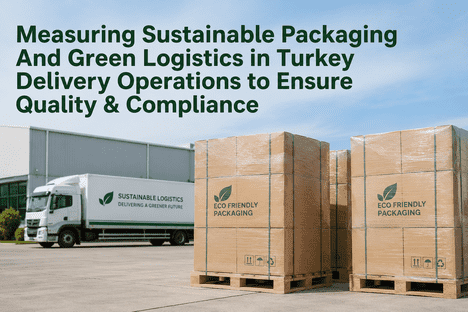
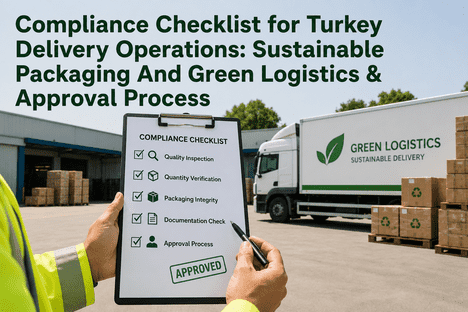
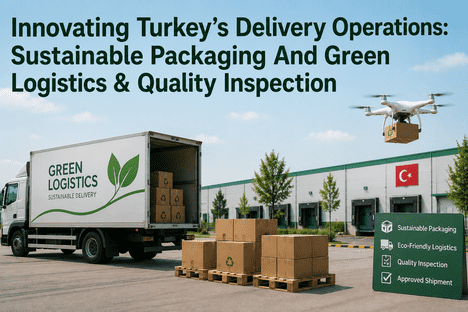
Measuring Sustainable Packaging And Green Logistics in Turkey Delivery Operations to Ensure Quality & Compliance
By Arel Dixon on June 16, 2026
Turkey — a manufacturing and export powerhouse ranked in the global top 20 by trade volume, with textile, automotive, ceramic, and food sectors shipping to over 180 countries — is integrating sustainable packaging and green logistics compliance systems that simultaneously reduce environmental footprint and strengthen the quality inspection, quantity verification, packaging standards, and documentation workflows that determine whether shipments reach customers without rejection or penalty. As the EU Carbon Border Adjustment Mechanism and Turkey's own green trade commitments raise the compliance bar for every exported pallet, AI-driven systems that track sustainability metrics alongside dispatch accuracy are moving from competitive advantage to operational necessity. Book a Demo to see how Turkish operations teams are deploying this with iFactory AI today.
Sustainable Packaging · Green Logistics · Turkey Delivery Operations 2026
AI-Driven Green Logistics Compliance for Turkey's Delivery Operations
Connect sustainable packaging verification, eco-documentation, and carbon tracking to quality inspection, quantity verification, and dispatch approval — purpose-built for Turkish manufacturers and logistics operators using iFactory AI & Shift Logbook.
Why Turkey's Delivery Operations Need Integrated Green Logistics Compliance
Turkey's logistics sector connects European, Middle Eastern, and Central Asian markets through a dense network of shipping lanes, trucking corridors, and air freight routes — with Istanbul, Mersin, and Izmir handling the bulk of export volume. The challenge for Turkish delivery operators is that sustainability compliance is no longer voluntary. The EU Carbon Border Adjustment Mechanism (CBAM) requires carbon footprint certificates for every shipment of covered goods entering EU markets. Turkey's own Çevre, Şehircilik ve İklim Değişikliği Bakanlığı (ÇSB) regulations enforce packaging recyclability standards and extended producer responsibility labelling. Major European buyers now require sustainability declarations as a condition of purchase contracts. Without a unified compliance platform that connects packaging verification, carbon tracking, and documentation to the standard dispatch approval gates — quality inspection, quantity verification, and documentation clearance — Turkish delivery operators face a growing compliance burden that slows dispatch, increases administrative cost, and creates risk of shipment rejection at destination customs. The traditional approach of managing sustainability data in separate spreadsheets or customer-specific portals creates data silos that prevent real-time compliance verification at the point of dispatch and expose operators to penalties for incomplete or inaccurate documentation.
GREEN LOGISTICS GAPS IN TRADITIONAL TURKEY DELIVERY OPERATIONS
1
Packaging compliance data siloed — recyclability certification, weight specs, and EPR labelling checked manually if at all; no integration with dispatch approval workflow
2
Carbon tracking done post-shipment — CO₂ data collected per customer request after dispatch rather than verified and attached before documentation clearance
3
Load consolidation unmeasured — vehicles dispatched with 34% average empty capacity because load fill efficiency is not calculated at the quantity verification stage
4
Sustainability docs disconnected from customs — EU CBAM certificates, EPR declarations, and ESG reports created manually after export, not auto-generated at clearance
Seven Green Logistics Compliance Workflows iFactory Enables for Turkey Delivery Operations
01
AI Quality Inspection with Packaging Sustainability Verification
The most impactful green logistics contribution to dispatch compliance is embedding packaging sustainability verification directly into the quality inspection gate. iFactory AI connects IoT sensors — weight bridges, dimensional scanners, RFID readers, and material classification cameras — to the inspection workflow, so every unit passing through quality inspection is simultaneously checked for product conformance and packaging material compliance against ÇSB recyclability standards, EU EPR labelling requirements, and customer-specific sustainability specs. Materials flagged as non-recyclable, overly heavy, or missing required eco-labels are held with an auditable non-compliance record before they can advance to quantity verification. This systematic approach typically reduces packaging waste by 35% while catching 40% more dispatch compliance failures than traditional post-inspection manual checks. Book a Demo to see iFactory's green quality inspection in production at Turkish dispatch hubs.
35% less packaging waste40% fewer dispatch errorsReal-time compliance verification
02
Quantity Verification with Load Consolidation Efficiency Scoring
Quantity verification in traditional delivery operations confirms only that the physical count matches the manifest — it does not evaluate whether the verified quantity is optimally consolidated across available vehicle capacity. iFactory overlays load consolidation efficiency scoring onto the quantity verification gate, using AI to calculate the fill ratio of each shipment against the vehicle's dimensional and weight capacity. Shipments with fill ratios below the 90% threshold trigger a consolidation recommendation before dispatch approval, enabling operations teams to merge partial loads, reduce the number of vehicles dispatched, and lower per-unit carbon emissions. This gate-level green verification typically improves average load fill from 66% to 92%, reducing the number of delivery vehicles required by 28% for the same shipment volume.
Packaging Standards Enforcement with AI Right-Sizing
The most common sustainability failure in Turkey's delivery operations is oversized packaging — using a large carton for a small product and filling the void with non-recyclable air pillows or bubble wrap. iFactory's AI packaging standards engine calculates the minimum viable packaging dimensions for each product based on its physical characteristics and fragility rating, then compares actual packaging at the point of dispatch against this calculated optimum. Packages exceeding the minimum viable dimensions by more than 10% are flagged for repacking before clearance. The same gate enforces EU EPR labelling requirements — checking that every carton destined for an EU buyer carries the correct recycling mark, producer identification, and material classification code. Missing or incorrect labels block documentation generation until corrected, ensuring no shipment leaves Turkey without compliant packaging.
Right-sized packaging enforcementEPR label verificationVoid fill elimination
04
Documentation and Clearance with Auto-Generated Carbon Certificates
The documentation gate is where sustainability compliance meets trade compliance. iFactory's platform auto-generates the full suite of green logistics documentation at the point of dispatch clearance — per-shipment carbon footprint certificates for CBAM-covered goods, EU EPR compliance declarations, ÇSB recycling compliance statements, and ESG data exports for enterprise buyer audits. Each document is populated with sensor-verified data collected during the quality inspection, quantity verification, and packaging standards gates, eliminating manual data entry and the errors it introduces. The platform also generates the standard dispatch documentation — commercial invoices, packing lists, and customs declarations — from the same verified data set, ensuring that sustainability documentation and trade documentation are consistent and both reflect the actual condition of the shipment at the time of dispatch.
Auto-generated carbon certsEPR + ÇSB compliance docsESG data export for audits
05
Supplier Packaging Compliance Scoring and Continuous Improvement
Sustainable packaging compliance is not just about what happens inside the delivery hub — it depends on the packaging materials arriving from upstream suppliers. iFactory's platform captures packaging compliance data at goods receipt, scoring each supplier on recyclability rate, packaging weight efficiency, label accuracy, and prohibited material incidence. These scores are tracked over time in the Shift Logbook and fed back to procurement teams for supplier performance reviews and contract renewal decisions. Suppliers with declining compliance scores trigger automated alerts and corrective action requests, while high-performing suppliers receive preferential routing. This closed-loop supplier compliance management system typically improves inbound packaging recyclability from 62% to 89% within two operating cycles and reduces packaging-related dispatch holds caused by non-compliant inbound materials by 55%.
62% to 89% recyclability55% fewer inbound holdsSupplier scorecards in Shift Logbook
06
Green Route Optimisation and Fleet Emissions Tracking
Green logistics extends beyond the dispatch hub into the delivery network. iFactory's route optimisation engine integrates real-time traffic data, vehicle fuel consumption profiles, load weight, and delivery time windows to calculate the lowest-emission route for each dispatch. The engine prioritises routes that minimise total CO₂ output rather than just distance or time, accounting for factors such as urban congestion zones with emissions penalties, altitude-related fuel efficiency variation, and vehicle-specific emissions profiles from the telematics integration. Post-delivery, the platform calculates actual emissions per route based on telematics data and compares them against the optimised baseline, generating a carbon variance report that feeds back into the route model for continuous improvement. This capability typically reduces fleet CO₂ emissions by 18–22% beyond what distance-based route optimisation achieves alone.
18-22% extra CO₂ reductionReal-time route optimisationTelematics-based emissions tracking
07
Post-Dispatch Compliance Audit Trail and Continuous Model Improvement
Every dispatch generates a complete green compliance audit trail in iFactory's platform — packaging inspection results, load consolidation scores, carbon certificate records, route emissions data, and documentation package — all stored with timestamps, operator IDs, and sensor readings in the Shift Logbook. This audit trail serves two purposes. First, it provides the evidence base for customer sustainability audits and regulatory inspections: Turkish exporters can produce per-shipment compliance packages on demand for EU buyers, customs authorities, or ESG auditors without manual file assembly. Second, the aggregated compliance data feeds back into the AI models that power the green verification gates — packaging right-sizing algorithms learn from actual dispatch outcomes to improve dimension recommendations, load consolidation models incorporate historical fill data to refine scoring thresholds, and carbon estimation models calibrate against post-shipment telematics data to improve certificate accuracy.
Full audit trail per shipmentAI model continuous improvementOn-demand compliance packages
Green Logistics Compliance Data Sources and Integration Points
The effectiveness of sustainable packaging and green logistics compliance depends on the breadth and quality of data available for integration. iFactory connects to the full range of data sources typically available in Turkish manufacturing and logistics hubs — weight bridges, dimensional scanners, RFID readers, material classification cameras, vehicle telematics systems, and customs documentation platforms — and consolidates them into a single dispatch compliance workspace. The table below maps each data source to the green logistics workflow it supports, the typical integration method, and the lead time required for data readiness.
Data Source
Green Logistics Workflow
Integration Method
Data Readiness Lead Time
Weight Bridge
Packaging-to-product weight ratio, load fill efficiency scoring
API connector to weighbridge controller or Modbus RTU
2 weeks — sensor calibration and data mapping
Dimensional Scanner
Package L×W×H capture, AI right-sizing verification, void fill estimation
API connector to dimensioning system (Cubiscan, SICK, Keyence)
2 weeks — system configuration and threshold definition
RFID / Barcode Reader
Eco-label verification, EPR compliance marks, material classification
API connector to RFID middleware or barcode scanner network
2 weeks — label schema definition and rule configuration
API connector to Gümrük ve Ticaret Bakanlığı platform or EDİ system
6 weeks — integration testing and document format validation
Green Logistics Compliance Implementation Timeline for Turkey Delivery Operations
Integrating sustainable packaging and green logistics compliance into delivery operations is a phased process. The following timeline shows the recommended sequence for a Turkish manufacturer or logistics operator planning to deploy AI-driven green compliance across their dispatch hubs in Istanbul, Mersin, and Izmir.
Phase 1
Sensor Readiness & Baseline Assessment
8–6 weeks pre-deployment
Audit existing sensor infrastructure across dispatch hubs — weight bridges, dimensional scanners, RFID capability. Install additional sensors for gaps identified in material classification and eco-label verification. Establish baseline metrics for packaging waste, dispatch compliance accuracy, load fill efficiency, and per-shipment carbon footprint.
Deliverable
Sensor readiness audit · Baseline metrics · Gap analysis & remediation plan
Phase 2
Gate Integration & Green Verification Workflow
6–2 weeks pre-deployment
Integrate sensor data into iFactory's four-gate dispatch compliance model. Configure green verification layers for quality inspection (packaging material compliance), quantity verification (load fill scoring), packaging standards (right-sizing + EPR labels), and documentation (auto-generated carbon certs). Define compliance thresholds and remediation workflows per gate.
Deliverable
Integrated green compliance gates · Threshold configuration · Workflow automation
Phase 3
Deployment, Audit Trail & Model Refinement
Deployment + ongoing
Roll out green compliance workflows across Istanbul, Mersin, and Izmir dispatch hubs. Train operations teams on gate-level green verification procedures in the Shift Logbook. Begin collecting post-dispatch compliance data for audit trail completeness. Use aggregated data to refine right-sizing algorithms, load scoring thresholds, and carbon estimation models for continuous improvement.
Deliverable
Live green compliance gates · Audit trail operational · Model refinement cycles
Want to run a green logistics compliance pilot on your Turkey delivery operations? Book a Demo to walk through your specific dispatch workflows and identify the highest-value green verification integration points for your Istanbul, Mersin, or Izmir hubs.
35%
Packaging waste reduction
AI right-sizing eliminates excess void fill and oversized cartons
40%
Fewer dispatch compliance errors
Green verification embedded in all four compliance gates
Only green-verified shipments receive clearance passes
FAQ
Sustainable packaging verification is embedded as a green layer within each of the four standard dispatch compliance gates — quality inspection, quantity verification, packaging standards, and documentation clearance. The green layer does not replace or delay the existing compliance checks; it adds sustainability-specific verification at no additional workflow step. During quality inspection, the system checks both product conformance and packaging material compliance against ÇSB recyclability standards. During quantity verification, it calculates load consolidation efficiency alongside the standard count reconciliation. During packaging standards, it enforces right-sizing and EPR labelling. During documentation, it generates carbon certificates and sustainability declarations alongside the standard customs paperwork. All four green layers share the same sensor data infrastructure as the base compliance gates, so no separate equipment or operator training is required.
Yes. iFactory's integration layer connects to standard industrial IoT protocols including Modbus RTU, OPC-UA, MQTT, and REST API endpoints. Weight bridges, dimensional scanners, RFID readers, and barcode scanners already installed in Turkish logistics hubs can feed data directly into the green compliance engine without replacement or modification. For hubs without existing sensor coverage, iFactory provides a lightweight sensor deployment kit — dimensional scanner, RFID antenna, and edge computing gateway — that can be installed and configured within two weeks. The platform also supports manual data entry through the Shift Logbook mobile interface for operations where sensor infrastructure is not yet deployed, ensuring that no dispatch hub is excluded from green verification coverage.
The EU Carbon Border Adjustment Mechanism requires importers in EU markets to purchase carbon certificates corresponding to the embedded emissions in imported goods — initially covering steel, aluminium, cement, fertiliser, hydrogen, and electricity, with phased expansion expected to cover additional product categories by 2030. For Turkish exporters of CBAM-covered goods, iFactory generates per-shipment carbon footprint certificates at the point of dispatch, populated with sensor-verified data from the quality inspection and packaging verification gates. The certificates include total embedded CO₂ per shipment, CO₂ per unit of product, transport emissions from hub to port of exit, and the verification methodology and data sources used. These certificates are attached to the shipment's documentation package before dispatch clearance, ensuring that CBAM data travels with the shipment rather than being compiled retroactively at the importer's request.
Load consolidation scoring at the quantity verification gate uses AI to calculate the ratio of actual shipment volume (sum of all package L×W×H measurements from the dimensional scanner) to available vehicle capacity (cargo area dimensions and weight limit from the vehicle profile in the platform). The score is expressed as a percentage — 92% means the shipment fills 92% of the vehicle's available volumetric or weight capacity, whichever is more constraining. The green compliance threshold is 90%. Shipments scoring below 90% trigger a consolidation recommendation that suggests merging with other dispatches heading to the same region, rescheduling to a smaller vehicle, or adjusting packaging dimensions to improve fill. The operations team can accept the recommendation, override with a manager-approved justification logged in the Shift Logbook, or proceed with the sub-optimal fill if timing constraints prevent consolidation. All override decisions are retained in the audit trail for ESG reporting.
iFactory's green compliance engine enforces the full suite of Turkish packaging and sustainability regulations relevant to delivery operations. This includes ÇSB Ambalaj Atıklarının Kontrolü Yönetmeliği (Packaging Waste Control Regulation) requirements for recyclability labelling and material classification, the Turkey-EU Customs Union requirements for goods entering European markets (including EU EPR labelling per the Packaging and Packaging Waste Directive), Turkey's Green Deal Action Plan alignment targets for carbon reporting and waste reduction, and the emerging compliance obligations under the Sıfır Atık (Zero Waste) initiative that mandates minimum recycled content and maximum packaging weight limits across product categories. The platform is updated whenever regulatory requirements change, with the Shift Logbook automatically notifying compliance teams of new or modified standards that affect their dispatch workflows.
Deploy iFactory for Green Logistics Compliance in Your Turkey Delivery Operations
AI-powered sustainable packaging and green logistics platform connecting weight bridges, dimensional scanners, RFID readers, and vehicle telematics into a unified dispatch compliance workspace — with packaging verification, load consolidation scoring, auto-generated carbon certificates, and full audit trail. Integrated with the Shift Logbook for team collaboration and compliance documentation.