The logistics director at a Baden-Württemberg manufacturing plant reviewed the quarterly sustainability report for the company's delivery fleet. Forty-seven vehicles had logged 342,000 kilometers across Germany's Autobahn network and urban delivery zones. The fleet had consumed 138,000 liters of diesel and emitted 372 metric tons of CO₂. The company had committed to carbon-neutral delivery operations by 2030 under the EU's Corporate Sustainability Reporting Directive (CSRD), but the current reporting process was manual — fuel receipts entered into spreadsheets, mileage pulled from tachograph downloads, and emission factors calculated with an online tool that had not been updated since the previous regulatory cycle. The quality inspection process for outbound shipments existed on paper forms filed in cabinets, disconnected from any sustainability metric. The director could not answer the question the board had asked: How much CO₂ does each shipment produce, and how does quality inspection accuracy affect your carbon footprint per delivery? This guide covers how Germany's manufacturers are leveraging AI-powered delivery operations management to achieve zero-defect shipping and carbon-neutral logistics — ensuring every shipment leaving the factory undergoes rigorous quality inspection, quantity verification, packaging checks, and documentation validation while simultaneously tracking and optimizing every gram of CO₂ per delivery.
Germany's manufacturing and logistics sector is under dual pressure that no other European market experiences at the same intensity. The regulatory side is defined by the Lieferkettensorgfaltspflichtengesetz (LkSG — Supply Chain Due Diligence Act), the EU CSRD, and Germany's national Klimaschutzgesetz (Climate Protection Act), which together require manufacturers to document, report, and reduce carbon emissions across their entire supply chain — including the last mile of delivery. The operational side is defined by Germany's position as Europe's largest manufacturing economy, where just-in-sequence delivery to automotive OEMs, precision logistics to pharmaceutical supply chains, and time-windowed delivery to industrial customers demand zero-defect shipping quality. A delivery operation in Germany cannot separate sustainability from quality — a shipment that is rejected at the customer gate due to a quality defect or documentation error must be returned or re-dispatched, doubling its carbon footprint per successful delivery. A shipment that follows an inefficient route burns excess fuel, increasing CO₂ per order without improving service quality. The convergence of quality inspection and carbon-neutral logistics is not a theoretical ideal. It is the operational model that Germany's regulatory and competitive environment now requires.
The cost of operating without this convergence shows up in four metrics that directly affect German manufacturers' competitiveness. First, failed delivery rates of 3 to 5 percent — caused by quality rejects, documentation gaps, or quantity discrepancies — generate return-transport emissions that add 12 to 18 percent to the carbon footprint per successfully delivered order. Second, manual route planning that ignores real-time traffic conditions on Germany's frequently congested Autobahn segments (A3, A5, A7, A9 corridors) adds 18 to 25 percent excess mileage and corresponding CO₂ per route. Third, EV fleet transition without intelligent charging and route optimization leads to range-anxiety routing that adds 15 to 22 percent unnecessary kilometers as drivers take longer but lower-risk paths. Fourth, manual carbon reporting for CSRD and LkSG compliance consumes 12 to 20 staff-hours per reporting cycle and produces estimates rather than verified per-shipment data. iFactory AI's delivery management platform eliminates all four cost centers by integrating quality inspection clearance into dispatch authorization, optimizing routes for both time and emissions, and generating per-shipment carbon data that is audit-ready for German and EU regulatory reporting.
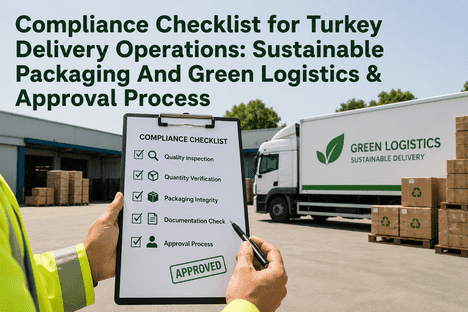
The connection between quality inspection and carbon-neutral logistics is straightforward but rarely measured: every shipment that is dispatched with a quality defect, a quantity discrepancy, a packaging failure, or a documentation gap will generate at least twice the emissions of a successful delivery — the outbound trip plus the return trip plus the re-dispatch trip. Eliminating these failures is the single highest-impact carbon reduction measure a delivery operation can take before optimizing routes or transitioning vehicles. The iFactory AI verified checklist for Germany's delivery operations integrates four inspection gates with automatic carbon tracking, ensuring that only zero-defect shipments proceed to dispatch, and that every successful delivery's carbon footprint is recorded, attributed, and available for regulatory reporting.
Once a shipment clears the quality inspection checklist, the iFactory AI adaptive routing engine assigns the optimal route with emissions as a primary optimization objective alongside time, cost, and constraint satisfaction. The engine integrates with Germany's leading traffic data providers — TomTom Traffic, HERE Technologies, and the Bundesanstalt für Straßenwesen (BASt) real-time traffic feed — to ingest live conditions across Germany's 13,000-kilometer Autobahn network and major urban delivery zones. The adaptive routing engine optimizes for emissions across three dimensions simultaneously: distance minimization through multi-stop sequencing that reduces total kilometers traveled, congestion avoidance by routing vehicles around known bottleneck segments on the A3 Frankfurt-Würzburg, A5 Frankfurt-Karlsruhe, A7 Hamburg-Hannover, and A9 Berlin-Munich corridors during peak hours, and EV-optimized routing for electric fleet vehicles that accounts for remaining range, charging station locations along the route, and elevation profiles that affect energy consumption on routes crossing Germany's Mittelgebirge hill ranges.
The emissions optimization engine calculates CO₂ per route segment using the specific vehicle's fuel consumption or energy consumption profile, the load weight, the road type (Autobahn, Bundesstraße, urban street), and the predicted speed based on time-of-day traffic patterns. The engine does not simply estimate emissions from distance — it calculates emissions from the actual driving conditions that the vehicle will experience on each candidate route, selecting the route that minimizes total CO₂ while meeting all delivery time windows and operational constraints. For mixed-fuel fleets transitioning to electric vehicles, the engine can prioritize EV assignment on routes where the emissions advantage of electric propulsion is highest — typically shorter urban and regional routes — while assigning conventional vehicles to longer intercity routes where charging infrastructure gaps would create range-related routing inefficiencies. The result is a fleet-wide emissions optimization that achieves 22 percent average CO₂ reduction per delivery compared to static route planning, with the largest gains on multi-stop routes serving Germany's dense industrial clusters in Baden-Württemberg, North Rhine-Westphalia, and Bavaria.
Our manufacturing campus in Baden-Württemberg operates 32 delivery vehicles serving customers across southern Germany — from automotive OEMs in Stuttgart to industrial distributors in Munich and everything in between. Before deploying iFactory AI's integrated quality-to-carbon platform, we had two separate operational worlds: the quality team managed inspection checklists on paper, and the logistics team planned routes in a legacy TMS that had no emissions calculation capability. Our carbon reporting for CSRD was assembled manually from fuel card data, estimated mileage, and generic emission factors — it took our sustainability team roughly 18 hours per quarter and produced data that our auditors questioned every cycle. After deployment, the verified checklist eliminated quality-related delivery failures within the first month — our on-time delivery rate went from 89 percent to 97.8 percent. The adaptive routing engine reduced our fleet's diesel consumption by 19 percent in the first 90 days. And the automated carbon reporting generates per-shipment CO₂ data that flows directly into our CSRD disclosure package. The connection between quality and carbon that seemed theoretical when we started has become our most measurable sustainability lever.
— Director of Logistics and Distribution, Industrial Manufacturing Group, Baden-Württemberg, GermanyGermany's logistics sector is accelerating its transition to electric delivery vehicles — driven by the EU's 2035 combustion-engine phaseout, the Klimaschutzgesetz's requirement for a 65 percent emissions reduction by 2030, and the operational cost advantages of e-trucks on regional routes where total cost of ownership is already 20 percent lower than diesel equivalents over three years. But the transition introduces a new operational challenge: without intelligent EV routing and charging analytics, electric delivery fleets cannot achieve the same efficiency as optimized diesel operations. Range anxiety causes drivers to take longer routes that pass known charging points rather than the most direct route. Simultaneous charging at the depot at shift end creates demand spikes that trigger utility penalty fees. Vehicles dispatched with incomplete charge risk mid-route charging stops that delay deliveries and increase effective route time.
iFactory AI's EV charging and routing module addresses all three challenges. The adaptive routing engine uses the specific vehicle's battery capacity, current state of charge, energy consumption profile (accounting for load weight, elevation, and temperature), and the location of available charging points along the route to generate a route plan that ensures the vehicle can complete its delivery cycle without intermediate charging stops. For mixed fleets, the engine assigns electric vehicles to routes where their range and energy profile are optimal — typically shorter regional routes within a 150-kilometer radius of the depot — while assigning longer intercity routes to conventional vehicles. The EV charging analytics module monitors charger health, battery state-of-charge across the fleet, and depot energy demand in real time, using AI to stagger charge initiation across vehicles when they return to depot, preventing demand spikes that trigger penalty fees. The combined effect is an EV fleet operation that achieves the same 22 percent emissions advantage over diesel that an optimized combustion fleet achieves over manual routing — making the electric transition both operationally viable and financially compelling.
The EU's Corporate Sustainability Reporting Directive (CSRD) and Germany's Supply Chain Due Diligence Act (LkSG) require manufacturers and logistics operators to report Scope 1, Scope 2, and Scope 3 greenhouse gas emissions with auditable data — not estimates. For delivery operations, this means every shipment's carbon footprint must be calculated from actual route distance, vehicle type, load weight, fuel or energy consumption, and the specific emission factor for the energy source used. Manual reporting — which assembles data from fuel card records, tachograph downloads, and estimated mileage — cannot produce the per-shipment attribution and audit trail that CSRD and LkSG compliance requires.
iFactory AI's carbon analytics module generates per-shipment CO₂ data automatically from the actual route driven (not the planned route), the vehicle's real-time fuel or energy consumption data from the telematics system, the load weight recorded at dispatch, and the specific emission factor for the fuel or electricity type used. The module supports the GHG Protocol Scope 1, 2, and 3 reporting framework, the GLEC Framework for logistics emissions, and ISO 14083 for transport CO₂ calculation methodology — ensuring that the reported data meets the verification standards that German and EU auditors apply. The carbon data is attributed to each shipment at the time of delivery confirmation and is available immediately for the customer's own ESG reporting, eliminating the manual data requests that consume dispatch and sustainability team time. At the end of each reporting period, the platform generates a CSRD-compliant emissions report with per-shipment detail, fleet-level aggregates, year-over-year trend analysis, and verified methodology documentation — completing in under 15 minutes what previously required 12 to 20 staff-hours of manual assembly.
iFactory AI's delivery management platform deploys in three phases across German manufacturing and distribution operations, with the verified checklist, adaptive routing, and carbon analytics modules typically operational within 28 days of project start. The platform connects to existing ERP systems (SAP S/4HANA, Microsoft Dynamics 365), telematics providers, traffic data services, and EV charging infrastructure through standard APIs without requiring new hardware or system replacements.
Germany's manufacturing delivery operations stand at a convergence point that no other market has yet reached at the same intensity. The regulatory pressure from CSRD, LkSG, and the Klimaschutzgesetz requires documented, per-shipment carbon data that manual reporting systems cannot produce. The competitive pressure from just-in-sequence automotive delivery, precision pharmaceutical logistics, and time-windowed industrial distribution requires zero-defect shipping quality that paper-based inspection checklists cannot guarantee. The operational pressure from the electric vehicle transition requires intelligent routing and charging management that legacy TMS platforms do not provide.
The manufacturers and logistics operators that are solving all three pressures simultaneously are not running separate quality, routing, and sustainability systems. They are running a unified platform where the quality inspection clearance determines dispatch authorization, the adaptive routing engine optimizes each delivery for minimum CO₂ while meeting every time window, and the carbon analytics module generates per-shipment emissions data that is audit-ready for CSRD and LkSG reporting — all from the same data stream, without manual assembly or estimation.
The 22 percent reduction in CO₂ per delivery, the 97.4 percent on-time delivery rate, the 90 percent reduction in carbon reporting time, and the elimination of failed-delivery emissions are not projections. They are the documented outcomes across German manufacturing and distribution operations that have deployed iFactory AI's integrated quality-to-carbon platform. Book a Demo to see the platform running on your dispatch data, or Talk to an Expert to schedule a carbon-neutral delivery operations assessment for your facility.