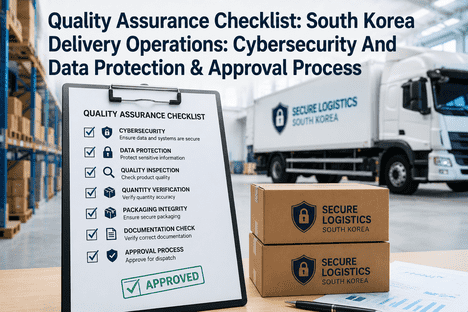
Implementing a quality assurance framework for delivery operations in South Korea requires a structured approach that integrates cybersecurity, data protection, and approval workflows at every checkpoint. Every shipment leaving the factory floor must pass through five sequential checkpoints — quality inspection, quantity verification, packaging integrity assessment, documentation validation with data protection compliance, and final clearance approval — before it can be dispatched. Korean manufacturers must satisfy the Personal Information Protection Act (PIPA), KISA industrial security guidelines, Korean Customs Service (KCS) UNI-PASS electronic clearance requirements, and zero-defect quality standards simultaneously. This checklist provides a structured framework aligned with Korean regulatory requirements, enabling operations managers to verify each shipment against quality, quantity, packaging, documentation, and data protection criteria before issuing a digitally signed clearance pass. Manufacturers who apply this framework consistently report sub-0.5% defect escape rates, 99.7%+ quantity accuracy, and full PIPA compliance across all shipment records. Book a Demo to see how iFactory AI automates each checkpoint with AI Vision inspection, blockchain-secured audit trails, and PIPA-compliant data governance configured for Korean manufacturing environments.
Checkpoint 1: Quality Inspection — AI Vision with Encrypted Records (Items 1–5)
Every outgoing unit must be inspected for surface defects, dimensional accuracy, labelling correctness, and material composition before it is approved for packaging. iFactory AI's AI Vision cameras inspect every unit at line speed with approximately 45 configurable criteria per product type and destination market. Each inspection result — including timestamped images — is encrypted at rest (AES-256), recorded immutably on the blockchain audit trail, and accessible only via role-based access control per PIPA requirements. The system targets a defect escape rate below 0.5% with 100% inspection coverage. Book a Demo to see AI Vision quality inspection and encrypted record management configured for Korean manufacturing specifications.
| Item | Checkpoint Criteria | Data Protection Control | Pass / Fail |
|---|---|---|---|
| 1 | Surface & visual defect detection — AI Vision cameras inspect every unit for scratches, dents, discolouration, contamination, and foreign material. Classification by type and severity with automated pass/reject decisions. Configurable resolution down to 0.1 mm² for electronics and semiconductor shipments. | Inspection images encrypted AES-256 at rest; accessible only via RBAC (quality inspectors and supervisors); all access logged in immutable audit trail per PIPA Article 29. | Pass / Fail |
| 2 | Dimensional accuracy & tolerance verification — Automated dimensional measurement against CAD or specification tolerances using calibrated AI Vision. Units outside acceptable tolerance (±0.3 mm for critical components) flagged for manual re-inspection or rejection. | Measurement data encrypted at rest; records retained per PIPA Article 28 schedule; secure deletion with cryptographic verification upon expiry. | Pass / Fail |
| 3 | Labelling & traceability mark verification — AI vision reading of barcodes, QR codes, serial numbers, and Korean-language labels. Verifies correct label placement, legibility, and data consistency against packing manifest. Validates KCS declaration labels and HS code markings for export shipments. | Label data and manifest records encrypted at rest; RBAC limits access to logistics and compliance roles; all label verification events logged in audit trail. | Pass / Fail |
| 4 | Material composition validation — For food-grade, pharmaceutical, or regulated materials — NIR or hyperspectral imaging confirms material composition matches declared specifications before dispatch. Certificates of analysis cross-referenced against shipment manifest. | Composition data and certificates stored in encrypted document vault; access logged with timestamp and user ID; consent verification automated per data processing purpose. | Pass / Fail |
| 5 | Destructive / sample testing verification — For batches requiring destructive testing (pull-test, seal-strength, compression), samples drawn at statistically validated intervals per ANSI/ASQ Z1.4 and results recorded against batch records before batch clearance. | Sample results and batch records encrypted at rest; automated retention per PIPA schedule; deletion verified cryptographically and recorded in audit trail. | Pass / Fail |
Checkpoint 2: Quantity Verification — Secure Chain-of-Custody (Items 6–8)
Quantity discrepancies are a leading cause of shipment disputes and customs holds in Korean delivery operations. Inline weighing stations, barcode scanners, and RFID readers count every unit, pallet, and case in real time, comparing physical counts against the packing list and ERP order manifest. Discrepancies trigger automated alerts with full chain-of-custody tracking recorded on the blockchain audit trail. Customer order quantities are encrypted at rest and accessible only to authorised roles. iFactory's quantity verification module targets 99.7%+ counting accuracy with full traceability from production line to loading dock.
| Item | Verification Method | Data Protection Control | Action on Failure |
|---|---|---|---|
| 6 | Unit count — inline vision counting + barcode scan at case-packing station. Exact count required with 0% tolerance. | Count data encrypted at rest and in transit; RBAC limits access to quality and logistics roles; discrepancy event auto-logged in audit trail. | Hold entire pallet; trigger recount and supervisor review; discrepancy recorded in blockchain audit. |
| 7 | Pallet / case tally — RFID pallet tag scan + weigh-scale confirmation at stretch-wrapping station. Acceptable tolerance ±0.5% of expected weight per pallet. | Tally and weight data encrypted; automated retention enforcement; access logged per PIPA Article 30. | Flag for manual re-palletisation; discrepancy recorded in blockchain audit; supervisor notified via Shift Logbook. |
| 8 | Manifest-to-physical reconciliation — AI comparison of scanned items against ERP order manifest (SAP, Oracle, Dynamics). Exact SKU and quantity match required with 0% tolerance. | ERP order data accessed via secure API gateway with OAuth 2.0; all reconciliation records encrypted at rest; access logged for PIPA compliance. | Block shipment clearance; auto-generate discrepancy report for logistics team; record in blockchain audit trail. |
Checkpoint 3: Packaging Integrity & Sustainability Compliance (Items 9–13)
Packaging integrity is a critical checkpoint in Korean delivery operations, particularly for electronics, semiconductor, and cosmetics shipments where in-transit damage can result in costly returns. iFactory AI's AI vision system assesses seal integrity, pallet stability, stretch-wrap tension, label visibility, and barcode legibility for every outgoing unit. Beyond structural integrity, the platform enforces Korean EPR (Extended Producer Responsibility) packaging recyclability requirements mandated by the Ministry of Environment and Sıfır Atik (Zero Waste) compliance standards. All packaging assessment images and compliance certificates are stored in the encrypted document vault with RBAC access controls.
Item 9: Seal Integrity & Closure
AI vision assessment of case-seal adhesion, tape-overlap width (minimum 50 mm), and tamper-evident seal presence. Heat-seal strength verification for food and pharmaceutical packaging via non-contact thermal imaging.
Pass / Fail
Item 10: Pallet Stability
3D pallet-profile analysis for load stability — layer alignment, overhang detection (>2 cm flagged), stretch-wrap coverage (minimum 75% surface), and containment force within specification. Unstable pallets flagged for re-wrapping before loading.
Pass / Fail
Item 11: Sustainable Right-Sizing
AI compares actual product dimensions against selected packaging — flags oversized boxes (void fill > 30%), recommends optimal box size from available inventory, and tracks packaging-material reduction metrics per SKU. All recommendations logged with encrypted audit trail.
Pass / Advisory
Item 12: Korean EPR Recyclability
Verifies packaging materials against Korean Ministry of Environment EPR recyclability registry. Non-compliant packaging flagged before dispatch with substitution recommendations. EPR compliance certificates stored in encrypted document vault with automated expiry alerts.
Pass / Fail
Item 13: Label & Handling Mark Visibility
AI verification that all required handling labels (fragile, this-side-up, stack limit, hazardous material markings, CE/KC marks) are present, visible, and legible for every destination-market requirement. Label verification data encrypted at rest and accessible only via RBAC for quality and logistics roles.
Pass / Fail
Data Protection Across Packaging Checkpoint
All packaging assessment images, EPR certificates, and label verification records are encrypted at rest with AES-256, accessible only via role-based access control, and logged in the immutable blockchain audit trail. Records are retained per PIPA Article 28 schedule and automatically purged with cryptographic verification after retention expiry. Consent and purpose verification is automated for any PII embedded in packaging labels or shipping marks.
Checkpoint 4: Documentation Validation & Data Protection (Items 14–18)
Documentation errors are the leading cause of customs holds and cross-border shipment delays in Korean delivery operations — particularly for electronics and automotive exports where HS code classification, certificate of origin, and KCS customs declaration accuracy are critical. iFactory's Smart Document Management module automates the validation of commercial invoices, certificates of origin, customs declarations, and regulatory compliance certificates against the ERP order record and blockchain ledger. All documents are stored encrypted with AES-256, accessible only via RBAC, and all access is logged in the immutable audit trail for PIPA compliance. The platform auto-generates CBAM carbon footprint certificates for EU-bound shipments and Korean EPR compliance declarations for domestic shipments. Book a Demo to see automated document validation with PIPA-compliant access controls in action.
Commercial Invoice & Packing List — AI validates each field (HS code, value, Incoterms, origin, weight) against ERP order record. Discrepancies flagged in real time.
Pass / Fail
Certificate of Origin & A.TR — Validates EUR.1, A.TR for EU-Korea FTA, and COO against trade-agreement eligibility. Expired or incorrect certs block clearance.
Pass / Fail
CBAM Carbon Footprint — Auto-generates CBAM-compliant carbon certificates per shipment. Supplier emissions data protected by RBAC within encrypted document vault.
Pass / Fail
KCS UNI-PASS Declaration — Validates Korean Customs Service electronic declaration format and data fields. Secure EDI transmission via OAuth 2.0 authenticated gateway.
Pass / Fail
Certificate Expiry Alerting — AI tracks expiry dates for all certificates (ISO, CE, KC, KCs). Blocks shipments with certificates expiring before estimated arrival. Auto-sends renewal reminders.
Pass / Fail
Checkpoint 5: Clearance Pass — Digital Sign-Off with Data Protection Verification (Items 19–22)
The final clearance checkpoint aggregates results from all four preceding checkpoints — quality, quantity, packaging, documentation — and applies a deterministic pass/fail decision. Additionally, a data protection verification step confirms that all PII associated with the shipment has been processed with valid consent, stored with appropriate encryption, and is within its permitted retention period per PIPA requirements. Only shipments that pass both quality and data protection criteria receive a digitally signed clearance pass with a unique QR code linking to the full encrypted inspection record. The clearance pass is cryptographically verifiable by Korean Customs Service inspectors, logistics partners, and end customers.
| Item | Clearance Criteria | Data Protection Verification | Pass Threshold |
|---|---|---|---|
| 19 | Aggregate score computation from all preceding checkpoints (Items 1–18). Minimum pass threshold: 95/100. Any single "Fail" status blocks aggregate pass regardless of total score — no single-point failure overrideable without supervisor authorisation. | All checkpoint records verified for encryption status, RBAC compliance, and audit trail completeness before aggregate score is computed. | 95/100 minimum |
| 20 | Digital clearance pass generation — Blockchain-timestamped digital clearance pass with unique QR code generated for shipments passing all criteria. QR code links to full encrypted inspection record — images, measurements, documents, and sign-off audit trail. | PIPA compliance check: consent verification, encryption status, retention schedule, and access log review for all shipment-related PII. | All data protection controls active |
| 21 | Escalation & override workflow — Failed checkpoints route automatically to designated approvers with root-cause classification. Supervisor override requires digital signature + reason code. All overrides logged immutably for audit and continuous improvement. | Override reason code reviewed for PII handling compliance; override logged with supervisor ID, timestamp, and affected data categories. | Override with valid reason code |
| 22 | First-pass yield target — Percentage of shipments clearing all five checkpoints without manual intervention. Target: 99.2%+ within 60 days of go-live. Yield data tracked per shift via Shift Logbook with AI-generated trend analysis. | First-pass yield data aggregated without individual PII; only role-based access to yield reports with no customer-identifiable data. | 99.2%+ yield target |
PIPA Compliance Checklist — Embedded Data Protection Controls
Beyond the five operational checkpoints, the platform includes a parallel PIPA compliance verification that runs continuously across all shipment data. This ensures that data protection is not a separate audit exercise but an integral part of how every shipment is cleared. The six PIPA compliance controls below are automatically verified at the clearance pass generation stage, and any non-compliance blocks the clearance pass regardless of operational checkpoint results. Book a Demo to review iFactory's PIPA compliance configuration toolkit for Korean manufacturing facilities.
PIPA Control A
Consent & Purpose Limitation — Every PII data field captured during delivery process has a recorded consent purpose. Automated consent expiry management prevents processing beyond consented scope. Korean-language consent forms with configurable processing agreements.
PIPA Control B
Encryption & Access Control — All PII encrypted at rest (AES-256) and in transit (TLS 1.3). RBAC per PIPA data classification levels with Korean-language role names. All access attempts logged with timestamp, IP, resource, and action.
PIPA Control C
Retention & Secure Disposal — Automated retention enforcement per configurable schedules per data category. Secure deletion with cryptographic verification upon expiry. Audit trail records deletion events for compliance inspection.
PIPA Control D
Breach Detection & Response — Real-time monitoring for anomalous access patterns, bulk exports, and unauthorised API calls. Automated session termination and KISA notification workflow within 72 hours. Korean-language incident templates pre-configured.
PIPA Control E
Data Localisation — On-premise deployment within Korean jurisdiction or Korean-region cloud (AWS Seoul, Azure Korea, GCP Seoul). Customer-managed encryption keys in Korean-located HSM. Contractual guarantees against cross-border replication.
PIPA Control F
Compliance Auditing — Real-time compliance dashboard showing PIPA posture per data category. Automated export of audit trail in Korean regulatory format for KISA inspections and PIPA compliance audits. All reports generated with Korean-language interface.
Shift Logbook Integration — Compliance Continuity Across All Shifts
Korean delivery operations run 24/7, and compliance gaps between shifts are a common source of clearance errors and data protection lapses. iFactory's Shift Logbook module provides digital shift handover with structured templates, mandatory digital acknowledgment, and AI-generated shift summaries that prioritise top issues for the incoming team. Every checkpoint result — quality inspection images, quantity verification counts, packaging assessments, documentation validation, PIPA compliance verification, and clearance pass records — is captured in the shift log with timestamps linked to the operator and supervisor. The shift log is encrypted at rest, accessible only via RBAC, and recorded in the blockchain audit trail for PIPA compliance and KISA inspection preparation.
Expert Perspective — Quality Assurance and Data Protection in Korean Delivery Operations
I have spent the last 15 years managing quality assurance and compliance for a Korean electronics manufacturer that ships over 200,000 units daily to 40 countries. Before deploying iFactory's integrated platform, we ran three separate systems — a quality inspection system, a document management platform, and a data protection compliance tool — none of which communicated with each other. When a KISA audit required us to produce the complete data processing record for a specific shipment, it took our compliance team three days to manually compile records from all three systems. With iFactory's unified platform, the same audit request is fulfilled in under five minutes — the quality inspection images, quantity verification records, packaging assessments, documentation validations, and PIPA compliance audit trail are all linked to the single clearance pass record. The blockchain audit trail eliminated a category of risk we had not fully appreciated: the possibility that inspection records could be retroactively modified. Now every clearance pass is cryptographically verifiable, and our KISA inspection preparation time has dropped from weeks to hours. For quality and compliance managers evaluating this approach, the key metric to track is not just operational efficiency — it is the confidence that every shipment's compliance record is authentic, complete, and evidentiary-grade.
— Quality Assurance and Compliance Director, Korean Electronics Manufacturing — 15 Years in QA OperationsFrequently Asked Questions
Every inspection event at each checkpoint — a quality pass/fail decision, a quantity discrepancy alert, a packaging integrity flag, a document validation result, a PIPA compliance verification check, or a clearance pass generation — is automatically recorded in the Shift Logbook with timestamps linked to the operator and supervisor. The Shift Logbook displays a real-time dashboard of clearance pass rates, bottleneck checkpoints, operator performance metrics, and PIPA compliance status per shift. Shift supervisors receive AI-generated summaries at handover highlighting shipments that require attention, pending escalations, data protection flags requiring compliance officer review, and trends in checkpoint failure patterns. The shift log is encrypted at rest with AES-256, accessible only via RBAC, and recorded in the blockchain audit trail for PIPA compliance and KISA inspection preparation. This ensures no compliance gap or data protection issue is lost between shifts and that the incoming team has full context on every in-progress shipment and its data governance status.
The digitally signed clearance pass includes a unique QR code that links to the full encrypted inspection record — quality images, quantity verification data, packaging assessment records, validated documents, and PIPA compliance verification. For KCS UNI-PASS integration, the clearance pass data is transmitted via secure EDI connection with OAuth 2.0 authentication, enabling customs inspectors to verify shipment compliance status by scanning the QR code or querying the EDI message. The blockchain-secured audit trail provides cryptographic proof that no inspection record, quantity verification, document, or data protection control result has been altered after the clearance pass was generated. For export shipments, the clearance pass data is pre-populated into the KCS electronic declaration format, reducing customs processing time and eliminating manual data entry errors.
Yes. The platform supports full Korean-language interface for operators, supervisors, quality engineers, compliance officers, and system administrators — including Korean-language labels, navigation, alert messages, compliance documentation, consent forms, training materials, and shift log templates. RBAC role names and descriptions are configurable in Korean per organisational structure. Regulatory reports — including PIPA compliance dashboards, KISA audit trail exports, and KCS clearance documentation — are generated in Korean by default with optional English-language parallel versions for multinational teams. The Korean-language interface and documentation are included as standard for Korean deployments at no additional cost. Multi-language support enables Korean headquarters to deploy the platform across international facilities with consistent quality and data protection standards while maintaining local-language interfaces for each facility's workforce.
Based on aggregate data across Korean manufacturing delivery operations deployments: 99.5%+ defect-free rate at quality inspection through AI Vision with 45 configurable criteria per product type, 99.7%+ quantity accuracy with blockchain-secured chain-of-custody tracking, 35% reduction in packaging waste through AI-driven right-sizing and Korean EPR compliance enforcement, full PIPA compliance across all shipment records with documented audit trail for KISA inspections, 99.2%+ first-pass yield at the clearance checkpoint within 60 days of go-live, sub-2% shipment rejection or return rate, and 4–8 week deployment timeline for single facility with ERP integration and KCS UNI-PASS EDI connectivity. The platform's Shift Logbook integration ensures that quality and compliance metrics are tracked per shift with AI-generated trend analysis for continuous improvement.