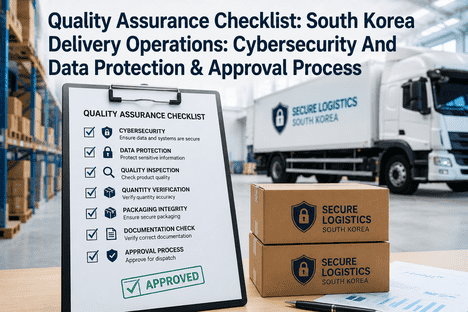
South Korea's manufacturing and logistics sector operates one of the most digitally advanced delivery infrastructures in the world — with automated sortation hubs processing millions of parcels daily and same-day delivery coverage reaching over 95% of the population. This digital velocity, however, creates an expanded attack surface for cyber threats targeting industrial control systems, shipment data integrity, customer personally identifiable information, and cross-border documentation. Korean manufacturers must simultaneously satisfy the Personal Information Protection Act (PIPA), KISA industrial security guidelines, and zero-defect quality standards that South Korean consumers and B2B partners expect. iFactory AI's delivery operations platform addresses both imperatives — combining AI Vision quality inspection, blockchain-secured data storage, and PIPA-compliant data governance within a unified five-checkpoint clearance workflow. Every shipment passing through quality inspection, quantity verification, packaging integrity assessment, documentation validation, and data protection review receives a digitally signed clearance pass that is cryptographically verifiable by Korean Customs Service inspectors, logistics partners, and end customers. Book a Demo to see how iFactory's platform secures delivery operations for Korean manufacturing environments.
The Convergence of Cybersecurity and Quality in Korean Delivery Operations
South Korea's manufacturing sector has undergone a rapid digital transformation over the past decade, with smart factory adoption rates among the highest globally at over 45% among mid-to-large manufacturers. This connectivity has delivered measurable productivity gains — but it has also introduced new vectors for cyber threats targeting delivery operations. KISA reported a 37% year-over-year increase in industrial control system (ICS) security incidents in 2025, with logistics and supply chain infrastructure emerging as the most targeted vertical after energy. For delivery operations, the convergence of cybersecurity and quality is not theoretical — a compromised quality inspection system could clear defective shipments, a breached documentation database could expose customer PII and trade secrets, and a manipulated clearance pass could enable unauthorised goods to leave the facility. iFactory's platform addresses this convergence by embedding data protection controls at every checkpoint of the quality verification workflow, ensuring that cybersecurity is not a separate compliance exercise but an integral part of how every shipment is cleared for dispatch.
| Capability Dimension | Traditional Approach | Integrated Cybersecurity & Quality | Compliance Impact |
|---|---|---|---|
| Quality Inspection Records | Paper-based or siloed digital records; accessible to multiple operators without access control; vulnerable to retroactive modification | Blockchain-secured inspection images and results; RBAC per operator role; immutable audit trail with cryptographic verification | PIPA Article 29 (security measures), KISA ICS security guidelines for data integrity |
| Customer Data in Shipments | Customer names, addresses, and contact details stored in plaintext across multiple systems; no automated retention enforcement | AES-256 encrypted PII at rest and TLS 1.3 in transit; automated retention per PIPA schedule; consent-driven data processing workflows | PIPA Articles 15–18 (consent and purpose limitation), Article 28 (data retention and disposal) |
| Clearance Pass Generation | Manual sign-off by supervisor; paper clearance pass vulnerable to forgery; no linkage to underlying inspection data | Digitally signed clearance pass with QR code linking to full blockchain-verified inspection record; cryptographically verifiable by customs and customers | KCS electronic clearance requirements, KISA digital signature guidelines for critical infrastructure |
| Cross-Border Documentation | PDF invoices and certificates emailed or printed; version control absent; document access unlogged | Encrypted document storage with version history; RBAC per document type; all access logged in immutable audit trail; automated expiry alerts | PIPA Article 29 (access logging), KISA document security guidelines, CBAM documentation requirements |
| Shift Handover Data | Verbal or paper shift notes; no standardised format; institutional knowledge lost between shifts | Digital Shift Logbook with structured templates, mandatory acknowledgment, AI-generated summaries, and blockchain-secured event timeline | PIPA Article 30 (data management), ALCOA+ data integrity standards for regulated industries |
The Five-Checkpoint Quality and Cybersecurity Clearance Workflow
iFactory's delivery operations platform implements five sequential checkpoints that every shipment must pass before receiving a digitally signed clearance pass. Each checkpoint integrates both quality verification and data protection controls — ensuring that a shipment cannot be cleared unless both its physical condition and its data governance status meet compliance thresholds. The workflow is designed for Korean manufacturing environments where PIPA compliance, KISA security guidelines, and zero-defect quality standards must be satisfied simultaneously without adding manual administrative burden to operators and supervisors.
PIPA Compliance Framework — Data Protection Built Into Every Shipment
South Korea's Personal Information Protection Act (PIPA) requires data controllers to implement technical and administrative measures to protect personal information across its entire lifecycle — collection, use, storage, transfer, and disposal. For manufacturing delivery operations, PIPA compliance extends to customer shipment data (names, addresses, phone numbers), recipient personal information, employee inspection and shift records, and supplier contact data embedded in customs documentation. iFactory's data protection framework implements PIPA requirements as configurable policies within the delivery operations platform rather than as separate compliance exercises. The framework covers six core PIPA compliance domains, each with configurable policies that legal and compliance teams can adjust without requiring platform code changes. Book a Demo to review iFactory's PIPA compliance configuration toolkit for Korean manufacturing facilities.
Consent Management and Purpose Limitation (PIPA Articles 15–18) — Every PII data field captured during the delivery process — customer name, shipping address, phone number, email, order history — requires a recorded consent purpose. The platform supports configurable consent collection workflows with Korean-language consent forms, purpose-specific data processing agreements, and automated consent expiry management. If a consent purpose expires (for example, a marketing consent tied to a promotional campaign), the platform automatically blocks processing of the associated data for any purpose beyond the consented scope. Data controllers can run consent compliance reports at any time, showing which PII data fields are associated with which consent purposes, when consent was obtained, and when it expires. The consent audit log is maintained in the immutable blockchain audit trail for PIPA compliance inspection preparation.
Data Encryption and Access Control (PIPA Articles 29–30) — All PII stored in the platform is encrypted at rest using AES-256 with customer-managed encryption keys stored in a hardware security module or cloud KMS within Korean jurisdiction. Data in transit between the platform, edge devices, ERP systems, and customs EDI gateways is encrypted with TLS 1.3. Role-based access control (RBAC) is configurable per PIPA data classification levels — with separate roles for operators (inspection results only), supervisors (operational data plus shift logs), quality engineers (inspection data plus quality metrics), compliance officers (PII access with full audit trail), logistics managers (order data without PII), and system administrators (configuration without data access). All access attempts — successful and failed — are logged with timestamp, IP address, accessed resource, and action type. The RBAC configuration supports Korean-language role names and descriptions for compliance documentation.
Data Retention and Secure Disposal (PIPA Article 28) — The platform enforces configurable data retention periods per PIPA requirements for each data category — customer shipment records (typically 5 years for tax compliance), quality inspection images (typically 3 years for product liability coverage), shift logs (typically 1 year for labour compliance), and consent records (until consent is revoked or purpose expires). When a retention period expires, the platform automatically executes secure deletion with cryptographic verification — the data is overwritten and the deletion event is recorded in the immutable audit trail. Data controllers can configure retention exceptions for active legal holds or regulatory investigations, with the exception recorded in the audit trail along with the authorising party and expected duration. Automated retention reporting provides compliance teams with a dashboard showing data volumes by category, retention expiry dates, and upcoming deletion events.
Breach Detection and Notification Workflow (PIPA Articles 34–36) — The platform continuously monitors for anomalous access patterns — bulk data exports by a single user, API calls from unusual IP addresses, access attempts outside normal shift hours, and repeated failed authentication attempts. When an anomalous pattern is detected, the platform automatically terminates the active session, blocks the originating IP address, and notifies the designated security officer via configurable escalation workflows. The breach notification workflow is pre-configured for PIPA requirements — including KISA notification within 72 hours and affected party notification with templates in Korean. The breach investigation package automatically captures the session logs, accessed resources, data classification levels, and timeline — enabling the security team to prepare the regulatory notification within the required timeframe. All breach detection events and response actions are recorded in the immutable audit trail for post-incident review and regulatory submission.
Expert Perspective — Cybersecurity and Quality in Korean Manufacturing
I have spent over a decade working in quality and compliance across Korean semiconductor, automotive, and electronics manufacturing facilities. The most significant shift I have observed in the last three years is the recognition that cybersecurity and quality can no longer be managed as separate functions — particularly in delivery operations, where a quality inspection record that can be altered without detection is functionally equivalent to no inspection at all. When we deployed iFactory's platform across our delivery operations, the most impactful change was not the AI Vision inspection or the automated documentation validation — it was the blockchain-secured audit trail that gave us cryptographic proof that every record we generated was authentic and unaltered. For Korean manufacturers subject to PIPA, KISA guidelines, and increasingly stringent customer audit requirements, this integrated approach to quality and data protection is becoming a competitive necessity. The facilities that adopt this approach early will build a compliance advantage that becomes increasingly difficult for competitors to replicate as regulatory requirements continue to tighten across both data protection and product quality domains.
— Quality and Compliance Director, Korean Electronics Manufacturing — 12 Years in QA and Data GovernanceKey Benefits — Integrated Cybersecurity, Quality, and Compliance
Adopting iFactory's integrated platform for Korean delivery operations delivers measurable benefits across quality, cybersecurity, compliance, and operational efficiency dimensions. The benefits compound over time as the platform captures more inspection data, builds richer defect correlation models, and accumulates compliance audit evidence that reduces regulatory inspection preparation effort.
Conclusion
South Korea's delivery operations are at an inflection point where digital velocity, quality expectations, and data protection requirements converge. Manufacturers that treat cybersecurity and quality as separate functions will face increasing compliance burden, audit preparation cost, and regulatory risk — while those that adopt an integrated platform approach will build a competitive advantage in both operational efficiency and regulatory confidence. iFactory's delivery operations platform offers a proven path to this integrated approach — combining AI Vision quality inspection, blockchain-secured audit trails, PIPA-compliant data governance, and Shift Logbook integration within a single unified workflow that requires no code changes to existing control infrastructure. The five-checkpoint clearance workflow ensures that every shipment is verified for quality, quantity, packaging, documentation, and data protection before a digitally signed clearance pass is issued — providing cryptographic proof of compliance at every step. For Korean manufacturers evaluating this approach, the recommended next step is a structured platform assessment that evaluates your current delivery operations workflow, data protection maturity, and highest-impact automation opportunities. Book a Demo to start your assessment and discover how iFactory's integrated platform can secure and accelerate your Korean delivery operations.
Frequently Asked Questions
iFactory's platform implements PIPA compliance across the full data lifecycle — consent collection with Korean-language forms, purpose limitation enforcement, AES-256 encryption at rest and TLS 1.3 in transit, RBAC with PIPA-based role definitions, automated retention enforcement with cryptographic deletion, and breach detection with 72-hour KISA notification workflow. For data localisation, the platform supports on-premise deployment within Korean jurisdiction or Korean-region cloud data centres (AWS Seoul, Azure Korea, GCP Seoul) with contractual guarantees that data is not replicated outside the region. Encryption keys can be customer-managed in a Korean-located hardware security module, ensuring that even iFactory cannot access customer data without explicit authorisation. Compliance reporting dashboards provide real-time visibility into PIPA compliance posture for each data category.
Yes. iFactory provides pre-built certified connectors for SAP S/4HANA, Microsoft Dynamics 365, and Oracle E-Business Suite — all widely deployed across Korean manufacturing enterprises. For Korean Customs Service integration, the platform supports secure EDI connectivity with the UNI-PASS customs clearance system, configurable within 6–8 weeks of project start. The secure API gateway with OAuth 2.0 authentication, rate limiting, and payload validation ensures all data exchanged between iFactory and external systems is encrypted and authenticated per zero-trust principles. The platform also integrates with weight bridges, barcode and RFID scanners, AI Vision cameras, and vehicle telematics platforms through standard industrial protocols (OPC UA, Modbus TCP, MQTT).
A standard deployment of the delivery operations platform for a single Korean manufacturing facility takes 6–10 weeks from project kick-off to go-live. The timeline covers AI Vision camera installation and calibration, ERP integration with business process testing, KCS UNI-PASS EDI connectivity configuration, PIPA-compliant data governance policy setup with legal team review, RBAC role definition per organisational structure, operator and supervisor training (two days per shift), and a two-week hyper-care period with on-site support. Multi-site deployments with consistent process standards typically require 10–14 weeks for the first site and 4–6 weeks per subsequent site. Korean-language interface, Korean-language training materials, and on-premise deployment are included in the standard deployment scope for Korean facilities.
The blockchain audit trail records every quality inspection image, quantity verification count, packaging assessment, documentation validation result, clearance pass generation, user access event, and RBAC permission change with cryptographic timestamping. For KISA inspections, the platform can export audit trail reports in Korean regulatory format showing the complete history of data processing activities, access logs, and security events. For Korean Customs Service audits, the clearance pass QR code links to the blockchain-verified inspection record, enabling customs inspectors to cryptographically verify that no inspection record has been altered since the clearance pass was generated. The blockchain audit trail meets ALCOA+ data integrity standards — attributable, legible, contemporaneously recorded, original, and accurate — providing evidentiary quality records suitable for regulatory submission and legal proceedings.
Yes. The platform supports full Korean-language interface for operators, supervisors, quality engineers, compliance officers, and system administrators — including Korean-language labels, navigation, alert messages, compliance documentation, consent forms, training materials, and shift log templates. RBAC role names and descriptions are configurable in Korean. Regulatory reports — including PIPA compliance dashboards, KISA audit trail exports, and KCS clearance documentation — are generated in Korean by default with optional English-language parallel versions for multinational teams. The Korean-language interface and documentation are included as standard for Korean deployments at no additional cost. Multi-language support enables Korean headquarters to deploy the platform across international facilities with consistent quality and data protection standards while maintaining local-language interfaces for each facility's workforce.