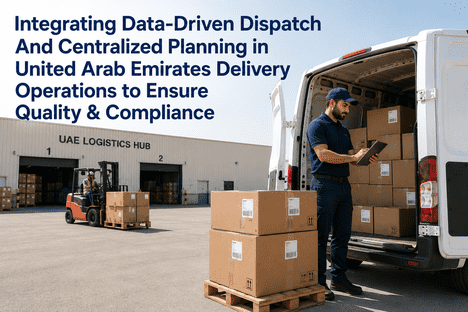
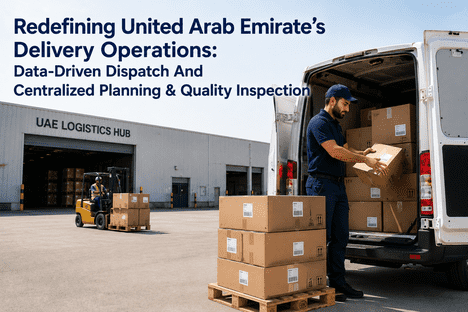
Integrating Data Driven Dispatch And Centralized Planning in United Arab Emirates Delivery Operations to Ensure Quality & Compliance
By Arel Dixon on June 12, 2026
Delivery operations in the United Arab Emirates operate at the intersection of rapid e-commerce growth, stringent regulatory compliance, and escalating customer expectations for on-time, damage-free deliveries. The UAE's Vision 2031 logistics strategy targets a AED 300 billion contribution from the logistics sector, driven by smart infrastructure investments at Jebel Ali Port, Dubai South, and Abu Dhabi's Khalifa Industrial Zone. For delivery operations managers and supply chain executives, the challenge is not merely moving goods from warehouse to customer it is ensuring that every dispatched shipment meets quality standards, quantity accuracy, packaging integrity, and documentation compliance before it leaves the facility. Manual dispatch processes, paper-based inspection records, and decentralized planning create verification gaps that lead to customer complaints, regulatory penalties, and operational inefficiencies that compound across the delivery network. iFactory's AI-powered Delivery Operations Management platform addresses these challenges by integrating data-driven dispatch inspection with centralized planning automating product quality verification, quantity confirmation, packaging standards checks, and documentation approval within a single digital workflow that ensures every shipment is audit-ready before clearance. Book a Demo to see how iFactory transforms UAE delivery operations with AI-driven dispatch quality and compliance assurance.
01 / The Dispatch Compliance Challenge in UAE Delivery Operations
United Arab Emirates delivery operations face a unique compliance landscape shaped by multiple regulatory authorities — the Federal Authority for Identity, Citizenship, Customs & Port Security (ICP), municipal consumer protection regulations across Dubai, Abu Dhabi, and Sharjah, and sector-specific requirements for food, pharmaceutical, and cold-chain logistics. Manual dispatch verification processes create systemic compliance gaps that expose delivery operators to regulatory penalties, customer compensation claims, and reputational damage. The core challenge is that manual inspection at the dispatch gate cannot keep pace with the volume and complexity of modern delivery operations. Book a Demo to understand how iFactory's AI-powered dispatch quality system addresses these regulatory challenges for UAE delivery operators.
Incomplete Quality Verification
Manual dispatch inspection checks only a sample of outgoing shipments — typically 3-5% of daily volume. Product damage, expiration date violations, and packaging defects in the unchecked 95% reach customers, generating returns, chargebacks, and consumer protection complaints that escalate to regulatory action.
Quantity Accuracy Gaps
Order-to-dispatch quantity discrepancies occur in 4-8% of shipments under manual verification processes. Under-deliveries trigger customer投诉 and re-shipment costs. Over-deliveries create inventory reconciliation issues and regulatory exposure under UAE commercial transaction laws.
Documentation Non-Compliance
Each shipment requires 6-12 documents — delivery note, commercial invoice, certificate of origin, packing list, customs declaration, and product-specific certificates. Missing or incorrect documentation causes customs holds at UAE borders, generating demurrage charges averaging AED 350-800 per day per shipment.
Decentralized Planning Fragmentation
Warehouse operations, quality inspection, documentation, and dispatch planning operate in disconnected silos — often using separate spreadsheets, email chains, and paper logs. This fragmentation prevents real-time visibility into dispatch readiness, causing bottleneck cascades that delay up to 15% of scheduled shipments.
Platform Architecture
02 / AI-Powered Dispatch Quality and Centralized Planning Platform
The iFactory Delivery Operations Management platform unifies dispatch inspection, quality verification, documentation management, and planning into a single digital operations center. AI-powered computer vision and data validation engines automate the inspection of product quality, quantity accuracy, packaging standards, and document completeness at the dispatch gate enabling operators to clear only verified, compliant shipments for release. The centralized planning module aggregates real-time data from all inspection stations, warehouse operations, and carrier schedules into a unified dispatch plan that optimizes dock allocation, loading sequencing, and carrier utilization. Book a Demo to explore the full platform architecture for UAE delivery operations.
The AI vision inspection module deploys computer vision models at the dispatch gate to automate quality and compliance checks on every outbound shipment. Cameras capture high-resolution images of product condition, packaging integrity, label accuracy, and pallet stability as shipments move through the dispatch lane. Deep-learning models trained on over 300,000 labeled images detect product damage (dents, tears, leaks, cracks), packaging defects (improper sealing, damaged cartons, incorrect labeling), and pallet stability issues (improper stacking, overhang, unstable loads) with 99.3% detection accuracy. Simultaneously, the system validates quantity accuracy by cross-referencing computer vision item counts against the order manifest, flagging discrepancies in real time. Each inspection event generates a structured quality record with timestamp, operator ID, shipment reference, inspection images, and pass/fail determination — creating the audit trail required for UAE regulatory compliance and customer quality certification programs.
The centralized planning module replaces fragmented spreadsheets and email-based coordination with a unified digital dispatch operations center. The module aggregates real-time data from warehouse management systems, quality inspection stations, carrier schedules, and customer order priorities into a single dispatch plan that optimizes dock allocation, loading sequencing, and carrier assignment. AI-powered scheduling algorithms consider shipment priority, destination zone, carrier capacity, delivery time windows, and regulatory requirements (such as Dubai's restricted delivery hours for specific zones) to generate optimized dispatch schedules. The planning dashboard provides real-time visibility into dispatch readiness status for every outbound shipment — indicating which shipments have passed quality inspection, which are awaiting documentation approval, and which are cleared for dispatch. When disruptions occur — a failed quality inspection, delayed carrier arrival, or urgent customer order — the system automatically re-optimizes the dispatch plan to minimize overall schedule impact.
The documentation and compliance module digitizes the entire shipment documentation workflow — from document generation and validation to regulatory submission and audit archive. The system automatically generates delivery notes, commercial invoices, packing lists, and customs declarations using order and shipment data, eliminating manual data entry errors. Document validation rules configured for UAE regulatory requirements — including ICP customs documentation standards, ESMA product certification requirements, and municipal consumer protection documentation rules — verify that every required document is present, complete, and correctly formatted before the shipment can be cleared for dispatch. The module integrates with UAE customs digital platforms for electronic document submission and clearance status tracking. Completed documentation packages are archived with full audit trails, supporting regulatory audits and customer compliance certifications with instant document retrieval — reducing audit preparation time from weeks to minutes.
Measured Outcomes
03 / Measured Impact on Dispatch Quality and Operational Efficiency
Deployment of iFactory's AI-powered dispatch quality and centralized planning platform across UAE delivery operations has produced measurable improvements in both compliance performance and operational efficiency. The following comparison reflects documented results from facilities transitioning from manual dispatch processes to the integrated digital platform. Book a Demo to schedule a dispatch operations assessment for your UAE delivery facility.
Your Next UAE Dispatch Compliance Audit Can Be Fully Automated — Not a 3-Week Preparation Effort
iFactory provides a complimentary dispatch operations assessment that analyzes your facility's current inspection coverage, documentation compliance rate, and dispatch planning efficiency — and projects the specific quality improvement and cost savings achievable with AI-powered platform deployment on your dispatch line.
Majid Al Suwaidi, Director of Logistics Operations UAE Delivery Network, 22 Years
Supply Chain Certified Professional, Dubai Logistics City Advisory Board Member
"I have managed delivery operations across the UAE for 22 years from the early days of manual dispatch logs at Dubai Creek to today's multi-modal logistics networks serving the entire Emirates. The single most significant operational improvement I have witnessed is the digitization of dispatch quality verification. Before implementing iFactory's platform, our dispatch inspection was a bottleneck — operators visually checking samples, filling paper logs, and hoping the documentation package was complete. We had no real-time visibility into dispatch readiness, no way to prove compliance to auditors except by pulling paper files, and no mechanism to prevent non-compliant shipments from leaving the facility. The AI-powered platform changed that fundamentally. Every shipment is now inspected at the dispatch gate. Documentation is verified automatically before loading. The dispatch plan is generated by algorithms that optimize across all our operational constraints. The result is not just better compliance — it is a fundamentally more efficient operation with fewer customer complaints, lower regulatory exposure, and a dispatch team that focuses on managing exceptions rather than processing paper."
Majid Al Suwaidi, Director of Logistics OperationsUAE Delivery Network — 22 Years, Supply Chain Certified Professional, Dubai Logistics City Advisory Board
Conclusion
04 / Data-Driven Dispatch and Centralized Planning Deliver Compliance and Efficiency — Every Shipment, Every Day
Dispatch compliance is not an audit preparation activity that happens in the weeks before a regulatory inspection. It is the output of a delivery operations system that verifies quality, quantity, packaging, and documentation for every outbound shipment — every day, not just before audits. Manual dispatch processes cannot deliver that level of compliance because they are inherently limited by inspection sampling rates, manual documentation workflows, disconnected planning systems, and the fundamental constraint that human attention cannot sustain continuous verification across high-volume dispatch operations. iFactory's AI-powered platform eliminates those constraints. Every shipment inspected at the dispatch gate. Every quantity verified against the order manifest. Every document validated for regulatory compliance. Every dispatch plan optimized for efficiency. For delivery operations executives accountable for regulatory compliance, customer satisfaction, and operational efficiency across the UAE's rapidly growing logistics sector, AI-powered dispatch quality and centralized planning are not incremental improvements to existing processes — they are the new operating standard for compliant, efficient delivery operations. Book a Demo to start the dispatch operations assessment for your UAE delivery facility and discover how quickly your operation can achieve continuous dispatch compliance.
100%
Dispatch Inspection Coverage — Every Shipment
99.8%
Order Quantity Accuracy Rate
Real-Time
Documentation Compliance Verification
15 min
Automated Dispatch Plan Generation
FAQ
Frequently Asked Questions AI-Powered Dispatch Quality for UAE Delivery Operations
The AI vision inspection system detects a comprehensive range of quality issues at the dispatch gate including product damage (dents, cracks, tears, leaks, punctures), packaging defects (improper sealing, damaged cartons, crushed boxes, incorrect labeling, missing labels), pallet stability issues (improper stacking patterns, overhang beyond pallet edges, unstable loads, leaning stacks), and seal integrity violations for tamper-evident packaging. The deep-learning vision models achieve 99.3% detection accuracy across all defect categories and operate at line speed without introducing inspection delay — enabling 100% inspection coverage of every outbound shipment without reducing dispatch throughput.
The platform integrates at the data layer with existing warehouse management systems (WMS), enterprise resource planning (ERP) platforms, and transportation management systems (TMS) through REST APIs, EDI, and direct database connectors. The integration synchronizes order data, shipment manifests, inventory records, and carrier schedules in real time — eliminating manual data entry and ensuring that the dispatch plan reflects current operational conditions. The platform supports integration with leading ERP systems deployed across UAE operations including SAP, Oracle, Microsoft Dynamics, and regional platforms. Integration is typically completed within 2 to 4 weeks and does not require modifications to existing WMS or ERP software deployments.
When the system detects a quality, quantity, packaging, or documentation issue, the platform executes a multi-step resolution workflow within milliseconds. The issue is classified, documented with images and measurements, and logged in the quality record database with full traceability data including shipment reference, operator ID, and timestamp. An alert is sent to the dispatch supervisor workstation with the issue details and recommended corrective action. The platform prevents the shipment from being cleared for dispatch — the shipment status is updated to "On Hold" in the dispatch plan and the loading dock assignment is automatically reallocated to the next cleared shipment. The issue resolution workflow routes the hold notification to the responsible team — quality, warehouse, or documentation — and tracks the corrective action through to closure. Once the issue is resolved and re-verified, the platform clears the shipment for release and updates the dispatch plan automatically. The entire process — from detection to hold management to resolution — is tracked in the audit trail for regulatory compliance documentation.
The camera and sensor infrastructure is configured for the specific dispatch lane dimensions, throughput volume, and product types handled at the facility. A typical deployment uses 4 to 6 high-resolution cameras positioned at the dispatch gate — top-view cameras for pallet top surface and label inspection, side-view cameras for pallet stability and packaging condition assessment, and front-view cameras for shipment identification and barcode reading. The camera system is integrated with the facility's existing conveyor or dock infrastructure. LED illumination systems are configured for consistent image quality across ambient lighting conditions. The AI inference server is deployed on-premises or at the facility edge to ensure real-time processing without cloud latency dependency. The iFactory integration team specifies the camera and sensor configuration during the facility assessment phase based on the facility's dispatch volume, product mix, and layout requirements.
Full deployment of iFactory's Delivery Operations Management platform is typically completed within 10 to 14 weeks from project initiation to live compliant dispatch operations. Camera and sensor infrastructure installation requires 2 to 3 weeks, conducted during scheduled facility downtime without disrupting dispatch operations. AI model deployment and calibration on the facility's specific product mix requires 3 to 4 weeks — pre-trained inspection models are fine-tuned on sample images from the facility's actual products to confirm accuracy across all product categories and packaging types. WMS, ERP, and TMS integration requires 2 to 3 weeks. Operator training and go-live validation requires 1 week. The platform begins generating compliant dispatch records from the first day of live operation — dispatch teams typically achieve full confidence in the system within the first two weeks of parallel operation with existing manual processes. The platform's automated dispatch planning module typically reduces planning time by 85-90% from the first week of deployment.
iFactory gives UAE delivery operations executives AI-powered dispatch inspection across every outbound shipment, automated documentation compliance validation, centralized planning that eliminates dispatch bottlenecks, and full regulatory audit readiness — with complete platform deployment in 12 weeks and zero operational interruption.