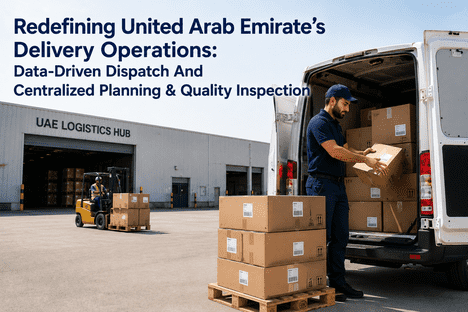
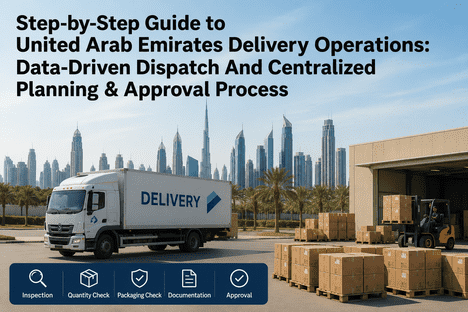
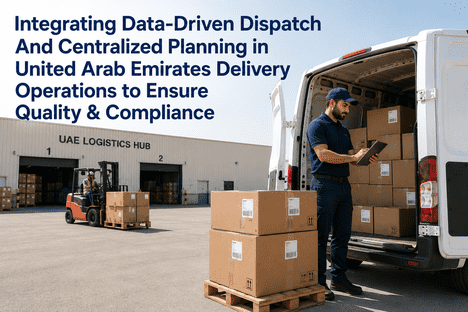
Every dispatch manager in the United Arab Emirates knows the pressure: shipments leaving manufacturing facilities must meet exact customer specifications, comply with trade documentation requirements, and arrive without damage all while maintaining throughput. Yet in facilities across Abu Dhabi, Dubai, Sharjah, and the Northern Emirates, the gap between what is shipped and what the customer receives remains a persistent source of cost, rework, and relationship strain. The root cause is rarely a single failure point. It is the cumulative effect of disconnected quality checks, manual documentation workflows, and reactive dispatch decisions made without a unified view of order readiness. iFactory's delivery operations management platform closes that gap by bringing data-driven dispatch, centralized planning, and end-to-end quality inspection into a single, real-time system purpose-built for UAE manufacturers who ship to global standards.
Data-Driven Dispatch · Centralized Planning · Quality Inspection · Zero-Defect Shipping
UAE Manufacturers Are Eliminating Dispatch Errors by Connecting Inspection, Documentation, and Approval in One Platform.
iFactory's delivery operations management system gives UAE manufacturers real-time visibility into shipment readiness, automated quality inspection workflows, centralized dispatch planning, and digital approval gateways so every shipment leaves with complete documentation and verified conformance.
99.7%
Shipment documentation accuracy achieved by UAE manufacturers using centralized digital approval workflows
62%
Reduction in dispatch-related quality incidents after deploying structured inspection and verification gateways
3.2x
Faster dispatch cycle time when planning, inspection, and approval data is unified in a single operations dashboard
100%
Traceability from production batch through final dispatch approval — every shipment linked to its inspection record
The Dispatch Quality Challenge in UAE Manufacturing
UAE manufacturers operate at the crossroads of global trade. A shipment leaving a factory in Jebel Ali or Al Ain may pass through multiple ports, free zones, and inspection points before reaching its final destination. Each transition point is an opportunity for discrepancy — incorrect quantity, damaged packaging, missing documentation, or non-conforming product. Yet many dispatch operations still rely on paper-based checklists, email-based approvals, and manual data entry across disconnected systems. The result is a process where quality inspection happens in isolation from dispatch planning, documentation is verified only after the truck is loaded, and approval decisions are made without visibility into the full order readiness picture.
Five Dispatch Failure Points That Cost UAE Manufacturers Time and Revenue
01
Disconnected Inspection and Dispatch
Quality inspection records are captured but not linked to the dispatch order, so loading teams proceed without confirmation that the product has passed all required checks.
iFactory fix: Inspection results are automatically synced to the dispatch order — no pass, no load.
02
Manual Quantity and Packaging Verification
Load verification relies on handwritten counts and visual checks that are not independently validated, leading to shipped quantities that differ from customer orders.
iFactory fix: Digital quantity and packaging checklists with photo capture and barcode scan confirmation at point of loading.
03
Documentation Fragmentation
Certificates of origin, packing lists, invoices, and customs declarations are prepared in separate systems, increasing the risk of mismatched or missing documents at the port of departure.
iFactory fix: Centralized document repository auto-populated from order and inspection data with template-driven generation.
04
Approval Bottlenecks at Shift Change
Final dispatch approval depends on a single authorized person who may not be available during shift transitions, causing trucks to wait or be released without proper clearance.
iFactory fix: Configurable approval hierarchies with remote digital sign-off and escalation rules when approvals are delayed.
05
No Post-Dispatch Traceability
When a customer reports a discrepancy, there is no single record linking the inspection data, loading photos, documentation set, and approval decision for that specific shipment.
iFactory fix: Every shipment generates a complete digital dossier — inspection, quantity, packaging, docs, and approval — linked to the production batch and order.
How Data-Driven Dispatch and Centralized Planning Transform UAE Delivery Operations
The shift from reactive, paper-based dispatch to data-driven, centralized operations does not require new equipment or a complete process overhaul. It requires connecting the data that already exists across production, quality, inventory, and order management into a single dispatch operations platform. iFactory's delivery operations management system is designed for this exact purpose — to give UAE manufacturers a unified view of every shipment's readiness status, from the production batch through inspection, documentation, and final approval.
Capability 01
Centralized Dispatch Planning Dashboard
Real-time visibility into every order, its inspection status, and document readiness
Rather than tracking dispatch readiness across spreadsheets, email threads, and paper folders, the centralized dashboard consolidates every order's status: production completion, inspection pass/fail, quantity verification, packaging check, and document completeness. Dispatchers see at a glance which shipments are cleared to load, which are held pending inspection or documentation, and which require escalation. The dashboard updates in real time as each checkpoint is completed, giving the dispatch team a single source of truth for every outbound shipment.
Unified order status view
Real-time readiness tracking
Automated escalation triggers
Capability 02
Structured Quality Inspection Workflows
Configurable inspection checklists with pass/fail gates and evidence capture
Each product category and customer can have its own inspection checklist — covering visual quality, dimensional tolerance, packaging integrity, labelling accuracy, and quantity confirmation. Inspectors complete checks on a mobile device at the point of loading, capturing photos and barcode scans as evidence. Any failed check blocks the shipment from proceeding to dispatch approval until corrective action is recorded and re-inspection passes. The system enforces the inspection sequence, ensuring that no shipment bypasses the required checks.
Configurable per product/customer
Photo and barcode evidence
Mandatory pass/fail gates
Capability 03
Digital Documentation and Compliance
Auto-populated shipping docs with template-driven generation
Packing lists, certificates of origin, inspection certificates, and customs declarations are auto-populated from the order, inspection, and production data already in the system. Document templates are configured per customer, destination, and product category — reducing the time spent on paperwork from hours to minutes. Every document is stored centrally and linked to the shipment record, so the complete documentation set is accessible for internal review, customs clearance, and customer delivery confirmation.
Auto-populated from system data
Template-driven generation
Centralised document repository
Capability 04
Approval Gateway and Clearance Pass
Digital sign-off with configurable hierarchy and full audit trail
Once all inspections are passed, quantities verified, packaging confirmed, and documents generated, the system presents the shipment for final approval. Approvers receive a digital summary of the complete readiness status and can sign off from any device — on the plant floor, remotely, or during shift handover. The approval is recorded with a timestamp and approver identity, generating a clearance pass that authorizes loading and dispatch. Any attempt to dispatch without a clearance pass triggers an alert, ensuring that zero shipments leave without full verification.
Digital sign-off from any device
Timestamped audit trail
Clearance pass enforcement
Zero-Defect Shipping · Clearance Pass · Full Traceability
Every Shipment That Leaves Your Facility Should Be a Verified, Documented, Approved Shipment.
See how iFactory connects inspection, documentation, and approval in a single dispatch operations workflow — purpose-built for UAE manufacturers shipping to global standards.
What the Dispatch Operations Dashboard Shows
For the dispatch manager and plant operations executive, the dashboard surfaces the metrics that matter most to outbound shipment performance: order readiness status, inspection pass rates, documentation completeness, approval cycle times, and the shipment clearance rate.
Dashboard View 01
Order Readiness Funnel
A visual funnel showing all scheduled shipments and their current readiness stage — production complete, inspection passed, documents ready, approved for dispatch — so bottlenecks become visible immediately.
Action: Identify and resolve holds at any readiness stage before they delay dispatch.
Dashboard View 02
Inspection Pass Rate by Product Line
Tracks the percentage of shipments passing first-time inspection, segmented by product line and customer, so recurring quality issues can be traced to root cause and addressed at the production stage.
Action: Direct quality improvement efforts to the product lines with the lowest first-pass rates.
Dashboard View 03
Documentation Completeness Rate
Monitors what percentage of shipments have complete documentation sets before the scheduled loading time, flagging any shipments where documents are missing or pending generation.
Action: Proactively resolve documentation gaps before they cause customs or customer delays.
Dashboard View 04
Approval Cycle Time by Shift
Measures the time between a shipment becoming ready for approval and the final sign-off being recorded, segmented by shift and approver to identify bottlenecks in the authorization process.
Action: Address approval delays that cause trucks to wait beyond the loading window.
Dashboard View 05
Shipment Clearance Rate
The percentage of scheduled shipments that clear all inspection, documentation, and approval gates within the planned dispatch window — the single leading indicator of dispatch operations health.
Action: The clearance rate becomes the primary KPI for dispatch operations performance reviews.
Dashboard View 06
Post-Dispatch Discrepancy Tracking
Customer-reported discrepancies are logged and linked back to the specific shipment record — inspection data, loading photos, documents, and approval — enabling rapid root-cause analysis and corrective action.
Action: Closed-loop discrepancy resolution with full traceability to the original dispatch record.
"
We were running three separate processes for dispatch — quality inspection on paper, documentation in a shared drive, and approval via WhatsApp. The handoffs between them were where errors happened. Since we deployed iFactory, every shipment goes through the same structured workflow: inspection, quantity check, packaging, documents, approval. The clearance pass is our single source of truth. Our customer-reported discrepancies dropped by over 60% in the first quarter, and our dispatch team now manages double the shipment volume with the same headcount.
— Operations Director, UAE Manufacturing & Export Facility — Industrial Products Sector
Building the Data-Driven Dispatch Workflow
Implementing a data-driven dispatch operation does not require replacing the ERP or TMS. iFactory's platform integrates with existing systems — pulling order data from the ERP, production status from the MES, and quality results from the QC system — and overlays the dispatch-specific workflows that connect them. The platform becomes the operational layer where inspection, documentation, and approval converge into a single dispatch operations record.
Step 1: Order Import and Dispatch Scheduling
Orders are imported from the ERP automatically and appear on the dispatch planning dashboard with scheduled delivery dates, customer specifications, and product details.
Step 2: Production Completion Verification
When production confirms the order is complete, the shipment status updates automatically. If production data indicates non-conformance, the system flags the order for quality review before dispatch.
Step 3: Quality Inspection at Point of Load
Inspector completes the digital checklist on a mobile device — visual, dimensional, packaging, labelling — with photo evidence. Failed checks block the shipment and trigger a corrective action workflow.
Step 4: Quantity and Packaging Confirmation
Loading team confirms quantities via barcode scan or manual count with photo evidence. Packaging condition is verified against customer specifications and recorded in the shipment record.
Step 5: Document Generation and Validation
Shipping documents — packing list, certificate of origin, inspection certificate, customs declaration — are auto-generated from the verified shipment data and attached to the shipment record.
Step 6: Approval and Clearance Pass
Authorized approver reviews the complete readiness summary and signs off digitally. The clearance pass is generated — no pass, no load. Full audit trail recorded for compliance and customer traceability.
Conclusion: From Reactive Dispatch to Data-Driven Operations
For UAE manufacturers, the dispatch operation is the last point of control before the product reaches the customer — and the last opportunity to prevent a quality, documentation, or compliance issue from becoming a customer-facing problem. Moving from fragmented, paper-based dispatch processes to a centralized, data-driven platform is not about replacing people with software. It is about giving every person in the dispatch workflow — inspector, loader, document controller, approver — the same complete picture of order readiness, and the tools to act on it in real time.
iFactory's platform connects the dots between production, quality, documentation, and approval, creating a single digital thread from the production batch through to the customer's receiving dock. The result is fewer discrepancies, faster dispatch cycles, complete traceability, and a dispatch operation that scales with the business — whether shipping across the Emirates or across the world.
See how iFactory's delivery operations management platform can transform your UAE dispatch operation. Book a Demo to see the platform in action, or talk to an expert about your dispatch operations requirements.
Frequently Asked Questions
Your Shipment Deserves a Clearance Pass Every Time. Build Your Data-Driven Dispatch Operation with iFactory.
iFactory's delivery operations management platform for UAE manufacturers — centralized dispatch planning, structured quality inspection, auto-generated documentation, digital approval gateway, and complete shipment traceability from production to customer receipt.