South Korea's manufacturing and logistics sector operates one of the most advanced delivery infrastructure networks in the world — with same-day delivery coverage reaching over 95% of the population and automated sortation hubs processing millions of parcels daily. However, the digitisation that enables this speed also creates an expanded attack surface for cyber threats targeting industrial control systems, shipment data integrity, and customer information. Korean manufacturers must comply with the Personal Information Protection Act (PIPA), KISA (Korea Internet & Security Agency) industrial security guidelines, and increasingly stringent data localisation requirements while maintaining the zero-defect shipping quality that Korean consumers and B2B customers expect. iFactory AI's delivery operations platform addresses both dimensions — combining AI Vision quality inspection, quantity verification, packaging integrity assessment, and documentation validation with blockchain-secured data storage, role-based access control, and immutable audit trails. Each shipment passing through the five-checkpoint clearance workflow receives a digitally signed clearance pass that is cryptographically verifiable by customs authorities, logistics partners, and end customers. Book a Demo to see how iFactory's platform secures delivery operations for Korean manufacturing and logistics environments.
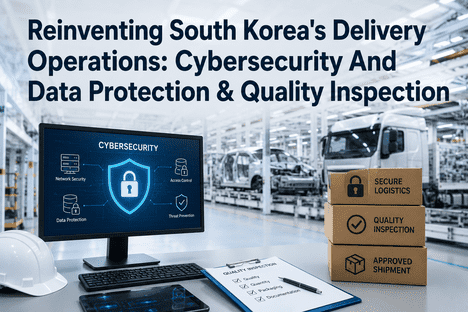
Reinventing South Korea's Delivery Operations — Cybersecurity, Data Protection & Quality Inspection
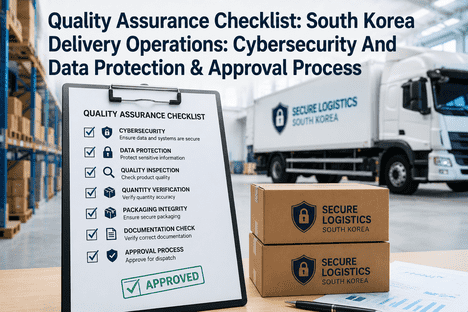
Five sequential AI-powered inspection checkpoints with blockchain-secured audit trails and PIPA-compliant data governance — quality inspection, quantity verification, packaging integrity, documentation validation, and clearance approval for zero-defect, secure shipping.
1–6: Zero-Trust Data Architecture & Industrial Cybersecurity
South Korea's manufacturing sector faces escalating cyber threats — KISA reported a 37% year-over-year increase in industrial control system (ICS) security incidents in 2025, with logistics and supply chain infrastructure emerging as the most targeted vertical after energy. The iFactory platform is architected on zero-trust principles: every API call is authenticated, every data write is blockchain-timestamped, and every user action is logged in an immutable audit trail. For Korean manufacturers subject to PIPA data localisation requirements, the platform supports on-premise deployment with data residency guarantees and Korean-language role-based access control (RBAC) configurable to the individual operator level. Book a Demo to review iFactory's security architecture documentation and data protection compliance framework for Korean manufacturing environments.
Blockchain-Secured Shipment Records
Implementation: Every quality inspection image, quantity verification count, packaging assessment, documentation validation result, and clearance pass is recorded on an immutable blockchain ledger. Records cannot be altered retroactively — providing cryptographic proof of shipment condition at the time of dispatch for dispute resolution and regulatory audit.
Role-Based Access Control (RBAC)
Implementation: Granular access permissions configurable per user role — operator, supervisor, quality engineer, compliance officer, logistics manager, and system administrator. Each role sees only the data and functions relevant to their workflow. All access attempts (successful and failed) are logged with timestamp and IP address.
PIPA-Compliant Data Governance
Implementation: All personally identifiable information (PII) — customer names, addresses, contact details — is encrypted at rest (AES-256) and in transit (TLS 1.3). Data retention policies are configurable per PIPA requirements. On-premise deployment option ensures data never leaves Korean jurisdiction.
Incident Detection & Automated Response
Implementation: Real-time monitoring for anomalous access patterns, bulk data export attempts, and unauthorised API calls. Suspicious activity triggers automated session termination and immediate notification to the security team via configurable escalation workflows.
7–11: AI Vision Quality Inspection for Zero-Defect Shipping
South Korean manufacturers — particularly in automotive, electronics, semiconductor, and cosmetics verticals — operate to zero-defect quality standards where a single defective unit in a shipment can trigger contractual penalties, customer trust erosion, and brand reputation damage. iFactory's AI Vision cameras inspect every outgoing unit at line speed with approximately 45 configurable criteria per product type, targeting a defect escape rate below 0.5% with 100% inspection coverage. Each inspection result is recorded with timestamped images on the blockchain audit trail, providing cryptographic evidence of quality status at the time of dispatch. The five inspection checkpoints below cover the complete quality verification workflow for Korean delivery operations.
Surface Defect Detection
AI Vision cameras inspect every outgoing unit for surface defects — scratches, dents, discolouration, contamination, and foreign material. Defect classification by type and severity with automated pass/reject decisions. For Korean electronics and semiconductor shipments, defect detection resolution is configurable down to 0.1 mm².
Dimensional Accuracy & Tolerance Verification
Automated dimensional measurement against CAD or specification tolerances using calibrated AI Vision cameras. Units outside acceptable tolerance (±0.3 mm for critical automotive and electronics components) are flagged for manual re-inspection or rejection. All measurements are recorded against the blockchain audit trail.
Labelling & Traceability Mark Verification
AI vision reading of barcodes, QR codes, serial numbers, and Korean-language labels. Verifies correct label placement, legibility, and data consistency against the packing manifest. For Korean export shipments, the system validates Korean Customs Service (KCS) declaration labels and HS code markings.
Packaging Integrity & Sustainability Check
AI assessment of seal integrity, pallet stability, stretch-wrap coverage, and handling label visibility. Configurable packaging material verification against Korean Extended Producer Responsibility (EPR) requirements mandated by the Ministry of Environment — ensuring packaging materials meet recyclability and waste reduction targets.
Documentation Validation & Data Protection
Automated validation of commercial invoices, packing lists, certificates of origin, and customs declarations against the shipment manifest and ERP order records. All documents are stored encrypted with AES-256 and accessible only to authorised roles via RBAC. Document access is logged in the immutable audit trail for PIPA compliance.
12–16: Data Protection & Privacy Compliance for Korean Delivery Operations
South Korea's Personal Information Protection Act (PIPA) is one of the strictest data protection frameworks globally — requiring explicit consent for data collection, purpose limitation, data minimisation, retention periods, and secure disposal. For delivery operations, PIPA compliance extends to customer shipment data, recipient personal information, and employee inspection records. iFactory's data protection framework is designed from the ground up for PIPA compliance, with Korean-language consent management, automated data retention enforcement, and encrypted data storage that supports on-premise deployment within Korean jurisdiction.
"When we evaluated delivery operations platforms for our Korean manufacturing facilities, we found most global vendors could not demonstrate PIPA compliance — their data governance was designed for GDPR or CCPA but lacked the specific consent management, data localisation, and retention enforcement that Korean regulators require. iFactory's platform was designed with PIPA as a primary compliance framework, not an afterthought. The Korean-language consent workflows, on-premise deployment option, and immutable audit trail gave us the confidence to proceed without legal reservations. The quality inspection capabilities were the deciding factor — having AI Vision quality checks and blockchain-secured records integrated into the same platform that handles our data protection compliance eliminated an entire category of integration risk."
17–20: Five-Checkpoint Clearance Workflow with Digital Clearance Pass
The final clearance checkpoint aggregates results from all quality inspection and data protection controls — quality inspection, quantity verification, packaging integrity, documentation validation, and cybersecurity compliance — and applies a deterministic pass/fail decision. Only shipments that pass every criterion receive a digitally signed clearance pass, which is required before the loading dock system releases the shipment for vehicle assignment. The clearance pass links to the full inspection record — images, measurements, documents, and cybersecurity compliance status — accessible via QR code by Korean Customs Service inspectors, logistics partners, and end customers.
| Checkpoint | Verification Criteria | Data Protection Control | Pass Threshold |
|---|---|---|---|
| 17. Quality Inspection | Surface defects, dimensional accuracy, labelling, material composition — AI Vision verified per unit | Inspection images stored encrypted (AES-256); access via RBAC; logged in blockchain audit | 99.5% defect-free per batch |
| 18. Quantity & Order Accuracy | Unit count, pallet/case tally, manifest-to-physical reconciliation — verified by weigh scale + RFID + barcode | Quantity records encrypted at rest; discrepancy events trigger automated alert with audit trail | 100% SKU and count match |
| 19. Packaging & Compliance | Seal integrity, pallet stability, sustainable right-sizing, Korean EPR recyclability verification | Packaging assessment images and EPR compliance certificates stored in encrypted document vault | All criteria pass |
| 20. Documentation & Data Security | Invoice validation, certificate verification, CBAM carbon, PIPA consent check, RBAC access review | Documents encrypted at rest; consent expiry verified; access audit logged; retention policy enforced | All documents valid + data protection controls active |
Shift Logbook — Secure Shift Handover with Blockchain Audit Trail
Delivery operations in Korean manufacturing facilities run 24/7, and secure shift handover is both an operational necessity and a data protection requirement. iFactory's Shift Logbook module provides digital shift handover with structured templates, mandatory digital acknowledgment, and AI-generated shift summaries that prioritise the top issues for the incoming team. Every checkpoint result — quality inspection images, quantity verification counts, packaging assessments, documentation validation — is captured in the shift log with timestamps linked to the operator and supervisor. The shift log is encrypted at rest, accessible only via RBAC permissions, and recorded in the blockchain audit trail for PIPA compliance and dispute resolution. Book a Demo to see the Shift Logbook in action with Korean-language interface and PIPA-compliant data governance.
How does the Shift Logbook ensure data protection compliance for Korean facilities?
The Shift Logbook is designed for PIPA compliance from the ground up. All shift data — operator entries, inspection records, approval decisions — is encrypted at rest with AES-256 and accessible only via role-based access control configurable per individual operator. Shift logs are retained per configurable PIPA-compliant retention periods and automatically purged with cryptographic verification of deletion after the retention period expires. The immutable blockchain audit trail records every access and modification, providing full accountability for data processing activities. For Korean facilities requiring data localisation, the Shift Logbook supports on-premise deployment with data never leaving Korean jurisdiction.
Can the platform integrate with existing Korean ERP and customs EDI systems?
Yes. iFactory provides pre-built certified connectors for SAP S/4HANA, Microsoft Dynamics 365, and Oracle E-Business Suite — all widely deployed in Korean manufacturing. For Korean Customs Service (KCS) integration, the platform supports EDI connectivity with the UNI-PASS customs clearance system, configurable within 6–8 weeks of project start. The secure API gateway with OAuth 2.0 authentication ensures all data exchanged between iFactory, ERP, and customs systems is encrypted and authenticated per zero-trust principles.
What cybersecurity certifications does the iFactory platform hold?
The iFactory platform maintains SOC 2 Type II certification for security, availability, and confidentiality. For Korean manufacturing deployments, the platform aligns with KISA's critical infrastructure security guidelines and supports PIPA compliance requirements including data localisation, encryption, consent management, retention enforcement, and breach notification workflows. Korean-language RBAC, documentation, and support are included as standard for Korean deployments.
Secure Your Korean Delivery Operations with iFactory's Integrated Quality & Data Protection Platform
Get a structured walkthrough of iFactory's AI Vision quality inspection, blockchain-secured audit trails, PIPA-compliant data governance, and Shift Logbook integration — configured for Korean manufacturing and logistics environments with Korean-language interface and on-premise deployment options.
Cybersecurity & Quality Inspection for Korean Delivery Operations — Common Questions
How does iFactory ensure data localisation for Korean manufacturing facilities?
iFactory supports on-premise deployment within Korean jurisdiction, ensuring all shipment data, quality inspection records, and shift logs remain within South Korean borders. For cloud deployments, data can be hosted in Korean-region cloud data centres (AWS Seoul, Azure Korea, GCP Seoul) with contractual guarantees that data is not replicated outside the region. Data encryption keys can be customer-managed in a Korean-located hardware security module, ensuring that even iFactory cannot access customer data without explicit authorisation.
What quality inspection standards does iFactory support for Korean export shipments?
The platform supports multiple quality frameworks configurable per destination market and product category. For Korean export shipments: KS (Korean Industrial Standards) inspection criteria for domestic and export goods, KCS customs declaration labelling verification, Korean EPR packaging recyclability requirements, and destination-market-specific standards (EU CE marking, UKCA, US FDA, China CCC, Japan JIS). Inspection criteria are configurable per product type and destination market through the platform's rules engine without requiring code changes.
How does the clearance pass work with Korean Customs Service (UNI-PASS) systems?
The digitally signed clearance pass generated by iFactory's five-checkpoint workflow includes a unique QR code that links to the full shipment inspection record — quality images, quantity verification, packaging assessment, validated documents, and cybersecurity compliance status. For KCS UNI-PASS integration, the clearance pass data is transmitted via secure EDI connection with OAuth 2.0 authentication, enabling customs inspectors to verify shipment compliance status by scanning the QR code or querying the EDI message. The blockchain-secured audit trail provides cryptographic proof that no inspection record has been altered after the clearance pass was generated.
What is the deployment timeline for Korean manufacturing facilities?
A standard deployment of the delivery operations platform — including AI Vision cameras, ERP integration, KCS UNI-PASS EDI connectivity, and PIPA-compliant data governance configuration — takes 6–10 weeks for a single Korean manufacturing facility. Multi-site deployments with consistent process standards typically require 10–14 weeks for the first facility and 4–6 weeks per subsequent facility. Korean-language interface, RBAC configuration, and on-premise deployment are included in the standard deployment scope. Operator training for the five-checkpoint workflow and Shift Logbook is completed in two days.