Inspection Checklist: France Delivery Operations: Integrated Ai Platforms And Control Towers & Approval Process
By Arel Dixon on June 15, 2026
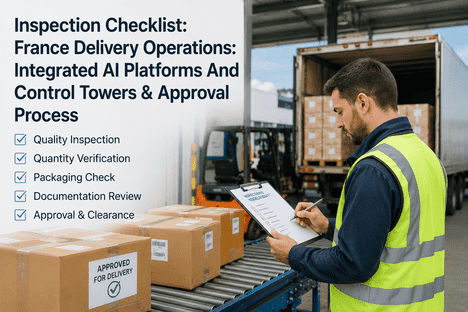
A structured inspection checklist is the operational foundation of every AI-driven delivery operation in France. Without a checklist, quality inspection relies on operator memory and institutional knowledge — conditions that vary by shift, by individual, and by workload. A checklist standardizes the verification process across every operator, every shift, and every distribution centre so that the same 45 criteria are checked in the same order with the same pass-fail threshold before any shipment receives a clearance pass. When the checklist is integrated with the control tower platform and AI-driven inspection systems, the verification becomes real-time, data-connected, and automatically documented — every check result is written to the shipment record, every exception is flagged to the dispatcher, and every clearance pass is generated only when all criteria are satisfied. This checklist covers the five critical checkpoints — quality, quantity, packaging, documentation, and clearance — that determine whether a shipment is ready for error-free dispatch from French distribution operations.
45-Point Inspection · AI Vision Verification · Digital Clearance · Automated Documentation
Every Shipment Cleared Against 45 Standardized Criteria Before Dispatch. Here Is the Complete Inspection Checklist for AI-Driven Delivery Operations in France.
iFactory's Delivery Management platform digitizes the entire inspection checklist — AI vision verification for quality and quantity, automated document extraction for compliance, and digital clearance pass generation — so every shipment leaves the distribution centre with a verified, documented, and auditable approval record.
Standardized inspection criteria across quality, quantity, packaging, documentation, and clearance checkpoints verified for every shipment before dispatch
100%
Checklist compliance rate achieved when digital checklists with mandatory fields and sequential verification replace paper-based inspection forms
2
Minutes average inspection time per pallet when AI vision automation handles quality, quantity, and packaging checks at the inspection station
99.7%
Dispatch accuracy rate achieved by French distribution operations using structured digital checklists with automated verification at every checkpoint
The Five-Checkpoint Inspection Framework for AI-Driven Delivery Operations in France
The inspection checklist is organized into five sequential checkpoints that every shipment must pass before a clearance pass is issued. Each checkpoint contains a defined set of criteria organized by category — quality, quantity, packaging, documentation, and final clearance. The operator sees the entire checklist on the control tower dashboard, with AI vision completing the measurable checks automatically and the operator confirming results and resolving exceptions. The sequence is enforced by the platform: a shipment cannot advance to the next checkpoint until all criteria in the current checkpoint are verified as passed. This sequential gate architecture ensures that no shipment reaches dispatch with unresolved exceptions.
The Five Sequential Checkpoints — Every Shipment Passes Through All Five Gates Before Dispatch Clearance
1
Quality
Product condition verified against order specification. AI vision detects damage, confirms product variant, checks seals. Operator reviews flag items only. Result written to shipment record automatically.
2
Quantity
Unit count per SKU verified against packing list and order. AI vision counts from captured images in under 30 seconds. Over, under, and split-shipment conditions flagged for operator resolution.
3
Packaging
Carton integrity, sealing method, labelling accuracy, and pallet stability inspected. AI vision detects tears, crushed corners, incorrect labels, and pallet wrap quality against defined standards.
4
Documentation
All required documents uploaded, fields extracted via OCR, validated against order and compliance rules. Missing or incorrect documents flagged. Certificate validity confirmed against regulatory databases.
5
Clearance
System verifies all prior checkpoints passed, confirms carrier assignment, validates label application, and generates digital clearance pass. No manual signature required. Pass accessible to carrier at pickup.
The quality checkpoint confirms that every product in the shipment matches the order specification in type, condition, and configuration. AI vision cameras capture images of each carton and product unit as they pass through the inspection station. The deep learning model compares the captured images against the expected product appearance — surface condition, seal integrity, label presence, and configuration. Products that pass are automatically released to the next checkpoint. Products that fail generate an alert with the specific defect classification and image evidence attached to the shipment record for operator review.
No visible damage, dents, scratches, or discolouration. AI vision inspects all visible surfaces. Operator reviews flagged items.
Q2
Product Variant
Product SKU and variant confirmed against order. Barcode scan and AI vision label read cross-referenced with order line item.
Q3
Expiry Date
Product expiry or best-before date within acceptable threshold for destination. OCR extracts date from label. System compares against order requirements.
Q4
Batch Traceability
Batch or lot number recorded and linked to shipment record. Scanner captures batch code. System verifies against quality hold and recall databases.
Q5
Temperature Evidence
Cold chain or temperature-controlled products: logger data confirmed within range. Digital temperature record attached to shipment documentation.
Q6
Seal Integrity
Tamper-evident seals and original packaging closures intact. AI vision inspects seal condition. Broken or missing seals flagged for inspection hold.
Q7
Foreign Object Check
No foreign objects, debris, or contamination visible in packaging. AI vision inspects carton interior at packing station. Results logged per carton.
Q8
Sampling Result
If statistical sampling required: sample units pass inspection. AQL threshold met. Sample result linked to batch record. Failed sample triggers full inspection.
Checkpoint 2 — Quantity Verification: Count Accuracy Against Manifest
The quantity checkpoint verifies that the number of units shipped matches the order quantity and packing list for every SKU on every order line. Discrepancies between shipped and ordered quantities are the most common source of post-dispatch disputes, customer credits, and return processing costs. An AI vision counting station eliminates manual counting by capturing images of every carton and applying computer vision models that count units by SKU, compare the count against the digital manifest, and flag any over, under, or split-shipment condition in real time.
Units per SKU counted by AI vision and matched against order line quantity. Each SKU on the order verified independently. Count recorded per carton.
N2
Total Carton Count
Number of cartons in shipment matches packing list and bill of lading. Each carton scanned at inspection station. Missing cartons flagged before dispatch.
N3
Over/Under Tolerance
Actual count within acceptable tolerance configured per customer and product. Tolerance exceeded = hold for resolution. Tolerance met = auto-release to next checkpoint.
N4
Split Shipment Check
All cartons in split shipment accounted for. System tracks partial shipments and prevents dispatch of incomplete orders. Remaining balance flagged for next wave.
N5
Zero-Damage Units
All counted units passed quality checkpoint. No damaged units included in count. Damaged units segregated and replacement order initiated automatically.
N6
Pallet & Load Check
Pallet count matches dispatch plan. Each pallet tagged and scanned. Loading sequence and pallet position recorded for carrier pickup verification.
The packaging checkpoint verifies that every carton and pallet meets the packaging standard defined for the product type, destination, and carrier. Packaging failures — inadequate cushioning, incorrect carton size, poor pallet stability, missing labels — cause more damage in transit than any other single factor. AI vision inspection at the packaging checkpoint detects these conditions before the shipment leaves the distribution centre, applying the same visual inspection models trained on the specific packaging standards for each product category and customer requirement.
Carton free of tears, crushed corners, punctures, or moisture damage. AI vision inspects all six visible sides. Damaged cartons flagged for repackaging.
P2
Sealing Method
Correct tape width, application pattern, and seal overlap per packaging standard. AI vision verifies tape placement. Insufficient seal flagged for resealing.
P3
Labelling Accuracy
Labels correct for destination, carrier, and product. Address, SKU, barcode, and handling marks verified by OCR and AI vision. Incorrect labels flagged.
P4
Pallet Stability
Cartons stacked correctly, pallet wrap applied with proper tension and coverage. AI vision captures pallet from multiple angles. Unstable stacks flagged.
P5
Internal Filler
Adequate internal cushioning, dunnage, or void fill per packaging spec. Load-shifting prevention confirmed for fragile items. Insufficient filler flagged.
Checkpoint 4 — Documentation Verification: Completeness and Compliance Checklist
The documentation checkpoint verifies that every required document is present, correctly filled, and compliant with regulatory and customer requirements. Missing or incorrect documentation is the leading cause of customs delays, carrier refusal, and customer invoice disputes in French delivery operations. An automated document extraction engine reads every document the moment it is uploaded, extracts the key fields, and compares the extracted data against the order requirements and compliance rules — surfacing only the exceptions that require human attention.
Documentation Checklist — 6 Verification Criteria
D1
Commercial Invoice
Invoice present with correct seller, buyer, invoice number, date, line items, quantities, unit prices, and totals. OCR extracted fields match order record.
D2
Packing List
Packing list present with carton-level detail matching actual contents. SKU, quantity per carton, batch numbers, and carton weights verified against inspection results.
D3
Certificate of Origin
If cross-border: certificate present, correctly completed, with valid reference number. Origin declared matches product sourcing data. Certificate attached to shipment record.
D4
Transport Document
CMR or equivalent transport document completed with correct sender, consignee, carrier, and goods description. Matches carrier assignment in control tower.
D5
Customs Declaration
Customs value, commodity codes, and country of origin correctly declared. Supporting documentation attached. Declaration signed. System validates against trade agreement rules.
D6
Compliance Certificates
All required compliance certificates present and valid — CE marking, REACH, RoHS, FDA, etc. Certificate reference numbers cross-checked against validity databases.
Checkpoint 5 — Clearance Pass: Final Approval and Dispatch Release Checklist
The clearance checkpoint is the final gate before dispatch. The system verifies that every criterion across all prior checkpoints has passed, confirms that the carrier assignment and loading details are correct, validates that the dispatch label is applied, and generates the digital clearance pass. No manual signature is required. The clearance pass is attached to the shipment record and made accessible to the carrier through the control tower portal. The operator sees a single green clearance status per shipment and the system logs the complete approval trail automatically for audit purposes.
All prior checkpoints passed. System confirms zero open exceptions across quality, quantity, packaging, and documentation. Override only with supervisor authorization.
C2
Carrier Confirmed
Carrier assigned, pickup window confirmed, route and ETA validated. Carrier notified through control tower portal. No-show carrier triggers reassignment workflow.
C3
Label Validation
Dispatch label printed, applied to correct pallet, and scanned. Label data confirmed against shipment record. AI vision verifies label position and readability.
C4
Loading Verified
Correct pallets loaded on correct truck. Loading sequence matches dispatch plan. Pallet IDs scanned at loading dock. Misloads flagged before truck departs.
C5
Digital Pass Issued
Digital clearance pass generated and attached to shipment record. Pass includes all checkpoint results. Accessible to carrier, customer service, and compliance. Auditable.
Manual Checklist vs AI-Integrated Digital Checklist — What Changes at the Inspection Station
The difference between a paper-based inspection checklist and an AI-integrated digital checklist is not just the medium. It is the difference between inspection as a disconnected manual task and inspection as a connected, data-generating quality event. A paper checklist produces a signed form that sits in a filing cabinet. A digital checklist produces structured data that flows into the control tower, triggers automated workflows, and becomes part of the permanent shipment record.
Paper Checklist vs AI-Integrated Digital Checklist — The Operational Difference
Paper-Based Inspection Checklist
Checklist format: Printed paper form, pen-and-paper check marks, handwritten notes. Each operator may interpret criteria differently.
Verification speed: 8-15 minutes per pallet. Inspector opens, inspects, counts, documents manually. Time varies by operator experience.
Data generated: One signed paper form per pallet. Data exists on paper only. Manual data entry required to digitize for shipment record.
Exception handling: Operator flags issue on paper form. Supervisor paged. Resolution depends on locating the right person. No automatic escalation.
Result: Inspection happens in isolation from the digital shipment record. Data quality depends on the operator. Post-dispatch discrepancies require paper form retrieval and manual investigation.
AI-Integrated Digital Checklist (iFactory)
Checklist format: Digital checklist on control tower dashboard. Checklist enforced by system — mandatory fields, sequential gating, no skips. Consistent across all operators.
Verification speed: Under 2 minutes per pallet. AI vision handles quality, quantity, and packaging checks automatically. Operator confirms and resolves exceptions only.
Data generated: Structured inspection data written directly to shipment record in the control tower. Every check result, image, and exception documented automatically.
Exception handling: Exception flagged automatically with defect classification and severity. Escalated to supervisor by role. Resolution tracked with timestamp and action history.
Result: Inspection data flows into the digital shipment record in real time. Every check is documented, every exception is traceable, and every clearance is auditable — without manual data entry.
"
We implemented the digital inspection checklist across five distribution centres in the Paris region simultaneously. The first thing the operators told us was that they had never seen a checklist enforced consistently before. The paper forms were always slightly different — different order of checks, different handwriting, different interpretation of what counted as a pass. The digital checklist eliminated all of that variation. The same 45 criteria in the same sequence with the same pass-fail definitions on every screen at every site. Within two weeks, the discrepancy rate between the inspection result and the actual shipment content dropped from 1.2% to 0.4%. Within two months, our post-dispatch dispute rate dropped by 65%. The operators initially resisted the change — they felt the system was checking their work. Within a month, they told us they would not want to go back to paper. The digital checklist saved them from chasing paperwork after every shift and gave them a clear, auditable record that protected them when a dispute arose. That was the moment we knew the checklist was working exactly as designed.
— Director of Distribution Operations, French Multi-Site Logistics Provider, 5 Distribution Centres, 2,800 Shipments per Week
Implementing the Digital Inspection Checklist Across Your Distribution Network
Moving from paper checklists to an AI-integrated digital inspection platform follows a structured deployment pathway. The platform connects to existing systems — no ERP replacement, no WMS migration, no new hardware procurement for the initial deployment. The operator sees the digital checklist on the same terminal that displays the order and inventory data. The implementation is designed to be operational within weeks, not months.
PHASE 1 — DAYS 1-7
Checklist Configuration and Integration
The standard 45-criteria checklist is configured in the platform for each distribution centre, product category, and customer. Existing inspection criteria are digitized. AI vision models are trained on site-specific product images and document samples. Integration with WMS and ERP is established for order data and shipment confirmation.
Deliverable: Digital checklist live with AI vision inspection configured for first product category.
PHASE 2 — DAYS 8-14
Parallel Run and Operator Onboarding
The digital checklist runs alongside the existing paper-based process. Every AI inspection result is compared against the manual outcome. Every checklist result is validated against the paper form. Operator training is delivered in two 30-minute sessions per shift. Feedback from operators is incorporated into checklist configuration.
Deliverable: Validated digital checklist with site-specific accuracy data and trained operators.
PHASE 3 — DAY 15+
Live Deployment and Continuous Improvement
The digital checklist becomes the primary inspection method. Paper forms are retired. AI vision handles quality, quantity, and packaging checks automatically. Exception rates are tracked against pre-deployment baselines. The checklist is updated as new products, customers, and regulatory requirements emerge.
Deliverable: Live digital inspection with automated KPI tracking and continuous improvement cycle active.
Conclusion
The inspection checklist is the operational backbone of every reliable delivery operation. Without a standardized checklist, quality varies by operator, discrepancies escape to the customer, and post-dispatch resolution costs multiply across every return, credit, and re-shipment cycle. The 45-criteria framework documented in this checklist — nine quality checks, six quantity checks, six packaging checks, six documentation checks, and five clearance checks — provides the complete verification sequence that every shipment must pass before it leaves the distribution centre.
An AI-integrated digital checklist does more than digitize the paper form. It transforms inspection from a disconnected manual task into a connected quality event that generates structured data, triggers automated workflows, and creates an auditable record for every shipment. AI vision handles the measurable checks — product condition, unit count, packaging integrity — automatically. The operator focuses on confirming results and resolving exceptions. The platform enforces the sequence, documents every result, and issues the clearance pass only when every criterion is satisfied.
iFactory's Delivery Management platform digitizes the complete inspection checklist for French delivery operations, from the first quality check to the final clearance pass. Book a Demo to see the digital checklist configured for your product categories and customer requirements, or talk to an expert about a free digital checklist assessment for your distribution operations.
Frequently Asked Questions
Yes. The checklist is fully configurable at multiple levels. At the product category level, criteria can be added or removed based on the product type — cold chain checks for temperature-sensitive products, hazardous goods checks for DG shipments, customs documentation checks for cross-border deliveries. At the customer level, specific inspection requirements, labelling standards, and documentation checklists can be configured per customer account. At the regulatory level, compliance rules for customs, trade agreements, and product safety standards can be applied per destination. The platform also supports versioned checklists — when a customer updates their requirements, the new checklist version is applied to all shipments after the effective date, and the previous version is retained for audit reference. Book a Demo to see how checklist configuration works for multi-customer, multi-product distribution operations.
When a criterion fails, the platform blocks advancement to the next checkpoint and prevents clearance pass generation until the exception is resolved. The failed criterion is highlighted on the dashboard with the specific failure reason — for AI vision checks, the captured image and defect classification are attached to the exception record. The operator has three resolution options: correct the condition and re-inspect (e.g., repackage a damaged carton), override with supervisor authorization for approved deviations (logged with supervisor ID and reason), or reject the shipment for return to stock or quarantine. The exception and its resolution are logged permanently in the shipment record with timestamps and responsible operator or supervisor identification. For time-sensitive shipments, an escalation workflow can be configured — if an exception remains unresolved after a configurable threshold (e.g., 30 minutes), the system notifies the next-level supervisor automatically. Talk to an expert about exception routing rules for your specific operational requirements.
The AI vision models achieve initial detection capability within 24 hours of image capture. During Phase 1 deployment, operators capture images of 200-300 units per product category covering the normal range of variation and any known defect types. These images are annotated and used to train the initial model, which is deployed the same day. The model is validated during the parallel run phase (Phase 2), where every AI detection is compared against the manual inspection result. The validation typically requires 500-1,000 shipments per product category to confirm accuracy metrics. After validation, the model is promoted to primary inspection mode. The model continues to improve through active learning — operator confirmations and corrections are incorporated into weekly model updates, increasing accuracy on edge cases and new defect patterns over time. For product categories that are visually similar to already-trained models, the initial accuracy is higher and the validation period is shorter, often completing within 200 shipments. Book a Demo to see how the active learning pipeline improves model accuracy over time.
Yes. Every digital checklist result is automatically documented and stored as part of the permanent shipment record in the control tower. The documentation includes the complete checklist result for every criterion (pass or fail with supporting evidence), the AI vision inspection images and defect classifications, the operator identity and timestamp for every manual confirmation, the exception records with resolution details and supervisor overrides, the digital clearance pass with generation timestamp and checkpoint summary, and the full audit trail accessible from the shipment record with a single click. For customer-specific audit requirements, the platform can generate a standardized inspection report in PDF format that includes all checklist results for the customer's shipments within a date range. For regulatory audits, the platform supports export of the complete inspection database filtered by date range, product category, or shipment. Talk to an expert about audit documentation requirements for your specific customers and regulatory environment.
Your Distribution Operation Already Runs Inspection Checklists. See What Happens When Every Check Is Connected to a Control Tower, Verified by AI Vision, and Documented Automatically.
iFactory's Delivery Management platform for French distribution operations — digital inspection checklists with AI vision verification, automated document validation, sequential gate clearance, and permanent audit-ready records — all running from a single platform that connects to your existing systems without infrastructure replacement.