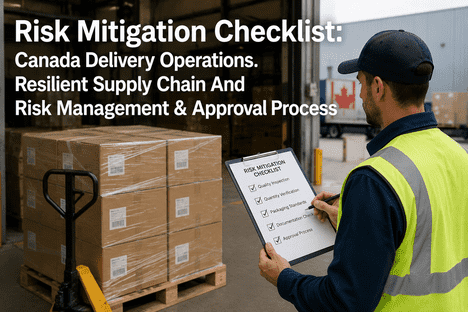
Japan's logistics sector is undergoing a structural transformation. With warehouse labor availability projected to decline 18% by 2030 and e-commerce parcel volume growing at 9.6% CAGR, delivery operations managers are turning to robotics and AI-powered automation to maintain throughput without compromising quality. But automation alone does not guarantee error-free dispatch. Every shipment that leaves a factory or distribution center must pass through a sequence of verification gates — quality inspection, quantity verification, packaging integrity, and documentation review — before it receives clearance for transit. This checklist provides a gate-by-gate operational framework for applying robotics and AI to each verification stage, ensuring that only compliant, damage-free, and fully documented shipments move through Japan's delivery network. iFactory AI's delivery operations management platform integrates these verification gates into a single digital workflow — connecting robotic inspection systems, automated counting stations, packaging scanners, and documentation validation tools into one real-time clearance dashboard. Book a Demo to see the platform in action.
Gate 1 — Quality Inspection: Robotic Vision and AI Defect Detection
The first and most critical gate is quality inspection. Before any shipment is authorized for dispatch, every unit must be verified against the quality specifications defined for that product, customer, and destination market. In Japan, where customer expectations for product condition and presentation are among the highest globally, a single cosmetic defect in an outgoing shipment can trigger a full order rejection and penalty clauses in procurement contracts. Traditional manual inspection — even with well-trained quality inspectors — cannot sustain 100% inspection at production throughput rates above 60 units per minute. Fatigue, ambient lighting variation, and the inherent limitations of human visual acuity mean that manual inspection typically achieves 75-85% defect capture at best.
Robotic vision inspection systems, integrated with AI defect classification models, change this entirely. High-resolution cameras positioned at multiple angles capture every surface of each unit as it moves along the conveyor. AI models trained on labeled images of acceptable and defective product conditions classify each unit in real time — identifying scratches, dents, discoloration, dimensional deviations, and assembly errors at throughput rates exceeding 120 units per minute with defect capture rates above 98%. iFactory AI's platform integrates these robotic vision inspection stations directly into the clearance workflow: a unit that fails inspection is automatically diverted to a rework or quarantine lane, its inspection images and AI classification results are attached to the non-conformance record, and the shipment's clearance status is held until all non-conforming units are either corrected or replaced. Book a Demo to see the integration architecture for robotic vision inspection in Japan delivery operations.
- 75-85% defect capture rate at typical production throughput
- Inspector fatigue reduces detection accuracy after 45-60 minutes
- No automated record of inspection outcome per unit — manual logs only
- Non-conforming units mixed with acceptable units until manual sort
- Inspection results not linked to shipment clearance in real time
- 98%+ defect capture rate at 120+ units per minute
- AI classification consistent across all shifts, all operators, all lighting conditions
- Every inspection image and result recorded per unit — full traceability
- Defective units auto-diverted to quarantine lane — no manual sort required
- Inspection linked to shipment clearance — clearance held until all units pass
Gate 2 — Quantity Verification: Automated Counting and Weight Reconciliation
Quantity discrepancies between ordered and shipped quantities are the second most common cause of delivery disputes in Japan's logistics network, accounting for approximately 14% of all delivery-related claims according to Japan Logistics Association data. Manual counting — by warehouse staff, pickers, or packers — is susceptible to distraction, miscounts during high-volume periods, and the inherent difficulty of accurately counting identical units in repetitive workflows. Automated counting systems eliminate this variability. Vision-based counting systems mounted at packing stations or on conveyor lines identify and count every unit as it enters the shipping container. Weight reconciliation systems compare the total packed weight against the expected weight calculated from the unit count and unit weight data in the order management system — flagging any discrepancy greater than the configured tolerance.
iFactory AI's quantity verification module integrates these automated counting and weighing systems directly into the shipment clearance workflow. When a packing station completes a container, the system automatically compares the vision-counted quantity and the reconciled weight against the order quantity. If the count matches and the weight is within tolerance, the quantity verification gate is marked passed and the clearance workflow advances to the next gate. If a discrepancy is detected — an overcount, undercount, or weight anomaly — the system holds the clearance status, sends an alert to the packing supervisor with the specific discrepancy details, and prevents the shipment from being loaded until the discrepancy is resolved. This closed-loop verification process has been shown to reduce quantity-related delivery disputes by 91% in facilities that deploy it. Book a Demo to see the automated quantity verification workflow.
Gate 3 — Packaging Integrity: Robotic Scanning and Seal Verification
Packaging damage during transit is a persistent cost driver in Japan's delivery operations, with estimates suggesting that 3-5% of all outbound shipments experience some degree of packaging compromise before reaching the end customer. While the product itself may remain undamaged, compromised packaging in Japan's retail and e-commerce channels often results in customer rejection — particularly in the food, cosmetics, and electronics sectors where packaging presentation is considered part of the product value. Robotic packaging inspection systems address this gate by scanning every sealed container, case, or pallet for packaging integrity before it is released to the loading dock.
These systems typically combine 3D structured-light scanning with AI-based seal verification. The 3D scanner captures the complete surface geometry of each package, identifying dents, bulges, punctures, or compression that may indicate inadequate protection or handling damage during the packing process. The AI seal verification module examines the sealing tape, strapping, or shrink wrap for continuity, tension, and positioning — flagging any package where the seal is incomplete, misaligned, or absent. iFactory AI's platform receives these packaging inspection results and associates them with the shipment record. A package that fails packaging integrity inspection is diverted for repacking, and the clearance status of the shipment is held until all packages in the shipment pass the integrity scan. This gate alone typically reduces transit damage claims by 55-65% in facilities that implement automated packaging inspection.
Gate 4 — Documentation Review: Automated Document Validation and Compliance Check
Documentation errors are the most expensive category of delivery failure in Japan's logistics ecosystem. A single incorrect shipping label, missing customs declaration, or mismatched invoice can delay a shipment at a distribution hub by 24-72 hours — incurring storage charges, re-routing costs, and in cross-border Japan logistics, potential customs penalties and customer penalties for late delivery. Manual document review — even with dedicated documentation clerks — is inherently error-prone because it requires cross-referencing information across multiple documents and systems: the shipping label against the order record, the packing list against the packed quantities, the customs declaration against the product classification codes, and the delivery instructions against the carrier routing guide.
Automated document validation systems using optical character recognition and AI-powered field matching eliminate these cross-referencing errors. The system scans every document — shipping labels, packing lists, invoices, certificates of origin, hazardous goods declarations — and extracts the key data fields using OCR. Each extracted field is automatically cross-matched against the corresponding data in the order management system, warehouse management system, and carrier integration platform. Mismatches are flagged in real time with the specific field discrepancy highlighted. Only when all document fields pass validation does the documentation gate receive a PASSED status. iFactory AI's platform consolidates document validation results into a single documentation clearance indicator within the shipment record — enabling loading dock supervisors to verify documentation compliance at a glance before any shipment is loaded. Book a Demo to see automated document validation for Japan delivery compliance.
Gate 5 — Clearance Pass Issuance: Digital Authorization and Loading Release
The final gate is the issuance of the clearance pass — the digital authorization that confirms every preceding gate has been passed and the shipment is approved for loading and dispatch. In traditional operations, the clearance pass is a paper document signed by the quality inspector, the packing supervisor, and the documentation clerk — with all the inefficiencies, delays, and forgery risks that paper-based authorization entails. Digital clearance pass issuance within iFactory AI's platform transforms this final step into an automated, auditable workflow. When all four preceding gates — quality inspection, quantity verification, packaging integrity, and documentation review — show PASSED status in the platform, the system automatically generates a digital clearance pass with a unique QR code. This QR code encodes the shipment identifier, the clearance timestamp, the name and role of the authorizing system, and links to the complete verification record for every gate.
The loading dock operator scans the QR code before loading begins. The scan confirms that the clearance pass is valid and that all gates passed within their configured validity windows — preventing expired clearances from being used for loading. If any gate shows a HOLD or FAILED status, the QR code scan returns a loading-blocked alert with the specific reason and the contact information for the gate owner who must resolve the issue. This digital clearance workflow eliminates the risk of shipments being loaded without completing all verification gates — a risk that persists in paper-based systems where pressure to meet dispatch deadlines can lead to skipped or backdated inspections. Book a Demo to see the digital clearance pass workflow in a live demonstration.
Clearance Gate Summary — Verification Matrix
The table below summarizes the five clearance gates, the verification method used at each gate, the key AI or robotic technology applied, the typical pass criteria, and the consequence of failure at each gate within iFactory AI's integrated clearance workflow.
| Clearance Gate | Verification Method | AI / Robotics Technology | Pass Criteria | Failure Consequence |
|---|---|---|---|---|
| Gate 1 — Quality Inspection | Robotic vision inspection at conveyor | AI defect classification — multi-angle high-resolution cameras | 98%+ defect capture rate per unit — all units classified acceptable | Unit diverted to quarantine — clearance held until all units pass or are replaced |
| Gate 2 — Quantity Verification | AI vision counting + in-line weight reconciliation | Vision SKU identification — weight tolerance matching against master data | Vision count matches order quantity — weight variance within configured tolerance | Clearance held — alert sent to packing supervisor with discrepancy details |
| Gate 3 — Packaging Integrity | 3D structured-light scanning + AI seal verification | Surface geometry analysis — seal continuity and positioning detection | No dent, bulge, puncture, or compression detected — seal intact and correctly positioned | Package diverted for repacking — clearance held until all packages pass |
| Gate 4 — Documentation Review | OCR document scanning + cross-system field matching | AI-powered OCR — automated field matching against OMS, WMS, and carrier data | All document fields match source system data — regulatory compliance confirmed | Clearance held — specific field discrepancy and responsible gate owner notified |
| Gate 5 — Clearance Pass Issuance | Digital QR code generation and loading dock scan | Automated workflow — system-generated pass after all gates PASSED | All four preceding gates PASSED — clearance issued within configured validity window | Loading blocked at dock — operator scan returns specific gate failure reason |
Frequently Asked Questions: Robotics and AI Verification for Japan Delivery Operations
The five-gate clearance workflow can be deployed incrementally. The minimum infrastructure for Gate 1 is a vision camera at the inspection conveyor and a basic AI classification model — no robotic hardware required if manual sortation is acceptable. Gates 2-5 require in-line weighing, a packaging scanner, and document scanning hardware respectively. iFactory AI's platform works with standard industrial cameras, off-the-shelf scales, and commercially available document scanners — no proprietary hardware procurement required. Most facilities can complete the full five-gate deployment within 8-12 weeks, with individual gates deployed and operational in 2-3 weeks each.
iFactory AI's platform is designed with configurable data residency and retention policies to comply with Japan's Act on the Protection of Personal Information and logistics industry regulations. Shipment verification records — including inspection images, scan data, and document scans — are stored with encryption at rest and in transit, with retention periods configurable per customer and per shipment type. The platform generates audit logs for every clearance gate action, supporting regulatory audits and customer quality audits without additional documentation effort. The platform can be deployed in Japan-based cloud regions for customers requiring in-country data residency.
Yes. iFactory AI's integration layer is vendor-agnostic and connects to robotic systems from Fanuc, Yaskawa, Denso, Mitsubishi, Kawasaki, and other major robotics vendors used in Japan's manufacturing and logistics facilities. The platform also integrates with common warehouse management systems, order management systems, and carrier platforms — enabling the clearance workflow to connect to existing automation infrastructure without replacing or disrupting current robotic deployments. The integration typically requires API-level connectivity to each system and is completed within 2-4 weeks per facility.
iFactory AI's platform maintains product-specific inspection profiles — defining the quality criteria, packaging specifications, document requirements, and quantity tolerances per SKU or per SKU-destination combination. When a shipment contains multiple SKUs, the platform applies the relevant inspection profile to each unit or package automatically, based on the SKU identified at the vision counting station or read from the barcode label. The clearance status for each SKU within the shipment is tracked independently, and the overall shipment clearance is held until all SKU-specific gates are passed. This SKU-level granularity is essential for Japan facilities that handle mixed-SKU shipments for retail, e-commerce, and wholesale distribution channels in a single packing operation.
Facilities deploying the full five-gate clearance workflow typically recover their investment within 6-10 months through three primary payback channels: reduction in transit damage claims (typically 55-65% reduction), elimination of quantity-related delivery disputes (91% reduction), and reduction in documentation error-related delays and penalties. For a facility shipping 2,000 orders per day with an average order value of ¥80,000 and a combined claim and dispute rate of 3.5%, the deployment typically recovers ¥12-18 million annually in avoided claims, penalties, and re-shipment costs. Individual gates can be deployed independently, enabling facilities to prioritize the gate with the highest visible cost impact and expand from there.
Conclusion: From Manual Verification Gates to Automated Clearance Workflow
Japan's delivery operations are under pressure to handle higher volumes, shorter lead times, and stricter quality expectations with a workforce that is shrinking and aging. The five-gate clearance workflow — quality inspection, quantity verification, packaging integrity, documentation review, and clearance pass issuance — provides a structured framework for ensuring that every shipment meets all quality, quantity, packaging, and compliance requirements before it leaves the facility. Robotics and AI technologies make this workflow practical at production throughput rates, eliminating the bottlenecks and error rates that manual verification processes cannot overcome.
iFactory AI's delivery operations management platform provides the digital infrastructure for this five-gate workflow — connecting robotic vision inspection systems, automated counting stations, packaging integrity scanners, and document validation tools into a single clearance dashboard that gives delivery operations managers real-time visibility into every shipment's gate status. The platform generates digital clearance passes with QR codes, blocks loading of shipments with any gate in HOLD or FAILED status, and maintains complete audit records for every gate at every clearance event. The verification gates are already defined. The data is already being generated. The missing component is the digital workflow that connects them into an automated, auditable, real-time clearance system. Book a Demo to see the platform connected to your facility's robotics and verification systems within a 30-minute live demonstration.