Hydraulic System Predictive analytics in Warehouse Delivery Operations
By Arel Dixon on June 4, 2026
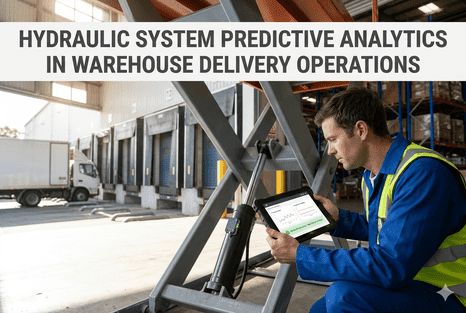
Hydraulic failures in warehouse delivery operations dock levelers that drop mid-loading, scissor lifts that stall under pallet weight, hydraulic presses that lose pressure mid-cycle cause immediate safety shutdowns, equipment damage, and delivery delays that cascade through the entire dispatch operation. Unlike mechanical wear that degrades gradually with observable symptoms, hydraulic system failures often present no warning until the moment of catastrophic loss a burst hose, a blown seal, or a pump that suddenly cannot build pressure. The root causes pump cavitation, fluid contamination, seal degradation, valve spool wear, cylinder drift develop over days and weeks through measurable trends in pressure, temperature, flow, and fluid condition that fixed-interval inspections miss. AI-driven predictive analytics for hydraulic systems changes this by continuously monitoring pressure decay rates, temperature rise profiles, pump vibration signatures, and fluid particle counts to detect degradation patterns 5–14 days before functional failure enabling planned intervention during scheduled downtime rather than emergency safety shutdown. iFactory AI's industrial software platform integrates pressure transducers, flow meters, temperature sensors, and fluid analysis data into machine learning models that forecast hydraulic component failure in dock levelers, scissor lifts, pallet jacks, and warehouse presses before they cause operational disruption. Book a Demo to see how iFactory predicts hydraulic failures before they stop your warehouse operation.
Hydraulic System Analytics · Warehouse Delivery · 2026
Predictive Analytics for Hydraulic Systems in Warehouse Delivery Operations
AI-driven hydraulic failure prediction · Pressure & temperature monitoring · Fluid contamination detection · Pump cavitation forecasting · Auto work orders with seal and hose parts — purpose-built for dock levelers, scissor lifts, pallet jacks, and warehouse presses.
Lower hydraulic maintenance costs with predictive scheduling
85%+
Failure prediction accuracy on pump and cylinder systems
Why Hydraulic Systems Are the Highest-Risk Failure Point in Warehouse Delivery
Hydraulic systems power the most safety-critical equipment in warehouse delivery operations dock levelers that bridge the gap between warehouse floor and truck bed, scissor lifts that position pallets at ergonomic working height, hydraulic presses that compact waste and recyclables, and pallet jacks that move thousands of pounds of goods daily. Unlike electric or mechanical systems where degradation produces audible or visible cues unusual noise, visible wear, increased vibration hydraulic systems fail through internal mechanisms that remain invisible until catastrophic loss of function occurs. Pump cavitation erodes impellers silently over weeks. Fluid contamination abrades seal surfaces until they suddenly blow out. Cylinder drift accelerates as internal bypass wear progresses, but the change is gradual enough that operators compensate unconsciously until the cylinder can no longer hold position at all. These failure modes follow measurable trends in pressure decay rate, temperature rise slope, pump vibration envelope, and fluid particle count — signals that AI models are uniquely suited to detect and forecast.
Three Hydraulic System Challenges iFactory Solves for Warehouse Operations
01
PROBLEM
Silent Degradation That Leads to Catastrophic Safety Shutdowns
Hydraulic system failures in warehouse equipment rarely give operators advance notice. A dock leveler hydraulic pump that has been cavitating for weeks due to a restricted suction strainer will operate normally day after day — until the pump finally loses prime and the leveler drops under load. A scissor lift cylinder with gradual seal wear will drift down a few millimetres per hour — until the drift accelerates past the safety threshold and the lift cannot hold position at working height. These failures cause immediate safety incidents, equipment damage, and operational shutdowns that cascade through the delivery schedule. iFactory's AI platform continuously monitors pressure decay rates, temperature rise trends, pump vibration signatures, and cylinder drift measurements to classify hydraulic health into four states — healthy, moderate wear, high risk, critical — enabling maintenance teams to intervene days before a catastrophic failure.
4-state healthPressure trend model5–14 day forecast
02
PROBLEM
Fluid Contamination That Destroys Components From the Inside
Hydraulic fluid contamination — water ingress, particulate debris, thermal degradation, and aeration — is the leading cause of premature pump, valve, and seal failure in warehouse hydraulic systems. Contaminants abrade pump surfaces, clog valve orifices, and accelerate seal wear through chemical attack. Traditional fluid analysis relies on periodic oil sampling and lab testing that takes days to return results, by which point damage has already progressed. iFactory integrates inline particle counters, moisture sensors, and fluid temperature monitoring into a continuous fluid health model that tracks ISO cleanliness code trends, water content thresholds, and fluid oxidation rates. When contamination levels approach critical thresholds, the platform generates alerts with specific recommendations — change fluid, replace filter, investigate water ingress source — before contaminants cause secondary damage to pumps and valves.
Reactive Repair Costs 3–5× More Than Planned Intervention
When a hydraulic pump fails catastrophically or a hose bursts under pressure, the repair is never simple — contaminated fluid must be flushed from the entire system, failed components shed debris that damages downstream valves and cylinders, and the equipment is down for days instead of hours. Emergency repair costs for a single dock leveler hydraulic power unit can reach $8,000–$15,000 when overtime labour, expedited parts shipping, secondary damage, and lost operational time are included. iFactory's predictive models forecast pump cavitation, seal degradation, and hose fatigue 5–14 days before failure, generating work orders with the specific pump model, seal kit, or hose assembly required — verified against your spare parts inventory. Planned intervention during a scheduled maintenance window costs 60–70% less than emergency response and eliminates the safety risk entirely.
Hydraulic conveyor power unit failure stops sortation and cascades to dispatch delays
Use Cases: What iFactory Delivers for Hydraulic System Health
Pumps
Hydraulic Pump Cavitation & Wear Prediction with Auto Parts Verification
Monitoring: Continuous
Pump cavitation — caused by restricted suction strainers, low fluid levels, or high fluid viscosity — erodes pump impellers and housings through vapour bubble collapse that pits metal surfaces. Cavitation damage develops over weeks but remains invisible until the pump loses flow capacity or begins making audible noise, at which point irreparable damage has already occurred. iFactory monitors pump inlet and outlet pressure differential, case drain flow, vibration at pump shaft frequency, and fluid temperature trends to detect cavitation onset 7–14 days before functional failure. When cavitation is detected, the platform generates a work order with the specific pump model from your equipment BOM, checks on-hand spare pump inventory, and recommends the corrective action — typically suction strainer cleaning or fluid replacement — before cavitation erodes the pump beyond repair.
Failure modesCavitation · wear · seal failure · bearing degradation
Prediction lead7–14 days before functional failure
Hydraulic Cylinder Seal Degradation & Drift Forecasting
Monitoring: Continuous
Hydraulic cylinder seal degradation is the most common failure mode in dock levelers, scissor lifts, and pallet jacks. As piston seals wear, fluid bypasses from the pressure side to the return side, causing the cylinder to drift under load. Operators compensate unconsciously for gradually increasing drift until the cylinder can no longer hold position at all — creating a sudden safety hazard. iFactory's cylinder monitoring model analyses position drift rate over time, pressure hold decay during static periods, cycle time changes, and fluid temperature trends to estimate remaining seal life with 85%+ accuracy. When seal degradation reaches the planned intervention threshold, the platform generates a work order with the specific seal kit part number from your BOM and recommends scheduling replacement during the next planned downtime window — before the cylinder fails during active operation.
Cylinder dataDrift rate · pressure hold · cycle time · temperature
Seal prediction10-day advance alert with seal kit reservation
Fluid
Hydraulic Fluid Health & Contamination Monitoring for System Protection
Monitoring: Continuous
Hydraulic fluid is the lifeblood of every warehouse hydraulic system — contaminated fluid damages pumps, erodes valves, accelerates seal wear, and causes erratic equipment behaviour long before a catastrophic failure occurs. Traditional fluid analysis relies on periodic sampling and lab testing, creating gaps where contamination goes undetected for weeks. iFactory integrates inline particle counters (ISO 4406 cleanliness code), moisture sensors, fluid temperature probes, and oxidation measurement into a continuous fluid health dashboard. When particle counts exceed ISO 4406 thresholds or moisture content approaches saturation, the platform alerts maintenance teams with specific recommendations — change fluid, replace filter element, investigate water ingress source — before contaminants cause secondary damage to pumps, valves, and cylinders. Continuous fluid health monitoring extends hydraulic component life by 25–35% and eliminates the lab testing delay that allows contamination damage to progress.
Fluid parametersISO 4406 code · moisture · temperature · oxidation
Component life25–35% extension through contamination control
What iFactory Delivers for Hydraulic System Reliability
42%
Fewer hydraulic-related safety incidents across monitored equipment
5–14 day failure prediction with auto work orders and parts verification
35%
Lower hydraulic maintenance costs through predictive vs reactive scheduling
Extended hydraulic component life with continuous fluid health monitoring
Contamination control prevents secondary damage to pumps, valves, and cylinders
1–2 Wk
Platform deployment with pre-built warehouse hydraulic templates
Dock levelers, scissor lifts, pallet jacks, presses pre-configured
FAQ: Hydraulic Predictive Analytics with iFactory
iFactory is sensor-agnostic and integrates with any sensor infrastructure already in your facility — pressure transducers on pump discharge and cylinder ports, temperature probes in reservoir and return lines, inline particle counters for ISO 4406 cleanliness trending, flow meters for pump and valve health assessment, and vibration sensors on pump and motor assemblies. The platform also supports manual data entry through the Shift Logbook mobile app for facilities without continuous sensor coverage. Pre-built hydraulic equipment templates map the recommended sensor types and placement for each equipment family, enabling a phased deployment — start with dock levelers and scissor lifts on pressure and temperature sensors, expand to fluid health monitoring as the programme proves ROI. Talk to iFactory's team to discuss your current sensor infrastructure.
The platform's ML models are trained on equipment-specific baselines established during the first 2–3 weeks of monitoring. Normal pressure variation due to load changes, temperature effects, and cycle-to-cycle differences is characterised and filtered. The AI detects deviations that follow failure-precursor patterns — progressive pressure decay during hold cycles, accelerating temperature rise rates, increasing pump vibration envelope, and gradual cycle time extension — that are distinct from normal operational variation. During the first 90 days, the model establishes baselines and the validation team tunes thresholds to your specific equipment population and operating conditions. False alarm rates typically drop below 5% within 30 days of baseline establishment.
Yes. iFactory connects to hydraulic power unit PLCs via Modbus, OPC-UA, BACnet, and proprietary protocols from major HPU manufacturers. The platform also integrates with facility building management systems for environmental context — ambient temperature affects hydraulic fluid viscosity and can influence pressure readings. The Shift Logbook captures operator observations — unusual pump noise, visible leaks, erratic cylinder movement — alongside sensor data, building a complete hydraulic health timeline. No rip-and-replace of existing controllers is required; iFactory reads data from your current systems through standard industrial communication protocols.
The platform can begin generating value with pressure and temperature data from as few as 10–15 hydraulic power units — typically dock levelers and scissor lifts in a single facility. The ML models use transfer learning from iFactory's industrial hydraulic equipment population baselines, so you do not need years of failure data to start seeing predictions. As the platform accumulates equipment-specific data, the models self-tune to your facility's operating cycles, load profiles, and environmental conditions. Most warehouse operations see meaningful hydraulic failure prediction alerts within 30–45 days of deployment. For facilities with no existing hydraulic sensors, iFactory's recommended starter kit bundles wireless pressure transducers and temperature sensors for 15 hydraulic power units with gateway and configuration.
Yes. iFactory's platform bi-directionally integrates with leading CMMS and ERP systems — SAP, Oracle, Infor, JDE, Maximo, Maintenance Connection, UpKeep, Fiix, and others via REST API, flat file, or database connector. Predictive alerts generated by the AI engine can auto-create work orders in your existing CMMS, or can be managed within iFactory's own work order module with subsequent sync to the corporate system. The integration layer resolves duplicate asset records, synchronises equipment hierarchies, and maps iFactory's health statuses to your CMMS status codes. Parts lists on work orders are drawn from your equipment BOM and cross-referenced against on-hand inventory. A standard integration is completed during the first week of deployment.
Deploy Predictive Hydraulic Analytics for Your Warehouse Operation
iFactory AI connects pressure sensors, temperature probes, fluid analysis data, and operator observations into a single predictive analytics platform — purpose-built for hydraulic systems in warehouse delivery operations. Pre-built equipment templates for dock levelers, scissor lifts, pallet jacks, hydraulic presses, and conveyor hydraulics. 1–2 week deployment with 90-day implementation support. Positive ROI within 4 months.