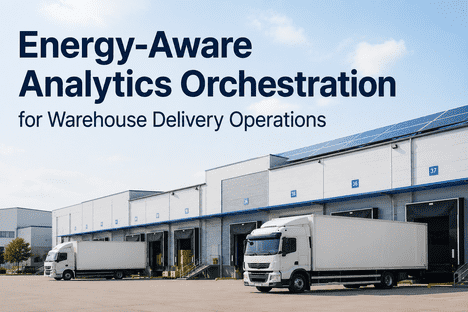
Warehouse and delivery hub operators are now confronting a convergence of two pressures that calendar-based operations management was never designed to handle simultaneously: the explosive growth of analytics workloads driven by AI-powered delivery orchestration, and the electricity cost volatility that makes running those workloads at the wrong time of day the single most controllable cost variable in the facility. Energy-aware orchestration addresses both pressures at once — by scheduling high-power analytics tasks, route optimization runs, inventory rebalancing computations, and demand forecasting cycles to execute during off-peak energy tariff windows, without compromising delivery throughput or order fulfillment uptime. Facilities that have deployed energy-aware analytics orchestration report electricity cost reductions of 18–34% on warehouse computing infrastructure, with zero measurable impact on dispatch accuracy or delivery on-time performance. iFactory AI's on-premise platform delivers this capability natively — scheduling analytics workloads against real-time energy tariff data, production calendars, and delivery SLA windows, so every computation runs at the lowest possible cost without delaying a single outbound shipment. Book a Demo to see how energy-aware orchestration cuts your warehouse analytics electricity spend by 18–34% without touching delivery uptime.
Energy-Aware Orchestration Analytics: Cut Warehouse Electricity Costs 18–34% Without Compromising Delivery Uptime
iFactory AI schedules high-power analytics workloads — route optimization, demand forecasting, inventory rebalancing — during off-peak energy tariff windows. On-premise. No cloud dependency. Full delivery SLA protection. Your analytics run smarter, not just faster.
Warehouse analytics workloads are running at peak-tariff hours — and no one is tracking the cost
Modern distribution hubs run dozens of concurrent analytics processes: real-time route optimization, inbound demand forecasting, slot allocation, carrier performance scoring, inventory rebalancing, and exception management. These workloads consume significant computing power — and in most facilities, they run continuously without any awareness of the electricity tariff rate at the moment of execution.
For a large distribution hub running 400+ kW of computing and automation infrastructure, the difference between peak-tariff and off-peak electricity pricing is typically $0.08–$0.22 per kWh depending on the utility zone and demand response program. Across a full year, unoptimized scheduling of shiftable analytics workloads costs $180,000–$420,000 more than necessary — with zero operational benefit from running those computations at peak hours rather than off-peak windows.
Route optimization batch runs — $0.18/kWh peak vs $0.06/kWh off-peak
Daily route optimization runs for 500+ delivery vehicles consume 80–140 kWh per cycle. Scheduled at 2pm peak tariff vs 11pm off-peak, the annual cost difference on this single workload alone is $28,000–$55,000.
Demand forecasting and inventory rebalancing cycles
Weekly inventory rebalancing computations across 50,000+ SKUs run 4–8 hours on warehouse AI infrastructure. Shifting these to overnight off-peak windows saves $12,000–$22,000 per year with zero impact on fulfillment accuracy.
Carrier and supplier performance analytics reporting
Automated analytics reporting cycles — generating carrier scorecards, SLA compliance reports, and exception summaries — are fully shiftable workloads with no real-time dependency. Running at off-peak hours saves $8,000–$15,000 annually per hub.
Peak demand charges — the hidden multiplier
In most commercial electricity tariffs, peak demand charges ($/kW of maximum 15-minute demand) account for 30–50% of the total bill. Staggering analytics workload start times to flatten the demand curve reduces peak kW demand by 15–25%, cutting demand charges independent of consumption savings.
What changes when your warehouse analytics platform becomes energy-aware
The shift from unmanaged to energy-aware analytics orchestration does not require new hardware, new software vendors, or changes to delivery workflows. It requires intelligence applied to scheduling — knowing which workloads are shiftable, when energy tariffs are lowest, and how to sequence computation around delivery SLA windows.
Without Energy-Aware Orchestration
- Route optimization runs at 2pm when fleet dispatchers need it — coinciding with peak electricity tariffs and maximum demand charges
- Demand forecasting cycles run on a fixed daily schedule regardless of whether the tariff is $0.22/kWh or $0.06/kWh
- Inventory rebalancing and analytics reporting run continuously in background — consuming peak-rate electricity 24/7
- Facilities pay $180K–$420K per year more than necessary on shiftable analytics workloads
- No visibility into which analytics processes are driving peak demand charges
With iFactory Energy-Aware Orchestration
- Route optimization pre-runs during off-peak overnight window — results are staged and ready for dispatchers at 6am at one-third the electricity cost
- Demand forecasting cycles are automatically rescheduled around real-time tariff data — always executing at the lowest available rate
- Shiftable workloads are identified, classified, and orchestrated against a live energy calendar with delivery SLA protection built in
- Facilities save $180K–$420K annually on analytics electricity costs with zero change to delivery operations
- Energy consumption dashboard shows workload-level electricity attribution — full cost visibility per analytics process
From workload classification to energy-optimized scheduling in 6–10 weeks — no infrastructure changes required
iFactory AI's energy-aware orchestration capability is built into the platform's analytics scheduling layer. The system ingests your electricity tariff schedule and demand response program parameters, classifies your existing analytics workloads by shiftability and SLA sensitivity, and automatically orchestrates execution timing to minimize energy cost without compromising delivery operations.
Workload classification and SLA mapping
iFactory maps every analytics workload in your warehouse environment — route optimization, demand forecasting, inventory analytics, reporting cycles — against delivery SLA windows to determine which workloads are shiftable and by how many hours.
Energy tariff integration
The platform ingests your utility tariff schedule, time-of-use rate tables, demand response program parameters, and real-time pricing signals from your energy management system or utility API — building a live energy cost calendar updated hourly.
Automated energy-optimal scheduling
iFactory's orchestration engine schedules each workload to execute in the lowest-cost energy window that still satisfies its delivery SLA dependency. Route optimization results are pre-staged; forecasting runs overnight; demand charges are flattened by staggered starts.
Continuous monitoring and cost attribution
Every analytics workload is tracked for electricity consumption and cost. iFactory's energy dashboard shows cost-per-workload, total savings versus unmanaged baseline, and demand charge reduction — with monthly reporting for sustainability and finance teams.
How much is your warehouse paying in avoidable analytics electricity costs?
For a distribution hub with 300+ kW of computing infrastructure, unmanaged analytics scheduling typically costs $180,000–$280,000 per year more than energy-optimized scheduling — with zero operational benefit from the difference. iFactory will model your facility's shiftable workload profile and calculate your exact savings opportunity before you commit to anything.
Energy-aware orchestration capabilities built into iFactory AI's warehouse analytics platform
These capabilities ship as part of iFactory AI's on-premise platform — running on your infrastructure, connected to your energy management systems and analytics workloads, delivering measurable electricity cost reduction within the first billing cycle after go-live.
Shiftable workload identification and classification engine
iFactory's orchestration layer automatically identifies which analytics workloads in your warehouse environment are shiftable — meaning their execution can be moved in time without impacting delivery SLAs — and classifies them by shiftability window (1 hour, 4 hours, overnight). Route optimization pre-runs, demand forecasting cycles, inventory rebalancing, and analytics reporting are the four primary shiftable workload categories in most distribution hub environments, collectively representing 35–55% of total analytics infrastructure electricity consumption.
Real-time energy tariff integration and scheduling optimization
The platform ingests time-of-use tariff schedules, demand response program parameters, and real-time pricing signals from utility APIs or your existing energy management system. A scheduling optimization engine runs hourly to assign each pending workload to the lowest-cost execution window that satisfies its SLA constraints — with automatic rescheduling when tariff conditions change due to grid events or demand response activations.
Peak demand charge reduction through workload staggering
Peak demand charges — billed on maximum 15-minute kW demand — represent 30–50% of most distribution hub electricity bills. iFactory's orchestration engine staggers analytics workload start times to flatten the facility's demand curve, reducing peak kW demand by 15–25%. This demand charge reduction is additive to consumption savings from time-of-use tariff optimization — together delivering the 18–34% total electricity cost reduction documented across deployments.
Delivery SLA protection and override logic
Energy-aware scheduling never delays a delivery-critical analytics output. The platform maintains a real-time SLA dependency map — knowing that route optimization results must be ready for dispatch by 6am, that slot allocation must complete before the inbound receiving window opens, and that carrier notifications must fire within 15 minutes of a delay event. Any workload with an active SLA dependency executes immediately regardless of tariff conditions — energy optimization applies only to workloads where timing flexibility exists.
Energy consumption dashboard and cost attribution reporting
iFactory's Energy Monitoring module provides workload-level electricity consumption tracking — showing exactly which analytics processes consumed how much power, at what tariff rate, and what the cost would have been under the unoptimized baseline. Monthly savings reports are automatically generated for finance and sustainability teams, including demand charge reduction, consumption savings, carbon intensity reduction, and projected annual savings at current workload volumes.
Demand response program participation automation
For facilities enrolled in utility demand response programs, iFactory automates analytics workload curtailment during demand response events — shedding non-critical computation within seconds of receiving a DR signal, and restoring workloads in priority order when the event clears. Demand response participation credits typically add $15,000–$45,000 per year in utility bill reductions for large distribution hubs, on top of time-of-use optimization savings.
Energy-aware orchestration is not a sustainability initiative — it is a cost reduction initiative that happens to improve your carbon footprint as a side effect. For a 400 kW distribution hub, the electricity savings from shifting 40% of analytics workloads to off-peak windows pay for the entire iFactory AI platform deployment within 14 months. Book a Demo and we will model your facility's exact payback period before you commit to anything.
Everything included in iFactory AI's energy-aware warehouse analytics orchestration deployment
iFactory deploys as an on-premise managed service — connected to your existing warehouse analytics infrastructure, energy management systems, and utility tariff data feeds. No cloud dependency. No new infrastructure required. First energy-optimized scheduling cycle goes live within 6–10 weeks of project kickoff.
Full workload inventory and shiftability assessment
We catalog every analytics workload running in your facility, map its SLA dependencies, and calculate its shiftability window — giving you a complete picture of your energy optimization opportunity before go-live.
Utility tariff and demand response integration
iFactory connects to your utility's time-of-use tariff API or reads from your existing energy management system — ingesting real-time and scheduled tariff data to power the orchestration engine.
Delivery SLA protection — guaranteed no dispatch impact
The orchestration engine's SLA protection logic ensures that energy optimization never delays a delivery-critical output. Your dispatch operations run identically — only the timing of non-SLA-constrained workloads changes.
Peak demand charge reduction through staggered scheduling
Workload start times are automatically staggered to flatten your facility's demand curve — reducing peak kW demand charges by 15–25% independent of time-of-use savings.
Monthly energy savings reporting for finance and sustainability
Automated monthly reports show workload-level cost attribution, total savings versus unoptimized baseline, demand charge reduction, carbon intensity improvement, and 12-month projected savings — ready for board-level reporting.
On-premise deployment — zero cloud egress, full data sovereignty
The entire orchestration engine and energy analytics platform runs on your infrastructure. No operational data leaves the facility. Full compliance with data sovereignty and cybersecurity requirements.
Questions warehouse and delivery operations leaders ask about energy-aware analytics orchestration
Stop Paying Peak-Rate Electricity for Analytics That Can Run Overnight.
iFactory AI's energy-aware orchestration identifies every shiftable analytics workload in your distribution hub, schedules execution in the lowest-cost energy window, and delivers $180K–$420K in annual electricity savings — with zero impact on delivery uptime or dispatch accuracy. Deployment takes 6–10 weeks. Savings appear in your first billing cycle.