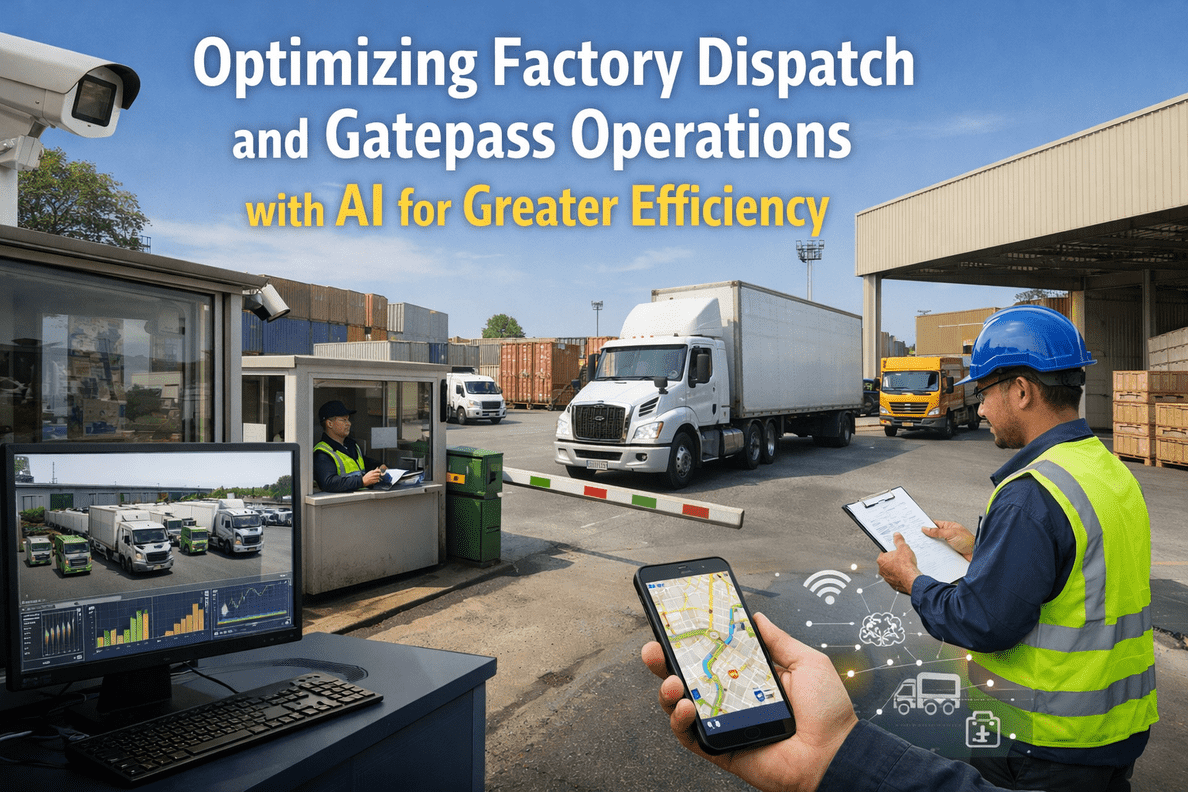
Optimizing Factory Dispatch and Gatepass Operations with AI for Greater Efficiency

By Enel Ron on March 13, 2026

ai-fleet-utilization-delivery

In 2026, AI in manufacturing is no longer an experiment — it is a structural requirement. More than 40% of manufacturers are adopting AI scheduling and planning tools this year, and the global AI manufacturing market is growing at 35.3% annually toward a projected $155 billion by 2030. Yet the department most directly responsible for what enters and exits the plant — the factory delivery department — remains the least digitized function in almost every facility. Gate passes still take 15–20 minutes per vehicle. Dispatch sequencing is still done on whiteboards or spreadsheets. Inbound receiving discrepancies are still discovered on paper, days after the shipment closes. The result is a production floor with digital dashboards and an AI-powered production scheduler — feeding on manual inputs from a delivery department that generates no structured data at all. This guide covers how AI-powered dispatch and gatepass optimization works in a factory delivery department context, what data it requires, and how iFactory's platform operationalizes it from the first shift — without a six-month implementation project. Questions about your specific facility? Talk to our support team directly.

iFactory  ·  AI Optimization  ·  Factory Dispatch & Gatepass 2026

AI Is Transforming Every Part of Your Factory — Except the Department That Controls What Enters and Exits It. That Changes Now.

Factory dispatch and gatepass operations generate zero structured data on paper. No dwell time trends. No SLA miss detection. No real-time material location. iFactory's AI-powered platform digitizes every movement — gate to dispatch — and converts daily delivery department activity into operational intelligence that drives measurable efficiency gains from day one.

40%
Of manufacturers adopting AI scheduling tools in 2026 — factory delivery departments lag every other function
87%
Reduction in gate pass processing time — 15–20 min manual to under 2 min with AI-powered digital workflows
90%
Fewer dispatch errors — AI-driven SLA-priority sequencing drops error rate from 2–3% to under 0.3%
14 days
iFactory go-live — AI-powered delivery department intelligence operational from the first shift
The Intelligence Gap

AI Has Reached Every Corner of Your Factory. Your Delivery Department Is Still Running on Paper.

Data Your Factory AI Systems Already Use
OEE data tracked continuously — 86% of manufacturers monitor production floor in real time
AI-powered production scheduling — machine status, workforce availability, demand forecasting integrated
Predictive maintenance alerts from IoT sensors on production equipment
Quality control defect detection — ML models identify anomalies faster than any visual inspection
Energy consumption analytics — AI optimizes utility use against production schedules
Finished goods inventory — warehouse management systems with real-time location tracking
Supply chain demand forecasting — predictive models driving procurement decisions
ERP integration — production, finance, HR, and stores all connected to one data layer
Data Your Delivery Department Has Never Generated — Until iFactory
Gate dwell time per vehicle — no AI can optimize what it cannot measure
Inbound receiving cycle time per supplier — discrepancy rates unknown until complaints arrive
Dispatch SLA compliance rate — misses undetected until customer escalation
Real-time internal material location after dock entry — production stoppages from search, not shortage
Vehicle inspection defect frequency — no pattern data across fleet over time
Incident detection timeline — events discovered days after occurrence, root cause impossible
Inbound PO match rate per supplier — no baseline for supplier performance management
Gate queue length trends — no data to justify staffing or process changes at security
8 Operational KPIs

8 Factory Delivery KPIs AI-Powered Dispatch and Gatepass Management Unlocks — and What the Numbers Mean Operationally

87%
Gate Pass Processing Time Reduction
AI-powered pre-registration and mobile verification eliminates manual gate processing. From 15–20 minutes per vehicle to under 2 minutes — recovering 280+ dock minutes daily for a 20-vehicle factory. This is the foundational metric that delivery department AI optimization generates first.
Manual: 15–20 min/vehicleAI-powered: under 2 min
78%
Faster Inbound Receiving Completion
Mobile PO verification with AI-matched purchase orders and photo POD reduces inbound receiving from 45–60 minutes to under 10 minutes per shipment. Discrepancies are flagged automatically at the point of receiving — not discovered at month-end inventory count.
Manual: 45–60 min/shipmentDigital: under 10 min
90%
Dispatch Error Rate Reduction
AI-driven SLA-priority dispatch sequencing eliminates the manual judgement errors that cause 2–3% of dispatches to miss their delivery windows. Under 0.3% digital error rate. Pre-miss alerts notify dispatch supervisors before the SLA window closes — not after the customer calls.
Manual: 2–3% error rateAI dispatch: under 0.3%
100%
Audit Trail Coverage
Every gate event, receiving transaction, material transfer, vehicle inspection, and dispatch decision is timestamped and person-attributed automatically. No manual logging step required. 100% coverage from day one — the complete data layer that audit, compliance, and AI analytics all require.
Paper: incomplete, fragmentedDigital: 100% auto-captured
40%
Inbound Delay Reduction
Digital gate workflows combined with pre-arrival vehicle registration and AI-generated receiving assignments reduce inbound delays by 40%. The production floor downstream gets raw materials faster — without any change to supplier schedules or inbound vehicle volume.
Manual: 280+ min lost/dayAI-optimized: 40% delay cut
30–40%
Material Search Time Eliminated
30–40% of production stoppages attributed to material unavailability are locating failures, not actual stock-outs. Real-time internal material tracking with timestamped transfer records at every handoff eliminates the search time — and gives AI scheduling systems accurate material location data for the first time.
Manual: no location after dockDigital: real-time tracking
3–6 mo
Full Platform Payback
Recovered dock time, eliminated dispatch errors, reduced compliance overhead, and production stoppage prevention combine to deliver full platform payback within 3–6 months of go-live. The AI optimization layer continues to improve as the dataset builds — delivering compounding returns after payback.
Legacy: 18–24 month paybackiFactory: 3–6 months
$155B
AI Manufacturing Market Context
The global AI manufacturing market grows from $34.2B in 2025 to $155B by 2030 at 35.3% CAGR. Delivery department digitization is the fastest-moving adoption area because it generates the foundational data layer that all downstream AI analytics in production, stores, and procurement require.
2025: $34.2B market2030: $155B projected
Your Factory's AI Is Making Decisions Based on Incomplete Data. iFactory Closes the Delivery Department Gap — in 14 Days.
Gate dwell time, inbound receiving performance, dispatch SLA compliance, and real-time material location — all generated automatically as a byproduct of daily delivery department operations. Talk to our support team for a delivery department gap assessment specific to your facility.
How AI Optimization Works

5 AI-Powered Workflows iFactory Implements in Your Factory Delivery Department — and the Intelligence Each One Generates

AI optimization in a factory delivery department context does not require retrofitting your facility with new hardware. It starts with replacing paper processes with digital data capture — and builds the structured dataset that enables predictive and prescriptive intelligence from the first month of operation.

01
AI-Powered Gate Pass Management — Pre-Arrival to Exit in Under 2 Minutes
Drivers pre-register via mobile before arrival, submitting vehicle registration, cargo manifest, and expected arrival time. iFactory's platform validates pre-registration against expected inbound POs and flags discrepancies before the vehicle reaches the gate. At arrival, security completes a mobile verification checklist — vehicle compliance status, driver credentials, cargo seal check — in under 2 minutes. The system timestamps every gate event: arrival, security check start, security check completion, dock assignment, exit. This dwell time data feeds the AI analytics layer that identifies where gate queue delays originate, which vehicle types take longest to process, which suppliers consistently arrive late, and what staffing adjustments would prevent peak-hour queue buildup. Over 60 days of gate data, the system identifies patterns that manual gate management never detects — and provides dispatch supervisors with actionable intelligence to eliminate them.
Dwell time analytics Supplier arrival pattern data Gate queue prediction Peak-hour staffing intelligence
02
Inbound Receiving Intelligence — PO Match Rates, Supplier Performance, and Discrepancy Analytics
Receiving staff verify inbound materials on mobile — scanning barcodes, matching against digital purchase orders, capturing discrepancy photos, and logging quantity variances in real time. Every receiving transaction generates a structured record: supplier, carrier, PO number, items received vs. ordered, discrepancy type and value, receiving time, and staff attribution. This data builds supplier performance analytics that factories have never had before: which suppliers have the highest discrepancy rates, which carriers consistently deliver short or damaged, which PO categories generate the most receiving exceptions. AI analytics on this dataset enables procurement and operations to have evidence-based supplier performance conversations — and identifies the suppliers whose delivery reliability is creating downstream production schedule pressure that nobody has been able to quantify on paper.
Supplier discrepancy rates PO match rate per supplier Receiving cycle time trend Carrier performance data
03
AI-Driven Dispatch Sequencing — SLA-Priority Optimization with Pre-Miss Alerts
Dispatch orders are sequenced automatically by SLA priority tier, vehicle type, load capacity, driver availability, and time-in-system. The AI sequencing engine continuously recalculates the optimal dispatch queue as new orders arrive, vehicles return, and SLA windows approach. Pre-miss alerts notify the dispatch supervisor when a shipment is at risk of missing its delivery window — before the window closes, not after. This is the difference between a proactive intervention (reallocating a vehicle, calling the customer to update the delivery time) and a reactive failure (the customer calling in to complain). Dispatch error rates drop from 2–3% to under 0.3% because AI sequencing eliminates the manual judgement gaps, priority conflicts, and overlooked time constraints that human-managed dispatch boards consistently generate under volume pressure.
SLA compliance rate Pre-miss alert system Real-time queue optimization Dispatch error trend data
04
Real-Time Internal Material Tracking — Eliminating the Location Failures Production Calls Shortages
Every internal material transfer — dock to stores, stores to production floor, production to quality, quality to dispatch — generates a timestamped, person-attributed record with material ID, quantity, source location, and destination. This creates a real-time material location trail that eliminates the production stoppage category that factory managers systematically misattribute to inventory shortages. 30–40% of events logged as "material unavailability" production stoppages are actually locating failures — the material is in the building but cannot be found quickly enough to prevent a line delay. iFactory's real-time tracking layer gives production schedulers accurate material location data, giving the factory's AI scheduling system the location inputs it needs to make accurate production timing predictions — rather than scheduling against nominal inventory counts that don't reflect where the material actually is on the floor at any moment.
Real-time material location Transfer chain of custody Search time elimination Production scheduling accuracy
05
Incident Detection and Escalation — From Days-After Discovery to Real-Time Capture
Incidents in the factory delivery department — vehicle damage at the gate, receiving discrepancies above threshold, dispatch exceptions, security events — are captured in real time on mobile with photo documentation, timestamp, vehicle or material linkage, and staff attribution. Auto-escalation rules route incidents to the relevant supervisor or manager immediately, with escalation path defined by incident type and severity. The incident dataset builds over time into a pattern analytics layer: which gate positions generate the most vehicle damage events, which suppliers trigger the most receiving exceptions, which dispatch time windows see the highest error rates. AI analytics on incident data turns historical event records into operational intelligence — enabling targeted process improvements rather than reactive policy changes made after the next major event forces attention.
Real-time incident capture Auto-escalation routing Pattern analytics dataset Root cause identification
Measurable Results

What Factory Delivery Departments Measure Within 90 Days of iFactory Go-Live

87%
Gate Pass Time Reduction
From 15–20 minutes manual to under 2 minutes AI-powered. A 20-vehicle/day factory recovers 280+ minutes of dock time daily — equivalent to 1.5–2 full FTE labor hours per day that previously disappeared into gate queues.
78%
Faster Inbound Receiving
Inbound receiving drops from 45–60 minutes to under 10 minutes per shipment with mobile PO verification. The same workflow generates supplier performance data that procurement has never had before — discrepancy rates per supplier, per carrier, per material category.
90%
Fewer Dispatch Errors
AI-driven SLA-priority sequencing reduces dispatch errors from 2–3% to under 0.3%. Pre-miss alerts catch at-risk shipments before the SLA window closes — eliminating the pattern where missed deliveries are discovered only when the customer calls in to complain.
100%
Audit Trail Coverage
Every gate event, receiving transaction, material transfer, inspection result, and dispatch decision is timestamped, person-attributed, and stored automatically. Compliance documentation is retrievable in under 60 seconds for any audit event — not hours of manual paper assembly.
30–40%
Production Search Time Cut
Real-time internal material tracking eliminates the location failures that production logs as unavailability stoppages. The production AI scheduler gets accurate material location data — improving its output predictions and reducing the schedule disruptions that trace back to an unknown material location in stores.
14 days
Go-Live Timeline
From decision to fully operational AI-powered delivery department in 7–14 days. Cloud-based, mobile-first deployment with no hardware procurement, no server installation, and no IT department involvement required. The AI analytics layer begins building from the first gate pass captured digitally.
Before vs. After

Factory Delivery Department — Manual Paper Operations vs. iFactory AI-Powered Platform

Delivery Function
Manual Paper Operations — Zero AI Input
iFactory AI-Powered Platform
Gate Pass Processing
15–20 min/vehicle. No dwell time data. No queue analytics. No AI optimization possible without data.
Under 2 min. Real-time dwell time capture. AI analytics identify delay patterns and staffing optimization opportunities.
Inbound Receiving
45–60 min/shipment. Paper POD. No supplier performance data. Discrepancies discovered at month-end.
Under 10 min. Mobile PO match. AI-flagged discrepancies at point of receiving. Supplier performance analytics built automatically.
Dispatch Sequencing
Manual whiteboard/spreadsheet. 2–3% error rate. SLA misses detected only when customer complains.
AI SLA-priority queue. Under 0.3% errors. Pre-miss alerts before window closes. Real-time re-optimization as conditions change.
Material Tracking
No location record after dock. 30–40% of "shortage" stoppages are actually location failures that search would resolve.
Real-time location at every transfer point. Production AI scheduler receives accurate material location data as input.
Vehicle Inspection
Paper checklists bypassed. No defect pattern data. Failed vehicles dispatched because no enforcement mechanism exists.
Digital checklists. Auto-block on failed inspection. Defect frequency analytics identify vehicles approaching failure before breakdown.
Incident Management
Events discovered days after occurrence. No photo documentation. No pattern data across incidents. Root cause analysis impossible.
Real-time mobile capture. Auto-escalation by type and severity. AI incident pattern analytics identify systemic causes, not just individual events.
Compliance Reporting
2–4 hours manual assembly per audit event. Records incomplete. AI cannot be applied to data that was never captured.
Auto-generated from daily operations. Retrievable in 60 seconds. Full structured dataset ready for AI analytics and regulatory reporting simultaneously.
AI Analytics Readiness
Zero. Paper generates no structured data. No AI system can optimize a delivery department with no digital input.
Complete. Every workflow generates structured, timestamped data from day one — the foundation all delivery department AI analytics requires.
iFactory  ·  AI-Powered Factory Dispatch & Gatepass

Your factory AI is making decisions with incomplete data. iFactory gives it the delivery department layer it has been missing.

86% of manufacturers track OEE. Almost none track gate pass processing time, inbound receiving cycle, or dispatch SLA compliance — the delivery department data layer that feeds every downstream production, procurement, and logistics decision. iFactory closes this gap in 7–14 days with no IT project and no hardware requirement.

87%Gate time reduction
90%Fewer dispatch errors
100%Audit trail coverage
14 DaysTo go-live
Frequently Asked Questions

AI-Powered Factory Dispatch and Gatepass Optimization — What Operations Leaders Ask First

How does AI actually improve gatepass operations in a factory delivery department — and what data does it generate that paper systems cannot?
AI optimization of factory gatepass operations works through two mechanisms that paper systems structurally cannot replicate. The first is speed through automation: pre-arrival vehicle registration, automated PO cross-referencing, and mobile verification checklists reduce gate processing from 15–20 minutes per vehicle to under 2 minutes. The second is intelligence through data accumulation: every gate event — arrival time, vehicle type, dwell time, processing duration, dock assignment, exit time — is captured as a structured data record. Over 30–60 days of operation, this dataset enables AI analytics to identify patterns that would be invisible in any volume of paper records: which suppliers consistently arrive outside their allocated gate slots, which vehicle types take longest to clear security, which time windows generate queue buildup, which dock assignments create inbound receiving bottlenecks. This shift from operational activity to structured data generation is what transforms a gatepass system from a security function into an operational intelligence layer. A factory receiving 20 vehicles per day accumulates 400–600 gate events per month — enough data in the first 60 days to build supplier arrival reliability scores, gate staff efficiency metrics, and peak-hour traffic models that inform everything from security staffing decisions to inbound scheduling conversations with procurement. For a specific assessment of what AI gate optimization would change at your facility, talk to our support team directly.
What is AI-driven SLA-priority dispatch sequencing — and how does it actually prevent missed deliveries rather than just reporting them?
Traditional dispatch management — whether on a whiteboard, spreadsheet, or basic TMS — sequences deliveries based on information that was accurate when the morning run was planned but degrades throughout the day as conditions change: vehicles return late from previous runs, new urgent orders arrive, drivers call in sick, traffic conditions affect route timing. Manual dispatch supervisors manage this complexity through experience and attention — but under volume pressure, the lowest-priority shipments approaching their SLA window get missed until they actually fail. AI-driven SLA-priority sequencing works differently. The dispatch queue is continuously recalculated by the AI engine as real-time inputs change: vehicle return status, current SLA position of each order in queue, driver availability, and load capacity. The system generates a pre-miss alert — a notification that a specific shipment is at risk of missing its delivery window — while there is still time to intervene. For the dispatch supervisor, this means the intervention decision is proactive: reallocate a vehicle that just returned, call the customer to reset the delivery window, or escalate to a manager if the situation requires it. The result is a 90% reduction in dispatch errors — from 2–3% of dispatches missing their SLA to under 0.3% — because the AI catches what manual attention misses under pressure. The dispatch error dataset also builds over time into pattern analytics: which routes have the highest SLA miss rate, which vehicle types generate the most delivery window failures, which time-of-day windows are highest-risk. This intelligence feeds back into dispatch planning and resource allocation decisions. Book A Demo to see iFactory's dispatch sequencing AI in a live factory delivery environment.
Why do factories attribute production stoppages to material shortages when the real cause is internal material location failures — and how does iFactory resolve this?
This is one of the most significant and consistently misdiagnosed problems in factory operations. When a production line stops for material unavailability, the event is typically recorded against inventory — triggering procurement responses, safety stock adjustments, and supplier pressure conversations. But 30–40% of these events are not inventory shortages at all. The material is in the building. It arrived through the receiving dock, was logged into stores inventory, and then moved to a staging area, a secondary stores location, or a production floor holding point — without any digital record of that movement. When the production scheduler asks stores for the material, stores cannot locate it quickly, and the production line waits while people physically search the facility. iFactory resolves this with real-time internal material tracking: every transfer of material between locations — dock to stores, stores to production, production to quality hold, quality hold to dispatch — generates a digital record with material ID, quantity, source and destination location, timestamp, and staff attribution. This creates a live material location trail that anyone with system access can query in real time. The production scheduler can see whether the material is in stores, staged for the line, or held at quality before a stoppage occurs. The broader benefit is that this dataset begins correcting the production disruption classification problem over time: events logged as material shortages but resolved by location search are identifiable in the data, enabling operations management to separate genuine stock-out events from location failures — and direct improvement efforts at the right root cause. Talk to our support team for a material tracking configuration walkthrough for your factory layout.
How quickly can iFactory deploy AI-powered dispatch and gatepass management — and what does the implementation process involve?
iFactory deploys in 7–14 days for a standard factory delivery department covering gate pass management, inbound receiving, internal material tracking, dispatch sequencing, vehicle inspection, and incident management simultaneously. The implementation runs in three phases. Days 1–3: data onboarding. Vehicle registry, driver roster, supplier list, and PO template upload. iFactory's onboarding team handles data migration with your operations team directly — no IT department involvement required. Days 4–7: workflow configuration and training. Gate pre-registration workflows, dispatch SLA rules, inspection checklists, receiving exception categories, and incident escalation paths are configured to your facility's specific operational structure. Training for security staff, receiving teams, dispatch supervisors, and drivers takes 2–4 hours via the mobile app — designed for operational personnel who are not software users. Days 8–14: go-live and verification. Live operations with iFactory support monitoring data quality, workflow completion rates, and any configuration gaps. By the end of Week 2, every core delivery department workflow is generating structured, timestamped digital records. The AI analytics layer begins producing meaningful insights — gate queue patterns, supplier performance comparisons, dispatch SLA compliance trends — within 30 days of go-live as the dataset builds to analytical depth. Because iFactory is cloud-based and mobile-first, there is no server infrastructure to install, no hardware procurement, and no extended implementation project. The platform is purpose-built for factory delivery departments — not adapted from a courier logistics tool — which means the default configuration reflects how factory gates, receiving docks, and dispatch operations actually work. Book A Demo to see a deployment timeline specific to your facility size and delivery volume.
How does iFactory handle AI-powered delivery department operations across multiple factory sites — and does the AI improve with data from more than one location?
iFactory is built as a multi-depot, multi-site platform from the ground up. A single deployment covers all factory locations in your portfolio under one dashboard with site-specific configuration and access controls. Each site maintains its own gate pass workflows, inspection checklists, dispatch SLA rules, and compliance templates — while sharing a unified analytics layer that provides group operations visibility across the entire facility network. For AI analytics specifically, multi-site data accumulation accelerates insight generation significantly. A single factory site accumulates 400–600 gate events per month. A four-site portfolio accumulates 1,600–2,400 events — reaching the dataset depth required for statistically reliable pattern detection in 25% of the time it takes a single site. Cross-site supplier performance comparisons become possible: the same supplier may perform well at Site A but have consistently high discrepancy rates at Site B — a pattern invisible in single-site data that is immediately apparent in portfolio-level analytics. Fleet health comparisons across sites identify which depot's yard vehicles have the highest breakdown rate, enabling targeted maintenance investment rather than uniform fleet replacement budgets. Group operations directors can see which site has the highest gate processing times, which facility has the worst dispatch SLA compliance, and which location's inbound receiving is creating the most production schedule pressure — all from one dashboard without visiting each facility. Regional compliance templates (DOT and OSHA for USA sites, Schedule M for India, LkSG for Germany) are configured per site while sharing the same underlying operational data model. Talk to our support team about multi-site configuration and portfolio-level analytics for your specific facility network.
What ROI does AI-powered factory dispatch and gatepass optimization deliver — and how is it measured?
The ROI calculation for AI-powered factory delivery department digitization has five independently measurable components. First, recovered dock time: a factory processing 20 vehicles per day at 15–20 minutes manual gate time recovers 280+ minutes of dock throughput daily by moving to under 2-minute digital processing. At average factory labor rates, this represents $40,000–$80,000 in annual recovered productive capacity depending on facility size and labor cost structure. Second, dispatch error elimination: reducing dispatch errors from 2–3% to under 0.3% eliminates re-dispatch costs, SLA penalty exposure, and the management time consumed by error resolution — typically $30,000–$150,000 annually for a mid-size factory depending on delivery volume and customer contract terms. Third, production stoppage reduction: eliminating the 30–40% of material unavailability stoppages that are location failures rather than stock-outs recovers production line uptime that the AI production scheduler was previously unable to protect because it lacked accurate material location data. Fourth, compliance overhead reduction: manual compliance documentation assembly for DOT, OSHA, and regulatory audits typically requires 4–8 hours per audit event. iFactory reduces this to under 30 minutes of dashboard navigation. Fifth, supplier performance improvement: AI analytics on receiving data enable evidence-based supplier conversations that reduce inbound discrepancy rates — recovering procurement spend that paper-based receiving was absorbing in untracked value shortages. Full platform payback is typically achieved within 3–6 months of go-live when all five components are included in the calculation. The AI analytics layer continues to improve returns after payback as the dataset builds depth and pattern detection becomes more accurate. Book A Demo for an ROI calculation specific to your facility's delivery volume and operational structure.
iFactory  ·  AI Factory Dispatch & Gatepass Optimization

40% of manufacturers are adopting AI scheduling in 2026. Most are building on delivery department data that does not exist yet. iFactory creates it in 14 days.

72% of manufacturers have partially implemented smart factory strategy — delivery departments lag behind every other function. iFactory closes the gap with AI-powered gate pass management, inbound receiving intelligence, SLA-priority dispatch sequencing, and real-time material tracking. Purpose-built for factory delivery departments. Live in 7–14 days.
87%Gate time reduction
78%Faster receiving
90%Dispatch errors cut
14 DaysTo go-live

Share This Story, Choose Your Platform!