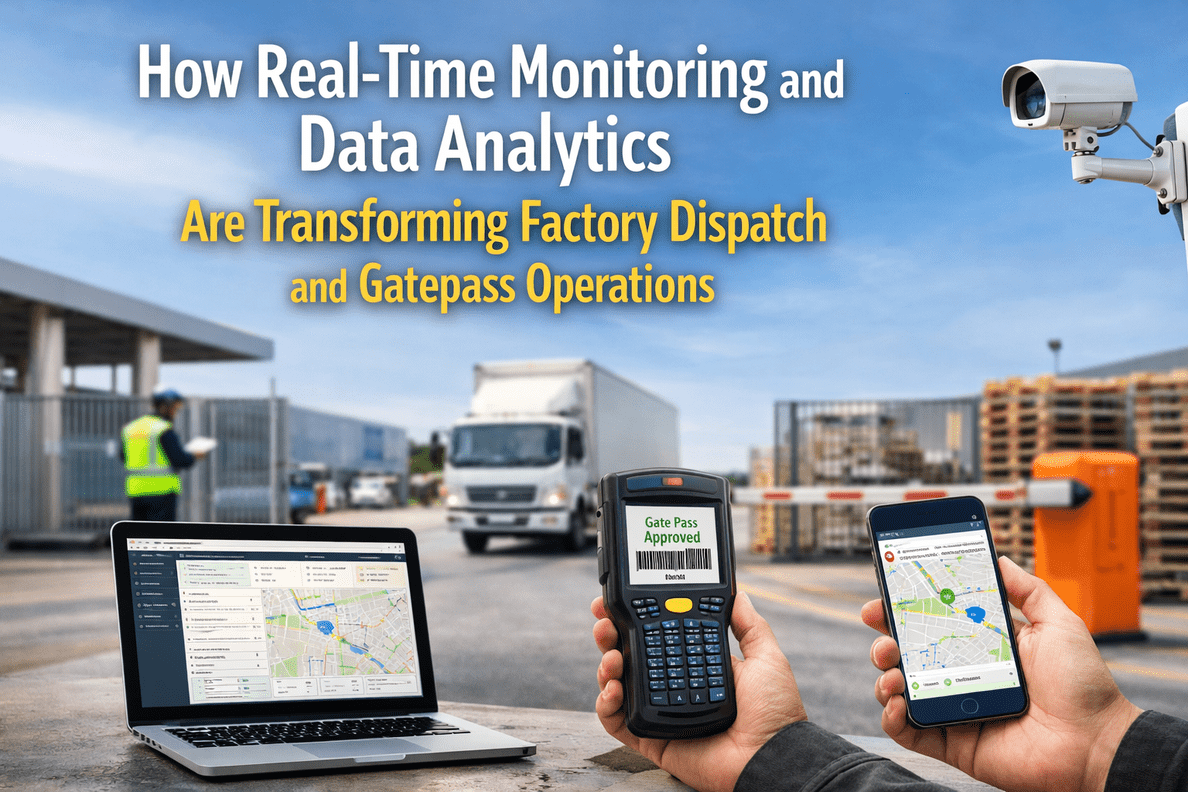
Artificial intelligence is no longer confined to production lines and quality control systems. In 2025 and 2026, AI is reshaping the factory delivery department — the gate, the dock, the dispatch floor, and the incident log — in ways that deliver measurable operational outcomes within weeks of deployment, not months. The global AI in logistics market reached $6.2 billion in 2024 and is projected to exceed $28.4 billion by 2031, growing at 24.7% CAGR. That growth is not driven by theoretical automation — it is driven by factory operations teams discovering that AI-powered gate pass management, smart dispatch sequencing, and real-time incident detection eliminate the manual coordination failures that have made the delivery department the most data-blind function in their plant. The problem is well-documented: 72% of manufacturers have partially implemented smart factory strategy, but the delivery department lags behind every other function. Production floors have AI-assisted OEE dashboards. Maintenance teams have predictive failure alerts. The gate, dock, and dispatch floor? Still running on paper logs, verbal handoffs, and 15–20 minute manual gate processing cycles that a 20-vehicle/day plant loses 280+ minutes to every shift. iFactory's AI-powered platform changes this — bringing smart gate pass automation, predictive dispatch intelligence, and real-time incident management to the factory delivery department as a unified system that deploys in 7–14 days. For a deployment assessment specific to your facility, talk to our support team directly.
iFactory · AI-Powered Delivery Department · 2026
Transforming Factory Delivery Operations with AI: Smart Gate Pass, Dispatch Tracking, and Incident Management
AI is eliminating the manual coordination failures that make the factory delivery department the most data-blind function in every plant — automating gate pass processing, intelligent dispatch sequencing, real-time material tracking, and incident detection that reaches supervisors in minutes, not days.
$28.4B
Global AI in logistics market by 2031 — 24.7% CAGR from $6.2B in 2024
87%
Gate pass processing time reduction — from 15–20 min manual to under 2 min with AI verification
90%
Fewer dispatch errors — AI SLA-priority sequencing vs. 2–3% manual error rate
14 Days
iFactory AI deployment timeline — from decision to live AI-powered delivery department
The AI Readiness Gap
Where AI Has Already Reached Your Plant — and Where Your Delivery Department Is Still Waiting
AI Already Deployed in Your Manufacturing Operations
AI-assisted OEE dashboards — production floor in real time
Predictive maintenance alerts from sensor data on production equipment
AI quality control vision systems on production and packaging lines
Demand forecasting AI integrated with procurement and production planning
Energy monitoring AI optimizing consumption per production shift
AI-driven safety monitoring on the production floor
Automated ERP workflows for financial and inventory processes
Digital twin simulation for production line layout and throughput modeling
Your Delivery Department Is Still Running Without AI
Gate passes processed manually — 15–20 min per vehicle, paper logs
No AI-assisted pre-arrival screening or cargo manifest verification
Dispatch sequencing done manually — SLA misses undetected until complaint
No real-time material location after dock entry — manual search required
Vehicle inspections on paper — no automated defect detection or enforcement
Incidents discovered days after occurrence — no real-time detection layer
Receiving discrepancy patterns invisible — no AI trend analysis by supplier
Compliance documentation assembled manually — hours per audit event
8 AI Performance KPIs
The 8 KPIs That AI-Powered Factory Delivery Operations Deliver — vs. Manual Department Benchmarks
87%
AI Gate Pass Processing Time Reduction
AI pre-arrival screening and mobile verification cuts gate processing from 15–20 minutes to under 2 minutes. 20 vehicles/day recovers 280+ minutes of dock time every shift.
Manual: 15–20 min/vehicleAI: under 2 min
78%
Faster AI-Assisted Inbound Receiving
AI-powered PO matching and mobile photo verification cuts inbound receiving from 45–60 minutes to under 10 minutes per shipment. Discrepancy patterns analyzed automatically by supplier.
Manual: 45–60 min/shipmentAI: under 10 min
90%
AI Dispatch Error Rate Reduction
AI SLA-priority dispatch sequencing reduces errors from 2–3% (manual) to under 0.3%. Pre-breach alerts fire before SLA windows close — intervention replaces post-complaint investigation.
Manual: 2–3% error rateAI: under 0.3%
100%
AI Audit Trail Coverage
Every gate event, receiving transaction, material transfer, inspection result, and dispatch decision is AI-timestamped and person-attributed — generating compliance documentation automatically as a byproduct of daily operations.
Manual: incomplete recordsAI: 100% auto-generated
40%
AI-Driven Inbound Delay Reduction
AI pre-arrival scheduling and intelligent dock assignment eliminate the coordination gaps that create inbound delays. Digital workflows reduce inbound delays by 40% — recovering production schedule adherence that manual gate processes erode daily.
Manual: 280+ min lost/dayAI: 40% delay reduction
30–40%
AI Material Location Failure Elimination
AI-tracked material transfers eliminate the location failures that masquerade as stock-outs. 30–40% of production stoppages attributed to material unavailability are locating failures — resolved in seconds with AI-powered transfer records.
Manual: no location recordAI: real-time location
Minutes
AI Incident Detection Speed
AI-powered auto-escalation detects and routes delivery department incidents to supervisors within minutes of occurrence — versus the days-after-the-fact discovery timeline of verbal reporting in manual operations.
Manual: days after occurrenceAI: minutes, auto-escalated
3–6 mo
AI Platform Full Payback Period
Recovered dock time, eliminated dispatch errors, AI-driven compliance overhead reduction, and production stoppage prevention combine for full platform payback in 3–6 months. iFactory deploys in 7–14 days.
Legacy: 18–24 mo paybackiFactory AI: 3–6 months
iFactory's AI Platform Transforms Your Factory Delivery Department in 14 Days — No IT Project Required.
Smart gate pass automation, AI dispatch sequencing, real-time material tracking, and incident detection — all from a single mobile-first platform that generates compliance documentation automatically.
Talk to our support team for a facility-specific AI readiness assessment.
AI Capabilities
6 AI Capabilities That Redefine Factory Delivery Department Performance
Each AI capability addresses a specific operational failure mode in the factory delivery department. Together they replace the manual coordination layer that creates delays, data gaps, and compliance exposure in paper-based delivery operations.
Smart Gate Pass AI
Pre-Arrival AI Screening and Intelligent Gate Clearance
Drivers pre-register cargo manifests and vehicle details via mobile before arrival. iFactory's AI layer cross-references the registration against expected deliveries, PO schedules, and supplier compliance status before the vehicle reaches the gate — surfacing exceptions for security review and clearing compliant vehicles automatically. Gate processing drops from 15–20 minutes to under 2 minutes. Every entry and exit is timestamped, person-attributed, and linked to the originating PO in a searchable audit record that generates without manual data entry.
87% processing time reduction — 280+ minutes/day recovered at 20 vehicles
AI Dispatch Intelligence
SLA-Priority AI Sequencing with Pre-Breach Alert System
iFactory's dispatch AI sequences outbound orders against SLA priority tiers, vehicle availability, and inspection clearance status — automatically. The system monitors active dispatch orders against committed departure windows in real time, generating a pre-breach alert when a departure is approaching the SLA threshold. Dispatch coordinators receive the alert with intervention time measured in hours rather than discovering the miss after a customer complaint arrives. The AI eliminates the 2–3% dispatch error rate that manual sequencing generates — reducing it to under 0.3% while creating a complete authorization-attributed dispatch audit trail.
90% error reduction — SLA misses detected before breach, not after complaint
AI Material Tracking
Real-Time AI-Powered Internal Material Location
iFactory's AI material tracking layer records every internal material transfer — dock to stores, stores to staging, staging to production, production to quality hold — as a timestamped, person-attributed event. The AI layer analyzes transfer patterns over time to identify bottlenecks, delays, and missing transfer events that indicate process gaps. When production supervisors query material location, they receive the AI-generated current location from the last logged transfer in under 10 seconds. The 30–40% of production stoppages that are actually location failures — not stock-outs — are eliminated without changing inventory levels or procurement processes.
30–40% of production stoppages eliminated — location failures resolved in seconds
AI Receiving Intelligence
AI-Powered PO Matching and Supplier Discrepancy Analysis
iFactory's receiving AI guides mobile verification — scanning barcodes, matching received quantities against purchase orders, flagging discrepancies with photo documentation, and closing shipments with a digital signature. Over time, the AI layer analyzes discrepancy patterns by supplier, carrier, and material type — surfacing the suppliers generating the most receiving overhead before procurement teams are aware of the pattern. Inbound receiving cycle time drops from 45–60 minutes to under 10 minutes. The same workflow generates the complete chain of custody record from supplier to factory floor simultaneously.
78% faster receiving — AI discrepancy pattern analysis surfaces supplier trends automatically
AI Inspection Enforcement
AI-Enforced Vehicle Inspection with Automatic Defect Escalation
Yard vehicles complete digital pre-use inspection checklists on mobile — with iFactory's AI layer analyzing inspection completion rates, failed item frequencies, and inspection interval compliance across the entire yard fleet. The AI auto-blocks vehicles with open failed items from dispatch assignment until a verified repair work order is completed. It also surfaces vehicles with rising defect rates before they become compliance events — enabling proactive maintenance scheduling that extends yard vehicle service life. Paper inspection checklists have no enforcement mechanism; iFactory's AI enforcement layer makes non-compliance structurally impossible.
100% inspection enforcement — failed vehicles auto-blocked, defect trends AI-analyzed
AI Incident Detection
Real-Time AI Incident Detection with Auto-Escalation
iFactory's incident AI captures delivery department events — vehicle damage at gate, receiving discrepancies, security exceptions, material quality holds, dispatch failures — in real time through mobile reporting. The AI layer classifies incident severity, determines the appropriate escalation path, and routes the incident to the correct supervisor with a timestamped record and photo evidence attached. Incidents that previously surfaced days after occurrence through verbal communication now reach supervisors within minutes — with a complete evidence chain that supports resolution, accountability, and regulatory reporting simultaneously.
Minutes vs. days — AI incident detection transforms the delivery department's response capability
AI Workflow
How iFactory's AI Platform Connects Every Factory Delivery Department Function in Real Time
iFactory's AI platform is not a collection of disconnected tools — it is a unified intelligence layer connecting every function of the factory delivery department into a single operational system that learns, adapts, and improves as your operations data accumulates.
01
AI Pre-Arrival Intelligence — Screening Before the Vehicle Reaches the Gate
Drivers register cargo manifests and vehicle details via mobile before departure. iFactory's AI layer analyzes the registration against the facility's expected delivery schedule, open POs, supplier compliance records, and historical delivery patterns — flagging exceptions for security review and confirming expected deliveries without manual lookup. Security receives a pre-screened arrival notification with the relevant PO, supplier, and cargo details pre-loaded before the vehicle arrives. This eliminates the manual verification step that accounts for most of the 15–20 minute manual gate processing time.
Pre-arrival AI screening
Exception flagging
PO cross-reference
Security pre-notification
02
AI Receiving Intelligence — PO Matching, Discrepancy Detection, and Supplier Learning
At dock arrival, iFactory's receiving AI activates the mobile PO verification workflow — guiding the receiving team member through barcode scanning, quantity verification, photo POD capture, and discrepancy documentation. The AI matches received quantities against the PO in real time, flagging shortfalls, overages, and damaged items with a structured exception record. Over time, the AI accumulates discrepancy data by supplier and carrier — surfacing the patterns that indicate systemic quality or quantity issues that procurement teams should address before they generate recurring receiving overhead across every delivery.
Real-time PO matching
AI discrepancy detection
Supplier pattern learning
Photo POD chain
03
AI Material Intelligence — Continuous Location Tracking and Stoppage Prevention
Every internal material transfer is logged as an AI-timestamped, person-attributed record at the moment of transfer. iFactory's material AI builds a continuous location record for every material batch — from dock entry through stores, staging, production, and quality holds. When production supervisors query material location, the AI surfaces the current location from the last logged transfer in under 10 seconds, eliminating the physical search that typically takes 20–45 minutes in manual operations. The AI also monitors transfer timelines — alerting supervisors when materials have been stationary in a staging area significantly longer than the typical throughput pattern, flagging potential staging bottlenecks before they impact production schedules.
AI location tracking
Transfer timeline monitoring
Staging bottleneck alerts
Production stoppage prevention
04
AI Dispatch Intelligence — SLA Sequencing, Pre-Breach Alerting, and Performance Learning
iFactory's dispatch AI sequences outbound orders against SLA priority tiers and vehicle availability, monitors departures against SLA windows in real time, and fires pre-breach alerts when a departure is approaching threshold. Each dispatch event outcome — on time, near-miss, or breached — feeds back into the AI model, which learns the patterns that predict SLA risk: specific vehicle types, specific routes, specific load configurations, specific shift periods. Over time, the AI generates SLA risk scores for new dispatch assignments before confirmation — enabling coordinators to reassign high-risk assignments proactively rather than reacting to breaches after they occur.
AI SLA sequencing
Pre-breach alerting
Dispatch risk scoring
Performance learning
05
AI Compliance Intelligence — Automatic Documentation and Regulatory Readiness
iFactory's compliance AI aggregates every gate record, receiving transaction, inspection outcome, material transfer, dispatch event, and incident report into a unified audit layer — retrievable by any combination of date, vehicle, supplier, material, or operator in under 60 seconds. The AI monitors compliance gaps in real time: vehicles approaching inspection overdue status, suppliers with escalating discrepancy rates, dispatch orders with approaching SLA risk, and materials with missing transfer records in the chain of custody. Each gap generates an alert before it becomes a violation — converting compliance from a reactive audit exercise into a proactive AI-monitored operational discipline.
Auto compliance documentation
Gap detection alerts
60-second audit retrieval
Proactive compliance monitoring
Measurable Results
What iFactory AI Customers Measure Within 90 Days of Go-Live
87%
AI Gate Pass Time Reduction
From 15–20 minutes manual processing to under 2 minutes with AI pre-screening and mobile verification. A 20-vehicle/day factory recovers 280+ minutes of dock time every shift — visible in the first week of deployment.
78%
Faster AI Receiving Completion
Inbound receiving drops from 45–60 minutes to under 10 minutes with AI-assisted PO matching and photo POD. Supplier discrepancy patterns surface automatically — without any dedicated analysis step from the operations team.
90%
Fewer AI-Prevented Dispatch Errors
Manual dispatch error rates of 2–3% drop to under 0.3% with AI SLA-priority sequencing and pre-breach alerting. Dispatch SLA disputes that previously required investigation resolve by querying the AI-generated authorization record.
100%
AI Audit Trail Coverage
Every gate event, receiving transaction, inspection result, material transfer, and dispatch decision is AI-timestamped and person-attributed. Regulatory documentation retrievable in under 60 seconds — not hours of manual binder assembly before each audit.
3–6 mo
Full AI Platform Payback
Recovered dock time, eliminated dispatch errors, AI-driven compliance overhead reduction, and production stoppage prevention combine for full platform payback in 3–6 months. iFactory AI deploys in 7–14 days — no heavy implementation project required.
14 Days
AI Platform Go-Live Timeline
From decision to fully operational AI-powered delivery department in 7–14 days. Cloud-based, mobile-first. No hardware procurement, no server installation, no IT department involvement required. AI learns from day one of go-live data.
Before vs. After
Factory Delivery Department — Manual Operations vs. iFactory AI-Powered Platform
Function
Manual Operations
iFactory AI Platform
Gate Pass Processing
15–20 min/vehicle — manual verification, paper logs, no AI screening, idle queue buildup
Under 2 min — AI pre-screening, mobile verification, automatic dwell time capture
Inbound Receiving
45–60 min/shipment — paper POD, manual PO matching, no AI discrepancy pattern detection
Under 10 min — AI PO matching, photo POD, discrepancy patterns surfaced by supplier automatically
Material Tracking
No location record after dock entry — 20–45 min physical search, stoppages misdiagnosed as stock-outs
AI real-time location at every transfer — 10-second query resolution, staging bottleneck alerts
Dispatch Sequencing
Manual — 2–3% error rate, SLA misses undetected, no AI pre-breach alert capability
AI-sequenced — under 0.3% errors, pre-breach alerts, AI risk scoring per dispatch assignment
Vehicle Inspection
Paper checklists — no AI enforcement, inspections skipped, defect trends undetected
AI-enforced digital checklists — failed vehicles auto-blocked, defect trend analysis by vehicle type
Incident Management
Verbal reporting — incidents discovered days later, no AI classification or escalation logic
AI incident detection — real-time capture, AI severity classification, auto-escalation in minutes
Compliance Documentation
4–8 hours manual assembly per audit — fragmented, incomplete, no AI gap monitoring
60-second AI retrieval — complete, person-attributed, AI gap monitoring runs continuously
Operational Learning
No learning layer — same errors repeat, no trend analysis, no pattern recognition
AI learns continuously — supplier patterns, SLA risk patterns, defect trends improve predictions over time
iFactory · AI-Powered Factory Delivery Department
Your Production Floor Has AI. Your Delivery Department Deserves the Same Intelligence.
iFactory's AI platform transforms every function of your factory delivery department — smart gate pass screening, AI dispatch sequencing, real-time material tracking, intelligent incident detection, and automatic compliance documentation — in a single mobile-first system that deploys in 7–14 days. No IT project. No hardware procurement. AI operational from day one.
87%Gate pass time reduction
90%Fewer dispatch errors
100%Audit trail coverage
14 DaysFull AI deployment
Book A Demo
Frequently Asked Questions
AI in Factory Delivery Operations — What Operations Leaders Ask First
For facility-specific questions about iFactory AI deployment, talk to our support team or book a demo to see the AI platform live in a factory delivery environment.
Does deploying AI in our factory delivery department require a major technology infrastructure project?
No. iFactory's AI-powered delivery department platform is cloud-native and mobile-first — it deploys in 7–14 days without server infrastructure, without hardware procurement, and without IT department project involvement. Your security staff, receiving teams, and dispatch coordinators access the AI platform through the iFactory mobile app on existing smartphones and tablets. The AI layer activates from the first operational data it receives — beginning to analyze gate events, receiving patterns, dispatch outcomes, and material transfer records from day one of go-live. The onboarding process has three structured phases: Days 1–3 for data onboarding (vehicle registry, driver roster, supplier list, PO templates), Days 4–7 for AI workflow configuration and role training (2–4 hours per role group), and Days 8–14 for live operations with iFactory support monitoring AI performance and resolving any workflow gaps. The AI components — pre-arrival screening, dispatch risk scoring, supplier discrepancy pattern analysis, material staging bottleneck detection, and compliance gap monitoring — all activate automatically as operational data accumulates. No data science expertise or dedicated AI operations team is required.
Talk to our support team about your specific deployment requirements, or
book a demo to see the AI onboarding process in detail.
How does iFactory's AI learn from our specific factory's operational patterns — and how quickly?
iFactory's AI platform operates in two complementary learning modes simultaneously. The foundational model uses pre-trained patterns built from industry-wide manufacturing delivery department data — enabling AI capabilities like dispatch SLA risk scoring, supplier discrepancy flagging, and gate exception detection from the first day of go-live without requiring your facility's own historical data. The facility-specific model layer learns from your factory's actual operational data as it accumulates — adapting to your specific supplier base, your delivery schedule patterns, your vehicle fleet characteristics, and your production schedule rhythms. The facility-specific model begins generating meaningful insights within 30 days of connected operation. By 60–90 days, it has learned your suppliers' discrepancy patterns well enough to flag high-risk inbound deliveries before dock arrival, your dispatch SLA risk patterns well enough to score new assignments with 90%+ accuracy, and your material transfer patterns well enough to detect staging anomalies that indicate upcoming production schedule impacts. Each resolved incident, confirmed discrepancy, SLA outcome, and material transfer event feeds back into the model — meaning the AI becomes measurably more accurate the longer your facility runs on the platform. Fleets running iFactory AI for 12+ months consistently report that the AI surfaces insights — supplier quality trends, recurring SLA risk windows, vehicle inspection patterns — that were completely invisible to the operations team before AI deployment.
Book a demo to see iFactory AI learning outputs from a live factory deployment, or
talk to our support team about AI configuration for your specific facility profile.
How does iFactory's AI dispatch intelligence prevent SLA misses — and what happens when an alert fires?
iFactory's AI dispatch intelligence operates across three distinct stages of the dispatch cycle to prevent SLA misses before they occur rather than detecting them after they become customer complaints. At assignment stage, the AI scores each new dispatch order against the SLA risk model built from your facility's historical dispatch data — factoring in vehicle type, route, load configuration, time of day, and current yard vehicle availability. High-risk assignments receive a risk flag that prompts the coordinator to confirm or reassign before the order is committed. At execution stage, the AI monitors every active dispatch order against its committed SLA departure window in real time — calculating the countdown to breach and generating a pre-breach alert when the window is approaching close with insufficient time for standard departure preparation. At resolution stage, when the pre-breach alert fires, the alert is routed to the dispatch coordinator's mobile app with the specific order details, the vehicles available for immediate reassignment, and the estimated breach time — giving the coordinator an actionable intervention package rather than just a notification. The manual dispatch error rate of 2–3% is driven primarily by the absence of this real-time monitoring layer — coordinators cannot simultaneously track every active order against SLA windows manually while managing incoming gate traffic, receiving exceptions, and yard communications. The AI monitoring layer runs continuously in the background, flagging only the orders that require intervention — meaning coordinators spend their attention on exceptions rather than monitoring the entire queue.
Talk to our support team about dispatch AI configuration for your SLA structure, or
book a demo to see the dispatch AI monitoring interface live.
What compliance documentation does iFactory's AI generate automatically — and how is it used in regulatory audits?
iFactory's compliance AI generates six categories of regulatory documentation automatically from daily factory delivery department operations — without any separate reporting step or dedicated compliance workflow. Gate pass records capture vehicle type, arrival and exit timestamps at second precision, dwell time per vehicle, security officer identity, and any gate-level exceptions — satisfying DOT and OSHA facility entry documentation requirements and, in California-operating facilities, SB 1383 idle emissions documentation requirements. Inbound receiving records capture supplier, carrier, PO reference, material description, quantities received versus ordered, photo POD, exception documentation, and the receiving team member's identity — satisfying supply chain traceability requirements including AB 2061 in California, Schedule M in India, and LkSG in Germany. Vehicle inspection records capture pre-use inspection results by checklist item, operator identity, timestamp, and photo evidence of any failed items, alongside the repair work order that resolved each failure — satisfying CARB in-use off-road diesel requirements and DOT inspection record-keeping obligations. Dispatch records capture vehicle ID, departure timestamp, SLA tier, cargo reference, and SLA outcome per dispatch event. Material transfer records capture material batch ID, transfer origin, destination, timestamp, and person completing each transfer. Incident records capture event type, severity classification, timestamp, operator involvement, and resolution timeline. During a regulatory audit, any combination of these records is retrievable through iFactory's audit dashboard in under 60 seconds by filtering on date range, vehicle, supplier, operator, or material batch. The AI compliance gap monitor runs continuously — alerting operations managers when records are missing, inspections are overdue, or compliance documentation has gaps that would be exposed in an audit before the auditor arrives.
Book a demo to see iFactory's compliance AI dashboard operating against real facility data, or
talk to our support team about compliance templates specific to your regulatory environment.
How does iFactory's AI handle incident management in the factory delivery department — and what does real-time detection actually mean operationally?
Real-time incident detection in the factory delivery department means that the time between an incident occurring and the appropriate supervisor receiving an actionable notification with evidence attached drops from the current industry average of 12–48 hours (verbal reporting through shift handovers) to under 15 minutes in iFactory-deployed facilities. The AI incident management layer works through three mechanisms. Mobile incident capture enables any team member — security officer, receiving staff, dispatch coordinator, yard driver — to report an incident from the iFactory mobile app in under 90 seconds, with the incident type, location, vehicle or shipment reference, and photo evidence attached at the time of reporting. AI severity classification analyzes the incident attributes against a severity model and classifies the incident into one of four response tiers: immediate supervisor notification, shift manager notification, operations head notification, or regulatory reporting queue. Automated escalation routes the classified incident to the correct recipient immediately — with a timestamped notification, the incident record, and the photo evidence attached in a single communication that requires no follow-up information gathering from the reporting team member. The AI also monitors incident resolution timelines — escalating to the next management level automatically if an incident remains unresolved beyond its tier-specific resolution threshold. For operations teams currently discovering incidents through verbal handovers at shift changes, this represents a structural change in how the delivery department's exception layer works — converting reactive incident discovery into proactive incident management with a complete evidence chain from the moment of occurrence.
Talk to our support team about AI incident management configuration for your facility, or
book a demo to see the incident detection and escalation interface live.
Can iFactory's AI platform manage factory delivery operations across multiple plant sites — and does AI performance improve across a multi-site deployment?
iFactory's AI platform is built as a multi-site architecture from its core — a single deployment covers all factory locations in your portfolio under a unified AI-powered operations dashboard, with site-specific AI configuration for each facility's delivery workflows, compliance templates, and SLA structures. For operations directors overseeing multiple manufacturing sites, the cross-site AI dashboard provides a portfolio-level view of AI-surfaced insights across all facilities simultaneously: the supplier generating the most receiving discrepancies across the network, the dispatch SLA risk patterns that appear at multiple sites during specific seasonal or operational windows, the vehicle inspection defect trends that indicate fleet-wide aging before site-level operations teams are aware. Multi-site AI deployment also delivers a cross-facility learning advantage that single-site deployments cannot replicate. When the AI at one facility learns a new discrepancy pattern for a shared supplier, that pattern becomes available to the AI models at all facilities sharing the same supplier — meaning the network of facilities collectively trains the AI faster than any individual facility could independently. Facilities that join an existing multi-site iFactory AI deployment benefit from pre-trained pattern recognition built on the operational data of the entire facility network — achieving accurate AI insights weeks faster than a standalone deployment would achieve on its own operational data alone.
Book a demo to see iFactory's multi-site AI dashboard operating with real facility data, or
talk to our support team about multi-site AI deployment configuration for your facility portfolio.
iFactory · AI-Powered Factory Delivery Department
72% of Manufacturers Have Partially Deployed AI. Your Delivery Department Should Not Be the Last Function Without It.
86% of manufacturers track OEE. Almost none track AI-analyzed gate pass dwell time, dispatch SLA compliance, or supplier discrepancy patterns — the operational intelligence that separates high-performing delivery departments from those perpetually firefighting. iFactory closes this gap with a purpose-built AI platform that deploys in 7–14 days and begins surfacing actionable intelligence from day one.
87%Gate time reduction
78%Faster receiving
90%Fewer errors
14 DaysFull deployment
Book A Demo