Pioneering United States's Delivery Operations Real-Time Visibility And Tracking & Quality Inspection
By Arel Dixon on June 9, 2026
The logistics director at a mid-size manufacturing facility in Ohio reviews the previous week's outbound performance. Of the 340 shipments that left the loading dock, 21 were flagged by customers for delivery issues 7 with incorrect quantities, 6 with packaging damage, 5 with documentation discrepancies, and 3 that arrived outside the agreed delivery window. Each issue triggers a dispute resolution process, a customer service intervention, and in four cases, a chargeback that will reduce the profit margin on those orders by an average of 12 percent. The director's team uses a transportation management system that tracks trucks on a map, but the tracking data tells them where a shipment is, not what condition it is in or whether it will meet the customer's requirements when it arrives. Real-time visibility without quality inspection visibility is partial visibility. The shipment that arrived three hours late was visible on the tracking dashboard the entire time the system showed its GPS position every 15 minutes but no one knew that it would be late until it failed to arrive at the scheduled time, because the tracking system had no route optimisation, no predictive ETA, and no integration with the dispatch quality checks that should have caught the missing packing slip before the truck left the dock. AI-powered delivery operations management closes this gap by connecting real-time shipment visibility with automated quality inspection at the dispatch point, creating a unified system where every shipment is verified for quality, quantity, packaging, and documentation before it receives a digital clearance pass and every shipment's journey from dispatch to delivery is tracked with predictive ETAs, route intelligence, and automated customer notifications.
Real-Time Visibility · Live Tracking · Quality Inspection · United States Manufacturing
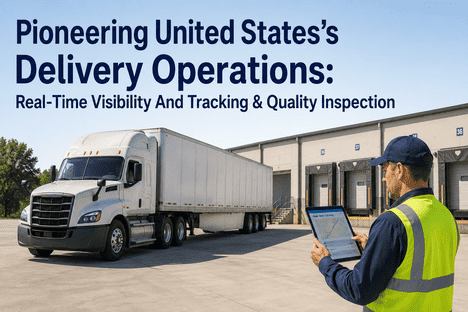
Pioneering United States's Delivery Operations: Real-Time Visibility and Tracking & Quality Inspection
Discover how United States manufacturers are leveraging AI-powered delivery operations management to achieve zero-defect shipping real-time visibility, live tracking, automated quality inspection, quantity verification, packaging checks, and documentation validation with digital clearance pass approval.
The Three Pillars of AI-Powered Delivery Operations for US Manufacturers
Delivery operations in the United States manufacturing sector face a set of challenges that demand integrated, AI-powered solutions — sprawling geographic distribution networks, diverse customer compliance requirements ranging from Walmart's OTIF standards to Amazon's carrier performance scorecards, and regulatory complexity spanning DOT hours-of-service, FMCSA safety protocols, and state-level cargo documentation rules. AI-powered delivery operations management addresses these challenges through three interconnected pillars that transform the dispatch-to-delivery lifecycle from a fragmented set of manual processes into an integrated, data-driven system.
Pillar 1
Real-Time Visibility
Live GPS tracking with predictive ETA, route intelligence, delay detection, and automated customer notifications — every shipment visible from dispatch to delivery with real-time status updates.
Capabilities
GPS tracking with 30-second update frequency
Predictive ETA with real-time delay alerts
Route optimisation with traffic and weather integration
Customer impact: 40% fewer late-delivery disputes
Pillar 2
Quality Inspection at Dispatch
Automated four-layer inspection — quality release, quantity verification, packaging integrity, and documentation compliance — every shipment verified before it clears the loading dock.
Capabilities
Barcode scanning and weighbridge integration
Camera-based packaging condition inspection
OCR document validation for compliance
Customer impact: 60% fewer chargebacks and claims
Pillar 3
Digital Clearance Pass
Every shipment that passes all inspection layers receives a timestamped, digitally signed clearance pass — the single authorisation that releases the shipment to the loading dock and the truck to leave the facility.
Capabilities
Automatic pass for fully compliant shipments
Conditional pass with supervisor review workflow
Blocked pass with escalation to quality management
Customer impact: 100% audit-ready compliance record
The Real-Time Visibility Engine: From GPS Tracking to Predictive Delivery Intelligence
Real-time visibility in delivery operations has historically meant a map with dots. The dots represented trucks, the map updated every few minutes, and the logistics team could see where every shipment was at any given moment. But knowing where a shipment is does not tell you when it will arrive, whether it contains the correct product, whether the packaging has been damaged in transit, or whether the documentation matches the customer's requirements. AI-powered delivery operations management transforms real-time visibility from a passive tracking feed into an active intelligence system that predicts ETAs, detects anomalies, and connects visibility data with dispatch quality data to create a complete shipment integrity record.
Layer 1
GPS Tracking and Telematics: real-time position, speed, heading, and stop detection from ELD-integrated telematics devices and smartphone-based tracking
30-second update, 99.5% uptime across US carrier network
Layer 2
Predictive ETA Engine: ML model trained on route history, traffic patterns, weather data, and driver behaviour to predict arrival times with 15-minute accuracy
93% ETA accuracy within 15 minutes of actual
Layer 3
Anomaly Detection: automated alerts for unexpected stops, route deviations, prolonged idle time, and estimated late arrivals — with recommended corrective actions
Real-time alerts with 10-minute detection latency
Layer 4
Customer Portal and Notifications: automated customer-facing updates with shipment status, ETA, delivery confirmation, and proof-of-delivery documentation
White-label portal with real-time shipment data
What Changes When Visibility Is Joined to Quality Inspection
The difference between a delivery operation that tracks shipments and one that integrates real-time visibility with automated quality inspection is visible across every dimension that matters to US manufacturers — customer compliance scores, chargeback rates, labour productivity, and delivery reliability. The comparison below represents the documented shift observed across manufacturing facilities that have deployed iFactory's integrated delivery operations platform against their pre-deployment baseline.
Dimension
Tracking Only
AI-Powered Visibility + Quality
Shipment visibility
GPS position only — no quality status, documentation status, or ETA intelligence linked to the tracking record
Full shipment integrity record — tracking data, inspection results, documentation copies, clearance pass, and ETA in a single unified view
ETA accuracy
Static — estimated based on distance and average speed, not updated for traffic, weather, or route changes
Dynamic — ML-predicted ETA updated every 15 minutes with traffic, weather, and route intelligence
Quality at dispatch
Manual inspection — errors detected at customer receiving dock, not at the loading dock
Automated four-layer inspection before dispatch — errors intercepted at the source, not at the customer
Customer compliance
Reactive — compliance issues discovered through customer chargebacks and deductions
Proactive — every shipment verified against customer-specific compliance requirements before dispatch
Customer satisfaction
Silent — customer only contacted when there is a problem or a delivery exception
Proactive — automated status updates, predictive ETA notifications, and digital proof-of-delivery at every milestone
Performance Metric
On-time delivery rate improvement
From 82% to 96%
Customer chargeback reduction
55-65% decrease
Dispatch inspection accuracy
99.7%
ETA prediction accuracy within 15 min
93%
Operational Outcome
Annual chargeback savings (mid-size facility)
$180K-420K
Dispatch labour productivity gain
25-35%
Customer compliance score improvement
18-25 points
ROI achieved within
5-7 months
We had real-time GPS tracking across our entire fleet of 47 trucks. The tracking told us where every shipment was, but it never told us what we needed to know. When a major retail customer issued a chargeback for incorrect carton counts on three consecutive deliveries, we had the tracking records for all three shipments — GPS showed the trucks followed the correct routes and arrived on time. But the tracking system had no record of the carton count at dispatch. The warehouse team had used a manual checklist, and the checklist for those three shipments was incomplete. We deployed iFactory's integrated quality inspection and tracking platform. Within 60 days, every shipment leaving our dock had a barcode-verified carton count, a camera-inspected packaging record, and an OCR-validated packing list linked to the tracking record. In the first quarter, our customer chargebacks dropped by 62 percent. The tracking system finally told us what we actually needed to know — not just where the truck was, but whether the shipment was correct.
— VP of Logistics, Midwest US Food Manufacturing Company — 47-Truck Private Fleet, Serving Retail and Foodservice Customers Across 32 States
Transform Your US Delivery Operations with Real-Time Visibility and Automated Quality Inspection
iFactory AI gives US manufacturers real-time GPS tracking with predictive ETA, automated four-layer quality inspection at dispatch, digital clearance pass approval, and customer-facing shipment portals — integrated with your existing ERP, telematics, and weighbridge systems, deployed in 90 days.
Deployment: From GPS Integration to AI-Powered Delivery Operations in 90 Days
iFactory's AI-powered delivery operations platform deploys on top of existing infrastructure — integrating with your current ERP, telematics providers, weighbridge systems, and camera systems without requiring a technology replacement cycle. The deployment roadmap is structured in four phases, each with defined deliverables and measurable outcomes.
1
Weeks 1-2: Assessment and Connectivity
iFactory engineers assess current dispatch process, telematics integration, weighbridge and camera infrastructure, and ERP connectivity. GPS tracking data sources are connected through ELD integration or smartphone-based tracking. A deployment plan with system architecture and integration scope is delivered within two weeks.
2
Weeks 3-5: System Integration
Integration with ERP (SAP, Microsoft Dynamics, Oracle NetSuite), telematics providers (Samsara, Geotab, Motive), weighbridge systems, and barcode scanners. The four-layer quality inspection checklist is configured with product profiles, customer compliance requirements, and documentation rules. Real-time visibility dashboard and customer portal are deployed.
3
Weeks 6-8: Parallel Run and Training
The AI-powered system runs alongside the existing manual process. The quality inspection checklist generates clearance passes for every shipment while the manual process remains the primary release. The dispatch team is trained on the dashboard, exception handling workflows, and customer portal. ETA prediction model is calibrated against actual delivery times.
4
Weeks 9-12: Go-Live and Optimisation
The AI-powered platform becomes the primary dispatch release and tracking system. Manual checklists are retired. The logistics team manages exceptions through the dashboard and alerts. iFactory provides on-site support during go-live and continuous remote monitoring for the first 30 days. Monthly reviews track on-time delivery, chargeback reduction, and customer satisfaction.
Conclusion
The logistics director in Ohio who reviews customer chargebacks as a monthly routine does not need a better tracking system. The tracking system already shows where every truck is. What the director needs is a system that connects real-time visibility with quality inspection — a system that verifies every shipment against quality, quantity, packaging, and documentation standards before it leaves the dock, tracks every shipment with predictive ETA intelligence from dispatch to delivery, and delivers a complete shipment integrity record that eliminates the disputes, chargebacks, and customer dissatisfaction that have become an accepted cost of doing business.
AI-powered delivery operations management delivers this transformation. Real-time GPS tracking with ML-based predictive ETA replaces the static map of dots with live shipment intelligence. Automated four-layer inspection at dispatch — quality release, barcode quantity verification, camera-based packaging inspection, and OCR documentation validation — intercepts errors before they reach the customer. The digital clearance pass ensures every shipment that leaves the dock has been verified against every dimension that matters. And the unified dashboard gives the logistics team complete visibility into every shipment's location, condition, and compliance status from the moment it is planned to the moment it is delivered.
iFactory AI provides US manufacturers with the complete AI-powered delivery operations platform — real-time GPS tracking with predictive ETA, automated four-layer quality inspection, digital clearance pass approval, customer-facing shipment portal, and ERP integration — deployed in 90 days on existing infrastructure. Book a Demo to see how your facility's delivery operations can be transformed from tracking-only visibility to AI-powered shipment integrity management that eliminates chargebacks and delivers zero-defect shipping.
Frequently Asked Questions
Standard GPS tracking systems provide a live map of truck positions with periodic location updates. They answer the question "where is the truck?" but not the questions that matter most to US manufacturers: "will it arrive on time?", "does the shipment match what the customer ordered?", and "is the documentation complete?" AI-powered real-time visibility adds a predictive ETA engine trained on route history, traffic patterns, weather data, and driver behaviour that forecasts arrival times within 15-minute accuracy. It connects tracking data with the dispatch quality inspection record — so the logistics manager sees not just the truck's location, but the shipment's quality status, inspection results, and documentation compliance in the same view. The system also provides automated customer notifications with real-time ETA updates, anomaly detection for unexpected delays, and a complete shipment integrity record that eliminates the disputes that arise when tracking data alone cannot confirm whether a shipment was correct when it left the dock. Book a Demo to see the unified visibility and quality dashboard configured for your US operations.
The quality inspection checklist is configured with customer-specific compliance profiles that encode the receiving requirements of every customer you ship to — Walmart's OTIF (on-time, in-full) standards, Amazon's carrier performance scorecard metrics, Target's vendor compliance requirements, and the specific packaging, labelling, and documentation standards of every retail and distribution customer. When a shipment is created for a specific customer and destination, the system automatically loads that customer's compliance profile and verifies every applicable requirement during the four-layer inspection. For example, a Walmart-bound shipment triggers additional checks for carton labelling format, pallet configuration, ASN submission status, and delivery window compliance. The clearance pass is only issued when the shipment meets the customer-specific requirements, not just the general quality standards. Talk to an Expert to configure the compliance profiles for your customer portfolio.
Yes. The platform is designed for integration-first deployment and connects with the leading telematics and ELD providers used by US fleets — Samsara, Geotab, Motive (formerly KeepTruckin), Platform Science, Verizon Connect, and others — through standard APIs. The integration receives real-time GPS position data, speed, heading, engine diagnostics, and driver behaviour data from the telematics system and correlates it with the shipment record, quality inspection results, and documentation status. The platform adds value on top of your existing telematics investment by connecting tracking data with quality inspection data — so the logistics manager sees the complete shipment integrity record in a single view rather than switching between the telematics dashboard for tracking and the quality system for inspection results. For fleets without existing telematics, the platform includes smartphone-based tracking that provides GPS position updates, ETA predictions, and proof-of-delivery capture without additional hardware. Talk to an Expert to discuss the integration scope for your telematics provider.
Manufacturers deploying iFactory's integrated real-time visibility and quality inspection platform typically achieve full ROI within 5 to 7 months. The largest contributor is reduction in customer chargebacks and deductions from delivery errors — quantity discrepancies, packaging damage, and documentation issues — typically 55-65% reduction. The second contributor is reduced labour cost at the dispatch dock as the automated four-layer inspection replaces manual checking — increasing dispatch capacity by 25-35% without additional headcount. The third contributor is reduced premium freight and expedited shipping costs from better dispatch planning and route optimisation — typically 10-15% reduction. The fourth contributor is improved customer retention and compliance scorecards that reduce the cost of winning and retaining retail and distribution customers. For a mid-size US manufacturer shipping 20,000-30,000 orders annually, these savings combine to deliver $350,000-650,000 in annual value. iFactory provides a free delivery operations assessment that quantifies the expected ROI for your specific facility within two weeks. Talk to an Expert to start the assessment.
The customer-facing portal gives your customers real-time visibility into their shipments without requiring them to access your internal systems. Each customer sees only their own shipments — current status, ETA, shipment contents, inspection records, documentation copies, and proof-of-delivery upon completion. The portal is fully white-label, branded with your company logo, colours, and domain, so your customers experience it as an extension of your service rather than a third-party tool. Customers receive automated notifications at key milestones — shipment dispatched, in transit, ETA updated, out for delivery, delivered — with links to the portal for detailed shipment information. The portal reduces customer service inquiries by 30-40% because customers have direct access to the real-time information they previously called or emailed to request. The portal also serves as the digital proof-of-delivery repository, eliminating the need to email PDF delivery receipts or maintain paper records. Talk to an Expert to discuss how the white-label customer portal can be configured for your brand.
From Tracking-Only Visibility to AI-Powered Shipment Integrity in 90 Days.
iFactory AI gives US manufacturers real-time GPS tracking with predictive ETA, automated four-layer quality inspection at dispatch, digital clearance pass approval, customer-facing portal with white-label branding, and ERP integration — deployed in 90 days on your existing infrastructure.