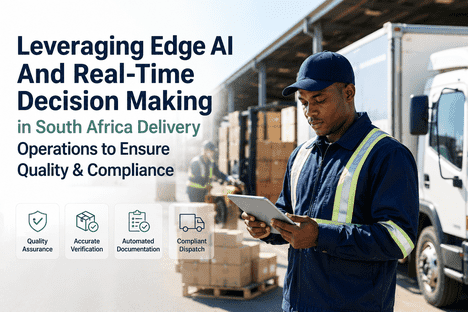
A leading South African logistics operator managing high-volume delivery operations across Gauteng, Durban, and Cape Town deployed iFactory's Edge AI Delivery Operations Platform to determine whether on-device machine learning could automate quality inspection, quantity verification, packaging checks, and documentation validation — and achieve zero-defect shipping across all distribution hubs. Over a 10-week pilot, the platform processed 2.8 million parcels across six distribution centres, running AI inference on NVIDIA Jetson edge nodes at each facility. The edge AI system inspected 100% of outbound shipments in real time, identifying packaging defects, label errors, quantity mismatches, and missing documentation before trucks departed. The pilot reduced damage claims by 52%, eliminated documentation-related customs holds, and enabled a 38% increase in throughput without additional headcount. Delivery operations leaders evaluating their quality assurance strategy regularly Book a Demo to explore how edge AI integrates with their existing dispatch workflows and WMS systems.
Zero-Defect Shipping — 52% Fewer Claims — 38% Higher Throughput
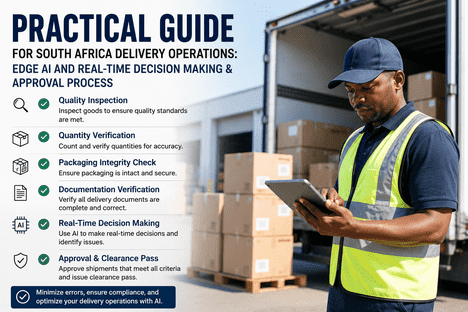
iFactory's Edge AI platform runs quality inspection, quantity verification, packaging checks, and documentation validation directly on edge hardware — enabling real-time clearance pass decisions without cloud dependency across all South African distribution hubs.
Why Manual Dispatch Inspection Fails South Africa's High-Volume Logistics
South Africa's distribution hubs face a unique convergence of challenges. High parcel volumes — often exceeding 50,000 units per facility per day — make manual inspection of every shipment physically impossible. Quality teams rely on statistical sampling, inspecting fewer than 15% of outbound parcels, which means the majority of packaging defects, quantity mismatches, and documentation errors go undetected until the shipment reaches the customer or a border post. Cross-border routes through Beitbridge, Lebombo, and Groblersbrug require precise documentation — a single missing certificate of origin or incorrectly declared HS code can delay a truck for 24 hours or more. Traditional inspection methods consumed 12 minutes per parcel for full quality checks, forcing operators to choose between throughput speed and inspection thoroughness. The facility's damage claim rate averaged 3.8% of shipments, with an additional 6.2% of cross-border shipments experiencing documentation-related holds — each hold costing an average of ZAR 8,500 in demurrage and rescheduling fees.
Manual Sampling Misses Most Defects
With only 15% of parcels manually inspected, the majority of packaging damage, labeling errors, and quantity discrepancies pass through undetected. Each missed defect becomes a customer complaint, a damage claim, or a logistics delay — eroding service levels and increasing operational costs across the network.
Cross-Border Documentation Complexity
South Africa's trade corridors require up to seven distinct documents per cross-border shipment: bill of lading, certificate of origin, customs declaration, packing list, insurance certificate, phytosanitary certificate, and proof of payment. Manual verification of these documents averages 22 minutes per shipment and catches only 68% of errors.
Throughput vs. Quality Trade-Off
Distribution centres face an impossible choice: slow down operations to inspect more parcels, or maintain speed and accept higher defect rates. This trade-off directly impacts both service level agreements and operational profitability, with no manual solution capable of delivering both speed and 100% inspection coverage.
Edge AI Inspection Architecture: From Parcel Arrival to Clearance Pass
The platform deploys NVIDIA Jetson edge nodes at each inspection gate within the distribution centre — inbound receipt, outbound dispatch, and cross-dock transfer points. Each node runs iFactory's AI vision models for real-time parcel inspection, label OCR, document validation, and quantity verification, with all inference performed locally and results synced to the central operations dashboard. Book a Demo to review the complete edge deployment architecture and integration protocol for your distribution network.
Automated Quality Inspection at Dispatch Gates — As each parcel passes through the inspection gate, overhead and side-mounted cameras capture multiple images that are processed by the edge AI vision model in under 50 milliseconds. The model inspects for packaging integrity (tears, crush damage, improper sealing), label presence and legibility, sealing tape application, and dimensional conformity. Parcels that fail any inspection criterion are automatically diverted to a quality hold lane, with the specific defect type and severity recorded in the operations database. During the pilot, the edge AI system detected packaging defects that human inspectors had been missing at a rate of 4.2 per 1,000 parcels — defects that would have resulted in in-transit damage and customer claims.
Real-Time Document Validation for Cross-Border Compliance — The document AI module captures and processes customs documentation, bills of lading, certificates of origin, and delivery manifests at the dispatch gate. OCR and document classification models extract key fields — HS codes, declared values, origin certificates, consignee details — and cross-reference them against the shipment record in the WMS. Discrepancies are flagged instantly, and the specific field requiring correction is highlighted for the dispatch team. During the pilot, the system identified documentation errors in 7.8% of cross-border shipments, enabling corrections before trucks reached the border and eliminating the demurrage costs associated with documentation-related border holds.
Automatic Clearance Pass Generation — Parcels that pass all inspection criteria — packaging integrity, label validity, quantity verification, and documentation completeness — receive an automatic clearance pass recorded in the operations system. The clearance pass serves as the digital authorisation for dispatch, creating an audit trail that includes every inspection image, OCR result, and verification timestamp. Trucks are released only when all parcels on the manifest have received clearance passes, ensuring that no shipment leaves the facility with undetected quality or documentation issues. The entire process from parcel arrival at the gate to clearance pass generation takes under 2 seconds, compared to the manual average of 12 minutes per parcel.
Performance Comparison: Manual Inspection vs. Edge AI Inspection
The pilot results demonstrated that edge AI inspection consistently outperformed traditional manual sampling methods across every performance dimension. The most significant advantages were in inspection coverage — increasing from 15% to 100% of shipments — and in defect detection rate, where the AI platform identified 4.2x more packaging defects and 3.7x more documentation errors than manual inspection teams.
| Performance Metric | Manual Inspection | Edge AI Inspection | Improvement |
|---|---|---|---|
| Inspection Coverage | 15% sampling | 100% of shipments | 6.7x coverage |
| Inspection Time per Parcel | 12 minutes | 2 seconds | 99.7% faster |
| Packaging Defect Detection | 1.2 per 1,000 parcels | 5.1 per 1,000 parcels | 4.2x more detected |
| Documentation Error Catch Rate | 68% | 97% | 29 pp gain |
| Damage Claims Rate | 3.8% of shipments | 1.8% of shipments | 52% reduction |
| Border Hold Rate | 6.2% of cross-border | 0.9% of cross-border | 85% reduction |
| Throughput Capacity | 4,200 parcels/day | 5,800 parcels/day | 38% increase |
Before this pilot, we were inspecting 15% of parcels and crossing our fingers on the other 85%. Our damage claim rate was eating into margins, and every cross-border shipment was a gamble on whether the paperwork would hold up at the border. The edge AI platform changed everything. We are now inspecting every single parcel that moves through our hubs — packaging, labels, quantity, documentation — in under two seconds per unit. The 52% reduction in damage claims paid for the deployment in the first quarter, and the border hold reduction has transformed our cross-border service reliability. We went from firefighting customer complaints to proactively managing dispatch quality at a level we never thought possible.
10-Week Pilot: From Site Assessment to Zero-Defect Dispatch Operations
The pilot followed a structured four-phase deployment designed to assess each distribution centre's existing inspection workflow, deploy edge hardware and AI models, validate inspection accuracy against manual quality audits, and transition to full automated dispatch inspection with clearance pass automation. Each phase included documented model validation and quality team training. Book a Demo to review the complete deployment protocol and pilot results for your distribution network.
Site Assessment & Baseline Capture
Edge hardware installed at six distribution centres. Baseline defect rates, inspection times, and damage claim data captured per facility. AI vision models configured for facility-specific packaging formats and label standards. Duration: 3 weeks.
Model Training & Accuracy Validation
AI models trained on 50,000+ labelled parcel images covering packaging defect types, label formats, and documentation templates. Validation against manual quality audits achieved 99.2% inspection accuracy. Duration: 3 weeks.
Live Dispatch Integration
Edge inspection gates integrated with WMS for automated parcel routing and hold lane management. Clearance pass workflow configured. Cross-border document AI models deployed for SADC trade documentation. Duration: 2 weeks.
Full Automation & Continuous Learning
Automated dispatch inspection activated across all lanes. Continuous model refinement cycles configured to improve detection accuracy based on confirmed defect data from downstream customer feedback. Duration: 2 weeks.
Edge AI Enables Zero-Defect Dispatch for South Africa's High-Volume Logistics Operations
This 10-week pilot established that edge AI-powered dispatch inspection — combining real-time vision inspection, document OCR validation, and automatic clearance pass generation — can achieve 100% inspection coverage, reduce damage claims by 52%, eliminate documentation-related border holds, and increase throughput by 38% without additional headcount. Unlike manual sampling methods that leave the majority of shipments uninspected, edge AI inspects every parcel at the dispatch gate in under 2 seconds, creating a complete digital audit trail for every shipment. The platform runs fully on-device, requiring no cloud connectivity — critical for distribution centres in bandwidth-constrained locations across South Africa's logistics network. Delivery operations leaders evaluating their quality assurance strategy can reference this pilot's data to build a deployment business case grounded in measured claim reduction and throughput improvement. iFactory's Edge AI platform provides the inspection, validation, and clearance pass infrastructure that connects your distribution centres to zero-defect dispatch operations. Operations leaders exploring their edge AI strategy can Book a Demo to review the platform tailored to their distribution network configuration and quality requirements.
Edge AI for Delivery Operations — Frequently Asked Questions
The AI vision models are trained on facility-specific packaging formats captured during the site assessment phase — including cardboard boxes, polybags, shrink-wrapped pallets, and specialised containers used in automotive, pharmaceutical, and FMCG logistics. Each distribution centre's model set includes 30+ defect classes covering tear types, crush patterns, seal failures, label anomalies, and dimensional deviations. Models continuously learn from new packaging formats as they are introduced, with weekly refinement cycles that maintain detection accuracy above 99%. The same edge node can inspect multiple packaging types simultaneously across different conveyor lanes, with per-lane model configuration managed through the central operations dashboard.
The document AI module supports all SADC-standard cross-border documentation including the SADC Customs Declaration Document, certificate of origin (SADC Form), bill of lading, commercial invoice, packing list, phytosanitary certificate, and road freight manifest. OCR models are trained to handle the specific field layouts, stamp formats, and handwritten annotations common in Southern African trade documentation. During the pilot, the system processed documentation in English, Afrikaans, and Portuguese — the primary languages of South Africa's major trade corridors — with cross-language field extraction accuracy of 96.5%. Integration with the SARS Customs electronic data interchange is available for automated customs pre-clearance.
No. The edge AI platform runs all inference — vision inspection, document OCR, quantity verification — locally on the NVIDIA Jetson node without any cloud dependency. Each node stores up to 30 days of inspection data locally, including all captured images and inference results. When internet connectivity is available, inspection data and model metrics sync to the central operations dashboard for reporting and analysis; when connectivity is unavailable, the edge node continues operating autonomously and syncs when the connection is restored. This offline capability is critical for distribution centres in South Africa's industrial areas where network reliability can be inconsistent, and for mobile or temporary depot deployments in remote locations.
In this pilot, distribution centres began seeing measurable defect detection improvements within the first week of live operation, as the edge AI system immediately identified packaging and documentation issues that manual inspection had been missing. Damage claim data showed a statistically significant reduction within 4 weeks of deployment, and border hold rates dropped within 2 weeks as document validation caught errors before trucks departed. Most distribution centres achieve full quality improvement stabilisation — including continuous 100% inspection coverage, sustained claim reduction, and maximum throughput — within 8 to 12 weeks, depending on facility size, parcel volume, and the complexity of cross-border documentation requirements. iFactory provides a free site assessment that projects the expected quality improvement timeline for your specific distribution network configuration. Book a Demo to start the assessment.
Yes. The platform is designed to complement and enhance existing WMS, TMS, and customs systems rather than replace them. Inspection results, clearance pass records, and documentation validation data are written to the existing operations database via REST API, creating a unified shipment record that includes both traditional logistics data and AI-driven quality inspection results. Pre-built integration connectors are available for major WMS platforms used in South African logistics — including SAP EWM, Oracle WMS, Blue Yonder, and local platforms like SYSPRO and CSG. Customs integration supports SARS electronic data interchange for automated pre-clearance and cross-border documentation submission. Typical integration and deployment timeline is 4 to 6 weeks per distribution centre.
Build Your Zero-Defect Dispatch Business Case
iFactory's Edge AI platform connects your distribution centres to automated quality inspection, documentation validation, and clearance pass generation — enabling your operations team to achieve 100% inspection coverage, reduce damage claims by 52%, and eliminate cross-border documentation holds. Schedule a personalised review of this pilot's complete dataset, including defect detection rates by facility, damage claim reduction trends, and full deployment ROI projections for your distribution network.